南京银行

Search documents
掘金银行三季报,息差企稳+险资增持,顶流银行ETF(512800)放量涨逾1%,建行、招行领涨2%
Xin Lang Ji Jin· 2025-11-03 11:52
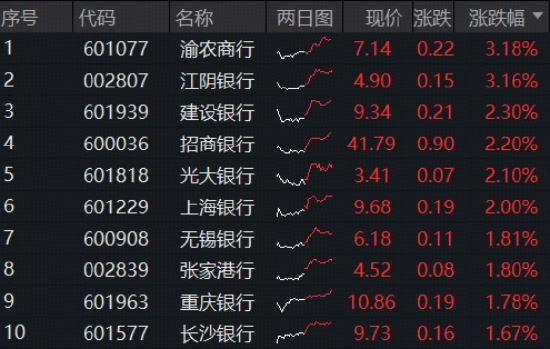
Market Performance - The Shanghai Composite Index rebounded today, with the banking sector showing significant strength, as evidenced by the China Securities Banking Index rising by 1.31% [1] - Among A-share banking stocks, 40 out of 42 increased, with notable gains from Chongqing Rural Commercial Bank and Jiangyin Bank, both rising over 3% [1][2] - The Bank ETF (512800) also saw a rise of 1.23%, recovering both the 5-day and 10-day moving averages, with a trading volume of 1.715 billion yuan, indicating a significant increase in market sentiment [2][3] Financial Performance - For the first three quarters, listed banks reported a revenue growth rate of 0.9%, a slight decrease of 0.1 percentage points from the mid-year, while net profit growth increased by 0.7 percentage points to 1.5% [4] - The narrowing decline in net interest margin is a positive indicator, suggesting that the banking sector is stabilizing [4] Investment Trends - Insurance companies have been actively increasing their stakes in A-share listed banks, with six insurance firms entering the top ten shareholders of six banks during the third quarter [4] - The market is expected to see increased demand for insurance products, which may positively impact the banking sector's performance in the fourth quarter [4] Investment Strategy - The investment logic for banks is shifting from "pro-cyclical" to "weak-cyclical," suggesting that during periods of economic stagnation, high dividend yields from bank stocks will remain attractive [5] - The Bank ETF (512800) is highlighted as an efficient investment tool for tracking the overall banking sector, with a current scale exceeding 18.5 billion yuan and an average daily trading volume of over 800 million yuan [5]

冲刺!前三季长三角头部城商行营收、净利润双增,前三甲洗牌
Nan Fang Du Shi Bao· 2025-11-03 11:44
Core Viewpoint - The performance of the five major city commercial banks listed in the A-share market in the Yangtze River Delta region shows significant differentiation in growth rates, business structures, and asset quality as of the third quarter of 2025. Asset Scale - As of September 30, 2025, Jiangsu Bank leads with total assets of 4.93 trillion yuan, a year-on-year growth of 27.8% [2] - Ningbo Bank's total assets surpassed 3.5 trillion yuan for the first time, ranking second among city commercial banks [2] - Shanghai Bank continues to lag with a year-on-year asset growth of only 2% [2][13] Revenue and Profit - All five banks achieved year-on-year growth in both revenue and net profit in the first three quarters of 2025 [3] - Jiangsu Bank (67.18 billion yuan), Ningbo Bank (54.98 billion yuan), and Nanjing Bank (41.95 billion yuan) ranked in the top three for revenue [3][4] - Jiangsu Bank's net profit reached 31.9 billion yuan, leading the group with an 8.9% increase [4][5] Interest Income - Nanjing Bank reported a remarkable 28.5% year-on-year increase in net interest income, reaching 25.21 billion yuan [6][7] - Jiangsu Bank and Ningbo Bank also showed strong growth in net interest income, with increases of 19.6% and 11.8%, respectively [8] Non-Interest Income - In the first three quarters of 2025, Ningbo Bank's fee and commission income grew by 29.3% to 4.85 billion yuan, surpassing Jiangsu Bank [9] - Shanghai Bank experienced a decline in non-interest income, with a 6.9% drop [9] Financial Investment Performance - Shanghai Bank's investment income increased by 58.5% to 16.78 billion yuan, the highest among the five banks, with investment income accounting for 40.77% of its revenue [10][11] - All banks faced losses in fair value changes, with Shanghai Bank reporting the highest loss of 3.26 billion yuan [10] Asset Quality - As of September 30, 2025, the non-performing loan ratio for Jiangsu Bank, Ningbo Bank, and Nanjing Bank remained stable between 0.76% and 0.84% [14][15] - Jiangsu Bank's non-performing loan ratio decreased by 0.05 percentage points compared to the end of the previous year [14] Capital Adequacy - Jiangsu Bank's core Tier 1 capital adequacy ratio fell to 8.61%, the lowest among the five banks, and is less than one percentage point above the regulatory line [16] - Shanghai Bank maintained the highest core Tier 1 capital adequacy ratio at 10.52%, showing a slight increase [16]






聚焦红利与复苏双主线
HTSC· 2025-11-03 11:10
Group 1 - The report highlights a favorable policy environment expected to support the banking sector's performance recovery in 2026, with a focus on value investment fundamentals [1][15][20] - The current macro policy has shifted from "one-way benefits" to a "two-way balance," which is more conducive to stable banking operations, emphasizing the importance of maintaining bank interest margins while supporting the real economy [2][16][20] - The banking sector is anticipated to see a gradual recovery in performance, driven by stabilizing interest margins and improving core profitability, with quality regional banks showing stronger resilience [3][17][21] Group 2 - The report identifies insurance and industrial capital as significant future incremental funding sources, with insurance companies expected to increase equity market allocations, particularly in banks with stable earnings and high dividend returns [4][18] - Local state-owned enterprises are actively increasing investments in local banks, creating a win-win situation for both parties, while asset management companies are also increasing their stakes in several national banks [4][18] - The report suggests focusing on banks with strong fundamentals and high dividend yields, as the importance of stock selection has increased in the current volatile market environment [5][19] Group 3 - The report recommends specific banks for investment, including Chengdu Bank, Industrial and Commercial Bank of China, Nanjing Bank, Chongqing Rural Commercial Bank, China Construction Bank, Shanghai Bank, Ningbo Bank, and Chongqing Rural Commercial Bank, indicating a positive outlook for these institutions [9][19] - The anticipated stabilization of interest margins and recovery of non-interest income is expected to support the overall performance of listed banks in 2026, with quality banks likely to outperform [3][17][21] - The report emphasizes the need for a strategic focus on banks with quality fundamentals and dividend advantages, as the market shifts from a defensive high-dividend strategy to one that values fundamental quality and profitability elasticity [5][19]
42家上市银行信披考评出炉:22家获A,光大、华夏和浙商银行提级
2 1 Shi Ji Jing Ji Bao Dao· 2025-11-03 08:21
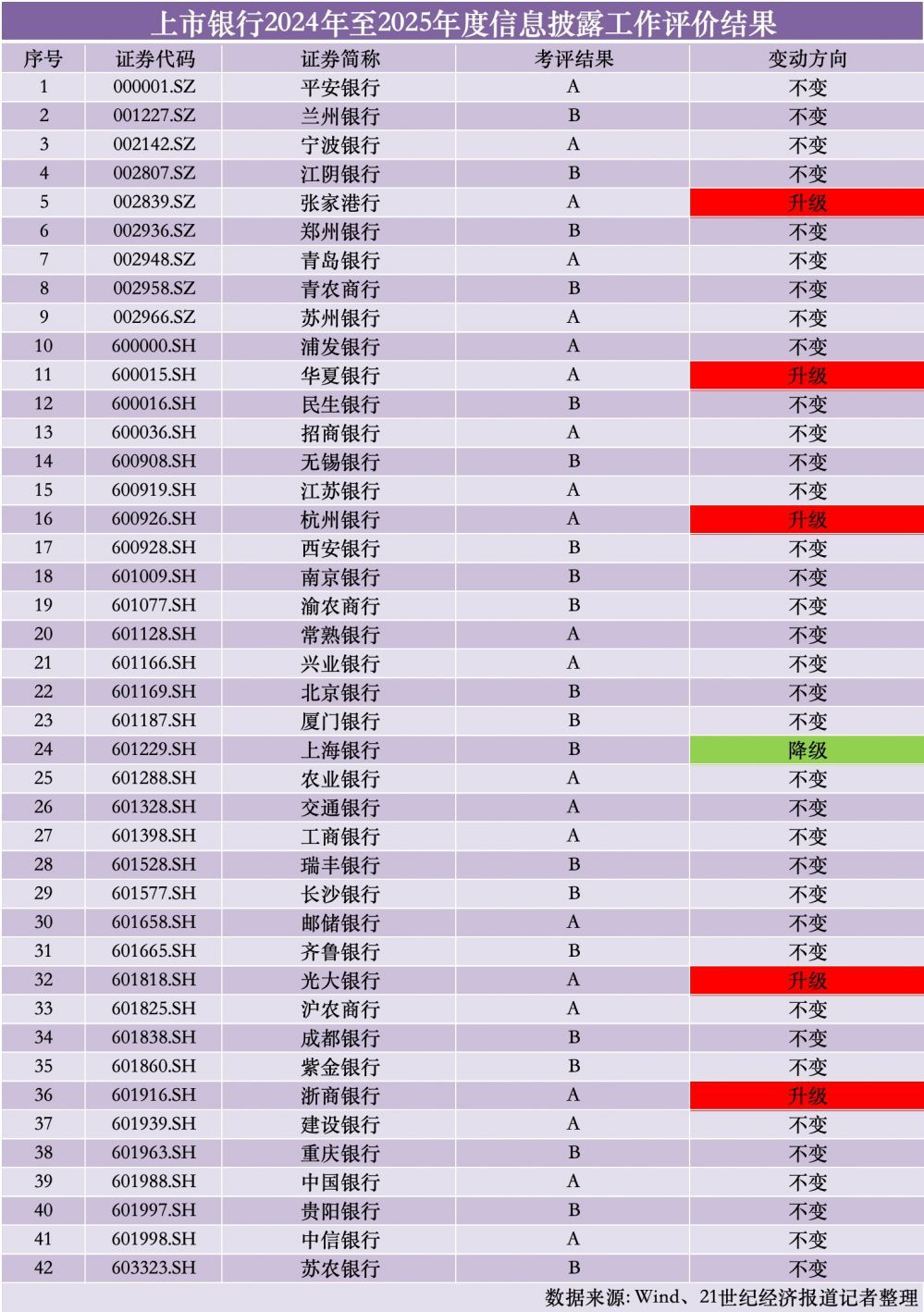
Core Insights - The recent disclosure evaluation results for listed banks in China for the 2024-2025 period show that all listed banks received ratings of B or above, with 22 banks rated A, indicating a strong performance in information disclosure [1] Summary by Category Overall Ratings - All listed banks achieved a rating of B or higher, with 22 banks rated A, reflecting consistent performance compared to the previous year [1] - Only six banks experienced rating changes, with five banks improving their ratings and one bank, Shanghai Bank, experiencing a downgrade [1] Banks with Rating Changes - The following banks improved their ratings: - Zhangjiagang Bank - Hangzhou Bank - Huaxia Bank - Everbright Bank - Zhejiang Commercial Bank [1] - Shanghai Bank was the only bank to see a downgrade in its rating [1] Detailed Ratings - A selection of banks and their ratings includes: - Ping An Bank: A - Ningbo Bank: A - Agricultural Bank of China: A - Industrial and Commercial Bank of China: A - Shanghai Bank: B (downgraded) [2]




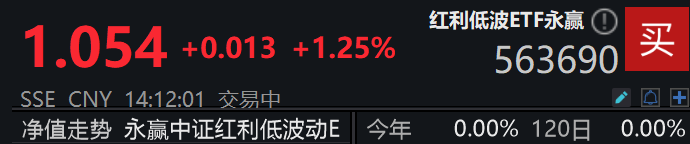
险资持续加仓股市,红利低波ETF永赢(563690)上涨超1%
Xin Lang Cai Jing· 2025-11-03 06:38
Group 1 - The core viewpoint of the news highlights a strong performance in the Chinese stock market, particularly in the low volatility dividend index and specific stocks like China Media and PetroChina [1] - The low volatility dividend ETF has shown a cumulative increase of 3.79% over the past month, indicating positive market sentiment [1] - Insurance capital has been increasingly investing in the stock market, with a 14% growth in the number of shares held by insurance institutions by the end of Q3, totaling over 650 billion yuan [2] Group 2 - The trend of insurance capital moving from large state-owned banks to high-quality regional banks is evident, with institutions like China Life and Taikang Life entering the top ten shareholders of several regional banks [2] - A-share market shows a calendar effect, suggesting that November to January could be a favorable period for both active and long-term investors [3] - The downward trend in interest rates is expected to enhance the absolute returns of dividend assets, particularly in a market lacking strong fundamental trends [3]
浙商证券:25Q3银行营收利润增速韧性强 Q4有望深蹲起跳
智通财经网· 2025-11-03 06:19
Core Viewpoint - The performance of listed banks in Q1-Q3 2025 slightly exceeded expectations, with revenue growth remaining stable and profit growth showing a slight increase [1][2] Performance Overview - Listed banks' revenue growth year-on-year is stable at 0.9%, while profit growth has increased to 1.6%. The weighted revenue and net profit attributable to shareholders increased by 0.9% and 1.6% respectively, with a slight slowdown in growth compared to H1 2025 [2][3] - Large banks showed a comprehensive performance turnaround, while the performance of small and medium-sized banks was mixed. Agricultural Bank, Bank of Communications, China Bank, and Industrial Bank performed better than expected, while China Construction Bank experienced a significant decline in quarterly interest margin [2][3] Driving Factors - Asset scale growth for listed banks in Q1-Q3 2025 was 9.3%, a slowdown of 0.3 percentage points compared to H1 2025. Loan growth decreased while financial investment growth increased [3] - The interest margin stabilized in Q3 2025, with a slight increase of 0.3 basis points to 1.37%. The asset yield decreased by 7 basis points to 2.81%, while the cost of liabilities decreased by 8 basis points to 1.56% [4] Non-Interest Income - Non-interest income for listed banks grew by 5.0% year-on-year, but the growth rate decreased by 2.0 percentage points compared to the previous quarter. Fee and commission income increased by 4.6% year-on-year, indicating some recovery in related business [5][6] - Bond trading income decreased by 0.6% year-on-year, with small and medium-sized banks experiencing a larger decline compared to state-owned banks [5][6] Asset Quality - The average non-performing loan (NPL) ratio remained stable at 1.23%, while the average attention rate increased by 2 basis points to 1.69%. The retail sector continues to face pressure, particularly in small and micro loans [7][8] - The number of banks announcing mid-term dividends has increased, with some banks raising their mid-term dividend rates compared to the previous year [9] Recommended Stocks - Recommended stocks include Shanghai Pudong Development Bank, Nanjing Bank, Shanghai Bank, Jiangsu Bank, Agricultural Bank, and Bank of Communications, with a focus on Qilu Bank and H-share large banks [9]



寻找绩优股:2026年银行业年度策略
GUOTAI HAITONG SECURITIES· 2025-11-03 05:20
Investment Rating - The report indicates a cautious outlook on the credit growth rate, suggesting a shift towards quality improvement, with expectations for a recovery in corporate loan increments by 2026 [5][9]. Core Insights - Credit growth is expected to slow significantly starting in 2024, but the decline in growth rate is anticipated to moderate by 2026, with corporate loans likely to see a year-on-year increase [7][9]. - The relationship between credit growth and economic growth is weakening, emphasizing the need to optimize credit structure and reduce idle financial resources [9]. - The report highlights that the banking sector's total asset growth will outpace loan growth in 2025, driven by government bond supply and fiscal policies [9]. Summary by Sections Credit Growth Forecast - New RMB loans are projected at 21.3 trillion, 23.6 trillion, and 18.9 trillion yuan for 2022, 2023, and 2024 respectively, with a further estimate of 14.7 trillion yuan for the first three quarters of 2025 [9]. - For 2026, new loans are expected to be between 17.2 trillion and 17.7 trillion yuan, corresponding to a growth rate of 6.3% to 6.5% [9]. Loan Composition - In 2023, the total RMB loans are expected to reach 237.59 trillion yuan, with a year-on-year growth rate of 10.6% [8]. - Retail loans are projected to grow from 80.10 trillion yuan in 2023 to 82.84 trillion yuan in 2024, reflecting a growth rate decline from 5.7% to 3.4% [8]. - Corporate loans are anticipated to increase from 157.07 trillion yuan in 2023 to 171.01 trillion yuan in 2024, with a growth rate of 12.7% [8]. Regional Performance - Regions such as Jiangsu, Zhejiang, Sichuan, and Shandong are expected to continue outperforming the national average in loan growth due to strong economic performance and support from new policy financial tools [12]. Banking Sector Dynamics - The report notes that state-owned banks are expected to maintain a competitive edge due to lower funding costs and capital injections from the Ministry of Finance [12]. - The net interest margin is in a downward trend, but the rate of decline is expected to slow starting in 2025, with some smaller banks potentially stabilizing their margins by 2026 [13][17]. Asset Quality - As of Q2 2025, the non-performing loan (NPL) ratio for listed banks is reported at 1.25%, indicating a stable asset quality despite pressures on retail credit [37]. - The report emphasizes that while retail loan NPLs have increased since 2021, corporate loan clearances have improved significantly, providing a buffer against retail risks [37].


震荡蓄势中!红利低波ETF(512890)十大重仓股全线飘红 近20个交易日逆势吸金近37亿!
Xin Lang Ji Jin· 2025-11-03 04:25
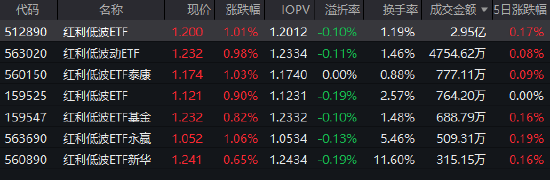
Core Viewpoint - The A-share market is experiencing fluctuations, with the major indices showing mixed performance, while the Huatai-PineBridge Dividend Low Volatility ETF (512890) stands out with a positive return amidst the overall market decline [1][4]. Fund Performance - The Huatai-PineBridge Dividend Low Volatility ETF (512890) closed at 1.200 yuan, up 1.01%, with a trading volume of 2.95 billion yuan, leading its category [2][4]. - Over the past 10 trading days, the fund has seen a net inflow of 678 million yuan, and over the last 20 days, the net inflow reached 3.609 billion yuan [2][3]. Holdings and Market Outlook - The top ten holdings of the ETF all reported gains, with notable increases in shares such as Agricultural Bank of China (up 1.13%) and Industrial Bank (up 1.98%) [3]. - The fund's total market value as of October 31, 2025, is 24.645 billion yuan, with a cumulative return of 137.56% since its inception in December 2018, ranking 79th among 502 similar products [4]. Investment Strategy - Analysts suggest that the market is in a consolidation phase, with a focus on "local tracks" and "early layout of cyclical stocks" for November [3][4]. - The banking sector is expected to benefit from a style switch, while non-bank financials are showing increasing elasticity [4].
银行ETF指数(512730)涨超1.2%,三季度险资频繁增持银行
Xin Lang Cai Jing· 2025-11-03 02:49
Core Viewpoint - The banking sector is experiencing a strong performance, with significant increases in stock prices and insurance companies actively increasing their holdings in various banks, indicating positive sentiment towards the sector [1][2]. Group 1: Market Performance - As of November 3, 2025, the CSI Bank Index (399986) rose by 1.36%, with notable increases in individual bank stocks such as Jiangyin Bank (up 2.53%), China Construction Bank (up 2.41%), and Shanghai Bank (up 2.11%) [1]. - The Bank ETF Index (512730) also saw a rise of 1.26%, with the latest price reported at 1.69 yuan [1]. Group 2: Insurance Investment Activity - In Q3, insurance companies have been actively increasing their stakes in banks, with Ping An Life increasing its holdings in Agricultural Bank of China A and Postal Savings Bank A, both entering the top ten shareholders [1]. - China Life has increased its holdings in Industrial and Commercial Bank of China, Nanjing Bank, CITIC Bank, and Suzhou Bank, with the first two also entering the top ten shareholders [1]. - Other insurance companies, such as National Pension and Lian Life, have also increased their stakes in various banks, including Suzhou and Wuxi [1]. Group 3: Investment Outlook - Dongfang Securities anticipates that the insurance sector is entering a "New Year" phase, with increased demand for dividend allocation [1]. - Given the uncertainties in the internal and external environment and the stabilization of interest margins, the banking sector's relative returns are expected to improve in Q4 2025 [1]. - Two main investment themes are highlighted: 1) High-quality small and medium-sized banks with stable fundamentals; 2) Large state-owned banks with solid fundamentals and good defensive value [1]. Group 4: Index Composition - As of October 31, 2025, the top ten weighted stocks in the CSI Bank Index (399986) include China Merchants Bank, Industrial Bank, and Agricultural Bank of China, collectively accounting for 64.87% of the index [2].
掘金银行三季报:险资继续“扫货”
Jing Ji Wang· 2025-11-03 02:21
Core Insights - The A-share listed banking sector experienced a significant decline of over 13% in the third quarter of 2025, following a strong performance in the previous year, while insurance funds continued to increase their holdings in bank stocks [1][6] Group 1: New Shareholder Dynamics - In the third quarter, six insurance companies entered the top ten shareholders of six A-share listed banks, indicating a growing presence of insurance capital in the banking sector [1] - China Life Insurance Company entered the top ten shareholders of Industrial and Commercial Bank of China (ICBC) with 757 million shares, representing 0.21% of the bank's total shares [2] - Other banks such as Wuxi Bank, Nanjing Bank, and Changshu Bank also saw new insurance capital entering their top ten shareholder lists [2] Group 2: Continued Investment by Insurance Funds - Several insurance companies that had already entered the top ten shareholders of listed banks continued to increase their holdings in the third quarter, with some seeking board seats [4] - For instance, Dajia Life Insurance increased its stake in Industrial Bank by 62.12 million shares, raising its holding to 3.38% [4] - China Life Insurance and Guomin Pension Insurance also increased their stakes in Suzhou Bank, reaching 3.4% and 2.76% respectively by the end of September [4] Group 3: Major Shareholder Concentration - By the end of the third quarter, at least two insurance companies were listed among the top ten shareholders of 12 A-share listed banks, highlighting a trend of concentration of insurance capital [6] - Zheshang Bank had four insurance shareholders, while banks like Industrial Bank and Changsha Bank had three [6] - The top five shareholders of Industrial Bank collectively held over 50% of the bank's shares, indicating strong institutional support [6] Group 4: Investment Strategy Insights - Insurance asset management institutions are focusing on companies with strong fundamentals and stable dividend growth potential for their core holdings [7]