
博时基金

Search documents
美政府停摆破记录,避险情绪升温,黄金ETF基金(159937)震荡走强,机构坚定看好金价上行趋势
Sou Hu Cai Jing· 2025-11-06 05:28
Group 1 - The core viewpoint of the news highlights the rising trend of gold ETFs, driven by increased risk aversion due to the prolonged U.S. government shutdown, which has reached a record 36 days, impacting economic forecasts negatively [1][2] - As of November 5, 2025, the gold ETF fund has seen a 4.10% increase over the past month, with a trading volume of 6.51 billion yuan and a turnover rate of 1.76% [1] - The COMEX gold futures price rose by 0.75% to 3990.40 USD per ounce, reflecting market reactions to the ongoing government shutdown and its potential economic impacts [1] Group 2 - Historical analysis indicates that gold prices are closely linked to geopolitical tensions and economic conditions, with upward movements typically associated with geopolitical chaos and weak U.S. economic performance [2] - Current risks to gold prices, such as a recovering U.S. economy or a hawkish Federal Reserve, are not significantly present at this time, suggesting a favorable environment for gold [2] - The long-term outlook for gold remains positive due to ongoing global liquidity expansion and increased preference for gold as a safe-haven asset, with expectations of continued price increases driven by multiple factors [2] Group 3 - Recent data shows that the gold ETF fund experienced a net outflow of 46.82 million yuan, but over the past 20 trading days, there were 11 days of net inflow totaling 5.099 billion yuan, indicating a strong interest in gold investments [2]
两市ETF两融余额较前日增加6.65亿元丨ETF融资融券日报
2 1 Shi Ji Jing Ji Bao Dao· 2025-11-06 02:40
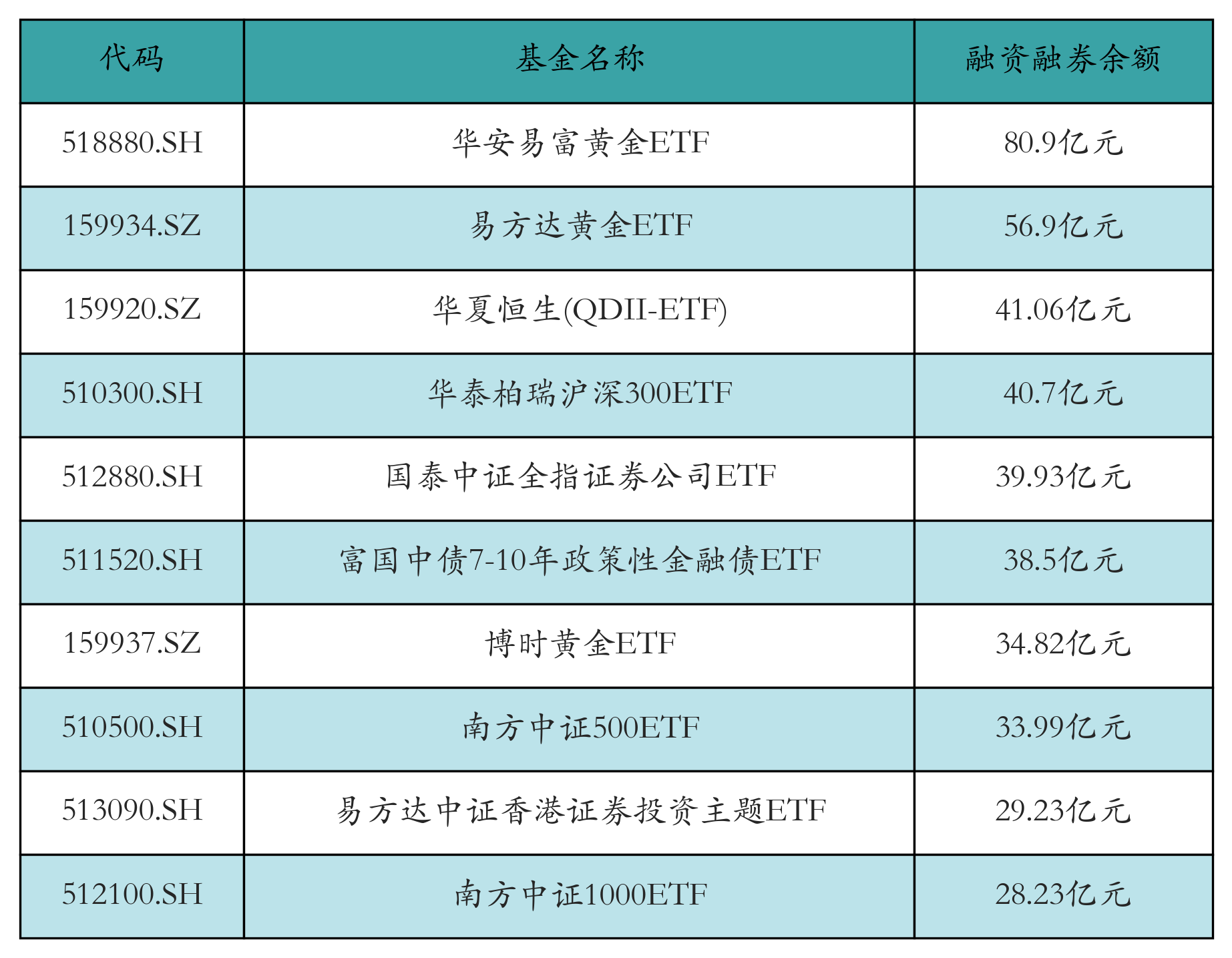
Market Overview - As of November 5, the total ETF margin balance in the two markets reached 121.972 billion yuan, an increase of 0.665 billion yuan from the previous trading day [1] - The financing balance was 113.717 billion yuan, up by 0.711 billion yuan, while the securities lending balance decreased by 46.055 million yuan to 8.255 billion yuan [1] - In the Shanghai market, the ETF margin balance was 85.612 billion yuan, increasing by 0.605 billion yuan, with a financing balance of 78.327 billion yuan, up by 0.654 billion yuan [1] - The Shenzhen market's ETF margin balance was 36.36 billion yuan, increasing by 59.972 million yuan, with a financing balance of 35.39 billion yuan, up by 57.3508 million yuan [1] ETF Margin Balance - The top three ETFs by margin balance on November 5 were: - Huaan Yifu Gold ETF (8.09 billion yuan) - E Fund Gold ETF (5.69 billion yuan) - Huaxia Hang Seng (QDII-ETF) (4.106 billion yuan) [2] ETF Financing Amount - The top three ETFs by financing amount on November 5 were: - Hai Fudong Zhongzheng Short-term Bond ETF (1.527 billion yuan) - Huatai-PB Southern Dongying Hang Seng Technology Index (QDII-ETF) (1.33 billion yuan) - Bosera Zhongzheng Convertible Bonds and Exchangeable Bonds ETF (1.313 billion yuan) [4] ETF Net Financing Amount - The top three ETFs by net financing amount on November 5 were: - Pengyang Zhongzheng - 30-Year Treasury ETF (180 million yuan) - Bosera Shanghai Stock Exchange 30-Year Treasury ETF (142 million yuan) - Bosera Zhongzheng Convertible Bonds and Exchangeable Bonds ETF (122 million yuan) [6] ETF Securities Lending Amount - The top three ETFs by securities lending amount on November 5 were: - Huatai-PB Shanghai-Shenzhen 300 ETF (36.505 million yuan) - Southern Zhongzheng 500 ETF (21.4285 million yuan) - Huaxia Shanghai Stock Exchange 50 ETF (16.7747 million yuan) [8]

280只ETF获融资净买入 鹏扬中债—30年期国债ETF居首
Zheng Quan Shi Bao Wang· 2025-11-06 02:11
Core Viewpoint - As of November 5, the total margin balance for ETFs in the Shanghai and Shenzhen markets reached 121.972 billion yuan, reflecting an increase of 0.665 billion yuan from the previous trading day [1] Group 1: ETF Financing and Margin Balances - The ETF financing balance stood at 113.717 billion yuan, which is an increase of 0.711 billion yuan compared to the previous trading day [1] - The ETF margin short balance was recorded at 8.255 billion yuan, showing a decrease of 0.046 billion yuan from the previous trading day [1] Group 2: Net Inflows in ETFs - On November 5, a total of 280 ETFs experienced net financing inflows, with the Pengyang Zhongzhai - 30-Year Treasury Bond ETF leading the way with a net inflow of 0.18 billion yuan [1] - Other ETFs with significant net inflows included Bosera SSE 30-Year Treasury Bond ETF, Bosera Convertible Bonds and Exchangeable Bonds ETF, Huatai-PB Hang Seng Technology ETF, and several Nasdaq 100 ETFs [1]
主动权益基金操作分化 这厢加仓猛干 那厢落袋为安
Zhong Guo Jing Ji Wang· 2025-11-06 00:29
Group 1 - Public funds have shown an overall trend of increasing positions in equity assets during the third quarter, particularly in the TMT (Technology, Media, Telecommunications) and power equipment sectors [1][2] - The average stock position of all public funds reached 83.28% by the end of the third quarter, an increase of 2.13 percentage points from the end of the second quarter [1] - The concentration of holdings in public funds has increased, with stock-type open-end funds and mixed open-end funds seeing concentration levels rise to 56.81% and 57.72%, respectively [1] Group 2 - Among fund companies, 27 firms had products with an average stock position exceeding 90% by the end of the third quarter, with Allianz, Zhuque, and Fidelity having over 94% [2] - The report from CICC indicates that the market sentiment has become more unified, with a notable increase in the concentration of holdings and a shift towards TMT and power equipment sectors [2] Group 3 - Several equity funds have significantly increased their stock positions, with some exceeding 99%, such as Huaxia Panyi and CITIC JianTou [3] - The Wanji New Opportunities Value-Driven Fund increased its stock position from 22% at the end of the second quarter to 93% by the end of the third quarter, indicating a strong bullish sentiment [3][4] Group 4 - Fund managers have adjusted their portfolios by reducing exposure to dividend stocks and increasing positions in domestic technology chains, reflecting a shift in risk preference [4] - Other funds, such as GF Industry Selection and Jin Xin Quality Growth, also made bold increases in their positions, achieving over 20% gains [5] Group 5 - Some funds opted to reduce their positions to lock in profits as the market approached the 4000-point mark, with examples including Huashang Fund, which decreased its stock position from 90% to 51% [6] - Concerns over high valuations in growth sectors led some funds to adopt a cautious approach, reducing positions to manage volatility [6]
“虚胖”的科创债ETF
阿尔法工场研究院· 2025-11-06 00:07
以下文章来源于阿尔法工场DeepFund ,作者基哥 阿尔法工场DeepFund . 专注基金行业事件、产品和人物故事,探究背后的深层逻辑。 导语:规模突破百亿的科创债ETF达到15只,但成交量明显偏低,反映出投资者认购意愿不强。 科创债ETF,这一曾经被机构视为"香饽饽"的产品,如今却遭遇尴尬的境遇。 截至10月31日,市场上24只科创债ETF中,有15只规模突破百亿;但这些产品的成交量却明显 偏低,这一现象直接反映出投资者认购意愿不强,与其刚上市时的市场表现形成了鲜明对比。 被垄断的做市业务 作为固收方向的一类创新产品,首批10只科创债ETF从7月2日正式获批,到7月7日首发当天触及 30亿元募集上限宣告售罄,到7月10日全部成立,再到7月17日上市交易,全程用时不足一个月。 上市伊始,从多家基金公司反馈的情况看,都很有信心,部分基金公司更是计划在1到3天之内把规 模直接做到200亿的体量。 但根据最新数据显示,仅科创债ETF嘉实一只产品达到了这一规模。 此前,各家公募竞相参与科创债ETF的发行,其中一个很重要的原因便是看好债券ETF的发展前 景。 | 基金管理人 | 2025Q3规模(亿元) | 202 ...

以业绩比较基准为锚 再定义绩优主动权益基金
2 1 Shi Ji Jing Ji Bao Dao· 2025-11-05 23:23
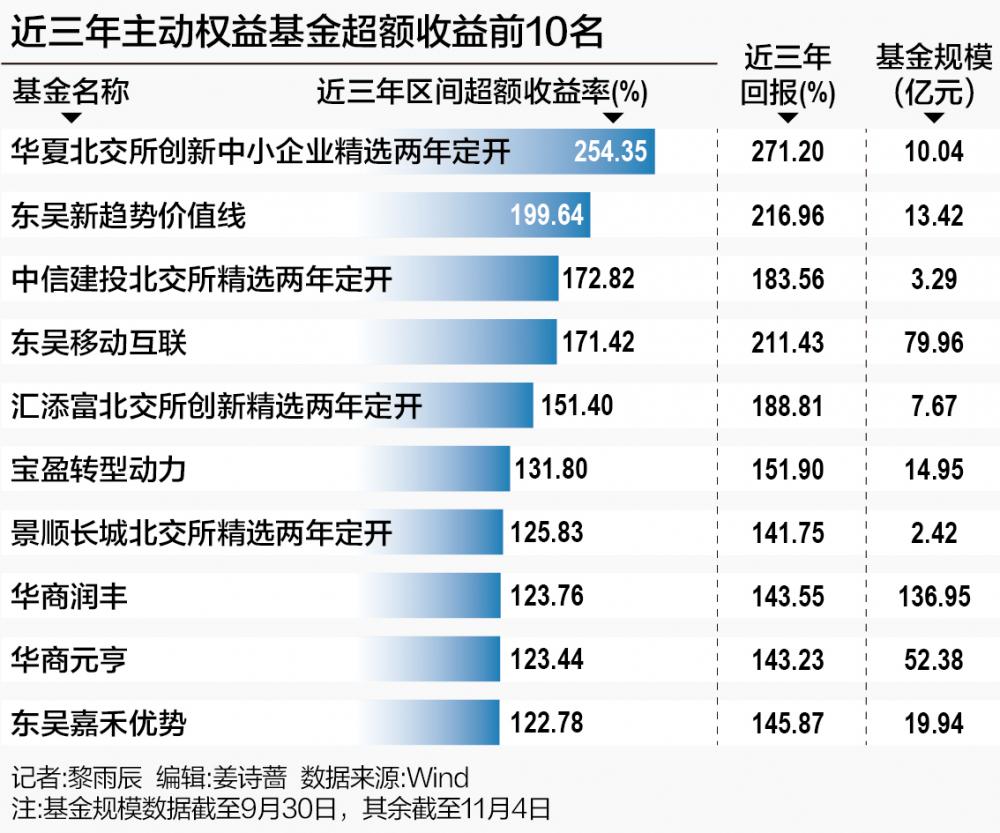
Core Viewpoint - The new regulations on performance benchmarks for public funds in China aim to enhance the accountability of fund managers by linking their compensation to the performance benchmarks, promoting a return to the fundamental purpose of asset management, which is to provide stable long-term returns for investors [1][9]. Group 1: Regulatory Changes - The China Securities Regulatory Commission (CSRC) released an action plan in May to promote high-quality development in the public fund industry, emphasizing the importance of performance benchmarks [1]. - A draft of new regulations regarding performance benchmarks was published on October 31, which is expected to improve the discipline of active investment and stabilize investment styles [1][9]. - The introduction of a performance benchmark element library aims to standardize the selection of benchmarks and prevent arbitrary changes, enhancing the comparability and normativity of benchmarks [9][8]. Group 2: Fund Performance Analysis - As of November 4, 2023, 3731 active equity funds were analyzed, with an average return that lagged behind their benchmarks by 7.26%, and only 34% of these funds outperformed their benchmarks over the past three years [2]. - Among the top-performing funds, only 20 funds achieved over 100% excess returns, indicating that achieving superior performance under the new standards is challenging [2]. - Some high-performing funds may have misleadingly high returns due to benchmark mismatches, highlighting the importance of appropriate benchmark selection [2][3]. Group 3: Size and Performance Correlation - Larger active equity funds do not necessarily correlate with superior excess returns; only 40% of funds over 10 billion yuan in size outperformed their benchmarks [5]. - Smaller funds, with an average size of 30.57 million yuan, showed better excess return capabilities, supporting the notion that smaller funds can adapt more flexibly to market changes [6][5]. Group 4: Fund Manager Impact - The total management scale of fund managers influences their active management capabilities, with a significant number of successful funds managed by managers overseeing over 10 billion yuan [7]. - The average tenure of fund managers does not significantly correlate with their ability to generate excess returns, indicating that experience alone may not guarantee performance [7]. Group 5: Industry Evolution - The new regulations are expected to lead to a systematic restructuring of the public fund industry, with a one-year transition period for existing products to adjust their benchmarks [9][10]. - The emphasis on long-term performance and the establishment of a benchmark-linked compensation system for fund managers will promote more transparent and standardized investment behaviors [9][10].
透视固收+系列专题(三):固收+规模“大洗牌”,高增量产品及公司特征解析
SINOLINK SECURITIES· 2025-11-05 14:20
1. Report Title - Perspectiv on the Fixed Income + Series Special Topic (III): Analysis of the Characteristics of High-Increment Products and Companies in the "Great Shuffle" of Fixed Income + Scale [1] 2. Core Viewpoints - The report conducts a detailed analysis of the scale changes of fixed income + products, including the scale, increment, performance, and investment characteristics of individual funds and fund companies, aiming to identify high-increment products and companies and their characteristics [24][30][45] 3. Summary by Relevant Catalogs 3.1 High-Increment Fixed Income + Funds - **Performance and Characteristics**: The report lists multiple high-increment fixed income + funds, such as Yongying Steady Enhancement A, Boshi Zhongrang Convertible Bond and Exchangeable Bond ETF, etc. These funds have different levels of scale growth, performance returns, and maximum drawdowns, and their investment styles cover balance, robustness, and aggressiveness. Their investment directions mainly focus on industries such as communications, non-ferrous metals, and pharmaceuticals [24] - **Investment Strategies**: Different funds adopt various investment strategies, including medium - and low - volatility positioning, medium - view selection strategies, and multi - strategy concepts. For example, Zhongou Fengli A has an equity center around 20% and adopts a medium - view selection strategy; Zhongou Pangu A has an equity center around 15% and practices a multi - strategy concept [45] 3.2 High-Increment Fund Companies - **Scale and Growth**: The report ranks fund companies based on product quantity, institutional shareholding ratio, 2025Q3 scale, Q3 scale increment, and year - to - date scale growth. Companies such as Invesco Great Wall Fund, Fullgoal Fund, and Boshi Fund have relatively high scale increments and growth rates [30] - **Market Share and Influence**: These high - increment fund companies have a certain market share and influence in the fixed income + market, which may be related to their product strategies, fund management capabilities, and market popularity [30] 3.3 Classification of Fixed Income + Products - **Risk - Return Characteristics**: Fixed income + products are classified into low - volatility, medium - volatility, and high - volatility types. Low - volatility products focus on volatility and drawdown control, targeting customers with wealth management substitution needs; medium - volatility products aim to optimize the long - term risk - return ratio and are the core products for shaping the company's fixed income + brand image; high - volatility products have clear strategy characteristics, targeting accounts with specific beta allocation needs, mainly institutional investors [50] - **Investment Strategies**: Different types of products adopt different investment strategies. For example, low - volatility products may use low - risk assets as the bottom position, while high - volatility products may actively participate in equity and convertible bond investments to enhance returns [50]
以业绩比较基准为锚,再定义绩优主动权益基金
2 1 Shi Ji Jing Ji Bao Dao· 2025-11-05 12:40
Core Insights - The new regulations on performance benchmarks for public funds in China aim to enhance the accountability of fund managers by linking their compensation to these benchmarks, marking a significant transformation in the public fund industry [1][8] - The introduction of these benchmarks is expected to improve the discipline of active investment, promote clearer investment styles, and attract more long-term capital into the market [1][8] Group 1: Performance of Active Equity Funds - Only 30% of active equity funds have outperformed their performance benchmarks over the past three years, with an average return lagging behind the benchmark by 7.26% [2] - Among the 3731 active equity funds, only 1262 have managed to beat the benchmark, indicating a challenging environment for achieving superior performance [2] - Notably, some high-performing funds may have achieved their results due to "benchmark mismatch," highlighting the importance of appropriate benchmark selection [2] Group 2: Risk and Return Analysis - High absolute returns do not necessarily correlate with high excess returns, as some funds with significant gains still underperformed against their benchmarks [3] - For instance, the fund "Baoying Artificial Intelligence" achieved a return of 67.75% but lagged behind its benchmark by 18.38% [3] - Additionally, 28 active equity funds that did not achieve positive returns still managed to outperform their benchmarks, primarily in sectors like pharmaceuticals and new energy [4] Group 3: Fund Size and Performance - Smaller-sized active equity funds tend to have better excess return capabilities compared to larger funds, with only 40% of large funds (over 10 billion) outperforming their benchmarks [5] - The average size of funds achieving positive excess returns is significantly lower than the overall market average, supporting the notion that larger fund sizes may hinder performance [5] Group 4: Fund Manager Influence - The total management scale of fund managers has some impact on their ability to generate excess returns, with a notable number of successful fund managers managing over 10 billion [6] - However, the tenure of fund managers does not show a significant correlation with their active management capabilities [6] Group 5: Regulatory Changes and Industry Standards - The introduction of the performance benchmark guidelines is expected to lead to a systematic restructuring of the public fund industry, with a one-year transition period for existing products [7][8] - The establishment of a benchmark element library aims to standardize benchmark selection, enhancing the comparability and regulatory compliance of fund performance assessments [8] - Future guidelines will require fund companies to set reasonable benchmarks based on investment strategies, further aligning actual investment behavior with product strategy [9]
南财观察|以业绩比较基准为锚,再定义绩优主动权益基金
2 1 Shi Ji Jing Ji Bao Dao· 2025-11-05 12:36
Core Viewpoint - The new regulations on performance benchmarks for public funds in China aim to enhance the accountability of fund managers by linking their compensation to these benchmarks, promoting a return to the fundamental purpose of asset management [1][10]. Group 1: Regulatory Changes - The China Securities Regulatory Commission (CSRC) released an action plan in May to promote high-quality development in public funds, emphasizing the importance of performance benchmarks [1]. - A draft of new regulations regarding performance benchmarks was published on October 31, which is expected to improve the discipline of active investment and stabilize investment styles [1][9]. - The introduction of a performance benchmark element library aims to standardize the selection of benchmarks, categorizing them into primary and secondary libraries to enhance comparability and prevent arbitrary changes [10][11]. Group 2: Fund Performance Analysis - Only 34% of active equity funds outperformed their benchmarks over the past three years, with an average return lagging behind benchmarks by 7.26% [3][4]. - Among the top-performing funds, only 20 funds achieved over 100% excess returns, indicating that achieving superior performance is challenging under the new evaluation standards [3][4]. - Some high-performing funds may have misleadingly high excess returns due to benchmark mismatches, highlighting the importance of appropriate benchmark selection [3][4]. Group 3: Fund Size and Performance - Smaller funds tend to have better excess return capabilities, with only 40% of large funds (over 10 billion) outperforming their benchmarks [6]. - The average size of funds achieving positive excess returns is significantly lower than the overall market average, supporting the notion that larger fund sizes may hinder performance [6]. Group 4: Fund Manager Impact - The total management scale of fund managers influences their active management capabilities, with a significant number of successful funds managed by those overseeing over 10 billion [7]. - The average tenure of fund managers does not show a significant correlation with their ability to generate excess returns, indicating that experience alone may not guarantee performance [7]. Group 5: Industry Trends - The number of funds changing their benchmarks has increased significantly, with over 132 funds adjusting their benchmarks in 2023 alone, signaling a shift towards stricter industry norms [9]. - The new guidelines are expected to lead to a systematic restructuring of the public fund industry, with a focus on aligning actual investment behavior with product strategy [10][11].

三季度基金市场数据透视:权益类产品规模逼近6万亿元,指数化投资趋势显著
Hua Xia Shi Bao· 2025-11-05 12:21
Group 1 - The Chinese public fund market is experiencing new development trends, with three main trends identified: strong growth in equity fund scale, an irreversible trend towards index-based investment, and a noticeable concentration effect among leading fund companies [2] - The total scale of equity funds has surpassed 5.8 trillion yuan, with a significant quarter-on-quarter growth of 24.11%, reaching a net asset value of 58,423.26 billion yuan by the end of Q3 2025 [3] - The scale of pure index equity funds has expanded from 40,164.48 billion yuan to 50,724.65 billion yuan, becoming the main driver of growth in the equity fund sector [3] Group 2 - Leading products, particularly broad-based ETFs, have shown significant growth, with the Huatai-PB CSI 300 ETF reaching a scale of 4,255.81 billion yuan, a 13.58% increase from the previous quarter [3] - The concentration of leading fund companies is increasing, with E Fund maintaining its leading position in equity fund scale, surpassing 1 trillion yuan for the first time, while the top four fund companies collectively manage over 3.2 trillion yuan [6] - The share of pure index equity funds in the equity fund category has strengthened, rising from 84.67% to 85.33%, indicating a growing preference for low-cost, transparent index products among investors [7]
