逆全球化风险

Search documents
美债持仓,新变化
Zhong Guo Ji Jin Bao· 2025-11-19 06:50
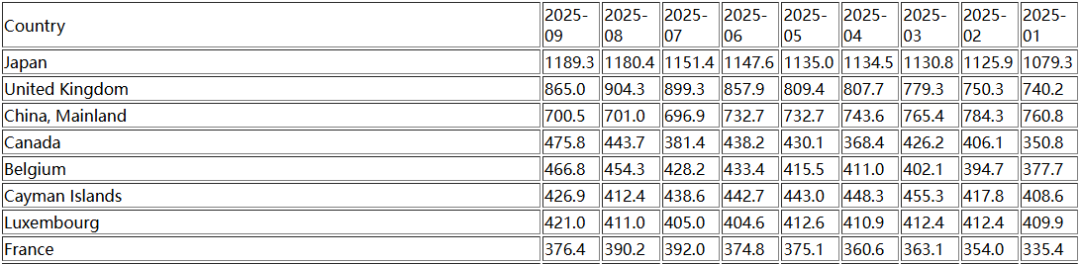
Summary of Key Points Core Viewpoint - Foreign investors' holdings of U.S. Treasury securities decreased to $9.249 trillion in September from $9.2662 trillion in August, with Japan increasing its holdings while China and the UK reduced theirs [1][2]. Group 1: Foreign Holdings of U.S. Treasuries - In September, Japan's holdings of U.S. Treasuries rose by $8.9 billion to $1.189 trillion, following an increase of $29 billion in August [4]. - The UK saw a rare decrease in its U.S. Treasury holdings, dropping by $39.3 billion to $865 billion, maintaining its position as the second-largest holder [4]. - China's holdings slightly decreased from $701 billion in August to $700.5 billion in September [4]. Group 2: Market Dynamics and Influences - The decline in overall foreign holdings reflects net selling of U.S. Treasuries by foreign investors, influenced by the rising Bloomberg U.S. Treasury Index in August and September [3]. - Analysts suggest that the differing strategies of central banks regarding U.S. Treasuries indicate varying external asset allocation directions, with a potential for China to continue reducing its holdings [4]. Group 3: Currency and Economic Factors - The weakening of the Japanese yen against the U.S. dollar has been noted, with the yen hovering at low levels since July [6]. - The Bank of Japan's decision to maintain a 0.5% benchmark interest rate, alongside the Federal Reserve's recent rate cut, has widened the interest rate differential, further contributing to the yen's depreciation [7]. Group 4: Gold Holdings and Trends - China's central bank has been increasing its gold reserves, with holdings reaching 7.406 million ounces (approximately 2303.523 tons) by the end of September, up by 40,000 ounces from August [11]. - The rising gold prices and increased central bank purchases reflect a trend towards diversifying international reserves amid geopolitical risks and a weakening dollar [9][10].

黄金,直线拉升!
Shang Hai Zheng Quan Bao· 2025-11-10 06:42
Core Insights - China's gold production in the first three quarters of 2025 reached 271.782 tons, a year-on-year increase of 1.39%, while gold consumption fell to 682.730 tons, down 7.95% [1][5]. Production Summary - Domestic gold production was 271.782 tons, an increase of 3.714 tons from the same period in 2024, representing a growth of 1.39% [5]. - Imported raw gold production totaled 121.149 tons, marking an 8.94% increase [5]. - Total gold production, combining domestic and imported sources, reached 392.931 tons, up 3.60% year-on-year [5]. - Significant projects are underway, including the Dadonggou gold mine in Liaoning, which has an estimated gold resource of nearly 1500 tons, potentially becoming a world-class gold mine [5]. Consumption Summary - Gold consumption in the first three quarters of 2025 was 682.730 tons, a decrease of 7.95% year-on-year [5]. - Jewelry consumption dropped to 270.036 tons, down 32.50% [5]. - Demand for gold bars and coins increased to 352.116 tons, a rise of 24.55% [5]. - Industrial and other gold usage reached 60.578 tons, reflecting a growth of 2.72% [5][6]. Market Trends - The market shows a strong demand for high-value jewelry products, while gold bars remain in high demand due to geopolitical tensions and economic uncertainties [6]. - The rapid development of industries such as electronics and renewable energy is contributing to a steady recovery in industrial gold demand [6]. Price Outlook - Gold prices are currently stabilizing around $4000 per ounce, with expectations of continued upward pressure due to central bank purchases and investment demand [8]. - The World Gold Council indicates that geopolitical risks and U.S.-China trade relations will keep gold investment demand relatively strong in the fourth quarter [8]. - Historical trends suggest that gold prices are closely linked to geopolitical instability and economic performance, with potential upward drivers remaining significant [8][9].
港股异动 | 现货黄金突破4040美元/盎司 万国黄金集团(03939)涨超5%
智通财经网· 2025-11-10 02:13
Group 1 - The core point of the article highlights the significant increase in the stock price of WanGuo Gold Group, which rose over 5% during trading, closing at HKD 32.92 with a trading volume of HKD 92.85 million [1] - The company's founder and major shareholder, Gao Mingqing, purchased 1.01 million shares at an average price of HKD 29.3408, totaling nearly HKD 30 million, indicating strong confidence in the company's future prospects [1] - Following the purchase, Gao Mingqing's investment vehicle holds 283 million shares, representing approximately 25.57% of the total issued share capital, reflecting a long-term commitment to the company [1] Group 2 - The article notes that on November 10, spot gold prices surpassed USD 4,040 per ounce, increasing by over 1% in a single day [1] - According to CITIC Securities, gold is expected to benefit from global liquidity expansion and heightened preferences due to de-globalization risks in the long term [1] - The recent volatility in gold prices is primarily driven by U.S.-China trade relations and interest rate cut expectations, with multiple factors likely to support upward trends in gold prices next year [1]
美政府停摆破记录,避险情绪升温,黄金ETF基金(159937)震荡走强,机构坚定看好金价上行趋势
Sou Hu Cai Jing· 2025-11-06 05:28
Group 1 - The core viewpoint of the news highlights the rising trend of gold ETFs, driven by increased risk aversion due to the prolonged U.S. government shutdown, which has reached a record 36 days, impacting economic forecasts negatively [1][2] - As of November 5, 2025, the gold ETF fund has seen a 4.10% increase over the past month, with a trading volume of 6.51 billion yuan and a turnover rate of 1.76% [1] - The COMEX gold futures price rose by 0.75% to 3990.40 USD per ounce, reflecting market reactions to the ongoing government shutdown and its potential economic impacts [1] Group 2 - Historical analysis indicates that gold prices are closely linked to geopolitical tensions and economic conditions, with upward movements typically associated with geopolitical chaos and weak U.S. economic performance [2] - Current risks to gold prices, such as a recovering U.S. economy or a hawkish Federal Reserve, are not significantly present at this time, suggesting a favorable environment for gold [2] - The long-term outlook for gold remains positive due to ongoing global liquidity expansion and increased preference for gold as a safe-haven asset, with expectations of continued price increases driven by multiple factors [2] Group 3 - Recent data shows that the gold ETF fund experienced a net outflow of 46.82 million yuan, but over the past 20 trading days, there were 11 days of net inflow totaling 5.099 billion yuan, indicating a strong interest in gold investments [2]
机构看金市:11月6日
Xin Hua Cai Jing· 2025-11-06 03:43
Core Viewpoint - The long-term potential for gold remains strong despite short-term fluctuations, driven by geopolitical uncertainties and economic conditions, while the recent U.S. government shutdown adds to market volatility [1][3][4]. Group 1: Market Analysis - Huatai Futures indicates that the U.S. ADP employment numbers for October increased by 42,000, significantly surpassing the expected 30,000, while the previous month's data was revised down by 29,000, suggesting a slowdown in overall labor demand [1]. - New Lake Futures reports that overnight precious metal prices rebounded, with London spot gold closing around $3,980 per ounce, and silver returning to the $48 per ounce mark, indicating a potential support level for precious metals [2]. - CITIC Securities highlights that historical trends show gold prices are closely linked to geopolitical turmoil and weak U.S. economic performance, with current risks not being significant [3]. Group 2: Economic Indicators - The ISM services PMI for October rose by 2.4 points to 52.4, marking an eight-month high, which exceeded expectations of 50.8, while the new orders index jumped by 5.8 points to 56.2, the highest in a year [1]. - FXStreet analysts note that better U.S. employment data has strengthened the dollar, impacting precious metals negatively, although uncertainties from the government shutdown may still push gold prices higher [3]. Group 3: Long-term Outlook - Sprott Inc. suggests that while gold prices may consolidate in the short term, there is significant long-term upside potential, with geopolitical and economic uncertainties continuing to support gold and silver prices [4]. - The ongoing trend of central bank gold purchases, combined with global monetary expansion and de-dollarization, is expected to sustain upward pressure on precious metal prices [2].
黄金早参 | 美政府停摆破记录,避险情绪升温,金价震荡走强
Sou Hu Cai Jing· 2025-11-06 01:29
Core Viewpoint - The U.S. government shutdown has reached a record 36 days, leading to increased risk aversion and a rise in gold prices, with COMEX gold futures up 0.75% to $3990.40 per ounce [1] Economic Impact - The Congressional Budget Office warns that if the shutdown continues for six weeks, economic losses could reach $11 billion, and the annual growth rate of U.S. GDP in Q4 is expected to decline by 1 to 2 percentage points [1] Gold Market Analysis - Historical patterns indicate that gold prices are closely linked to geopolitical and economic conditions, with upward pressure typically arising from geopolitical turmoil and weak U.S. economic performance [1] - Current downward risks for gold prices include a recovering U.S. economy, a hawkish Federal Reserve, strong fiscal discipline, easing geopolitical tensions, and global central banks selling gold, none of which are currently significant [1] - Long-term, gold is expected to benefit from the expansion of global liquidity and increased preference due to risks associated with de-globalization [1] - Recent volatility in gold prices has been primarily driven by U.S.-China trade relations and interest rate cut expectations, with multiple factors likely to continue influencing upward trends in gold prices next year [1]
中信证券: 展望明年多种因素仍然很可能主导金价上行
Sou Hu Cai Jing· 2025-11-06 00:21
Core Insights - The long-term price trend of gold is highly correlated with geopolitical and economic conditions [1] - The upward drivers of gold prices typically stem from geopolitical turmoil and weak performance of the US economy, while the downward risks can be categorized into five types [1] - Currently, the identified downward risks are not significant, suggesting a favorable outlook for gold prices [1] Summary by Categories Price Drivers - Geopolitical chaos and weak US economic performance are primary drivers for rising gold prices [1] - Recent fluctuations in gold prices have been primarily influenced by US-China trade relations and interest rate cut expectations [1] Downward Risks - The five categories of downward risks include: improvement in the US economy, a hawkish shift from the Federal Reserve, strong fiscal discipline in the US, easing geopolitical tensions, and global central banks selling gold [1] - At present, these risks are not pronounced, indicating a stable environment for gold prices [1] Long-term Outlook - In the long run, gold is expected to benefit from the expansion of global liquidity and increased preference due to risks associated with de-globalization [1] - Multiple factors are likely to continue driving gold prices upward in the coming year [1]

全球掀起“购金热”,市场资金大幅涌入,年内多只黄金ETF规模大增
Hua Xia Shi Bao· 2025-06-13 06:56
Core Insights - The ETF market is experiencing unprecedented growth due to increasing investor demand for asset allocation, with approximately 1,200 ETF products and a net inflow of about 250 billion yuan this year, with nearly 40% of products showing positive net inflows [2][3] - Gold ETFs have emerged as a new favorite in the capital market, driven by their unique hedging properties and investment value, amidst a global surge in gold purchases by central banks [2][5] ETF Market Expansion - The ETF market has seen a significant influx of funds, with a total net inflow of approximately 250 billion yuan as of June 12, 2023, and nearly 40% of products recording positive net inflows [3] - There are 92 ETF products with net inflows exceeding 1 billion yuan this year, with over 40 products attracting more than 3 billion yuan and 30 products over 5 billion yuan [3] - Notably, 14 ETF products have raised over 10 billion yuan within a year, indicating strong capital attraction among leading products [3] Leading ETF Products - The top-performing ETF is the Huaxia CSI 300 ETF, which has seen a net inflow exceeding 30 billion yuan this year, with its total scale growing from 37.7 billion yuan at the end of 2023 to over 160 billion yuan by the end of 2024 [4] - Other notable ETFs include Huatai-PB CSI 300 ETF and Haitong CSI Short Bond ETF, both with net inflows exceeding 17 billion yuan this year [4] Gold ETF Performance - Gold ETFs, particularly the Huaan Gold ETF, have shown remarkable performance, with a net inflow of approximately 23 billion yuan this year and a return exceeding 25% [5] - The total scale of Huaan Gold ETF has surpassed 60 billion yuan, reflecting a steady growth trend from 9.7 billion yuan at the end of 2022 to 28.7 billion yuan by the end of 2024 [5] - Other gold ETFs, such as Bosera Gold ETF and E Fund Gold ETF, have also performed well, with net inflows of 9.5 billion yuan, 9.4 billion yuan, and 9.1 billion yuan respectively this year [5] Central Bank Gold Purchases - A global "gold buying spree" has emerged, with central banks purchasing a net total of 1,045 tons of gold in 2024, marking the third consecutive year exceeding 1,000 tons [7] - China's central bank has increased its gold reserves for seven consecutive months, reaching 7.383 million ounces by the end of May [7] - Analysts suggest that central bank demand for gold may become a long-term trend, particularly in the context of weakening dollar credit and rising risks of de-globalization [7]