
晶澳科技

Search documents
光伏行业扭困现曙光 "反内卷"纠偏初显成效
Zheng Quan Shi Bao· 2025-08-29 02:36
Core Viewpoint - The photovoltaic industry is facing significant losses across the supply chain, with major manufacturers reporting substantial financial setbacks in the first half of the year, despite some signs of cash flow improvement and a reduction in aggressive price competition [1][2][3][4]. Financial Performance - The top five global manufacturers of photovoltaic modules, including JinkoSolar, LONGi Green Energy, Trina Solar, JA Solar, and Tongwei Co., all reported losses in the first half of the year, with a combined loss of approximately 160 billion yuan [2][3]. - JinkoSolar's revenue decreased by 32.63% to 31.83 billion yuan, with a net loss of 2.91 billion yuan, a decline of 342.4% year-on-year [2]. - LONGi Green Energy's revenue fell by 14.83% to 32.81 billion yuan, resulting in a net loss of 2.57 billion yuan, although this was an improvement compared to the previous year [2]. - Trina Solar's revenue dropped by 27.72% to 31.06 billion yuan, with a net loss of 2.92 billion yuan, marking a shift from profit to loss [2]. - JA Solar reported a revenue decline of 36.01% to 23.90 billion yuan, with a net loss of 2.58 billion yuan, an increase in loss of 195.13% [2]. - Tongwei Co. achieved a revenue of 40.51 billion yuan, down 7.51%, with a net loss of 4.96 billion yuan, an increase in loss of 58.35% [3]. Cash Flow Situation - Cash flow health is critical for the survival of photovoltaic companies, with some firms reporting improved cash flow despite overall losses [4]. - TCL Zhonghuan reported a net cash flow of 523 million yuan, an increase of 308.40% year-on-year [4]. - Trina Solar's net cash flow was 1.843 billion yuan, with a second-quarter cash flow of 2.679 billion yuan [4]. - Canadian Solar reported a net cash flow of 3.78 billion yuan, an increase of over 150% [4]. - However, companies like Daqo Energy reported negative cash flow of -1.608 billion yuan, and JinkoSolar, Tongwei, and LONGi Green Energy also reported negative cash flows [4]. Industry Trends - The photovoltaic industry is undergoing a "reverse involution" movement, with efforts to reduce low-price competition and improve product quality [6][7]. - The Chinese government has initiated measures to regulate low-price competition, including new laws to classify below-cost sales as illegal [6]. - Industry associations have called for enhanced self-regulation to maintain fair competition and promote the exit of outdated production capacity [6][7]. - Recent trends indicate a recovery in prices across various segments of the supply chain, with manufacturers hopeful for a return to sustainable pricing [6][7].





光伏行业扭困现曙光 “反内卷”纠偏初显成效
Zheng Quan Shi Bao· 2025-08-28 17:55
Core Viewpoint - The photovoltaic industry is facing significant losses across the supply chain, with major manufacturers reporting substantial financial setbacks in the first half of the year, despite some signs of cash flow improvement and a reduction in aggressive price competition [1][2][3][4]. Financial Performance - The top five global manufacturers of photovoltaic modules, including JinkoSolar, LONGi Green Energy, Trina Solar, JA Solar, and Tongwei Co., all reported losses in the first half of the year, with a combined loss of approximately 160 billion yuan [2][3]. - JinkoSolar's revenue decreased by 32.63% to 31.83 billion yuan, with a net loss of 2.91 billion yuan, a 342.4% increase in losses year-on-year [2]. - LONGi Green Energy's revenue fell by 14.83% to 32.81 billion yuan, resulting in a net loss of 2.57 billion yuan, although this was a reduction in losses compared to the previous year [2]. - Trina Solar's revenue dropped by 27.72% to 31.06 billion yuan, with a net loss of 2.92 billion yuan, marking a significant shift from profit to loss [2]. - JA Solar reported a revenue decline of 36.01% to 23.90 billion yuan, with a net loss of 2.58 billion yuan, an increase in losses of 195.13% year-on-year [2]. Cash Flow Situation - Cash flow health is critical for the survival of photovoltaic companies, with several firms reporting improvements in cash flow despite overall losses [4]. - TCL Zhonghuan reported a net cash flow from operating activities of 523 million yuan, a 308.4% increase year-on-year [4]. - Trina Solar's net cash flow from operating activities was 1.843 billion yuan, with a second-quarter figure of 2.679 billion yuan [4]. - Canadian Solar reported a net cash flow from operating activities of 3.78 billion yuan, a growth of over 150% [4]. - In contrast, companies like Daqo New Energy and JinkoSolar reported negative cash flows of -1.608 billion yuan and -3.81 billion yuan, respectively [4]. Industry Trends - The photovoltaic industry is undergoing a "reverse involution" movement, with efforts to reduce low-price competition and improve product quality [6][7]. - The Chinese government has initiated measures to regulate low-price competition, including new laws that classify below-cost sales as illegal [6]. - Industry associations have called for enhanced self-regulation to maintain fair competition and promote the exit of outdated production capacities [6][7]. - Recent trends indicate a recovery in prices across various segments of the supply chain, with manufacturers expressing hope for prices to stabilize above cost levels [6][7].
8股获社保基金增持均超千万股
Zheng Quan Shi Bao Wang· 2025-08-28 11:13
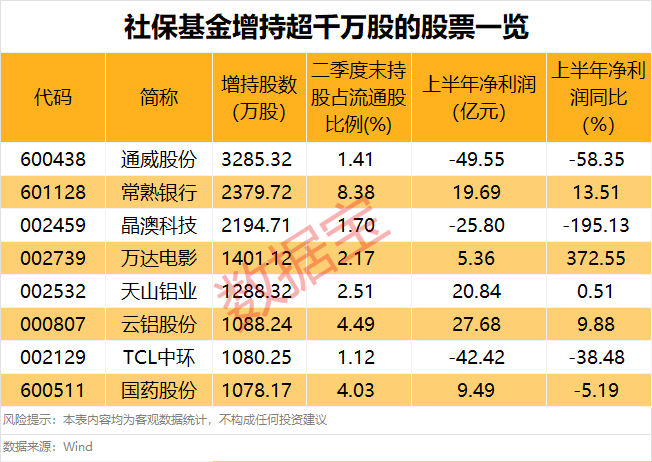
Core Viewpoint - The social security fund has made significant adjustments to its stock holdings, with a focus on long-term investment strategies, reflecting its presence in the top ten shareholders of 425 companies as of August 28 [1] Group 1: Stock Adjustments - In the second quarter, the social security fund entered 108 new stocks, increased holdings in 108 stocks, reduced holdings in 111 stocks, and maintained its position in 98 stocks [1] - Among the stocks with increased holdings, eight stocks saw an increase of over 10 million shares, with Tongwei Co., Ltd. having the largest increase of 32.85 million shares, raising its holding percentage from 0.68% to 1.41% [1][2] Group 2: Performance of Increased Holdings - The companies with significant increases in holdings include Wanda Film, Changshu Bank, and Tianshan Aluminum, all of which reported year-on-year growth in their performance for the first half of the year [1] - Wanda Film reported the highest net profit growth, with total operating revenue of 6.689 billion yuan, a year-on-year increase of 7.57%, and a net profit of 536 million yuan, reflecting a staggering growth of 372.55% [1][2] Group 3: Detailed Stock Data - The following stocks were notably increased by the social security fund: - Tongwei Co., Ltd.: 32.85 million shares, holding percentage 1.41%, net profit -495.5 million yuan, year-on-year change -58.35% [2] - Changshu Bank: 23.80 million shares, holding percentage 8.38%, net profit 1.969 billion yuan, year-on-year change 13.51% [2] - Wanda Film: 14.01 million shares, holding percentage 12.17%, net profit 536 million yuan, year-on-year change 372.55% [2] - Tianshan Aluminum: 12.88 million shares, holding percentage 2.51%, net profit 2.084 billion yuan, year-on-year change 0.51% [2]



光伏半年报观察:龙头企业员工薪酬普降、有高管“零报酬”,天合研发人员涨薪7300元
Sou Hu Cai Jing· 2025-08-28 09:54
Core Viewpoint - The photovoltaic industry continues to face significant losses, with only one out of eight leading companies reporting profitability in the first half of 2025, while the others are struggling with expanding losses [3][4]. Financial Performance - Among the eight leading photovoltaic companies, only Aters maintained profitability, while the others reported losses, with Longi Green Energy and Aiko Solar showing reduced losses of 50% and 80% respectively [3][4]. - Total revenues for the companies showed a decline, with Tongwei Co. reporting 40.51 billion yuan, down 7.51%, and JinkoSolar reporting 31.83 billion yuan, down 32.72% [4]. - The overall net loss for 31 A-share listed photovoltaic companies reached 12.58 billion yuan in Q1 2025, a year-on-year increase of 274.3% [7]. Employee Compensation and Management Costs - Employee compensation across the leading companies has generally decreased, with Tongwei's employee compensation dropping from 2.025 billion yuan to 1.342 billion yuan, leading to a 37.33% reduction in management costs [8][9]. - Key management personnel compensation also saw reductions, with Longi Green Energy's key management remuneration decreasing from 7.03 million yuan to 5.80 million yuan [10][11]. Strategic Shifts and New Growth Areas - Companies are increasingly focusing on energy storage as a new growth area, with Aters reporting a significant increase in its energy storage sales, achieving 3.1 GWh in the first half of 2025, a 19.23% year-on-year increase [13][14]. - Trina Solar is also pivoting towards energy storage, with a notable increase in its second-quarter shipments [14]. Market Dynamics and Future Outlook - The industry is experiencing a shift towards quality, technology, and service competition rather than price wars, as indicated by TCL Zhonghuan's management [15]. - Despite the ongoing challenges, there are signs of price recovery in the supply chain, with recent bidding prices for components showing an upward trend [15].

主题量化投资系列之二:基于“反内卷”的量化投资策略研究
CMS· 2025-08-28 09:04
Group 1 - The report highlights that from the second half of 2024, policies aimed at preventing "involution-style" competition will become more frequent and will gradually be institutionalized by 2025, impacting key industries such as photovoltaics, steel, automotive, and lithium battery materials [1][4][8] - The "anti-involution" process is characterized by three stages: capacity expansion, intensified competition, and industry clearing and recovery, with significant implications for investment strategies [4][23][48] - The report identifies that the photovoltaic industry has seen substantial investment and capacity expansion, driven by government policies and market demand, leading to a competitive landscape where companies are increasingly investing in upstream materials like silicon [27][30][41] Group 2 - The steel industry has experienced a plateau in production levels, maintaining around 1 billion tons since 2020, indicating a need for structural adjustments in response to market conditions [34][44] - The automotive sector has witnessed a surge in capacity expansion since 2020, supported by government incentives and a focus on new energy vehicles, leading to significant increases in fixed asset investments [35][36] - The lithium battery industry has seen a dramatic rise in lithium carbonate prices, from approximately 40,000 yuan per ton in early 2020 to over 500,000 yuan per ton by the end of 2022, reflecting the rapid growth of the new energy vehicle market [37][39] Group 3 - The report emphasizes the importance of identifying high-quality companies during the industry clearing phase, where weaker firms exit the market and stronger firms show signs of operational efficiency improvement [48][50] - It notes that industry concentration is a significant indicator of recovery, with leading companies in sectors like new energy vehicles and photovoltaics regaining market share as competition rationalizes [56][59] - The report outlines a quantifiable investment strategy based on industry structure, company fundamentals, and valuation factors, aimed at capturing opportunities arising from the "anti-involution" policies [63][64]



硅业分会:本周单晶硅片价格小幅探涨 成本端支撑下价格有望维持上行
智通财经网· 2025-08-28 07:49
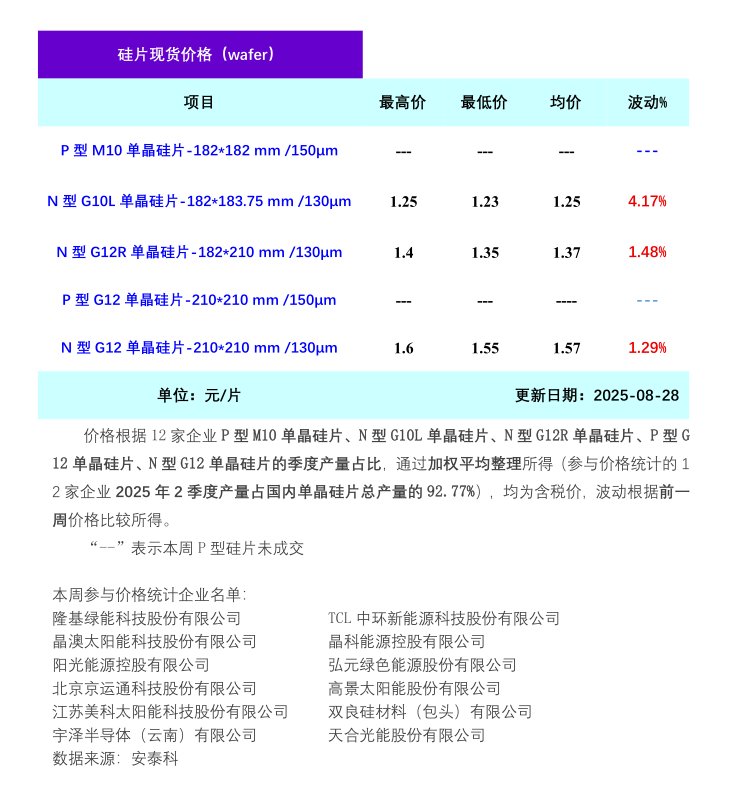
Group 1 - The core viewpoint of the articles indicates that silicon wafer prices have slightly increased this week due to positive market sentiment, with various grades experiencing different levels of price hikes [1][2] - N-type G10L monocrystalline silicon wafer average transaction price is 1.25 yuan/piece, up 4.17% from last week; N-type G12R at 1.37 yuan/piece, up 1.48%; and N-type G12 at 1.57 yuan/piece, up 1.29% [1][3] - The supply side is influenced by rising polysilicon prices, leading manufacturers to have a bullish outlook and a strong willingness to raise prices [1][2] Group 2 - Downstream battery and module prices remained stable this week, with mainstream battery prices at 0.28-0.29 yuan/W and module prices at 0.65-0.67 yuan/W [2] - Future silicon wafer price trends will depend on the acceptance levels of downstream battery and module sectors; if wafer prices exceed expected psychological price points, high-priced transactions may be affected [2] - Despite weak terminal demand, the industry is in a supply-demand mismatch situation, but short-term support from high polysilicon prices suggests a low probability of significant price drops for silicon wafers [2] Group 3 - The overall operating rate in the industry remains stable compared to last week, with major companies operating at rates of 50% and 46%, while integrated companies operate between 50%-80% [1] - The data on silicon wafer prices is based on a weighted average from 12 companies, which accounted for 92.77% of the domestic monocrystalline silicon wafer total production in Q2 2025 [4] - The participating companies in the price statistics include major players such as JA Solar Technology, Trina Solar, and LONGi Green Energy [4]
【安泰科】单晶硅片周评-市场情绪相对积极 硅片价格小幅上行(2025年8月28日)
中国有色金属工业协会硅业分会· 2025-08-28 07:37
Group 1 - The core viewpoint of the articles indicates a slight increase in silicon wafer prices this week, driven by positive market sentiment and rising raw material costs [2][3] - N-type G10L silicon wafer average price is 1.25 yuan/piece, up 4.17% week-on-week; N-type G12R at 1.37 yuan/piece, up 1.48%; and N-type G12 at 1.57 yuan/piece, up 1.29% [2][4] - The overall operating rate in the industry remains stable, with major companies operating at 50% and 46%, while integrated companies operate between 50%-80% [2] Group 2 - Downstream battery and module prices remain stable, with mainstream battery prices at 0.28-0.29 yuan/W and module prices at 0.65-0.67 yuan/W [3] - Future silicon wafer price trends will depend on the acceptance levels of downstream battery and module sectors; if prices exceed expected psychological thresholds, high-price transactions may be affected [3] - Despite weak terminal demand, the cost support from high polysilicon prices suggests a low probability of significant price drops for silicon wafers, with expectations for slight upward fluctuations [3]
长城证券:光伏组件出货重心聚焦海外 欧洲工商储需求旺盛
智通财经网· 2025-08-28 07:29
Core Viewpoint - The photovoltaic storage industry has experienced a decline in prosperity over the past year, but 2024-2025 may represent a bottoming out for industry profitability [1][4] Industry Summary - Domestic manufacturers are shifting their export focus overseas, with July 2025 solar cell component exports reaching $2.223 billion, down 14% year-on-year but up 1.1% month-on-month, corresponding to an export volume of 30.48 GW, which is up 26.1% year-on-year and 1.5% month-on-month [2] - The European market's demand has returned to normal, with July exports of photovoltaic battery components to Europe reaching 9.37 GW, up 13% year-on-year and 3.83% month-on-month, marking the first year-on-year growth in six months [2] Inverter Export Summary - In July 2025, the total domestic export value of inverters reached $911 million, up 15.83% year-on-year but down 0.65% month-on-month, with a total of 4.6001 million units exported, down 12.23% year-on-year and 10.31% month-on-month [3] - The inverter export scale reached a multi-month high, with strong downstream storage demand and recovery in major Asian markets [3] - Specific provinces showed varied performance in inverter exports, with Zhejiang exporting 1.9072 million units, Jiangsu 436,400 units, Guangdong 1.5469 million units, and Anhui 72,200 units in July 2025 [3] Investment Recommendations - The photovoltaic storage industry is expected to reach a profitability bottom in 2024-2025, with potential differentiation in financial performance among companies [4] - The ongoing energy transition and grid parity remain fundamental drivers for global photovoltaic storage demand, while supply-side issues are leading to the exit of older capacities and delays in new projects [4] - Companies to watch include: Canadian Solar, JA Solar, Junda Co., Sungrow Power Supply, Foster, Deye, Jinlang Technology, Shenghong, Dike, and Flat [4]

【盘中播报】23只个股跨越牛熊分界线
Zheng Quan Shi Bao Wang· 2025-08-28 06:24
Market Overview - The Shanghai Composite Index is at 3812.43 points, above the annual line, with a change of 0.32% [1] - The total trading volume of A-shares is 1,230.98 billion yuan [1] Stocks Breaking Annual Line - 23 A-shares have broken above the annual line today, with notable stocks including Chuangyi Information, Zhongfu Information, and Qifeng New Materials, showing divergence rates of 11.29%, 5.02%, and 3.05% respectively [1] - Stocks with smaller divergence rates that have just crossed the annual line include Guizhou Tire, Andisoo, and Haier Smart Home [1] Top Stocks by Divergence Rate - Chuangyi Information (300366) has a daily increase of 13.27% and a divergence rate of 11.29% [1] - Zhongfu Information (300659) has a daily increase of 6.91% and a divergence rate of 5.02% [1] - Qifeng New Materials (002521) has a daily increase of 3.24% and a divergence rate of 3.05% [1] Additional Stocks with Minor Divergence - Anuoqi (300067) shows a daily increase of 2.60% with a divergence rate of 1.87% [1] - Henglin Shares (603661) has a daily increase of 2.56% and a divergence rate of 1.35% [1] - Other stocks with minor divergence rates include Rabbit Baby (002043), Landun Optoelectronics (300862), and Transsion Holdings (688036) [1]




光伏电池组件逆变器出口月报(25年7月)-20250828
Great Wall Securities· 2025-08-28 05:39
Investment Rating - The report assigns a rating of "Outperform" for the industry [1]. Core Insights - The focus of shipments is shifting towards overseas markets, with strong demand from European industrial and commercial sectors. In July 2025, China's total export value of solar cells and modules reached $2.223 billion, a year-on-year decrease of 14% but a month-on-month increase of 1.1%. The corresponding total export volume was 30.48 GW, reflecting a year-on-year increase of 26.1% and a month-on-month increase of 1.5% [2]. - The inverter exports in July 2025 totaled $911 million, with a year-on-year increase of 15.83% but a month-on-month decrease of 0.65%. The monthly export volume reached 4.6001 million units, showing a year-on-year decrease of 12.23% and a month-on-month decrease of 10.31% [2]. - The report highlights that the solar storage industry has experienced a decline in prosperity over the past year, with no clear bottom in performance metrics. However, the period of 2024-2025 may represent a bottoming out for industry profits, with a focus on the supply chain's production changes and price trends [3]. Summary by Sections Export Data - In July 2025, the export volume of solar cells to various countries included 3.57 GW to the Netherlands, 0.71 GW to Spain, and 5.41 GW to India, with India showing a significant year-on-year increase of 57.05% [12]. - The report notes that the export of inverters from Zhejiang province reached 1.9072 million units, with an export value of 1.543 billion yuan, reflecting a month-on-month increase of 8% [2]. Market Dynamics - The European inverter market is recovering, with strong downstream storage demand. The report indicates that the export value of inverters from Guangdong province was 2.441 billion yuan, with a month-on-month increase of 1% [2]. - The report suggests that the competitive landscape in the photovoltaic industry is evolving, with older capacities facing losses and new projects being delayed. This non-rational competition is accelerating capacity clearance, indicating a potential for improved market conditions [3].