南京银行

Search documents
小红日报 | 再秀防御力!标普红利ETF(562060)标的指数逆市收涨0.45%
Xin Lang Ji Jin· 2025-11-03 02:01
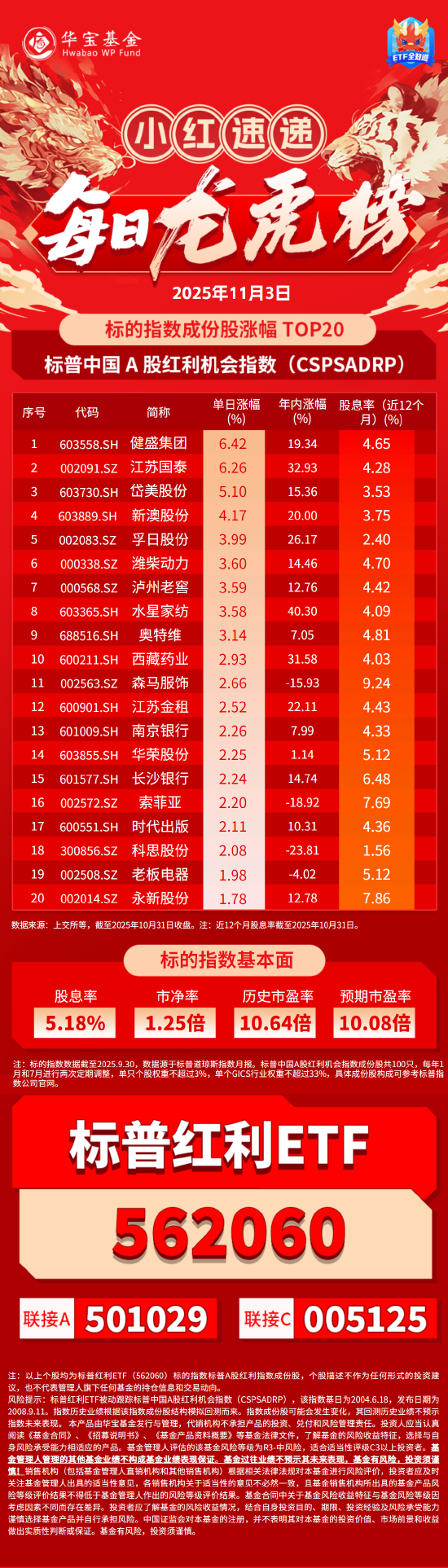
Core Insights - The article highlights the top-performing stocks in the S&P China A-Share Dividend Opportunity Index, showcasing significant price increases and dividend yields for various companies [1]. Group 1: Stock Performance - The top stock, 健盛集团 (Jiansheng Group), experienced a daily increase of 6.42% and a year-to-date increase of 19.34%, with a dividend yield of 4.65% [1]. - 江苏国泰 (Jiangsu Guotai) follows closely with a daily increase of 6.26% and a year-to-date increase of 32.93%, offering a dividend yield of 4.28% [1]. - Other notable performers include 岱美股份 (Daimai Co.) with a daily increase of 5.10% and a year-to-date increase of 15.36%, and 新澳股份 (Xinao Co.) with a daily increase of 4.17% and a year-to-date increase of 20.00% [1]. Group 2: Dividend Yields - The article lists several companies with attractive dividend yields, such as 森马服饰 (Semir Fashion) at 9.24%, 长沙银行 (Changsha Bank) at 6.48%, and 家非业 (Jiafei Industry) at 7.69% [1]. - The dividend yields for other companies in the top 20 range from 2.08% to 5.12%, indicating a generally favorable income potential for investors [1]. Group 3: Year-to-Date Performance - The year-to-date performance of the listed stocks varies significantly, with some companies like 水星家纺 (Mercury Home Textiles) showing a remarkable increase of 40.30%, while others like 科思股份 (Kesi Co.) have seen a decline of 23.81% [1]. - Overall, the data reflects a mixed performance landscape, with certain stocks demonstrating resilience and growth potential in the current market environment [1].






银行业周度追踪2025年第43周:保险资本三季度继续增持银行股-20251103
Changjiang Securities· 2025-11-02 23:30
Investment Rating - The report maintains a "Positive" investment rating for the banking sector [11] Core Insights - The banking index declined by 2.3% this week, underperforming the CSI 300 and ChiNext indices by 1.9% and 2.8% respectively, indicating a high volatility in market risk preference [2][18] - The report highlights the importance of focusing on large bank stocks for dividend allocation as more banks approach mid-term dividend stages [2][9] - The third quarter results showed a slight decline in revenue and profit growth for listed banks, which was in line with expectations, with interest income growth being a key highlight [6][36] Summary by Sections Banking Sector Performance - The banking sector experienced a decline in performance, with individual stocks showing significant variability based on quarterly results [2][9] - Notable outperformers included Standard Chartered Group and Xiamen Bank, while underperformers included Pudong Development Bank due to convertible bond expirations [18] Third Quarter Financial Results - The third quarter results indicated a marginal decline in revenue and profit growth, with state-owned banks showing a recovery trend [6][36] - Interest income growth is a core highlight, with most banks showing a quarter-on-quarter increase in net interest margins, suggesting a clearer turning point [7][36] Insurance Capital Involvement - Insurance capital has accelerated its investment in bank stocks, with significant purchases in Agricultural Bank and Postal Savings Bank [8][36] - Major insurance companies are diversifying their investments into city commercial banks, indicating a growing recognition of quality banks in the Jiangsu and Zhejiang regions [8][36] Market Dynamics - The report notes a shift in market dynamics with increased trading volumes in bank stocks, reflecting a change in short-term market risk preferences [30][32] - The average dividend yield for the six major state-owned banks is reported at 3.89%, with a significant spread of 210 basis points over the 10-year government bond yield [20][23]



无惧回调!掘金银行三季报:险资继续“扫货”
券商中国· 2025-11-02 23:27
Core Viewpoint - The article discusses the significant changes in the shareholder structure of A-share listed banks following the disclosure of their Q3 2025 reports, highlighting the increasing presence of insurance funds as long-term investors in the banking sector [1][2]. Shareholder Changes - A-share listed banks experienced a substantial decline in Q3 2025, with an overall drop exceeding 13% in a single quarter, while insurance funds continued to increase their holdings in bank stocks [2]. - Six insurance companies entered the top ten shareholders of six A-share listed banks in Q3, with several existing insurance shareholders also raising their stakes and seeking board seats [2]. - By the end of September, at least two insurance funds were present in the top ten shareholders of 12 listed banks, with Zhejiang Zheshang Bank having four insurance shareholders [2]. New Top Shareholders - China Life Insurance Company entered the top ten shareholders of Industrial and Commercial Bank of China in Q3, holding 757 million shares, representing 0.21% of the bank's total shares [3]. - In addition to ICBC, China Life also became a top shareholder in Nanjing Bank, holding approximately 256.8 million shares (2.08%) [4]. - Li'an Life Insurance entered the top ten shareholders of Wuxi Bank, holding 50 million shares (2.96%), while Changcheng Life Insurance increased its stake in Wuxi Bank to over 7% [4]. Continued Increases in Holdings - Several insurance companies that entered the top ten shareholders of listed banks continued to increase their holdings in Q3, with Dajia Life Insurance raising its stake in Industrial Bank to 3.38% [5]. - China Life Insurance and Guomin Pension Insurance both increased their holdings in Suzhou Bank to 3.4% and 2.76%, respectively [5]. - Hongkang Life was nominated for a non-executive director position at Sunong Bank after entering its top ten shareholders with a 4.95% stake [6]. Concentration of Insurance Shareholders - By the end of Q3, 12 listed banks had at least two insurance funds among their top ten shareholders, with Zhejiang Zheshang Bank having the highest concentration of four insurance shareholders [7]. - Industrial Bank had three insurance shareholders, while several other banks, including Postal Savings Bank and Agricultural Bank, had two [7]. - The presence of multiple insurance shareholders in these banks is expected to attract further investment from existing and new investors in the secondary market [7]. Investment Focus - Insurance asset management institutions are advised to focus on companies with strong fundamentals and stable dividend growth potential for their core holdings [8].

A股中小银行前三季度业绩分化
Zheng Quan Ri Bao· 2025-11-02 16:41
Core Insights - The performance of A-share listed banks in the third quarter of 2025 shows significant differentiation among small and medium-sized banks, with city commercial banks leading, rural commercial banks in the middle, and joint-stock banks under pressure [1] Group 1: City Commercial Banks - City commercial banks have demonstrated outstanding performance, with 14 out of 17 banks reporting year-on-year revenue growth and 16 reporting net profit growth [2] - Chongqing Bank reported the highest performance, achieving revenue of 11.74 billion yuan, a year-on-year increase of 10.4%, and a net profit of 4.879 billion yuan, up 10.19% [2] - Other banks like Qingdao Bank, Nanjing Bank, and Ningbo Bank also showed steady growth, with Qingdao Bank's revenue at 11.013 billion yuan (5.03% increase) and net profit at 3.992 billion yuan (15.54% increase) [2] Group 2: Rural Commercial Banks - Most rural commercial banks also reported increases in both revenue and net profit, but the growth rates were relatively moderate, with most banks showing single-digit growth [3] - A few rural banks achieved double-digit growth, contrasting with the performance of city commercial banks [3] Group 3: Joint-Stock Banks - Joint-stock banks faced a decline in both revenue and net profit, although the rate of decline has narrowed compared to the first half of the year, indicating signs of stabilization [3] - For instance, Ping An Bank reported revenue of 100.668 billion yuan, down 9.8%, and net profit of 38.339 billion yuan, down 3.5%, with declines narrowing by 0.2 and 0.4 percentage points respectively [3] Group 4: Asset Quality - The overall asset quality of small and medium-sized banks has improved, with non-performing loan ratios remaining low [4] - Specific banks like Wuxi Rural Commercial Bank and Nanjing Bank maintained non-performing loan ratios of 0.78% and 0.83% respectively, while Chongqing Bank's ratio decreased to 1.14% [4] - Factors contributing to the improvement in asset quality include enhanced risk management, focused regional market strategies, and effective macroeconomic policies [4]



面对城商行突袭,华夏银行打起业绩「防御战」
Hua Er Jie Jian Wen· 2025-11-02 10:45
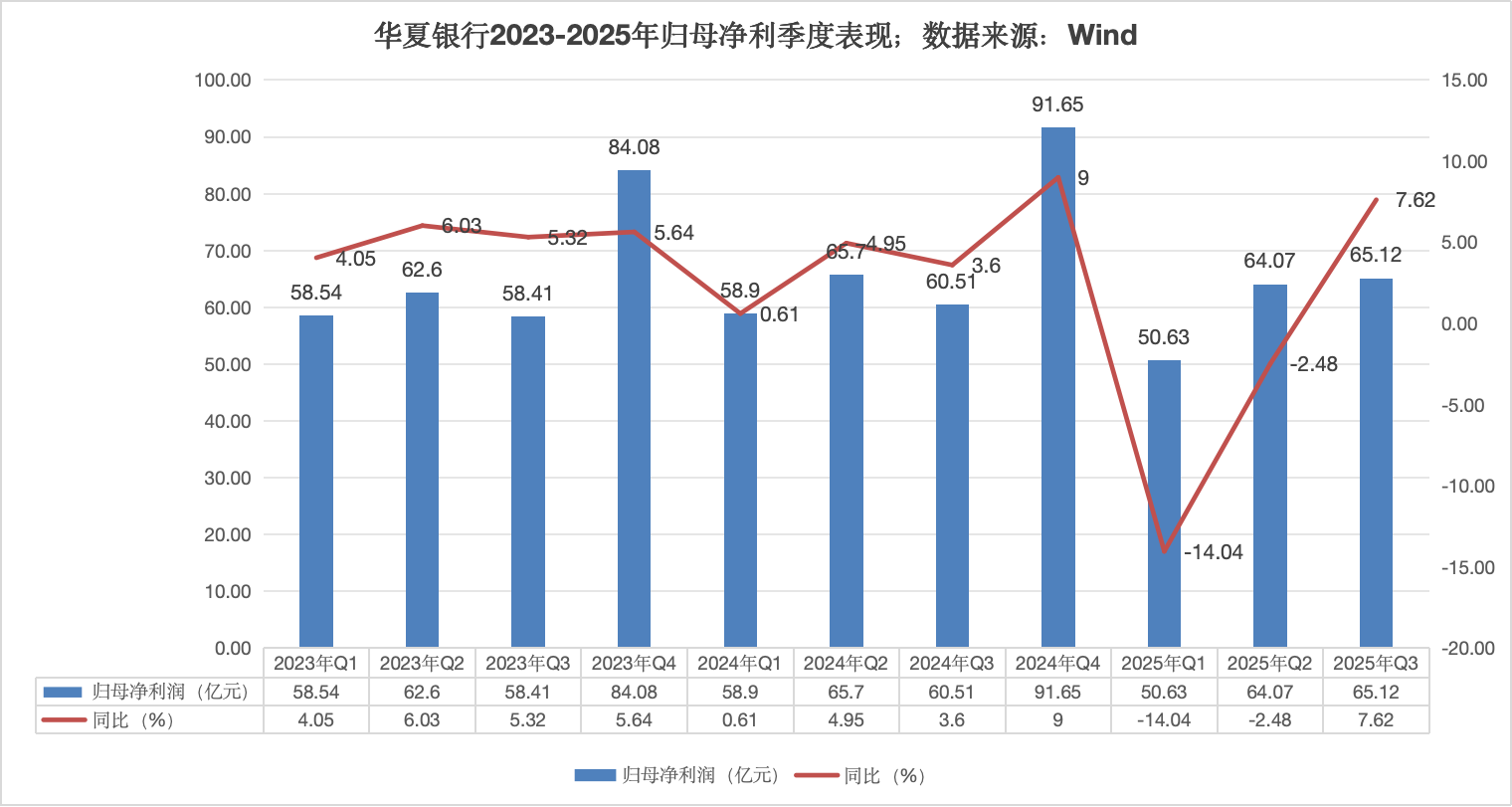
Core Viewpoint - Under the reshuffling of commercial banks, city commercial banks are gaining momentum, increasing growth anxiety for lagging joint-stock banks like Huaxia Bank [1][2]. Group 1: Financial Performance - Huaxia Bank reported a revenue of 64.881 billion and a net profit of 17.982 billion for the first three quarters, representing declines of 8.79% and 2.86% year-on-year, respectively [1][6]. - Among 42 listed banks in A-shares, Huaxia Bank ranked 40th and 37th in revenue and net profit growth rates, indicating a significant lag behind most banks [2]. - In the third quarter, Huaxia Bank experienced a revenue decline of 15.02% but a net profit increase of 7.62%, marking a V-shaped reversal in profit growth [7][9]. Group 2: Asset Quality and Risk Management - As of the end of the third quarter, Huaxia Bank's non-performing loan ratio stood at 1.58%, the worst among A-share joint-stock banks [4][14]. - The bank faces a dilemma between sacrificing risk control for growth or tightening risk management and potentially losing market share to aggressive city commercial banks [5][16]. - The bank's management has undergone significant changes, including the appointment of a new chairman and several key executives, aimed at addressing long-standing governance and risk management issues [18][19]. Group 3: Strategic Adjustments - Huaxia Bank is implementing a "cutting inward" strategy to optimize its organizational structure and improve operational efficiency [20][21]. - The bank's focus is shifting towards retail transformation and digital risk control, with an emphasis on supporting technological innovation and green finance [29]. - The bank's capital adequacy ratio is at 12.63%, which, while above the regulatory requirement, is still at the lower end compared to peers, indicating a weak capacity to absorb risks [14][23]. Group 4: Competitive Landscape - Huaxia Bank's profits have been surpassed by five city commercial banks, which are experiencing higher growth rates, intensifying competitive pressure [25][26]. - The bank's main markets, the Beijing-Tianjin-Hebei and Yangtze River Delta regions, are also the battlegrounds for these aggressive city commercial banks [28].

这场科技金融对接会搭平台铺通道合作成果丰硕 金融活水赋能 创新活力迸发
Zhen Jiang Ri Bao· 2025-11-01 23:48
Group 1 - The 2025 Zhenjiang Science and Technology Finance Matching Conference was successfully held, focusing on "Innovation Leading, Financial Empowerment" [1] - The event aimed to create a platform for technology talent, projects, and enterprises to connect with financial institutions, facilitating a green channel for technology SMEs to access capital [1][2] - The local government has implemented the "876" innovation leading project, establishing a risk compensation fund of 240 million yuan to support technology financial products [2] Group 2 - A total of 47 technology financial products were launched during the event, with significant participation from various banks and insurance companies [3] - The cooperation between technology enterprises and financial institutions is expected to enhance R&D, capacity expansion, and talent acquisition, potentially doubling revenues in emerging fields [4] - Insurance institutions are playing a crucial role in alleviating financing difficulties for technology enterprises by providing credit enhancement through a government-bank-insurance risk-sharing mechanism [5] Group 3 - The city aims to optimize technology financial products and develop a comprehensive investment and financing service system covering the entire lifecycle of technology enterprises [5][6] - The focus is on creating a financial ecosystem that encourages early, small, and long-term investments in technology innovation [5][6]


南京银行(601009):利息净收入延续强势表现 拨贷比环比持平
Xin Lang Cai Jing· 2025-11-01 00:27
Core Viewpoint - Nanjing Bank shows continuous improvement in revenue growth, while the growth rate of net profit attributable to shareholders has slightly declined, primarily due to increased provisioning for bad debts [1][2]. Revenue and Profitability - As of Q3 2025, Nanjing Bank's revenue, PPOP, and net profit attributable to shareholders have increased year-on-year by 8.8%, 11.7%, and 8.1% respectively, with slight improvements from H1 2025 [1]. - Net interest income growth has risen by 6.4 percentage points from H1 2025 to 28.5%, supported by a stable net interest margin [1]. - Fee income has increased by 8.5% year-on-year, with a quarter-on-quarter growth of 1.8 percentage points, while retail customer AUM has grown by 17.1% since the beginning of the year [1]. Asset Quality and Provisioning - The asset quality remains stable, with a non-performing loan (NPL) ratio decreasing by 1 basis point quarter-on-quarter, and the provisioning coverage ratio at 313%, up by 1.6 percentage points [2]. - The company has seen a significant increase in credit costs compared to H1 2025, indicating ongoing efforts to manage non-performing assets [2]. Growth Forecast - The forecast for net profit attributable to shareholders for 2025, 2026, and 2027 is projected to grow by 8.3%, 7.9%, and 8.3% respectively, with BVPS expected to be 14.99, 16.38, and 17.88 yuan [2]. - The current stock price corresponds to a PB ratio of 0.74X, 0.68X, and 0.62X for the years 2025, 2026, and 2027, respectively, with a target price of 11.99 yuan per share based on a 0.80X PB valuation for 2025 [2].
信贷“换锚”驱动两位数增幅 重庆银行晋升万亿规模行列
Zhong Guo Jing Ying Bao· 2025-10-31 19:12
Core Viewpoint - The financial performance of regional banks, particularly city commercial banks, is showing significant divergence, with Chongqing Bank becoming a highlight by surpassing the 1 trillion yuan asset mark in Q3 2023, reflecting a broader trend of aggressive asset expansion among city commercial banks [1][2]. Group 1: Chongqing Bank's Performance - Chongqing Bank's total assets reached 1.0227 trillion yuan as of September 30, 2023, marking a year-on-year increase of 19.39% [2]. - The bank's deposits totaled 554.25 billion yuan, up 16.9% year-on-year, while loans reached 520.39 billion yuan, reflecting an 18.1% increase [2]. - The bank's net interest margin was 1.32%, down 4 basis points year-on-year, but the decline was less severe compared to previous quarters, indicating improved profitability [3]. Group 2: Industry Trends - City commercial banks are increasingly focusing on corporate loans, particularly in manufacturing and infrastructure sectors, to stabilize their net interest margins amid declining loan rates [1][6]. - The overall asset growth among city commercial banks is notable, with 10 out of 12 banks showing growth rates exceeding 10%, contrasting with 16 banks experiencing growth below 5% [4]. - The divergence in growth rates among banks is attributed to regional economic differences, with banks in economically vibrant areas like the Yangtze River Delta and Pearl River Delta performing better [4][5]. Group 3: Challenges and Strategic Adjustments - The pressure on net interest margins is prompting banks to adjust their loan structures, reducing reliance on low-yielding bill financing and increasing high-yield corporate loans [6][7]. - Capital constraints are becoming a common challenge for city commercial banks, with many facing declining core tier-one capital ratios due to rapid asset expansion [8][9]. - Banks are shifting their focus from scale-driven growth to efficiency-driven strategies, emphasizing the need for capital-efficient operations and exploring light-capital business models [10].
险资现身713家A股公司前十大流通股股东名单
Zheng Quan Ri Bao· 2025-10-31 15:52
Group 1 - As of the end of Q3 2023, insurance institutions were among the top ten shareholders in 713 A-share listed companies, with significant movements in their stock holdings [1] - In Q3, insurance institutions entered 203 new stocks, increased holdings in 185 stocks, and maintained positions in 112 stocks, indicating active portfolio management [1] - The top ten stocks held by insurance institutions included major banks and companies, reflecting a continued preference for bank stocks due to their high dividends and low volatility [1] Group 2 - Insurance stocks generally exhibit characteristics of high dividends, low valuations, and large market capitalizations, often being industry leaders with strong cash flows [2] - The net profit of the five major listed insurance companies reached 426.04 billion yuan, a year-on-year increase of 33.5%, driven by a favorable equity market [2] - There is an expectation for insurance institutions to continue increasing their allocation to equity assets, particularly in strategic emerging industries and high-end manufacturing sectors [2][3] Group 3 - The trend for insurance institutions is to steadily increase the total amount of equity assets while optimizing the structure of their investments [3] - The need to enhance long-term investment returns in a declining interest rate environment drives the shift towards equity assets [3] - Regulatory encouragement for long-term capital to enter the market supports the ongoing strategy of focusing on high dividend stocks and sectors aligned with national strategic development [3]
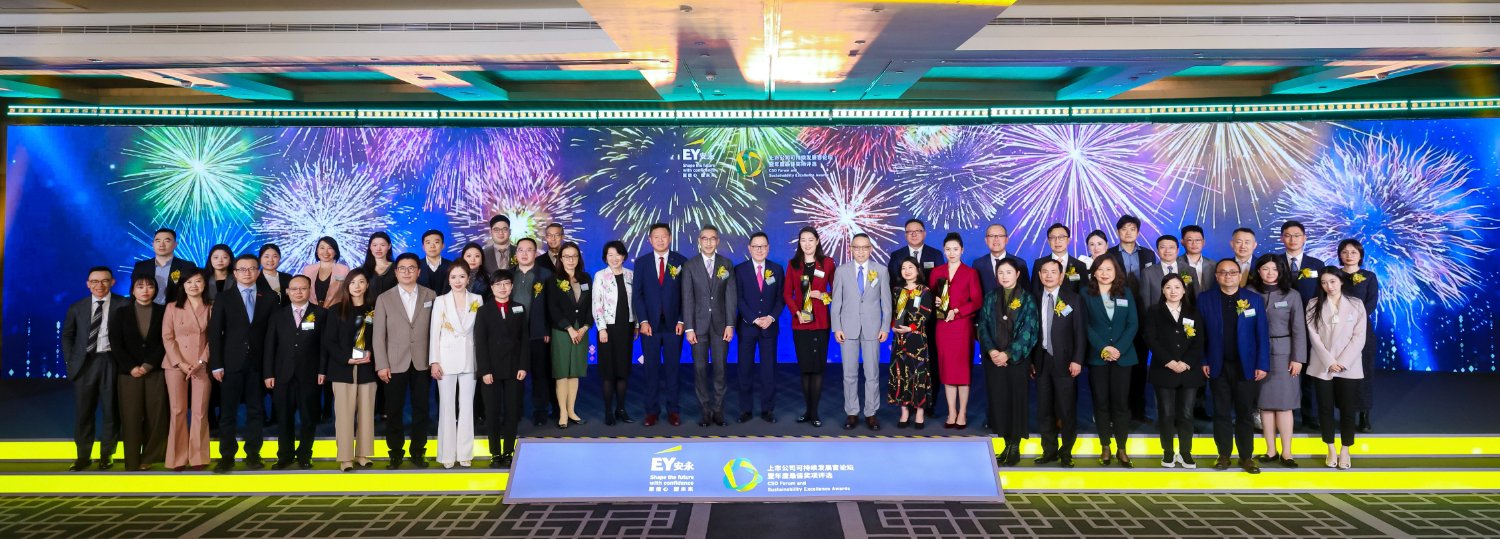
以数为擎,向绿而行,企业可持续发展迎“智”变——第四届上市公司可持续发展官论坛暨年度最佳奖项评选结果隆重揭晓
Zhong Guo Jin Rong Xin Xi Wang· 2025-10-31 14:58
Core Insights - The integration of "digital intelligence" and "green" initiatives is advancing corporate ESG (Environmental, Social, and Governance) practices from conceptual advocacy to systematic and intelligent implementation [1][3] - The fourth annual forum on sustainable development for listed companies, themed "Digital Intelligence and Green Movement Leading New Journey," was held in Beijing, revealing the winners of the "Ernst & Young Sustainable Development Annual Best Awards 2025" [1][3] - The awards highlighted the innovative practices of Chinese companies in the ESG and AI integration space, showcasing their contributions to building a modern industrial system and achieving high-quality development [1][3] Group 1: Event Overview - The forum featured 2 special awards, 12 outstanding companies, 2 distinguished individuals, 16 excellent cases, and 1 special contribution award for technological innovation in ESG development [1][3] - The focus of this year's awards was on the role of digitalization as an innovative driving force, emphasizing zero-carbon technology and AI's role in enhancing productivity [1][3] Group 2: Industry Trends - Ernst & Young's China Chairman noted that 2023 is a pivotal year for global sustainable development, marking the 10th anniversary of the Paris Agreement and the 20th anniversary of the "Green Mountains and Clear Water are Gold and Silver Mountains" concept [3] - The rapid advancement of AI technology is accelerating the digital and green transformation of Chinese enterprises, positioning them as key players in sustainable development [3][4] Group 3: AI and ESG Integration - Companies are encouraged to integrate ESG into their core strategies and leverage technology to transform sustainable development into a quantifiable and operational value system [4][5] - Ernst & Young has introduced AI-driven solutions, including the DeepSeek model and the METIS AI platform, to support enterprises in their green transformation efforts [4][5] Group 4: Award Evaluation and Criteria - The evaluation framework for the awards includes nine dimensions, focusing on technological innovation, low-carbon benefits, and social responsibility [5] - This year, an AI assessment component was introduced to enhance the evaluation process, utilizing a comprehensive ESG information database [5] Group 5: Future Outlook - Ernst & Young aims to deepen its professional service capabilities, helping companies embed sustainable development into their strategic core and operational processes [6]