南京银行

Search documents
对公发力、零售分化 两家长三角城商行的共性与分化
2 1 Shi Ji Jing Ji Bao Dao· 2025-10-29 23:08
Core Insights - Both Ningbo Bank and Nanjing Bank reported over 8% growth in revenue and net profit for the first three quarters of 2025, despite ongoing pressure in the banking sector [1] - Ningbo Bank outperformed Nanjing Bank in key metrics, including total assets, net interest margin, and asset quality [1][5] Financial Performance - Ningbo Bank achieved operating income of 54.976 billion yuan, a year-on-year increase of 8.32%, and a net profit of 22.445 billion yuan, up 8.39% [1] - Nanjing Bank reported operating income of 41.949 billion yuan, a growth of 8.79%, and a net profit of 18.005 billion yuan, an increase of 8.06% [1] - Nanjing Bank's net interest income surged by 40.53% year-on-year, driven by an expansion in interest-earning assets [2] - Ningbo Bank's net interest income grew by 13.21% year-on-year, indicating stable performance [2] Cost Management - Nanjing Bank's cost-to-income ratio improved to 23.27%, a decrease of 4.81 percentage points year-on-year [3] - Ningbo Bank maintained a cost-to-income ratio of 30.68%, stable compared to the previous quarter [3] Asset Quality - Both banks maintained low non-performing loan (NPL) ratios, with Nanjing Bank at 0.83% and Ningbo Bank at 0.76% [4] - Nanjing Bank's provision coverage ratio stood at 313.22%, while Ningbo Bank's was at 375.92%, indicating strong risk mitigation capabilities [4] Business Structure - Nanjing Bank's corporate loans accounted for 76% of total loans, while retail loans made up 24% [5] - Ningbo Bank's corporate loans represented 69% of total loans, with personal loans decreasing to 31% due to a strategic reduction in high-risk retail credit [6] Investment and Wealth Management - Both banks experienced a decline in investment income due to market volatility, but saw significant growth in wealth management and commission income [7][8] - Nanjing Bank's retail segment revenue grew by 22.10%, with a notable increase in commission income from wealth management products [7] - Ningbo Bank reported a 94.02% year-on-year increase in net fee income, reflecting strong performance in wealth management [8]


金价如坐“过山车”,搅动年轻人投资观
Xin Hua Ri Bao· 2025-10-29 21:57
Core Viewpoint - The recent sharp decline in gold prices has created tension among both consumers and investors, raising questions about the future of gold investments and purchasing decisions [1] Group 1: Market Trends - Gold jewelry prices have dropped below 1190 yuan per gram, with a decline of over 7% in domestic gold spot prices [1] - In just seven trading days, gold jewelry prices fell by more than 70 yuan per gram, from a peak of 1262 yuan per gram on October 20 to the current levels [2] - The current market is characterized by two main types of gold jewelry products: "weight gold + processing fee" and "fixed price" products, with the former being more sensitive to gold price fluctuations [2] Group 2: Investment Behavior - The gold spot price reached a peak of 1002.99 yuan per gram on October 17, then fell to 925.00 yuan per gram by October 28 [3] - There has been an increase in the number of investors purchasing physical gold, paper gold, and accumulating gold through banks, as well as interest in gold ETFs and new investment channels [3] - Young investors, including students as young as 20, are increasingly interested in gold investments due to lower entry barriers and perceived lower risks compared to stock and real estate markets [3] Group 3: Future Outlook - The international gold price is projected to be between 3970 and 3930 USD per ounce, with gold seen as a defensive asset amid ongoing trade tensions [5] - Financial institutions are advising investors, particularly inexperienced young ones, to view gold as a long-term hedging tool rather than a short-term speculative asset [5] - The current market environment allows for more diverse investment options, which helps mitigate risks associated with gold price volatility [4]
九十股前三季业绩超预期 多只行业龙头上榜
Zheng Quan Shi Bao· 2025-10-29 18:40
Core Insights - The A-share market is witnessing a significant number of companies reporting better-than-expected performance in their Q3 2025 results, reflecting economic recovery and industry growth opportunities [1] - A total of 90 stocks have been rated as "better-than-expected" by brokerage reports, with notable representation from industries such as computer, automotive, power equipment, basic chemicals, electronics, and non-ferrous metals [1] - The computer industry has the highest number of outperforming stocks, including leading firms like Hikvision, Tonghuashun, Kingsoft, Dahua Technology, and Dameng Technology [1] Performance Highlights - Over 80% of the 90 stocks reported a year-on-year increase in net profit for the first three quarters, with companies like Gaode Infrared, Wancheng Group, Jinli Permanent Magnet, Shanghai Jahwa, and Dazhong CNC showing significant growth [1] - Gaode Infrared achieved a net profit of 582 million yuan, a year-on-year increase of 1,059% [1] - Wancheng Group reported a net profit of 855 million yuan, a year-on-year increase of 817% [2] Market Trends - In the secondary market, 27 stocks with better-than-expected performance have seen a cumulative increase of over 10% since October, with Okoyi, Dazhong CNC, Beifang Shares, Haixing Power, and Zhongmei Energy leading the gains [2] - Okoyi's stock price increased by 40.3%, reaching a new high for the year, with a net profit of 50 million yuan in Q3, marking a return to profitability [2] Valuation Metrics - There are 23 stocks with a rolling P/E ratio below 30 and a P/B ratio below 2, including Nanjing Bank, Chongqing Bank, Waneng Power, Xinji Energy, and Jingneng Power, with Nanjing Bank having the lowest rolling P/E ratio at 6.4 [2][3] - Nanjing Bank is expected to maintain stable performance growth due to improving revenue growth and asset quality [3] Capital Inflows - 21 stocks have seen net financing purchases exceeding 100 million yuan since October, with notable inflows into leading stocks like Dongfang Fortune, Zijin Mining, CITIC Securities, and Ningde Times [3] - Dongfang Fortune led with a net financing purchase of 1.946 billion yuan, reporting a net profit of 9.097 billion yuan for the first three quarters, a year-on-year increase of 50.57% [3] Trading Activity - Hikvision recorded an average daily trading volume of 3.925 billion yuan since October, a 94.91% increase, and reported a net profit of 9.319 billion yuan for the first three quarters, a year-on-year increase of 14.94% [4] - The company showcased its capabilities at the 2025 China Industrial Expo, highlighting its "IoT perception + AI" products, indicating strong long-term growth potential [4]



外资重点加仓A股高端制造业
2 1 Shi Ji Jing Ji Bao Dao· 2025-10-29 11:49
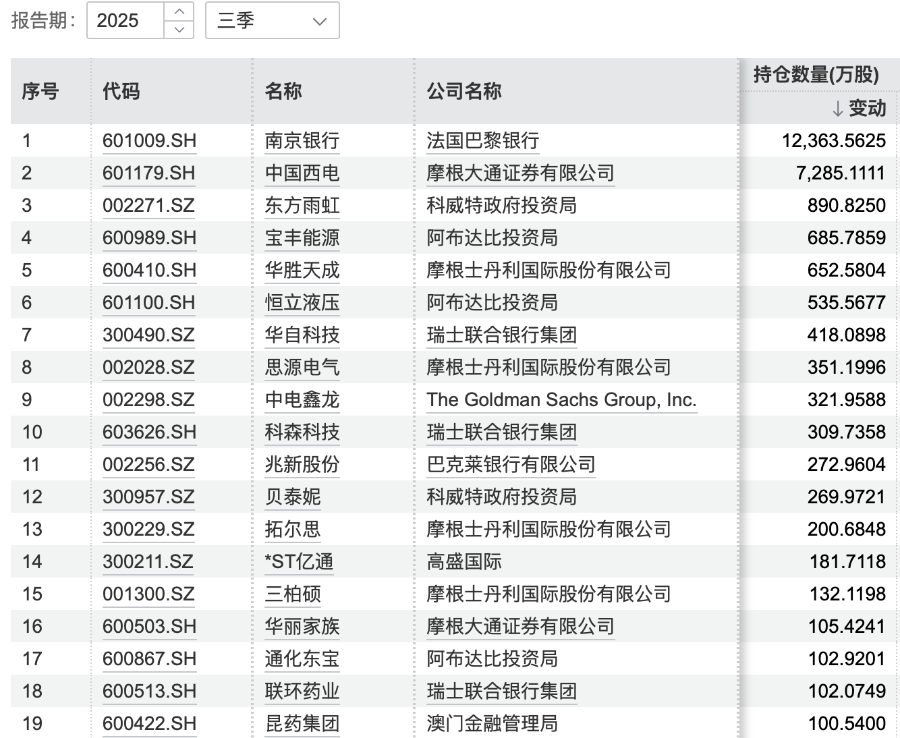
Core Insights - QFII continues to favor A-share core assets, particularly in high-end manufacturing and defensive sectors, reflecting a strategic shift towards tactical accumulation under domestic autonomy logic [1][7][11] - As of the end of Q3, nearly 40 QFII institutions held approximately 119.4 billion yuan in A-shares, indicating a significant foreign interest in the Chinese market [1][10] QFII Investment Trends - QFII has increased holdings in over 500 A-share companies, with notable investments in banking, electrical equipment, building materials, chemicals, software services, machinery, and hardware [2][3] - Major QFII purchases include 124 million shares of Nanjing Bank by BNP Paribas and 72.85 million shares of China West Electric by JPMorgan Securities, highlighting a focus on financial stability and growth potential [2][3] Key Stocks and Sectors - Significant QFII increases were observed in stocks such as Oriental Yuhong, Baofeng Energy, and Huasheng Tiancheng, with multiple QFII institutions accumulating shares [4][5] - The most heavily accumulated stocks include Nanjing Bank, China West Electric, and Shengyi Technology, with QFII holdings in these companies reaching substantial market values [11][12] Sector Analysis - The banking sector saw a total increase of 124 million shares, while electrical equipment and computer sectors also received notable QFII investments, driven by stable dividends and growth prospects [7][11] - QFII's diversified approach includes investments across various industries, such as machinery, food and beverage, and biopharmaceuticals, while maintaining a focus on leading companies and core assets [11][12] Future Outlook - Analysts suggest that QFII's continued interest in Chinese assets reflects confidence in the market's upward trajectory, despite potential short-term fluctuations [13][14] - High-profile institutions like Goldman Sachs and UBS maintain a positive outlook on Chinese equities, advocating for a diversified investment strategy that includes growth stocks and high cash yield portfolios [13][14]

外资重点加仓A股高端制造业
21世纪经济报道· 2025-10-29 11:45
Core Viewpoint - QFII continues to favor A-share core assets, particularly in high-end manufacturing, while also diversifying into defensive assets and sectors aligned with domestic production trends [1][7][10]. Group 1: QFII Investment Trends - In Q3, QFII increased holdings in over 500 A-share companies, with significant investments in banking, electrical equipment, building materials, chemicals, software services, machinery, and hardware sectors [3][10]. - Notable increases include 124 million shares in Nanjing Bank by BNP Paribas and 72.85 million shares in China West Electric by JPMorgan Securities, making them the top two stocks with QFII accumulation [3][6]. Group 2: Key Stocks with Increased Holdings - Key stocks with significant QFII increases include Nanjing Bank, China West Electric, Oriental Yuhong, Baofeng Energy, and Huasheng Tiancheng, among others [3][5][6]. - Specific increases include 6.52 million shares in Huasheng Tiancheng by Morgan Stanley and 3.09 million shares in Kosen Technology by UBS [4][6]. Group 3: Sector Preferences - QFII's top sectors for increased stock counts are banking, electrical equipment, and computing, with banks attracting attention due to stable dividend rates and improving performance expectations [7][10]. - The electrical equipment sector benefits from strong policy support and demand growth driven by energy transition and grid upgrades [7][10]. Group 4: Portfolio Diversification - QFII maintains a diversified portfolio, with nearly 40 firms holding a total A-share market value of approximately 119.4 billion yuan by the end of Q3 [9][10]. - Major holdings include Ningbo Bank, Nanjing Bank, and Shengyi Technology, reflecting a focus on core assets while pursuing diversification across various industries [10]. Group 5: Future Outlook - Some foreign institutions remain optimistic about Chinese assets, with recommendations to shift from "selling high" to "buying low" as market conditions evolve [11]. - Analysts suggest focusing on growth stocks, particularly leading private enterprises, AI themes, and small-cap stocks in the A-share market [11].

QFII三季度新宠曝光:银行担当“压舱石”,高端制造获加仓
2 1 Shi Ji Jing Ji Bao Dao· 2025-10-29 10:17
Core Insights - QFII continues to favor core A-share assets, particularly in high-end manufacturing and defensive sectors, reflecting a strategic approach to investment amidst ongoing market trends [1][2][7] - As of October 28, nearly 40 QFIIs collectively held approximately 119.4 billion yuan in A-shares, indicating significant foreign interest in the Chinese market [1][9] Industry Focus - QFII has notably increased holdings in various sectors, including banking, electrical equipment, building materials, chemicals, software services, machinery, and hardware [3][10] - The banking sector saw a substantial increase, with QFII adding 124 million shares, driven by expectations of improved performance and attractive valuations [7][10] - Electrical equipment and computer sectors also received tactical increases from QFII, supported by favorable policies and growth in demand due to energy transition and infrastructure upgrades [7][10] Notable Stocks - Key stocks with significant QFII increases include Nanjing Bank (12.36 million shares), China Western Power (7.29 million shares), and others in various sectors such as construction materials and chemicals [6][10] - Specific stocks like Huazhi Technology and Huasheng Tiancheng saw multiple QFII firms increase their stakes, indicating strong interest in new productivity concepts [4][5] Investment Strategy - QFII's investment strategy appears to be diversified, focusing on both core assets and emerging opportunities across multiple industries, including machinery, food and beverage, and pharmaceuticals [10][11] - Large foreign institutions, such as Goldman Sachs, are actively seeking diversified investment opportunities in the A-share market, reflecting a positive outlook on Chinese equities [11][12]


对公发力、零售分化,两家长三角城商行的共鸣与独立
2 1 Shi Ji Jing Ji Bao Dao· 2025-10-29 09:18
Core Viewpoint - Both Ningbo Bank and Nanjing Bank have shown over 8% growth in revenue and net profit in the first three quarters of 2025, despite the ongoing pressure in the banking sector [1] Financial Performance - Ningbo Bank reported operating income of 54.976 billion yuan, a year-on-year increase of 8.32%, and a net profit of 22.445 billion yuan, up 8.39% [1] - Nanjing Bank achieved operating income of 41.949 billion yuan, a year-on-year growth of 8.79%, and a net profit of 18.005 billion yuan, an increase of 8.06% [1] - Ningbo Bank's total assets reached 3.58 trillion yuan, while Nanjing Bank's total assets were 2.96 trillion yuan as of the end of Q3 2025 [1][5] Business Segments - Corporate banking significantly contributed to revenue, with Nanjing Bank's corporate loans reaching 1.07 trillion yuan, a growth of 14.63% year-on-year [2] - Ningbo Bank's corporate loans accounted for 69% of total loans, while personal loans decreased to 31% [6] - Nanjing Bank's personal loans grew by 11% year-on-year, but the growth rate was lower than that of corporate loans [6] Cost Management - Nanjing Bank's cost-to-income ratio improved to 23.27%, a decrease of 4.81 percentage points year-on-year [3] - Ningbo Bank's cost-to-income ratio was 30.68%, stable compared to the previous quarter [3] Asset Quality - Nanjing Bank maintained a non-performing loan (NPL) ratio of 0.83% and a provision coverage ratio of 313.22% [4] - Ningbo Bank's NPL ratio was 0.76%, with a provision coverage ratio of 375.92%, indicating strong risk mitigation [4] Investment Income - Both banks experienced a decline in investment income due to market volatility, impacting overall revenue [7] - Despite the drop in non-interest income, both banks saw significant growth in commission and fee income, particularly in retail banking [7][8] Wealth Management - Ningbo Bank reported a substantial increase in net fee income, growing by 94.02% year-on-year in Q3 [8] - Nanjing Bank's retail banking segment achieved a revenue growth of 22.10%, with a notable increase in wealth management clients [7][8]
银行行业今日跌1.98%,主力资金净流出20.90亿元
Zheng Quan Shi Bao Wang· 2025-10-29 09:03
Market Overview - The Shanghai Composite Index rose by 0.70% on October 29, with 24 out of 31 sectors experiencing gains, led by the power equipment and non-ferrous metals sectors, which increased by 4.79% and 4.28% respectively [1] - The banking and food & beverage sectors were the biggest losers, declining by 1.98% and 0.56% respectively, with the banking sector taking the lead in losses [1] Capital Flow - The net inflow of capital in the two markets was 5.406 billion yuan, with 12 sectors seeing net inflows. The power equipment sector had the highest net inflow of 16.132 billion yuan, followed by the non-ferrous metals sector with 5.997 billion yuan [1] - Conversely, 19 sectors experienced net outflows, with the electronics sector leading with a net outflow of 6.540 billion yuan, followed by the communications sector with 4.736 billion yuan [1] Banking Sector Performance - The banking sector saw a decline of 1.98%, with a net outflow of 2.090 billion yuan. Out of 42 stocks in this sector, only one stock rose while 39 stocks fell [2] - Among the banking stocks, China Bank had the highest net inflow of 299 million yuan, followed by CITIC Bank and Nanjing Bank with net inflows of 111 million yuan and 81.076 million yuan respectively [2] - The stocks with the largest net outflows included China Merchants Bank, Minsheng Bank, and Jiangsu Bank, with net outflows of 773 million yuan, 418 million yuan, and 241 million yuan respectively [2]





城商行板块10月29日跌2.43%,成都银行领跌,主力资金净流出7.42亿元
Zheng Xing Xing Ye Ri Bao· 2025-10-29 08:41
Core Viewpoint - The city commercial bank sector experienced a decline of 2.43% on October 29, with Chengdu Bank leading the drop, while the overall stock market indices showed an increase [1][2]. Market Performance - The Shanghai Composite Index closed at 4016.33, up 0.7% - The Shenzhen Component Index closed at 13691.38, up 1.95% [1]. Individual Stock Performance - Chengdu Bank saw a significant decline of 5.74%, closing at 17.07 - Other notable declines included Xiamen Bank (-4.90%), Jiangsu Bank (-3.84%), and Qingdao Bank (-3.66%) [2]. - Chongqing Bank was one of the few gainers, with a slight increase of 0.84%, closing at 10.76 [1]. Trading Volume and Turnover - Chengdu Bank had a trading volume of 1.298 million shares, with a turnover of 22.27 million yuan - Jiangsu Bank had a trading volume of 2.039 million shares, with a turnover of 2.164 billion yuan [2]. Capital Flow Analysis - The city commercial bank sector saw a net outflow of 742 million yuan from institutional investors, while retail investors contributed a net inflow of 410 million yuan [2]. - The data indicates that speculative funds had a net inflow of 331 million yuan [2]. Individual Stock Capital Flow - Qingdao Bank had a net inflow of 61.11 million yuan from institutional investors, while it experienced a net outflow of 59.42 million yuan from speculative funds [3]. - Nanjing Bank also saw a net inflow of 43.97 million yuan from institutional investors, but a net outflow of 34.08 million yuan from speculative funds [3].


长三角生物医药专利赛揭晓:7项目夺金,沪通临床转化联盟同步启动
Shang Hai Zheng Quan Bao· 2025-10-29 07:16
来源:上海证券报·中国证券网 上证报中国证券网讯(记者 邓贞)近日,第三届长三角高价值专利运营大赛生物医药(大健康)赛道决赛路演暨紫琅 药谷产业对接会在南通国际会议中心成功举办。来自政、产、学、研、投各领域的约140名代表齐聚紫琅湖畔,围绕生 物医药知识产权运营与产业创新展开深度交流。 南通市副市长李玲在致辞中表示,南通正全力打造生物医药战略性新兴产业,积极构建"上海研发、南通转化"的协同 创新模式,推动上海研发实力与南通产业优势深度融合,以紫琅药谷等载体为依托,完善"研发—转化—制造—服 务"一体化生态。 上海交易集团总裁管小军表示,将以国家知识产权运营(上海)国际服务平台南通中心为枢纽,精准对接长三角生物 医药专利资源与南通产业要素,推动建设特色产业集群,深化专利金融服务,助力企业加速成长。 全国政协常委周汉民在题为《人工智能时代生物医药产业的创新发展与价值跃升》的主旨报告中表示,AI与生物医药 的深度融合正推动行业从"工具辅助"迈向"范式革命",未来将形成以AI为驱动、以患者为中心的智能健康新体系。 路演环节中,来自全国的23项高价值专利项目同台竞技,覆盖基因技术、AI辅助诊疗、高端医疗器械、创新药物等 ...