
平安银行

Search documents
金价回升推高入场费!多家银行积存金门槛突破千元,“随金价浮动”新模式来了
Mei Ri Jing Ji Xin Wen· 2025-11-12 08:56
Core Viewpoint - The recent rise in international gold prices to $4100 per ounce has led to an increase in domestic gold prices, prompting banks to adjust the minimum investment thresholds for gold accumulation products [1][2]. Group 1: Price Trends - International gold prices have recently increased to $4100 per ounce, while domestic prices have risen from 900 yuan per gram at the end of October to over 940 yuan per gram [1]. - The increase in gold prices has resulted in banks raising the minimum investment amounts for gold accumulation products, with many banks surpassing the 1000 yuan threshold [2]. Group 2: Bank Adjustments - Citic Bank announced an increase in the minimum investment for gold accumulation from 1000 yuan to 1500 yuan, effective November 15 [1]. - Other banks, including Bank of China and Industrial and Commercial Bank of China, have also raised their minimum purchase amounts for gold accumulation products [1][2]. - Some banks have shifted their accumulation models from fixed amounts to variable amounts based on current gold prices [3]. Group 3: Market Dynamics - The gold accumulation business allows customers to either withdraw physical gold or sell it for cash, making it attractive to consumers [2]. - The pricing of gold accumulation products is influenced by the Shanghai Gold Exchange prices, leading to increased thresholds for consumers as gold prices rise [2]. - Traffic Bank has adjusted its gold accumulation plan to a model where the minimum investment is based on the fluctuating gold price, requiring the investment to be at least equal to the current gold price [3]. Group 4: Investment Insights - Analysts suggest that gold remains a reliable asset for hedging against risks and inflation, despite recent price volatility [3]. - The long-term upward trend in gold prices is supported by factors such as global uncertainty and declining real interest rates, although market sensitivity to external news can increase price fluctuations [4][5].
股份制银行板块11月12日涨0.04%,光大银行领涨,主力资金净流入6.81亿元
Zheng Xing Xing Ye Ri Bao· 2025-11-12 08:49
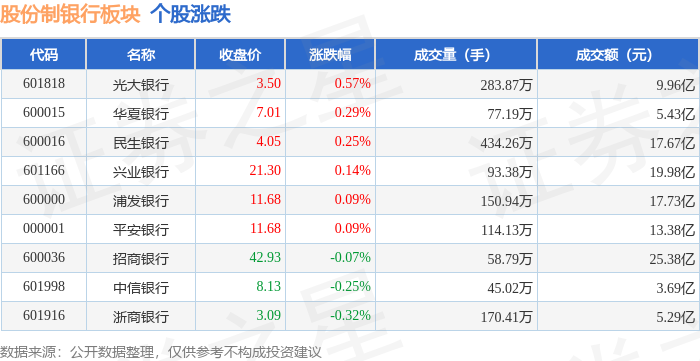
Market Overview - On November 12, the share price of the joint-stock bank sector increased by 0.04% compared to the previous trading day, with Everbright Bank leading the gains [1] - The Shanghai Composite Index closed at 4000.14, down 0.07%, while the Shenzhen Component Index closed at 13240.62, down 0.36% [1] Individual Bank Performance - Everbright Bank (601818) closed at 3.50, up 0.57% with a trading volume of 2.83 million shares and a transaction value of 996 million [1] - Huaxia Bank (600015) closed at 7.01, up 0.29% with a trading volume of 771,900 shares and a transaction value of 543 million [1] - Minsheng Bank (600016) closed at 4.05, up 0.25% with a trading volume of 4.34 million shares and a transaction value of 1.767 billion [1] - Industrial Bank (601166) closed at 21.30, up 0.14% with a trading volume of 933,800 shares and a transaction value of 1.998 billion [1] - Shanghai Pudong Development Bank (600000) and Ping An Bank (000001) both closed at 11.68, up 0.09% with transaction values of 1.773 billion and 1.338 billion respectively [1] - China Merchants Bank (600036) closed at 42.93, down 0.07% with a transaction value of 2.538 billion [1] - CITIC Bank (601998) closed at 8.13, down 0.25% with a transaction value of 369 million [1] - Zhejiang Commercial Bank (601916) closed at 3.09, down 0.32% with a transaction value of 529 million [1] Fund Flow Analysis - The joint-stock bank sector saw a net inflow of 681 million from main funds, while retail funds experienced a net outflow of 360 million [1] - The main fund inflow and outflow for individual banks showed varied results, with China Merchants Bank experiencing a main fund inflow of 2.86 billion, while retail funds saw a net outflow of 910 million [2] - Industrial Bank had a main fund inflow of 168 million and a retail fund outflow of 1.17 billion [2] - Everbright Bank had a main fund inflow of 65 million, with retail funds seeing a net outflow of 4.64 million [2]






银行行业:公募业绩基准改革引导配置均衡化,银行板块较受益
Dongxing Securities· 2025-11-12 08:21
Investment Rating - The industry investment rating is "Positive" [1] Core Viewpoints - The recent reform of public fund performance benchmarks is expected to guide balanced allocation, benefiting the banking sector [1][9] - The reform aims to enhance the stability of fund investment styles and improve the decision-making process for benchmark selection [2][3] - The banking sector is currently underweighted in active equity fund holdings, presenting a potential opportunity for reallocation as the new benchmarks are implemented [9] Summary by Sections Benchmark Selection and Management - The new guidelines require benchmarks to accurately reflect the investment style of funds, with a focus on compliance with investment objectives and strategies [2] - A comprehensive control mechanism for benchmark selection and monitoring is mandated, with accountability placed on management [2] - An independent department must monitor deviations from benchmarks, ensuring timely adjustments and oversight of fund managers [2] Impact Outlook - The selection and adjustment of benchmarks will become more precise, reflecting the true investment styles and strategies of funds [4] - The effective use of benchmarks is expected to stabilize fund investment behaviors and prevent style drift, correcting short-term investment tendencies [4] - The banking sector is currently underrepresented in active fund portfolios, with only 1.82% allocation compared to 12.5% in the CSI 300 index, indicating a potential for increased investment following the benchmark reforms [9] Market Dynamics - The banking sector is anticipated to benefit from the reform, as it encourages a more balanced allocation of funds, particularly in a low-interest-rate environment where high dividends remain attractive [9] - The fundamental resilience of banks is supported by stabilizing net interest margins and improving asset quality, suggesting a favorable outlook for valuation recovery in the banking sector [9]
数字经济行业周刊:支持政策持续强化,产业链生态加速完善
Chan Ye Xin Xi Wang· 2025-11-12 07:04
Group 1 - The State Council issued the "Implementation Opinions on Accelerating Scene Cultivation and Open Promotion of Large-Scale Application of New Scenes" to deploy relevant work [1] - The National Development and Reform Commission emphasized that scenes are key innovative resources connecting technology and industry, facilitating the integration of technological and industrial innovation [2][3] - The opinions outline major fields for scene cultivation and open paths, proposing measures to promote fair and efficient allocation of scenes [3] Group 2 - The Ministry of Industry and Information Technology plans to accelerate the cultivation of application scenarios in key areas such as "5G+", "Artificial Intelligence+", and "Industrial Internet+" [4] - The Ministry of Science and Technology will strengthen core technology breakthroughs to drive major scene cultivation and open up [5] - Local governments, such as Guangdong and Anhui, are developing specific policies and action plans to enhance scene innovation and application [6] Group 3 - The Ministry of Industry and Information Technology announced the launch of the 2025 Artificial Intelligence Industry and Empowering New-Type Industrialization Innovation Task [7] - The "Implementation Opinions on Promoting and Regulating the Application Development of 'Artificial Intelligence + Healthcare'" aims to enhance healthcare service capabilities through AI [8][10] Group 4 - The construction of national data infrastructure has made significant progress, with over 13,000 data products provided and more than 3,900 entities involved [25] - The digital economy cooperation conference in Zhejiang signed over 100 projects, with a total amount exceeding 100 billion yuan, highlighting the province's leadership in the digital economy [33] Group 5 - The establishment of the Artificial Intelligence College at Yanshan University marks a significant step in AI education and research [59] - Ant Group received four Internet Light Awards at the World Internet Conference, showcasing its capabilities in transforming AI technology into industrial value [60]

京东支付11.11放大招:支付免单、银行特惠、积分抵现激发消费新动力
Zhong Jin Zai Xian· 2025-11-12 06:31
Core Insights - JD.com achieved a record high transaction volume during the 2025 11.11 shopping festival, simplifying promotional strategies to enhance consumer shopping experiences [1] Payment Experience - JD.com Payment collaborated with over 80,000 merchants and more than 120 banks, offering various benefits such as "payment waivers," cash back, and discounts using digital RMB, leading to a 40% year-on-year increase in quick payment transaction volume [1] - The number of JD.com Payment users reached 650 million, with nearly 10 million users participating in the "payment waiver" activity [1][4] - The "post-payment cash back" initiative significantly boosted sales, with transaction volumes for partnered products doubling year-on-year [1] Bank Marketing Strategies - The 11.11 shopping event saw diverse bank marketing strategies, enhancing user engagement and transaction volumes through initiatives like "bank category days" and "credit card points redemption" [5][6] - Specific promotional days were created in collaboration with various banks, offering exclusive discounts and incentives, which resulted in an average order volume increase of over 138% for participating banks [8] Credit Card Points Utilization - The integration of credit card points for cash redemption on JD.com has expanded, allowing users to effectively utilize previously idle points, with over 30 million users having access to this feature [9] - During the 11.11 event, the number of transactions using points redemption doubled year-on-year, with a 70% increase in transaction volume [9] Digital RMB Adoption - The use of digital RMB has gained traction, with JD.com promoting its adoption through various discounts and campaigns, resulting in an 80% year-on-year increase in user activity and transaction volume [10] Collaborative Ecosystem - JD.com Payment has expanded its partnerships across various sectors, enhancing payment options in travel, dining, and e-commerce, creating a positive feedback loop that benefits users, banks, and the platform [11]



已有7家银行私银客户超10万户
2 1 Shi Ji Jing Ji Bao Dao· 2025-11-12 05:45
Core Insights - The private banking sector has seen significant growth in the first three quarters of this year, with seven listed banks reporting over 100,000 private banking clients as of September 30, 2023, indicating a rising demand for wealth management services among high-net-worth individuals [2][4][5] Group 1: Growth in Private Banking Clients - Multiple banks reported a client growth rate exceeding 10%, with Minsheng Bank, Beijing Bank, and Nanjing Bank showing increases over 15% [4] - Minsheng Bank had the fastest growth, reaching 73,409 private banking clients, an increase of 18.21% from the end of last year [5] - Beijing Bank reported 20,586 private banking clients, up 17.9%, and an asset under management (AUM) of 224 billion yuan, a 14.39% increase [5][6] Group 2: Market Position of Major Banks - State-owned banks continue to dominate the private banking market, with Agricultural Bank of China leading at 279,000 clients, followed by China Construction Bank and Bank of China [6] - China Merchants Bank and Ping An Bank have also joined the "100,000 club," with Ping An Bank reaching 103,300 clients, marking its first entry into this category [6][7] Group 3: Challenges and Opportunities in Wealth Management - The growth in private banking clients is attributed to the expanding base of high-net-worth individuals and the upgrading of banking services [9] - The Hu Run Wealth Report indicates that the total wealth of China's 6 million affluent families has reached 150 trillion yuan, with ultra-high-net-worth families holding 87 trillion yuan, an increase from 56% to 58% of total wealth [9] - The private banking sector is facing challenges such as economic shifts, declining risk-free returns, and reduced investor confidence, necessitating a transformation in wealth management services [10][11]






不良资产处置“大年”持续,金融风险“堰塞湖”加速排解
Zheng Quan Shi Bao Wang· 2025-11-12 05:41
Core Insights - The Chinese banking sector has entered a significant asset disposal phase in the second half of this year, with various institutions accelerating the clearance of long-standing non-performing loans through market-oriented methods such as transfer listings and packaged sales [1][2] - The scale of asset packages being listed has expanded dramatically, with some institutions offering packages worth hundreds of billions, indicating a new norm in the financial market for the fourth quarter [1] - The demand for financial risk resolution is expected to grow, leading to an increase in the supply of non-performing assets, marking a continued "big year" for asset disposal [1][2] Group 1: Factors Driving Asset Disposal - Multiple factors are contributing to the current wave of asset disposals, including macroeconomic pressures, weakened recovery capabilities in certain industries, and increased regulatory scrutiny on asset quality and capital adequacy [2] - As of June this year, the balance of non-performing loans in commercial banks was 3.43 trillion yuan, with a non-performing loan ratio of 1.49%, indicating ongoing pressure to manage these assets [2] Group 2: Market Dynamics and Trends - The market for personal consumer non-performing loans has seen explosive growth this year, significantly accelerating the overall disposal process [3] - In the first quarter of this year, the scale of personal consumer loans and credit card overdrafts reached 268.2 billion yuan and 51.9 billion yuan respectively, with personal consumer loans accounting for 72.4% of the total [3] Group 3: Impact on Banking Institutions - The accelerated disposal of non-performing assets is expected to improve banks' capital adequacy ratios and profitability metrics [4] - Large-scale disposals can directly reduce non-performing loan ratios and provisioning requirements, thereby enhancing asset quality and freeing up capital for new loans [4][5] Group 4: Regulatory and Systemic Implications - The regulatory environment is focused on preventing systemic financial risks, with measures to enhance asset disposal and capital replenishment efforts [7] - The current wave of concentrated asset disposals is seen as necessary for maintaining the stability of the banking sector and preventing a "dam" of non-performing loans from impacting credit availability in the economy [7][8]
已有7家银行私银客户超10万户
21世纪经济报道· 2025-11-12 05:38
Core Insights - The private banking business has seen significant growth in the first three quarters of this year, with seven listed banks surpassing 100,000 private banking clients as of September 30, 2023, driven by the increasing number of high-net-worth individuals and evolving wealth management needs [1][3][6] Growth of Private Banking Clients - Several banks reported a client growth rate exceeding 10%, with Minsheng Bank, Beijing Bank, and Nanjing Bank showing increases over 15%. Minsheng Bank led with an 18.21% growth, reaching 73,409 clients [3][6] - Beijing Bank's private banking clients grew by 17.9% to 20,586, with total assets under management (AUM) increasing by 14.39% to 224 billion yuan [3][6] - Nanjing Bank also reported a 15.43% increase in private banking clients [3] Dominance of State-Owned Banks - State-owned banks continue to lead in absolute numbers, with Agricultural Bank of China having 279,000 clients, followed by China Construction Bank with 265,500 clients [4] - China Merchants Bank and Ping An Bank have also joined the "100,000 club," with Ping An Bank reaching 103,300 clients, marking its first time surpassing this threshold [4][6] Market Dynamics and Competition - The private banking market is characterized by a competitive landscape where state-owned banks leverage their scale, while joint-stock banks focus on differentiated services and operational efficiency [7] - The growth of high-net-worth individuals is expected to drive competition towards service quality and asset allocation capabilities [7] Challenges in Wealth Management - The wealth management sector faces three main challenges: economic growth slowdown, declining risk-free returns, and reduced investor confidence [10][11] - Banks are urged to upgrade their wealth management services to meet clients' real needs and utilize various financial tools for comprehensive solutions [11] Changing Client Demographics - The core client base for private banking is shifting from traditional business owners to new economy groups, with a notable increase in demand for comprehensive wealth management services [9] - Banks are redefining their target clients based on their strengths, with some focusing on family wealth transfer and others on retirement financial management [9]


首次,有银行取消五年期定期存款产品,还下调了其他期限的利率,什么情况?
Mei Ri Jing Ji Xin Wen· 2025-11-12 03:28
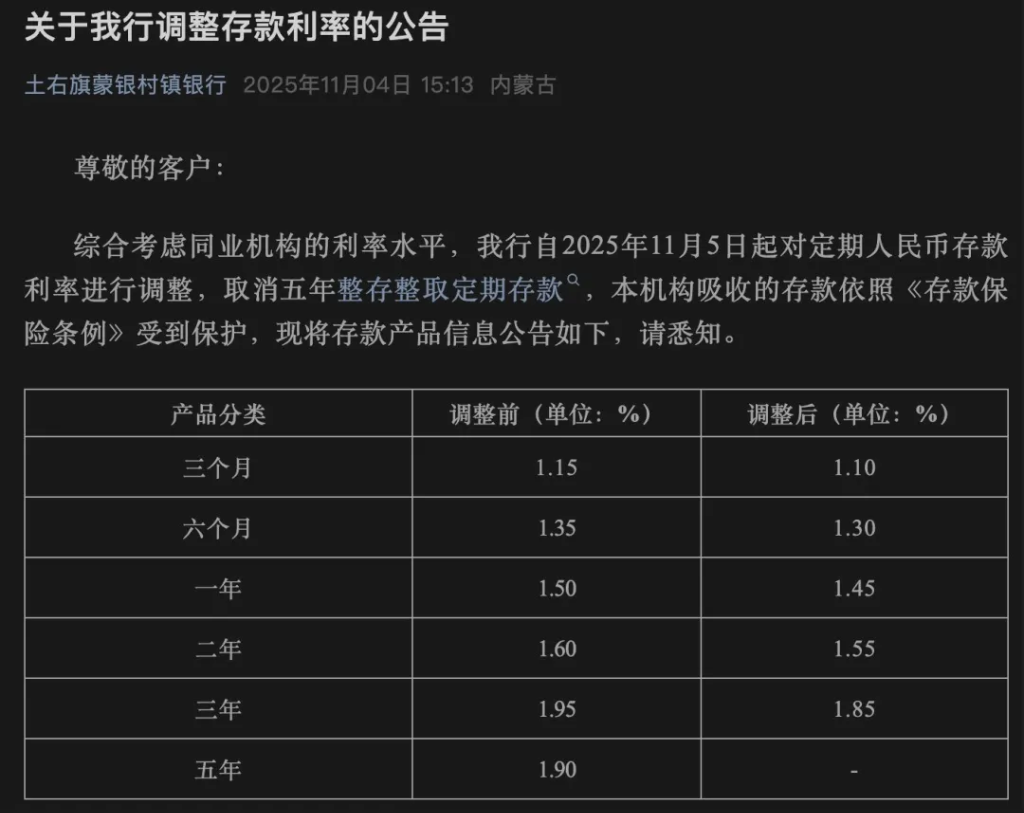
Core Viewpoint - The announcement by Inner Mongolia's Tuyuqi Mengyin Village Bank to cancel its five-year fixed deposit product starting November 5, 2025, marks a significant shift in the banking industry, reflecting ongoing pressure on net interest margins and prompting other banks to adjust their deposit rates and products accordingly [1][5][12]. Summary by Category Product Adjustments - Tuyuqi Mengyin Village Bank is the first commercial bank to explicitly announce the removal of the five-year fixed deposit product, alongside lowering interest rates for other deposit terms [1][5]. - The bank has reduced the interest rates for various deposit terms: three-month from 1.15% to 1.10%, six-month from 1.35% to 1.30%, one-year from 1.50% to 1.45%, two-year from 1.60% to 1.55%, and three-year from 1.95% to 1.85% [3][6]. - Similar actions have been observed in other banks, with some private banks reporting "sold out" or removal of mid to long-term deposit products [1][7]. Market Context - The adjustments in deposit products are a response to the persistent pressure on net interest margins faced by banks, particularly smaller banks that are more sensitive to funding costs [4][8]. - The overall trend shows that many banks are actively lowering deposit rates to manage their liabilities and improve their financial stability amid a challenging interest rate environment [7][9]. Implications for the Banking Sector - The cancellation of long-term deposit products and the reduction of interest rates are seen as proactive measures by banks to optimize their balance sheets and mitigate the impact of declining asset yields [11][12]. - This shift may lead to a "deposit migration" effect, where funds move from traditional bank deposits to capital markets, potentially increasing liquidity in stocks, bonds, and funds [12][13]. - Analysts suggest that the market is witnessing a more pronounced adjustment mechanism for deposit rates, indicating a trend towards stabilizing net interest margins in the banking sector [13].
银行ETF指数(512730)涨近1%,险资加力布局银行板块
Xin Lang Cai Jing· 2025-11-12 02:22
Group 1 - The China Banking Index (399986) increased by 0.86% as of November 12, 2025, with notable gains from Agricultural Bank (601288) up 2.65%, Chongqing Rural Commercial Bank (601077) up 2.01%, and others [1] - As of Q3 2025, insurance capital's holding in banks was at 27.95%, with a market value accounting for 3.99% of the circulating A-shares, reflecting a decrease of -0.29 percentage points and -2.52 percentage points respectively from the previous quarter [1] - Insurance capital increased its holdings by 8.36 billion shares in the banking sector, with 23 banks being allocated by insurance capital as of the end of September, an increase of 2 banks from the previous quarter [1] Group 2 - China Galaxy Securities noted that factors such as new premium inflows, increased equity investment ratios, and strengthened long-term assessments provide room for growth in insurance capital's allocation to the banking sector [1] - The banking sector is favored for its stable dividends and low valuation, with a continued advantage in dividend yield [1] - The top ten weighted stocks in the China Banking Index as of October 31, 2025, accounted for 64.87% of the index, including major banks like China Merchants Bank (600036) and Industrial and Commercial Bank of China (601398) [2]