
成都银行

Search documents
银行转债存量“缩编”机构底仓资产如何腾挪
Zhong Guo Zheng Quan Bao· 2025-07-08 20:50
Core Viewpoint - The banking sector has shown strong performance in 2023, leading to a significant increase in bank convertible bonds, with many set to exit the market, raising questions about asset allocation for institutional investors [1][2][3]. Group 1: Market Dynamics - Several bank convertible bonds, including Hangzhou Bank and South Bank, have completed their market conversion and delisting, with a total estimated reduction of around 100 billion yuan in bank convertible bonds this year [1][2]. - The strong redemption mechanism of convertible bonds is closely linked to the performance of the underlying bank stocks, which have been rising recently [1][2]. - The total outstanding convertible bonds as of July 8 was approximately 664.65 billion yuan, a decrease of 68.98 billion yuan since the beginning of the year, with projections suggesting it may fall below 600 billion yuan by the end of the year [3][6]. Group 2: Institutional Investment Trends - Convertible bonds have become a key asset in the "fixed income plus" strategy for asset management products, with institutions increasingly favoring them due to their low volatility and high returns [3][4]. - The demand for bank convertible bonds remains high due to their strong credit quality and risk resistance, despite a slowdown in new issuances [3][4]. - Institutions are now seeking to diversify their asset allocation strategies, looking for alternative high-yielding base assets as the supply of convertible bonds decreases [5][7]. Group 3: Future Outlook - The shrinking supply of bank convertible bonds and the ongoing demand may lead to a situation where valuations become difficult to maintain, prompting institutions to explore other investment opportunities [6][7]. - Analysts suggest that the current market conditions may create short-term trading opportunities in bank convertible bonds, despite their high valuations [6][7]. - The focus may shift towards convertible bond ETFs and other asset classes like REITs and thematic ETFs as institutions adapt to the changing market landscape [6][7].


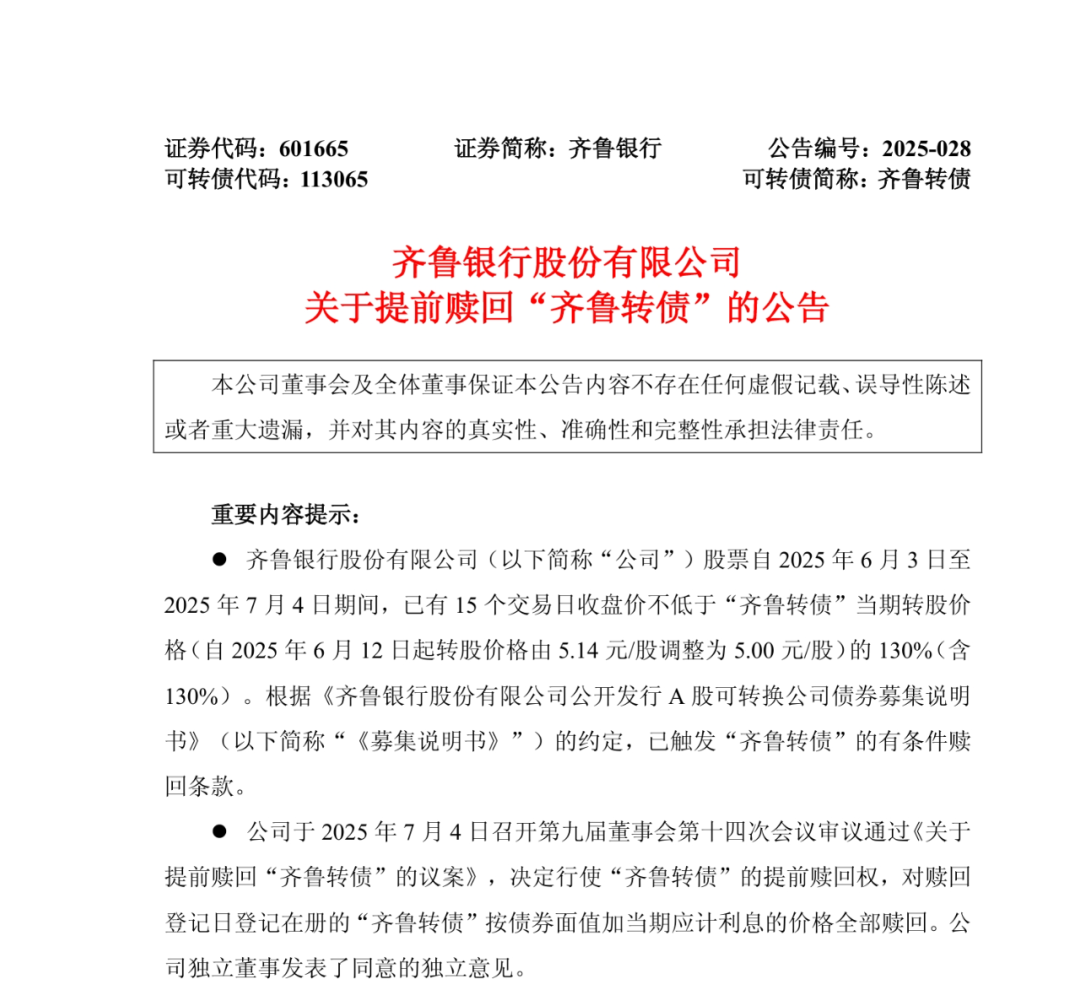
年内第5只!又有银行可转债触发强赎
Jin Rong Shi Bao· 2025-07-08 13:41
Core Viewpoint - Qilu Bank has triggered the conditional redemption clause for its convertible bonds, indicating a strong performance in its stock price, which has implications for investors holding these bonds [1][3]. Summary by Sections Qilu Bank's Convertible Bonds - Qilu Bank announced on July 4 that its "Qilu Convertible Bonds" have triggered the conditional redemption clause, allowing the bank to exercise its early redemption rights [1]. - The stock price of Qilu Bank has been above 130% of the adjusted conversion price of 5.00 CNY per share for 15 trading days, leading to this decision [1][3]. Investor Options and Market Context - Investors holding "Qilu Convertible Bonds" can either trade them in the secondary market or convert them at the price of 5.00 CNY per share, but those who hold until forced redemption may face significant losses [3]. - The recent strength in the A-share banking sector has led to multiple banks' convertible bonds triggering forced redemptions, including those of Hangzhou Bank and Nanjing Bank [3][4]. Broader Market Trends - The banking sector has shown strong performance in the secondary market, with the Shenwan Primary Bank Index rising over 17.77% year-to-date, ranking second among 31 primary industry indices [4]. - The downward adjustment of conversion prices has made it easier for bank convertible bonds to trigger redemption clauses, further enhancing expectations for forced redemptions [5]. Capital Structure and Investor Sentiment - Convertible bonds are increasingly seen as a means for banks to optimize their capital structure and enhance capital strength, with early redemption signaling good financial health and stability [6]. - The completion of conversions from convertible bonds can significantly improve a bank's core Tier 1 capital adequacy ratio, reducing the urgency for refinancing [6].


天风MorningCall·0708 | 策略-中观景气度/固收-转债/银行-国有大行“村支改”
Xin Lang Cai Jing· 2025-07-08 11:20
Group 1 - The overall industry sentiment shows an upward trend in coal, machinery, electronics, food and beverage, textiles, non-bank financials, public utilities, and retail, while electricity equipment, pharmaceuticals, light manufacturing, home appliances, automotive, banking, real estate, and environmental protection are on a downward trend [1] - The automotive sector sees a significant increase in daily sales of passenger cars by 18.44%, but the operating rate of semi-steel tires has decreased by 7.64 percentage points [1] - The machinery equipment sector reports a 4.65% increase in the ex-factory price of liquid oxygen [1] Group 2 - The convertible bond market experienced a decline this week, with the weighted average conversion value increasing to 94.08 yuan, up by 2.58 yuan from last week, and the weighted average premium rate decreasing by 2.77 percentage points to 45.56% [4] - There is a recommendation to focus on convertible bond downshift opportunities, particularly as recent downshift proposals have seen significant price increases [4] Group 3 - The reform and risk mitigation of village and town banks is a key focus for financial work in 2024, with over 50 village banks undergoing mergers and restructuring in the first half of the year [5] - The overall performance of banks remains stable, with investment value supported by high valuations and policy benefits [5] Group 4 - Lens Technology and Luxshare Precision are planning to list in Hong Kong, enhancing their global presence, while the US-Vietnam trade agreement is expected to lower supply chain costs for Apple [8] - The upcoming release of Nvidia's GB300 AI chip is anticipated to significantly boost revenue opportunities, with AI server revenue expected to exceed 50% [8] Group 5 - The instant beverage market is projected to grow significantly, with China's per capita consumption still having room for improvement [17] - IFBH's successful IPO and strong revenue growth highlight its leading position in the coconut water market, which is expected to continue expanding [17] Group 6 - The cement supply-side reform focuses on eliminating excess capacity, with a current utilization rate of only 53%, indicating potential for improvement [20] - The electronic cloth sector is experiencing a positive outlook due to increased demand driven by computing power expectations [20]

成都银行: 成都银行股份有限公司关于实际控制人控制的股东增持计划进展公告
Zheng Quan Zhi Xing· 2025-07-08 11:14
Summary of Key Points Core Viewpoint - Chengdu Bank's actual controller, Chengdu State-owned Assets Supervision and Administration Commission, plans to increase its stake through two subsidiaries, but the implementation has been delayed due to stock price exceeding the set limit [1][2][3]. Group 1: Shareholding Increase Plan - Chengdu Bank's actual controller, Chengdu State-owned Assets Supervision and Administration Commission, through Chengdu Industrial Capital Holding Group and Chengdu Xintianyi Investment, plans to increase its shareholding starting from April 9, 2025, for a period of six months [1][3]. - The maximum purchase price is set at 17.59 yuan per share, which is the historical highest price after the ex-dividend date [1][3]. - The total number of shares to be acquired is capped at 79,588,706 shares, representing no more than 1.878% of Chengdu Bank's total shares [1][3]. Group 2: Implementation Progress - As of the announcement date, the time frame for the shareholding increase plan is over half completed, but no shares have been purchased due to the stock price consistently exceeding the upper limit [1][3]. - The two entities will continue to monitor stock price fluctuations and market trends to determine the timing for the share purchase [1][3]. Group 3: Shareholding Background - Prior to this announcement, Chengdu Industrial Capital Group and Chengdu Xintianyi held a combined total of 1,272,731,998 shares, accounting for 30.03% of Chengdu Bank's total shares [2][3]. - In the twelve months preceding this announcement, the two entities had increased their holdings by 5,180,000 shares, which is 0.13% of the total shares as of December 10, 2024 [2][3]. Group 4: Regulatory Compliance - The shareholding increase plan complies with relevant laws and regulations, including the Securities Law and the Shanghai Stock Exchange listing rules [4]. - During the implementation of this plan, the Chengdu State-owned Assets Supervision and Administration Commission has committed not to reduce its holdings in Chengdu Bank [4].

成都银行(601838) - 成都银行股份有限公司关于实际控制人控制的股东增持计划进展公告
2025-07-08 10:15
证券代码:601838 证券简称:成都银行 公告编号:2025-038 成都银行股份有限公司 关于实际控制人控制的股东增持计划进展公告 本公司董事会及全体董事保证本公告内容不存在任何虚假记载、 误导性陈述或者重大遗漏,并对其内容的真实性、准确性和完整性承 担法律责任。 重要内容提示: 已披露增持计划情况: 成都银行股份有限公司(以下简称"成都银行")于 2025 年 4 月 9 日披露了《成都银行股份有限公司关于实际控制人控制的股东增持 计划公告》,成都银行实际控制人成都市国有资产监督管理委员会(以 下简称"成都市国资委")实际控制的企业成都产业资本控股集团有 限公司(以下简称"成都产业资本集团")、成都欣天颐投资有限责任 公司(以下简称"成都欣天颐"),拟自 2025 年 4 月 9 日起 6 个月内, 通过上海证券交易所系统以集中竞价等合法合规方式增持成都银行 A 股普通股股份。增持价格不超过截至增持计划公告披露日成都银行 除权除息后的历史最高股价 17.59 元/股,在上述增持价格上限范围内, 两家增持主体拟增持的股份数量合计不超过 79,588,706 股,占成都银 行股份总数(4,238,435,3 ...
银行深度:历次存款整改和利率下调回顾与复盘
China Post Securities· 2025-07-08 09:44
Industry Investment Rating - The industry investment rating is maintained at "Outperform" [1] Core Insights - The report discusses the impact of deposit rate adjustments on banks, indicating that the adjustments have a limited impact on financial outflows [4][7] - The establishment of a market-oriented deposit rate adjustment mechanism aims to align deposit rates with market rates, thereby reducing banks' funding costs and facilitating lower loan rates [14][17] - The report highlights a significant shift in deposit structures due to regulatory changes, with a notable migration of deposits from large banks to smaller banks and non-bank financial institutions [6][37] Summary by Sections 1. Reasons for Deposit Rate Adjustments - The adjustments are aimed at promoting interest rate marketization and improving policy transmission, breaking the rigid link between deposit rates and benchmark rates [4][14] - The adjustments are expected to lower banks' funding costs, which constitute over 70% of their liabilities, thereby creating room for loan rate reductions [17][18] 2. Review of Past Adjustments - Historical adjustments include the reduction of structured deposits from CNY 15.4 trillion to zero between 2019 and 2020, and the optimization of deposit rate ceilings in June 2021 [5][22] - The establishment of a market-oriented adjustment mechanism in April 2022 has led to multiple rounds of deposit rate reductions, with long-term deposit rates decreasing more than short-term rates [23][24] 3. Market Impact Review - The report notes that during the initial adjustment phases, there was a significant outflow of structured deposits to wealth management and insurance products [6][37] - The adjustments have generally resulted in a shift of deposits from large banks to smaller banks, as well as a migration towards wealth management and insurance products [6][37] 4. Future Outlook and Investment Recommendations - The report anticipates a significant volume of maturing fixed-term deposits in the third quarter, with potential outflows to non-bank institutions [7] - It suggests focusing on banks that may benefit from reduced funding costs and improved net interest margins, highlighting specific banks such as Bank of Communications and Chongqing Bank as potential investment targets [7]



四川首例村镇银行“村改分”落地! 成都银行雅安分行挂牌
Zhong Guo Jing Ji Wang· 2025-07-08 09:20
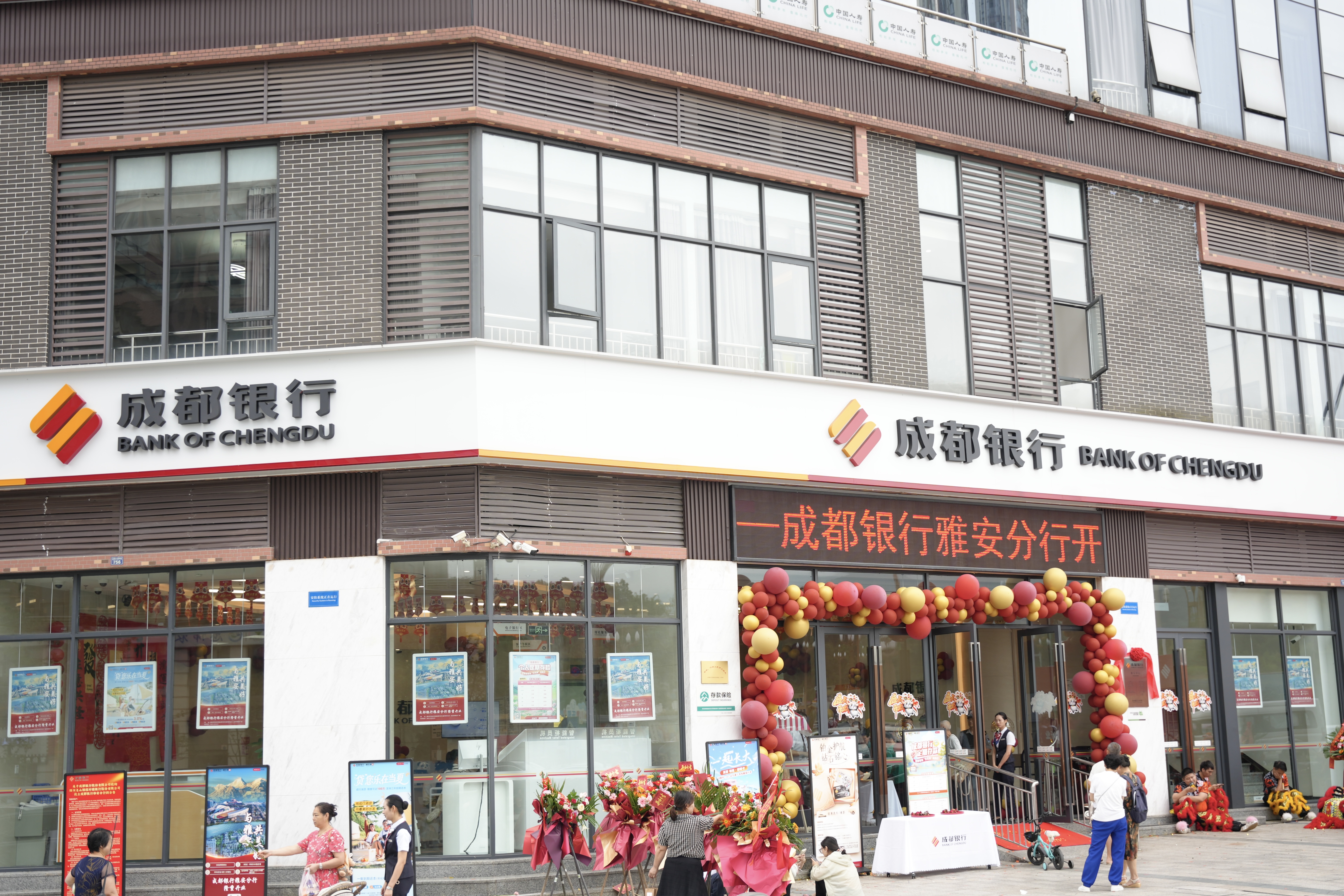
Core Viewpoint - The establishment of Chengdu Bank's Ya'an branch marks the first transformation of a village bank into an urban commercial bank branch in Sichuan, aimed at enhancing inclusive financial services and supporting regional economic development through strategic integration with local resources and national initiatives [1][4]. Group 1: Establishment and Purpose - Chengdu Bank's Ya'an branch officially opened on July 8, 2023, after a year-long restructuring process from the original Mingshan Jincheng Village Bank [4]. - The new branch will focus on bridging the financial service gap in rural areas and leverage opportunities from the Sichuan-Tibet Railway and the Sichuan-Tibet Economic Cooperation Experimental Zone [1][3]. Group 2: Strategic Integration and Development - The branch aims to integrate local resources and national strategies, enhancing its role as a "financial main force" in supporting the local economy [5][7]. - The transformation from a village bank to a branch of Chengdu Bank allows for greater business permissions, improved service capabilities, and a broader operational scope [5][6]. Group 3: Economic and Environmental Focus - Ya'an is rich in natural resources, with a forest coverage rate exceeding 69%, and is positioned as a key area for green development and ecological tourism [7]. - The branch will support core industries such as big data, advanced materials, and high-end equipment manufacturing, while also promoting clean energy and environmental sustainability [8]. Group 4: Financial Products and Services - The branch will implement inclusive financial products like "Tianfu Industry Loan" and "Huiqi Loan" to better serve small and micro enterprises, simplifying approval processes and lowering barriers [8]. - Chengdu Bank's digital transformation initiatives will enhance the operational efficiency and risk management capabilities of the Ya'an branch, providing a more accessible and user-friendly banking experience [8].
成都银行已完成对“名山村镇银行”的收购
Jin Tou Wang· 2025-07-08 03:19
Core Points - Chengdu Bank has completed the acquisition of Sichuan Mingshan Jincheng Village Bank, approved by the Sichuan Regulatory Bureau of the National Financial Supervision Administration [1] - Mingshan Village Bank will be dissolved, and all its business assets, liabilities, and rights will be inherited by Chengdu Bank's Yaan Branch [1] Group 1: Service Transition - Customers of the former Mingshan Village Bank can continue their banking services at Chengdu Bank's Yaan Branch, with existing accounts and cards remaining valid [2] - Customers will need to replace their passbooks, while personal business media can be exchanged at any Chengdu Bank outlet [2] - Company-related business media must be replaced at the original account opening location [2] Group 2: Yaan Branch Information - Chengdu Bank's Yaan Branch is located at 756 Huangcha Avenue, Mingshan District, Yaan City, with a contact number of 0835-3225528 [3] - The branch will operate under the supervision of the People's Bank of China Yaan Branch and the Sichuan Regulatory Bureau to protect the rights of depositors and other clients [3]
中小银行积极补充资本满足监管要求
Jin Rong Shi Bao· 2025-07-08 01:13
Core Viewpoint - The demand for capital replenishment among small and medium-sized banks is increasing, with a significant acceleration in the issuance of subordinated and perpetual bonds in the first half of the year [1][2][3]. Group 1: Capital Replenishment Trends - In the first half of 2025, commercial banks issued a total of 52 subordinated and perpetual bonds, amounting to 812.56 billion yuan, a 3.4% increase compared to the same period last year [1]. - Small and medium-sized banks issued 33 subordinated and perpetual bonds, totaling 154.56 billion yuan, representing a 50% year-on-year growth, significantly higher than the industry average [1][2]. - Recent issuances include Sichuan Bank's 6.6 billion yuan bond at a 2.15% interest rate and Xi'an Bank's 5 billion yuan perpetual bond [1]. Group 2: Regulatory Environment and Approval - The National Financial Regulatory Administration has approved several banks, including Shanxi Bank and Chengdu Bank, to issue capital tools, with approval limits of up to 9.5 billion yuan and 11 billion yuan respectively [2]. - Lanzhou Bank is set to issue a 4 billion yuan perpetual bond, marking the first perpetual bond issuance by a commercial bank in July [2]. Group 3: Capital Adequacy and Challenges - As of Q1 this year, the capital adequacy ratios for city commercial banks, private banks, and rural commercial banks were 12.44%, 11.98%, and 12.96% respectively, compared to 17.79% and 13.71% for state-owned and national joint-stock banks [3]. - Small and medium-sized banks face pressure to expand capital and are increasingly turning to subordinated bonds to quickly enhance their capital adequacy ratios [3]. Group 4: Capital Supplementation Methods - Capital replenishment for banks includes both internal and external sources, with internal sources primarily being retained earnings and external sources including IPOs, rights issues, and subordinated bonds [3][4]. - The issuance of perpetual bonds is seen as a significant method for banks to optimize their capital structure and meet regulatory requirements [2][3]. Group 5: Market Dynamics and Investor Sentiment - Historically, the issuance of perpetual bonds by small and medium-sized banks has been limited due to high regulatory thresholds and market skepticism regarding credit risks [6]. - The approval of perpetual bonds for private banks, such as the 4 billion yuan issuance by WeBank, indicates a potential shift in market dynamics [5][6]. Group 6: Future Outlook - With ongoing regulatory improvements, the capital replenishment channels for private and small banks are expected to diversify, leading to a more robust capital replenishment system [7].
银行投资跟踪:国有大行推进“村改支”的启示
Tianfeng Securities· 2025-07-07 08:13
Investment Rating - The industry investment rating is "Outperform the Market" (first rating) [1] Core Insights - The reform of rural banks is a key focus for financial work this year, with significant risks identified in small and medium-sized banks, particularly in economically weaker regions [2][5] - Since 2024, the reform of rural banks has accelerated, with over 50 banks undergoing mergers and restructuring in the first half of the year [2][8] - The main reform paths for rural banks include "village to branch" (村改支), "village to division" (村改分), and equity transfer [9][11] - The acquisition of rural banks by state-owned banks is a crucial strategy for risk mitigation, with the Industrial and Commercial Bank of China (ICBC) leading the way [12][14] - Financial indicators for state-owned banks remain robust, and the impact of participating in rural bank reforms on their operations is relatively limited [16][21] Summary by Sections Section 1: Background and Policy Requirements - The economic restructuring and external uncertainties have led to deteriorating asset quality and increased credit risks in small banks, necessitating urgent risk resolution [5] - As of Q1 2025, the non-performing loan ratio of rural commercial banks is 1.35 percentage points higher than the average for commercial banks, indicating significant asset quality pressure [5] Section 2: Recent Developments in Rural Bank Reforms - The first half of 2024 saw a rapid pace of rural bank reforms, with over 50 banks merged or restructured [2][8] - The regulatory authority has issued approximately 20 approvals for mergers and dissolutions of rural banks in December 2024, a significant increase from the previous year [8] Section 3: Financial Health of State-Owned Banks - Key financial metrics for state-owned banks as of Q1 2025 show stability, with non-performing loan ratios and provision coverage ratios indicating a strong financial position [15] - The potential impact of acquiring "red zone" banks on the overall non-performing loan ratio is minimal, with estimated increases of only 4 to 8 basis points depending on the acquisition percentage [17][18] Section 4: Investment Implications - The current performance of banks is stable, presenting investment opportunities, particularly in high-yield dividend stocks [21] - The anticipated policy support and strong capital positions of state-owned banks further enhance their investment attractiveness [21]



