千禾味业

Search documents
看穿商标和营销的“文字游戏”丨2025消费问题高发区⑦
Xin Jing Bao· 2025-12-30 11:41
Core Viewpoint - The article highlights the misleading marketing practices in the food industry, where products are often misrepresented through names, concepts, and branding, leading to consumer confusion and potential health risks [1][2][4]. Misleading Product Names - Many food products are marketed under names that do not accurately reflect their content or quality, such as "edible raw eggs" which may not be safe for consumption as claimed [2][3]. - The term "cordyceps egg" is often misleading, as it refers to feed containing insects and grass rather than the well-known medicinal cordyceps [4]. Misleading Marketing Concepts - Products labeled with "new concepts" often do not deliver on their health claims, with many nutritional benefits being overstated or based on minimal ingredient presence [11][12]. - For example, some fish sausages marketed for their DHA content may actually contain little to no real fish, misleading consumers about their nutritional value [11][12]. Brand Confusion and Trademark Issues - Companies are using "near-brand" trademarks to confuse consumers, such as "Oriental Refreshing Tea" mimicking the branding of "Oriental Leaf," leading to potential legal disputes [14][15]. - The practice of "riding on the coattails" of established brands through similar names or packaging is prevalent, with companies facing legal challenges for trademark infringement [15][16]. Regulatory and Consumer Rights - Consumers have the right to know the true characteristics of the products they purchase, and misleading packaging can violate consumer protection laws [10]. - New regulations are being introduced to prevent misleading claims such as "zero additives," which have been misused in marketing [10]. Recommendations for Consumers - Consumers are advised to scrutinize ingredient lists and nutritional information rather than relying solely on product names and marketing claims [5]. - There is a call for the establishment of clearer national standards to regulate misleading marketing practices in the food industry [5].
2025年A股十大最惨板块,跌麻了
Ge Long Hui· 2025-12-30 11:30
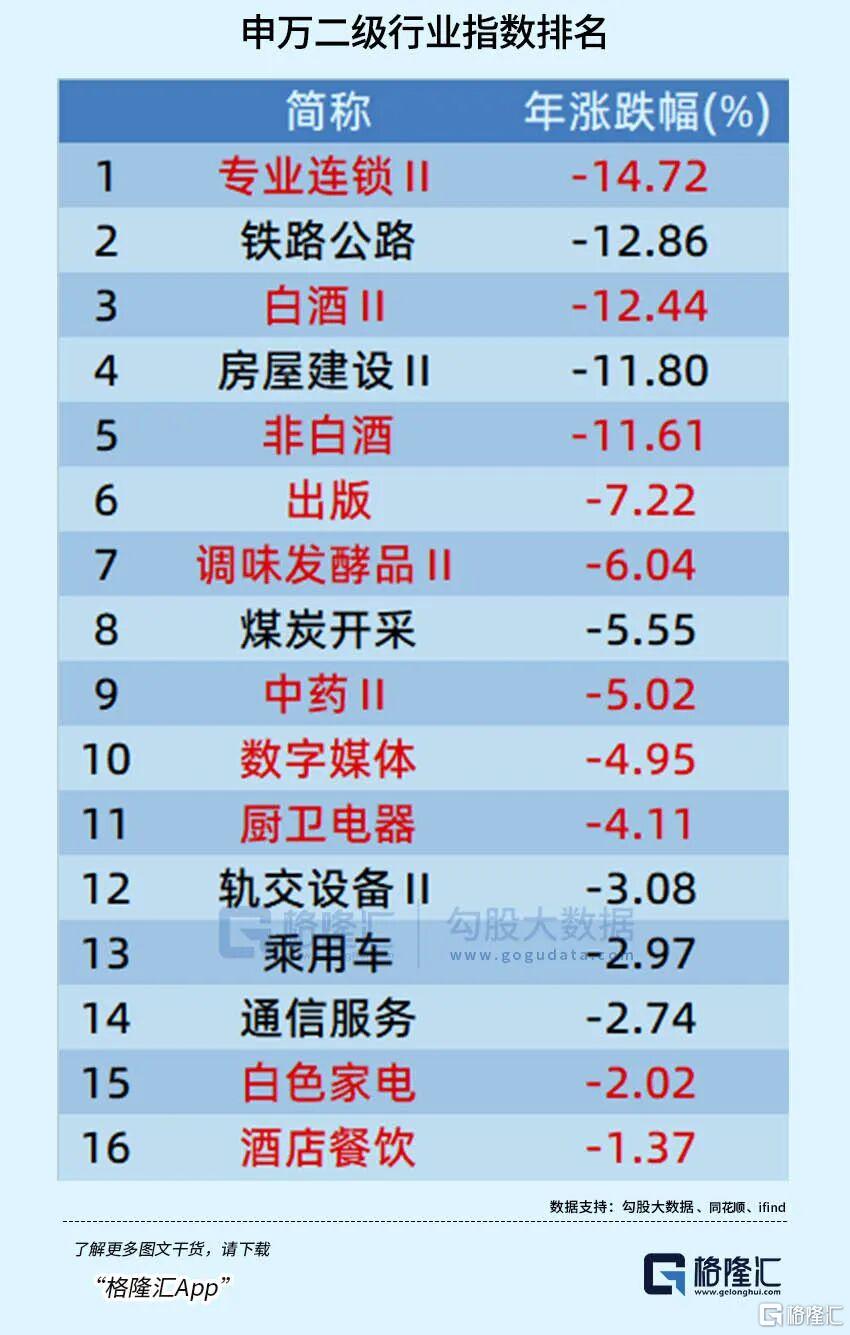
Core Viewpoint - The consumer sector has faced significant challenges in the past year, with many sub-sectors experiencing declines despite overall market growth. The focus on domestic demand and consumption has not translated into positive performance for many consumer-related industries [1][5]. Consumer Sector Performance - In the first half of the year, 10 out of 16 declining industries were from the consumer sector, indicating a broader trend of underperformance [1]. - The white liquor sector, a key component of the consumer market, has seen a year-to-date decline of 12.44%, with major brands like Wuliangye experiencing significant drops in revenue and profit [6][9]. - The professional chain sector has been particularly hard-hit, with a year-to-date decline of 14.72%, exemplified by the struggles of companies like Renrenle [16][20]. White Liquor Sector - The white liquor industry is facing its eighth consecutive year of production decline, with both volume and price dropping simultaneously [10]. - Wuliangye reported a 10.26% decline in revenue and a 13.72% drop in net profit for the first three quarters, marking its first negative growth in a decade [9]. - The industry is shifting from a growth-driven model to one focused on consumer choice, with a need for companies to adapt to changing consumer preferences [15]. Professional Chain Sector - The professional chain sector is experiencing a crisis, with many physical stores closing and traditional business models failing [16][20]. - Renrenle, once a leading private supermarket, has seen its market value plummet and is now facing delisting due to ongoing financial struggles [21][24]. - The shift towards online shopping and personalized consumer demands has further exacerbated the challenges faced by traditional retail chains [24][25]. Non-White Liquor Sector - The non-white liquor sector, including beer and wine, has also faced declines, with the beer segment seeing a notable drop in sales and profits [27][32]. - Budweiser APAC reported an 8.2% decline in domestic sales and a 24.4% drop in net profit, reflecting broader industry challenges [32][33]. - The market is witnessing a trend of cross-industry competition, with liquor companies diversifying into new beverage categories [34]. Publishing Sector - The publishing industry has shown resilience despite a 10.4% decline in the overall market for printed books, with listed companies managing to increase net profits by 14.65% [43][44]. - However, leading companies like Zhongwen Media are struggling, with significant revenue and profit declines due to changes in educational material procurement policies [45][48]. Seasoning Sector - The seasoning industry has faced a 6.04% decline, with companies like Qianhe Flavor struggling due to falling revenues and a loss of consumer trust [51][55]. - The industry is experiencing a shift in consumer preferences and increased competition, necessitating a reevaluation of business strategies [60]. Traditional Chinese Medicine Sector - The traditional Chinese medicine sector is facing challenges, with companies like Pian Zai Huang reporting significant declines in revenue and profit due to rising costs and regulatory pressures [61][66]. - The industry is undergoing a transformation as companies seek to innovate and diversify their product offerings [70]. Digital Media Sector - The digital media industry has seen a 4.95% decline, with companies like Mango TV reporting significant drops in revenue and profit due to changing consumer behaviors and market dynamics [71][74]. - The sector is grappling with the need to adapt to new content consumption trends while facing pressure from traditional advertising models [75]. Kitchen and Bathroom Appliances Sector - The kitchen and bathroom appliance sector has experienced a 4.11% decline, largely due to reduced demand from the real estate market [78][79]. - Companies like Boss Electric are facing revenue declines for the first time in years, highlighting the challenges of adapting to a changing market landscape [79][80]. White Goods Sector - The white goods sector has seen a 2.02% decline, with major players like Gree Electric facing significant revenue and profit pressures due to increased competition and market saturation [83][84]. - The industry is shifting towards a focus on product quality and brand strength as external stimuli diminish [88]. Hotel and Restaurant Sector - The hotel and restaurant sector has faced a 1.37% decline, with revenue pressures stemming from changing consumer spending habits and increased competition from online platforms [89][92]. - Companies are beginning to adopt more refined operational strategies to navigate the challenging market environment [96].




今年十大最惨板块,跌麻了
格隆汇APP· 2025-12-30 11:04
Core Viewpoint - The article discusses the significant downturn in various consumer sectors, particularly the liquor and retail industries, highlighting the challenges and potential opportunities for recovery amidst changing consumer behaviors and market dynamics [2][4][43]. Group 1: Liquor Industry - The liquor sector, especially the white liquor segment, has faced substantial declines, with the overall white liquor market down by 12.44% this year [9][15]. - Major brands like Wuliangye have reported significant drops in revenue and profit, with a 10.26% decline in revenue and a 13.72% drop in net profit for the first three quarters [17]. - The white liquor industry is experiencing a shift from a growth-driven model to one focused on consumer preferences, with a need for companies to adapt to changing consumption patterns [26][27]. Group 2: Retail Industry - The professional chain sector has seen a dramatic decline of 14.72%, with many traditional retail models struggling to survive [28][30]. - Companies like Renrenle have faced severe financial difficulties, leading to a significant reduction in store numbers and ultimately triggering delisting procedures [34][35]. - The shift towards online shopping and changing consumer preferences have forced traditional retailers to innovate or face extinction [36][39]. Group 3: Non-White Liquor Sector - The non-white liquor sector, including beer and wine, has also suffered, with a reported decline of 11.61% this year [40]. - Major players like Budweiser APAC have experienced significant sales drops, with a 9.5% revenue decrease and a 24.4% decline in net profit [46]. - The industry is witnessing a trend of cross-industry competition, with liquor companies diversifying into other beverage categories to adapt to market changes [51][56]. Group 4: Publishing Industry - The publishing sector has faced a 7.22% decline, with the overall market for printed books down by 10.40% [60]. - Despite the downturn, some publishing companies have managed to increase profits through cost control and operational efficiency, with a 14.65% rise in net profit for listed companies [61][62]. - The industry is undergoing significant transformation, moving from traditional sales models to more dynamic content management and IP development strategies [70][71]. Group 5: Seasoning Industry - The seasoning sector has seen a 6.04% decline, with companies like Qianhe Flavor struggling due to a drop in revenue and profit [74]. - The industry is facing challenges from both market saturation and changing consumer preferences, necessitating a shift in strategy for many companies [81]. Group 6: Traditional Chinese Medicine - The traditional Chinese medicine sector has experienced a 5.02% decline, with companies like Pian Zai Huang facing significant revenue and profit drops [86]. - The industry is under pressure from regulatory changes and increased competition, pushing companies to innovate and diversify their product offerings [91][92]. Group 7: Digital Media - The digital media sector has reported a 4.95% decline, with traditional advertising models struggling to adapt to new market realities [97][100]. - Companies like Mango TV have seen significant revenue drops, highlighting the challenges of maintaining profitability in a rapidly changing landscape [101][104]. Group 8: Kitchen and Bathroom Appliances - The kitchen and bathroom appliance sector has faced a 4.11% decline, with major players like Boss Electric experiencing revenue drops for the first time in years [112]. - The industry is grappling with reduced demand due to a slowdown in the real estate market, necessitating a shift towards innovation and international expansion [117][118]. Group 9: White Goods - The white goods sector has seen a 2.02% decline, with companies like Gree Electric facing significant challenges due to market saturation and increased competition [126][129]. - The industry is shifting towards a more rational consumer base that prioritizes product quality and brand reputation over traditional growth drivers [133]. Group 10: Hotel and Restaurant Industry - The hotel and restaurant sector has experienced a 1.37% decline, with many businesses struggling to convert increased tourism into profits [140][141]. - The industry is witnessing a shift towards more refined operational models, with companies focusing on member engagement and digital transformation to enhance profitability [142][143].





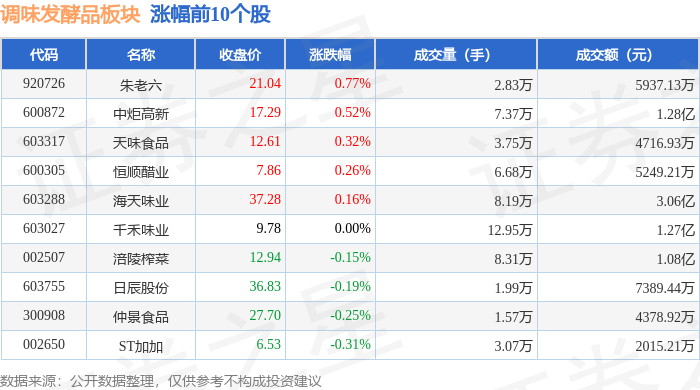
调味发酵品板块12月30日跌0.37%,安记食品领跌,主力资金净流出1.47亿元
Zheng Xing Xing Ye Ri Bao· 2025-12-30 09:00
Core Viewpoint - The seasoning and fermentation products sector experienced a decline of 0.37% on December 30, with Anji Food leading the drop [1] Group 1: Market Performance - The Shanghai Composite Index closed at 3965.12, down 0.0%, while the Shenzhen Component Index closed at 13604.07, up 0.49% [1] - The main stocks in the seasoning and fermentation sector showed mixed performance, with Anji Food falling by 10.01% to a closing price of 21.21 [2] Group 2: Trading Volume and Value - Anji Food had a trading volume of 371,300 shares and a transaction value of 800 million yuan, indicating significant trading activity despite the price drop [2] - The overall sector saw a net outflow of 147 million yuan from main funds, while retail investors contributed a net inflow of 123 million yuan [2] Group 3: Individual Stock Performance - Stocks such as Zhu Laoliu and Zhongju Gaoxin showed slight increases of 0.77% and 0.52%, respectively, while others like ST Jiajia and Zhongjing Food experienced minor declines [1][2] - The net inflow of funds varied across stocks, with notable inflows into stocks like Tianwei Food and Baoli Food, while others like ST Jiajia and Hengshun Vinegar faced outflows [3]



国泰海通晨报-20251230
国泰海通· 2025-12-30 05:14
Group 1: Food and Beverage Industry - The report highlights that the liquor industry is accelerating its bottoming process, moving towards supply-demand balance, with leading brands like Moutai and Wuliangye expected to stimulate sales through price adjustments in 2026 [3] - The domestic dairy product sector is anticipated to see accelerated domestic substitution due to temporary anti-subsidy measures on EU dairy products, which may increase domestic milk consumption and reverse the industry cycle [3] - Key recommendations include focusing on companies with price elasticity such as Moutai, Wuliangye, and Luzhou Laojiao, as well as high-growth beverage companies like Dongpeng Beverage and Nongfu Spring [2][3] Group 2: Banking Sector - The report on Ningbo Bank indicates a strong growth trajectory in loans, with a year-on-year increase of 17.9% in the first three quarters of 2025, primarily driven by corporate clients [10] - The bank's net profit growth forecasts for 2025-2027 are set at 8.6%, 10.9%, and 12.4%, respectively, with a target price of 38.89 yuan per share [9] - The bank's asset quality is improving, with a decrease in non-performing loan generation rate from 1.23% in Q1 2024 to 0.92% in Q3 2025, indicating a positive trend in credit risk management [11] Group 3: Energy Sector - PX and PTA prices have been on the rise since October 2025, with PX futures increasing from 6296 yuan/ton to 7324 yuan/ton, a rise of 16.33% [13] - The polyester production in China showed strong performance, with a year-on-year increase of 7.7% in the first eleven months of 2025, indicating robust downstream demand [14] - The report anticipates a tight supply-demand balance for PX in the first half of 2026, with new capacity expected to come online in the second half of the year [14] Group 4: Brain-Computer Interface Industry - 2025 is projected to be a pivotal year for the development of brain-computer interfaces in China, with numerous policies being introduced to support the industry [6] - Clinical trials for invasive and semi-invasive brain-computer interfaces are expected to surge, with several companies like Borui Kang aiming for regulatory approval in 2026 [8] - The commercialization of non-invasive brain-computer interfaces is already underway in areas such as brain monitoring and rehabilitation, indicating early market entry [8]
智通A股限售解禁一览|12月30日




智通财经网· 2025-12-30 01:05
Core Viewpoint - On December 30, a total of 7 listed companies will have their restricted shares unlocked, with a total market value of approximately 11.55 billion yuan [1]. Group 1: Company Specifics - Lisheng Pharmaceutical (Stock Code: 002393) will unlock 497,000 shares under equity incentive restrictions [1]. - Xuefeng Technology (Stock Code: 603227) will unlock 97.6172 million shares from the issuance of A-shares to institutional investors [1]. - Su Yan Jingshen (Stock Code: 603299) will unlock 622,700 shares under equity incentive restrictions [1]. - Qianhe Flavoring (Stock Code: 603027) will unlock 2.043 million shares under equity incentive restrictions [1]. - Hongming Co., Ltd. (Stock Code: 301105) will unlock 3.375 million shares from pre-issuance restrictions [1]. - Fulede (Stock Code: 301297) will unlock 200 million shares from pre-issuance restrictions [1]. - Baiwei Storage (Stock Code: 688525) will unlock 11.4 million shares [1].
千禾味业食品股份有限公司关于开展期货套期保值业务的公告
Shang Hai Zheng Quan Bao· 2025-12-29 21:19
Core Viewpoint - The company, Qianhe Flavor Industry Co., Ltd., has announced the initiation of futures hedging business to mitigate the impact of raw material price fluctuations on its operations, with a focus on maintaining cost stability and competitive advantage [3][10]. Group 1: Announcement Details - The board of directors and the audit committee have approved the decision to engage in futures hedging business [2][9]. - The maximum trading margin to be utilized is capped at 20 million RMB, with the highest contract value held on any trading day not exceeding 200 million RMB, and these amounts can be reused within the specified period [4][25]. - The funding for this trading will come from the company's own funds and will not involve raised capital [5]. Group 2: Trading Specifications - The trading will occur on domestic commodity futures exchanges, focusing on futures contracts related to key raw materials such as soybeans, wheat, and sugar [6]. - The trading period is set for 12 months from the date of board approval, with management authorized to execute decisions within the approved limits [6][25]. Group 3: Risk Management - The company acknowledges the inherent risks associated with futures hedging, including market, funding, operational, technical, and policy risks, but emphasizes that the primary goal is not speculation or arbitrage [3][10]. - To manage these risks, the company has established a comprehensive internal control and risk management system, ensuring that the scale of hedging aligns with production needs and operational stability [13][15].
千禾味业:第五届董事会第八次会议决议公告
Zheng Quan Ri Bao· 2025-12-29 13:59
Group 1 - The company, Qianhe Flavor Industry, announced that its fifth board of directors held the eighth meeting, where several proposals were approved [2] - The approved proposals include amendments to existing agreements and the initiation of futures hedging business [2]
千禾味业荣获2025年度行业影响力品牌 引领配料干净调味品消费新潮流
Cai Jing Wang· 2025-12-29 09:51
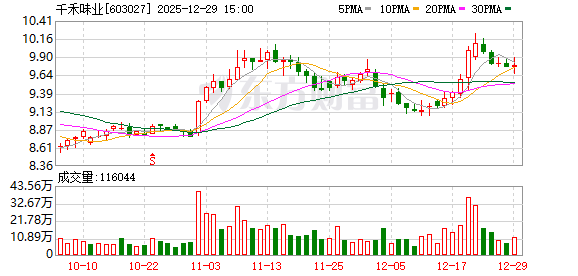
Core Insights - The company, Qianhe Flavor Industry, focuses on the clear trend of health-oriented condiments, emphasizing "clean ingredients" as its core principle [1] - Qianhe has developed a comprehensive product matrix that includes zero-additive, organic, and reduced-salt series, supported by a verifiable system for health commitments [1] - The company won the "2025 Industry Influence Brand" award at the New Consumption·New Economy Awards, reflecting its recognition in the context of consumer upgrades in the condiment industry [1] Product Quality and Safety - Qianhe implements a complete quality control system throughout the production chain, utilizing big data and supply chain management to ensure food safety [2] - The company has established strategic partnerships with core raw material suppliers, ensuring quality control from raw materials to sales, achieving over 2000 inspections and zero errors in CCP management over the past decade [2] Product Innovation and Consumer Focus - Qianhe has successfully combined tradition and innovation, focusing on consumer needs and transforming R&D results into high-quality products [3] - The company has launched several clean ingredient series products, including the Qianhe 0 series soy sauce, which has become a preferred choice among consumers [3] Transparency and Industry Standards - Qianhe addresses the "ingredient label trap" by being the first to place ingredient lists on the front of packaging, enhancing transparency and consumer trust [4] - The Qianhe 0 series soy sauce has achieved the first clean label product certification in the Chinese condiment industry, meeting compliance, safety, and transparency standards [4] Market Trends and Future Directions - The clean ingredient soy sauce is expected to become the preferred choice for Chinese households, with leading brands capturing 50% of the market share, projected to rise to 63.9% in the next three years [1] - The condiment industry is entering a turning point towards clean ingredient products, with quality competition becoming a central theme for sustainable development [4]

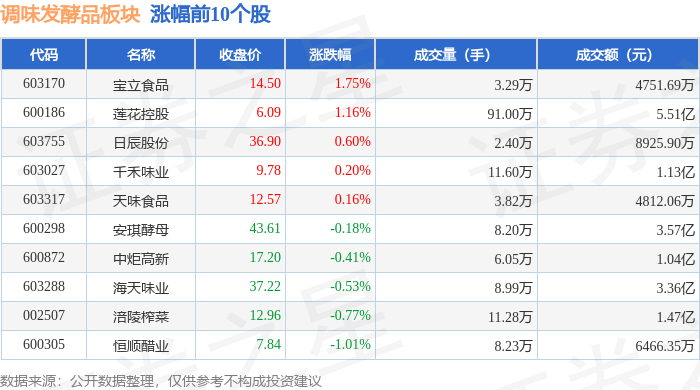
调味发酵品板块12月29日跌0.57%,安记食品领跌,主力资金净流出3348.46万元
Zheng Xing Xing Ye Ri Bao· 2025-12-29 09:06
Group 1 - The seasoning and fermentation sector experienced a decline of 0.57% compared to the previous trading day, with Anji Food leading the drop [1] - The Shanghai Composite Index closed at 3965.28, up 0.04%, while the Shenzhen Component Index closed at 13537.1, down 0.49% [1] - Key stocks in the seasoning and fermentation sector showed varied performance, with Baoli Food rising by 1.75% to a closing price of 14.50, while Anji Food fell by 10.00% to 23.57 [2] Group 2 - The net outflow of main funds in the seasoning and fermentation sector was 33.48 million yuan, while retail investors saw a net inflow of 65.52 million yuan [2] - The individual stock fund flow indicated that Lianhua Holdings had a main fund net inflow of 44.63 million yuan, while Qianhe Flavor Industry had a net inflow of 22.09 million yuan [3] - The overall trend showed that retail investors were more active, with significant net inflows in several stocks despite the main and speculative funds experiencing outflows [3]