青岛啤酒

Search documents
重庆啤酒18年包销纠纷了结增利1908万 啤酒卖不动年砸25亿销售费营收仍降
Chang Jiang Shang Bao· 2026-01-06 23:40
Core Viewpoint - The long-standing distribution dispute between Chongqing Beer and its affiliate, Jiawei Beer, has been resolved through court mediation, allowing the company to potentially improve its financial position and operational focus moving forward [1][2]. Group 1: Dispute Resolution - The contract dispute between Chongqing Beer and Jiawei, which lasted for 18 years, has been settled, with Chongqing Beer agreeing to pay a total of 100 million yuan (approximately 14.1 million USD) for all price difference settlements up to the end of 2025 [1][4]. - The mediation agreement includes provisions for the distribution of profits and the sales cooperation model between 2026 and 2028 [4]. Group 2: Financial Impact - Following the resolution, Chongqing Beer plans to reverse a previously accrued liability of 254 million yuan (approximately 35.8 million USD) and recognize a new liability of about 217 million yuan (approximately 30.7 million USD) for the settlement [1][4]. - This accounting adjustment is expected to increase the company's net profit attributable to shareholders by approximately 19.08 million yuan (around 2.7 million USD) for the year 2025 [4]. Group 3: Performance Challenges - Chongqing Beer has faced declining sales, with a reported revenue of 14.645 billion yuan (approximately 2.06 billion USD) in 2024, down 1.15% year-on-year, and a net profit of 1.115 billion yuan (around 157 million USD), down 16.61% [5]. - The company's net profit has continued to decline in the first three quarters of 2025, with revenues and net profits both showing a decrease compared to the previous year [5][6]. - The beer industry is experiencing challenges due to changing consumer habits and market conditions, impacting Chongqing Beer's sales performance [6]. Group 4: Strategic Initiatives - In response to market pressures, Chongqing Beer is focusing on expanding non-traditional sales channels and increasing its canning rate to adapt to changing consumption trends [6]. - The company has invested significantly in marketing, employing various celebrity endorsements to enhance brand visibility and appeal [6].

从0到310家!山东资本市场规模与质量双升、创新与价值共生
Sou Hu Cai Jing· 2026-01-06 16:31
Core Viewpoint - The development of the A-share market in Shandong has significantly contributed to the high-quality economic growth of the region, with a notable increase in both the number and market capitalization of listed companies over the past 32 years [1][7]. Group 1: Historical Development - The first A-share company in Shandong, Qingdao Beer, was listed in 1993, marking the beginning of a rapid expansion in the region's capital market [5]. - By the end of 1993, the market capitalization of Shandong listed companies was 9.6 billion yuan, which has grown to 4.79 trillion yuan by December 2025 [5][1]. - The number of A-share companies in Shandong reached 310 by 2023, with a market capitalization of 3.46 trillion yuan, reflecting a significant increase in both quantity and quality [7]. Group 2: Economic Contributions - In the first three quarters of 2025, Shandong A-share companies collectively achieved revenue of 2.30 trillion yuan, contributing to regional economic development [1][11]. - The total market capitalization of Shandong state-owned A-share companies reached 1.85 trillion yuan, accounting for nearly 40% of the overall market capitalization of the Shandong sector [10]. Group 3: Performance Metrics - In 2025, Shandong A-share companies reported a net profit of 737 billion yuan, representing 46% of the total net profit of the Shandong sector [10]. - Among the 310 listed companies, 251 were profitable, with 63 companies achieving profit growth year-on-year [11][10]. Group 4: Innovation and R&D - Shandong listed companies have increased their R&D investments, with 173 companies reporting a year-on-year increase in R&D expenses in 2025 [12]. - Notable companies such as Haier Smart Home and Weichai Power have significantly increased their R&D expenditures, with Haier reaching 10.74 billion yuan [13][14]. Group 5: Future Outlook - The continuous growth and innovation of Shandong listed companies are expected to drive further economic development and industrial upgrades in the region [15].





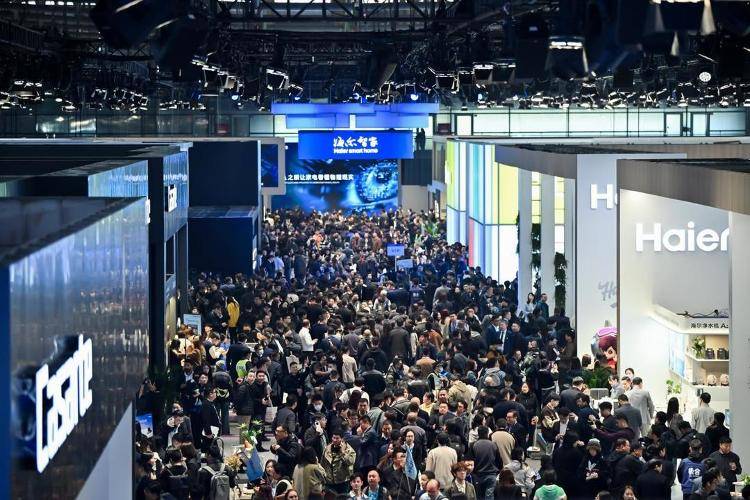
锚定世界一流目标 打造东北亚空中门户
Qi Lu Wan Bao· 2026-01-06 15:14
Core Insights - In 2025, Qingdao Airport Group aims to become a "world-class enterprise" and "world-class, domestically leading" international hub airport, achieving significant progress in various areas such as route network expansion, transit hub construction, cargo service innovation, safety operation assurance, passenger service optimization, and technological innovation [1][13] Group 1: Expansion of Connectivity - Qingdao Airport completed 193,000 transport flights in 2025, with a daily peak of 680 flights, and achieved a passenger throughput of 26.9 million, setting historical records for both metrics [2] - The steady growth in passenger traffic is attributed to the continuous optimization of the route network, including deepening "dual hub" strategic cooperation with 18 airport groups and increasing the number of fast routes to 14, with a capacity share of 50% [3] Group 2: Transit Hub Development - In 2025, Qingdao Airport collaborated with 42 airports to implement "one-time check-in and baggage direct transfer," creating a transit network covering 25 cities and facilitating international connections [4] - The airport handled 2.477 million transit passengers, with international transit passengers increasing by 31.5% to 1.188 million [4] Group 3: Cargo Operations - Qingdao Airport launched its first cargo route to Southeast Asia, with a total of 15 domestic and international cargo routes, achieving a cargo throughput of 227,100 tons in 2025 [5] - The airport innovated with the use of an intelligent cargo system and ensured timely delivery of local products, receiving recognition at the 2025 Global Trade and International Logistics Summit [5] Group 4: Safety and Operational Efficiency - Qingdao Airport ranked 4th nationally among similar airports for operational safety assurance in the first half of 2025, receiving accolades for its safety management practices [6][7] - The airport achieved a flight departure and release normal rate ranking 7th among major airports in China, implementing advanced operational techniques to enhance efficiency [7] Group 5: Passenger Experience and Service Quality - Qingdao Airport optimized passenger services by reducing check-in times and enhancing communication channels, achieving a 98% satisfaction rate in addressing passenger complaints [8] - The airport received multiple awards for service quality, including the "Best Airport" title from the International Airports Council for its passenger service improvements [8] Group 6: Industry Collaboration and Economic Impact - Qingdao Airport is transitioning to a large-scale management group that balances operational assurance with market operations, forming strategic partnerships with various local enterprises to enhance economic impact [9] - The "Qingyunze·Aviation Travel Voucher" integrates local tourism resources with airport services, promoting economic vitality [9] Group 7: Technological Innovation - Qingdao Airport advanced its smart airport initiatives, achieving breakthroughs in key technologies and establishing the first unmanned driving test site in the civil aviation industry [10] - The airport launched a 5G messaging service and developed an airport collaborative decision-making system, enhancing operational efficiency [10] Group 8: Organizational Development and Employee Engagement - The airport's leadership emphasizes high-quality development through strong organizational and community engagement, winning multiple awards for its innovative party-building initiatives [11][12] - Employee welfare programs and a focus on creating a supportive work environment have been implemented to enhance staff morale and productivity [12] Group 9: Future Development Plans - Looking ahead to the "15th Five-Year Plan," Qingdao Airport aims to transform into a multi-faceted aviation service ecosystem, enhancing its role as an international aviation hub and supporting regional economic development [13]
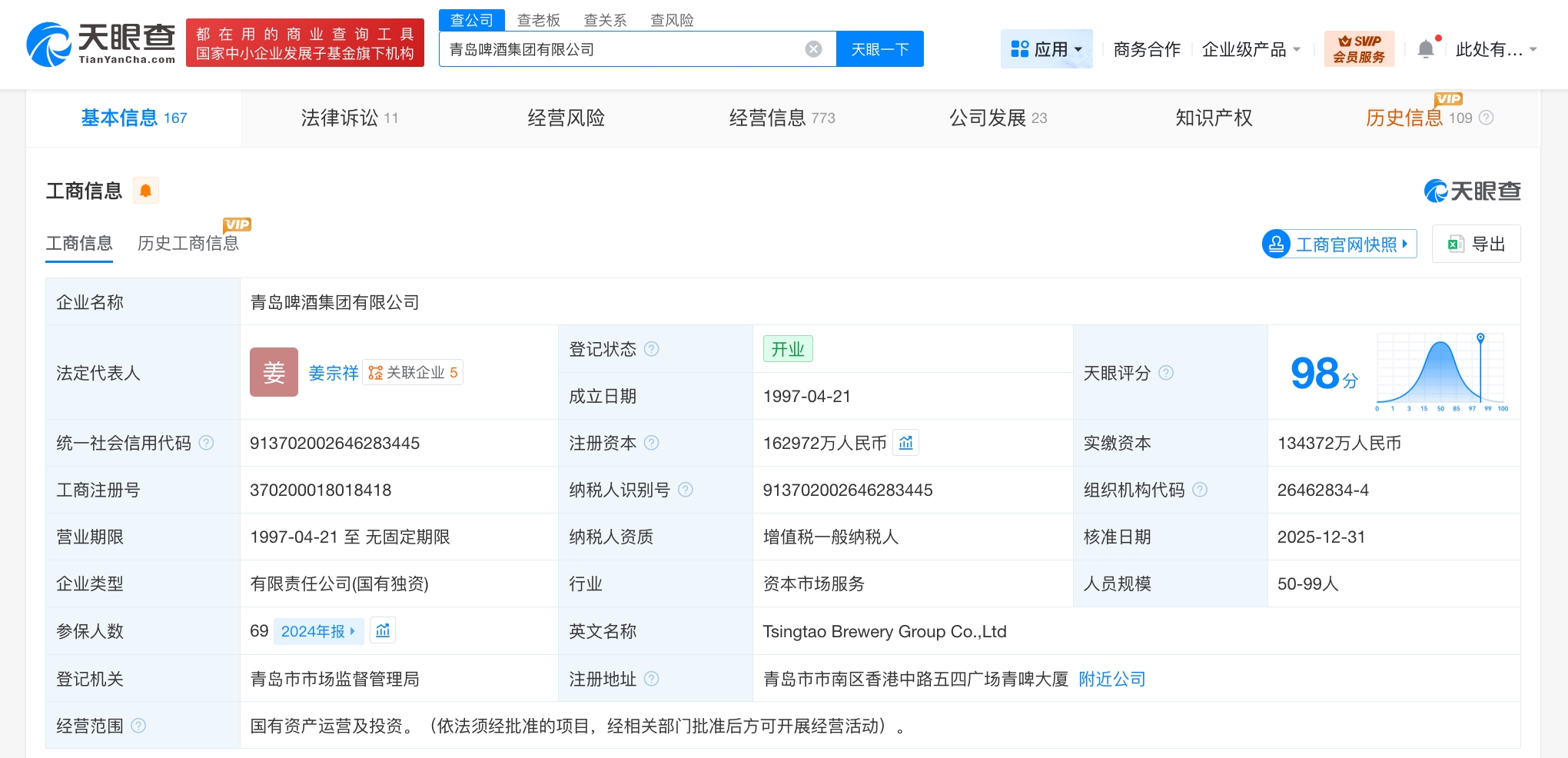
青岛啤酒集团注册资本增至16.3亿元
Zheng Quan Ri Bao Wang· 2026-01-06 13:45
Group 1 - The core point of the article is that Qingdao Beer Group Co., Ltd. has increased its registered capital from approximately 1.34 billion yuan to about 1.63 billion yuan [1] Group 2 - The change in registered capital indicates a potential expansion or investment strategy by the company [1] - The increase in capital is significant, reflecting a growth trend within the company [1] - This adjustment in capital structure may enhance the company's financial stability and operational capacity [1]
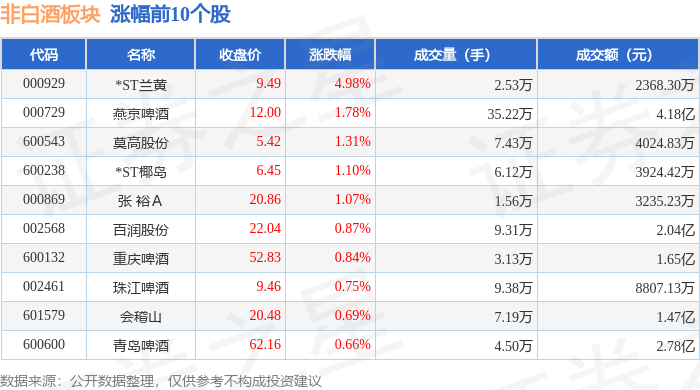
非白酒板块1月6日涨0.86%,*ST兰黄领涨,主力资金净流出1692.41万元
Zheng Xing Xing Ye Ri Bao· 2026-01-06 08:56
Market Overview - The non-baijiu sector increased by 0.86% compared to the previous trading day, with *ST Lanhua leading the gains [1] - The Shanghai Composite Index closed at 4083.67, up 1.5%, while the Shenzhen Component Index closed at 14022.55, up 1.4% [1] Stock Performance - The top-performing stock was *ST Lanhua, closing at 676 with a rise of 4.98% and a trading volume of 25,300 shares [1] - Other notable stocks included Zai Liang Beer, which rose by 1.78% to 12.00, and Mogaogongsi, which increased by 1.31% to 5.42 [1] - The overall trading volume and turnover for various stocks in the non-baijiu sector were significant, with Zai Liang Beer achieving a turnover of 418 million yuan [1] Capital Flow - The non-baijiu sector experienced a net outflow of 16.92 million yuan from institutional investors, while retail investors saw a net outflow of 6.90 million yuan [2] - Conversely, speculative funds recorded a net inflow of 23.83 million yuan [2] Individual Stock Capital Flow - Qingdao Beer had a net inflow of 22.44 million yuan from institutional investors, representing 8.06% of its total capital flow [3] - *ST Lanhua saw a net inflow of 6.04 million yuan from institutional investors, accounting for 25.51% of its capital flow [3] - In contrast, Huichuan Beer experienced a net outflow of 2.87 million yuan from institutional investors, indicating a negative sentiment [3]


年度投资策略报告:底部向阳,寻找结构性亮点-20260105
Tai Ping Yang Zheng Quan· 2026-01-05 14:15
Overall Industry Review - The food and beverage sector significantly underperformed the market, with a year-to-date decline of -0.62%, lagging behind the Shanghai Composite Index by 15.0 percentage points [7][11] - The snack sector showed strong performance with a year-to-date increase of 28.88%, driven by channel expansion and a total revenue growth of 30.97% in the first three quarters of 2025 [11] - The beverage sector, particularly soft drinks, benefited from travel demand and low-price, high-frequency consumption, achieving a revenue and profit growth in double digits [11][14] Alcoholic Beverages - The liquor sector exhibited weak performance, with a decline in sales and prices, particularly for white liquor, which saw a year-on-year revenue drop of -5.83% and a net profit decline of -6.93% in the first three quarters of 2025 [11][44] - The overall white liquor sector's revenue decreased by -5.8% and net profit by -6.9% in the first three quarters of 2025, with a significant drop in Q3, where total revenue fell by -18.4% [44] - The report indicates that the white liquor industry is in a prolonged adjustment phase, with the current downturn lasting 57 months, marking the longest adjustment period in history [35][40] Future Outlook - The central economic work conference emphasized the importance of boosting domestic demand in 2026, with expectations for policy support to stimulate recovery [3] - The report suggests focusing on sectors with low bases for recovery, such as frozen foods and beverages, which are expected to benefit from demand recovery and new product opportunities [3][4] - The report highlights the potential for structural opportunities in the food and beverage sector, particularly in overseas markets and cost improvements, recommending companies like Anqi Yeast and Mijiu Group for their overseas expansion strategies [4][34] Investment Strategies - The report identifies four key investment themes for 2026: opportunities in overseas markets, cost benefits, new product launches, and value-for-money consumption [4] - Companies with strong platform capabilities and innovative products, such as Dongpeng Beverage and Wancheng Group, are recommended for their potential in the beverage sector [4] - The report also emphasizes the importance of identifying companies that can adapt to a low-inflation, low-confidence environment by offering high-value products [14]






青岛啤酒集团增资至16.3亿,增幅约21%
Sou Hu Cai Jing· 2026-01-05 09:07
Group 1 - The core point of the article is that Qingdao Beer Group Co., Ltd. has undergone a significant change in its registered capital and management structure [1] - The registered capital has increased from approximately 1.34 billion RMB to about 1.63 billion RMB, representing a growth of around 21% [1] - The company was established in April 1997 and is wholly owned by the State-owned Assets Supervision and Administration Commission of the Qingdao Municipal Government [1] Group 2 - The legal representative of the company is Jiang Zongxiang, and its business scope includes state-owned asset operation and investment [1] - Several senior management personnel have changed as part of the recent corporate adjustments [1]
青岛啤酒集团增资至16.3亿
2 1 Shi Ji Jing Ji Bao Dao· 2026-01-05 08:43
Core Viewpoint - Qingdao Beer Group Co., Ltd. has recently increased its registered capital from approximately 1.34 billion RMB to about 1.63 billion RMB, marking an increase of around 21% [1]. Group 1: Company Information - Qingdao Beer Group Co., Ltd. was established in April 1997 and is wholly owned by the State-owned Assets Supervision and Administration Commission of Qingdao Municipal Government [1]. - The company operates in the field of state-owned asset management and investment [1]. Group 2: Changes and Updates - The recent changes in the company include alterations in registered capital and multiple executive changes [1]. - The new registered capital is approximately 1.63 billion RMB, reflecting a significant increase from the previous amount [1].
冰雪游稳居C位,年轻人爱上“悦己游”
Qi Lu Wan Bao· 2026-01-04 16:13
Core Insights - The Shandong cultural tourism market is thriving during the 2026 New Year holiday, with a focus on creating memorable experiences for visitors through diverse activities and events [1][3] Visitor Statistics - During the New Year holiday, 200 monitored tourist attractions in Shandong received a total of 4.682 million visitors, generating revenue of 194.387 million yuan, reflecting a daily increase of 14.0% in visitor numbers and 12.2% in revenue compared to previous years [2] - The 16 five-star tourist attractions in the province averaged 370,800 visitors per day, a 24.1% increase from January 1, 2025, and daily revenue of 12.9174 million yuan, up 38.3% from the previous year [2] Event Highlights - Various cultural activities were organized in Jinan, including extended hours at the Shandong Art Museum and a collaborative "Art New Year" event featuring exhibitions and performances [3] - The New Year celebrations included diverse events such as music festivals and countdown activities across different cities, enhancing the festive atmosphere [3] Tourism Trends - The tourism trend during the holiday was predominantly driven by younger generations, with "post-2000" travelers making up 39% of the tourist demographic, emphasizing a new travel philosophy focused on self-indulgence and meaningful experiences [5][6] - Popular tourist destinations in Shandong saw significant growth in bookings, with cities like Rizhao leading with a 160% increase, followed by Qingdao at 118% and Tai'an at 107% [6] Seasonal Attractions - The demand for "ice and snow tourism" remained strong, with various regions offering integrated experiences combining ice activities with hot springs and local customs [6] - The launch of the second Ice and Snow Consumption Season in Shandong aimed to boost winter tourism, with events like the Ice Waterfall Festival attracting visitors [6] Special Promotions - Various attractions offered promotions targeting visitors born in the Year of the Horse, including free entry and discounts at hotels and scenic spots [7] Cultural Performances - The holiday period featured a rich array of performances, including concerts and traditional operas, enhancing the cultural experience for visitors [8] - The newly renamed Fang Rongxiang Grand Theatre hosted a significant performance featuring renowned Peking opera artists, drawing attention from the cultural community [9][10]

食品饮料行业周报:茅台调整线上渠道,落实市场化转型-20260104
Shenwan Hongyuan Securities· 2026-01-04 15:13
Investment Rating - The report maintains a positive outlook on the food and beverage industry, particularly on the liquor sector, with a focus on high-quality companies for long-term investment [3][7]. Core Insights - The report emphasizes the importance of domestic demand, which has been highlighted by authoritative media and government officials since mid-December 2025. It notes that the high-end liquor prices have recently declined, indicating a market shift towards finding a balance between volume and price [3][7]. - For 2026, the report anticipates a double-digit decline in sales volume in Q1, with a potential stabilization in Q2 and a turning point in fundamentals by Q3. If the fundamentals recover as expected, a dual boost in valuation and performance is anticipated towards the end of 2026 and into 2027 [3][7]. - The report recommends several key liquor companies, including Luzhou Laojiao, Shanxi Fenjiu, Guizhou Moutai, and Wuliangye, while also suggesting attention to other brands like Yingjia Gongjiu and Jinhuijiu [3][7]. - In the consumer goods sector, the report highlights opportunities in the supply chain related to condiments, frozen foods, and dairy products, recommending companies such as Anjijia, Yili, and Qianhe Flavoring [3][10]. Summary by Sections 1. Food and Beverage Weekly Insights - The food and beverage sector experienced a decline of 2.26% last week, with liquor down 2.79%, underperforming the broader market [6][33]. - The report notes that the liquor sector's performance is closely tied to the upcoming Spring Festival, with expectations of improved market conditions compared to the previous months [11]. 2. Market Performance of Food and Beverage Sectors - The report indicates that the food and beverage industry underperformed the Shenwan A index by 1.95 percentage points, with the liquor sector lagging behind by 2.48 percentage points [33][34]. 3. Key Company Updates - Guizhou Moutai announced a significant adjustment to its online sales strategy, which is expected to have a profound impact on both the company and the industry. The adjustment includes a new product matrix aimed at better consumer engagement and market pricing [8][11]. - The report also mentions that Moutai's product prices have seen a decline, with the retail price for its flagship product dropping to 1490 yuan per bottle, reflecting a broader trend in the high-end liquor market [8][19].