
陕西煤业

Search documents
2025年1-7月煤炭开采和洗选业企业有5175个,同比增长1.63%
Chan Ye Xin Xi Wang· 2025-09-14 02:31
上市公司:甘肃能化(000552),新大洲A(000571),冀中能源(000937),山西焦煤(000983), 电投能源(002128),郑州煤电(600121),兖矿能源(600188),华阳股份(600348),盘江股份 (600395),安源煤业(600397),开滦股份(600997),晋控煤业(601001),昊华能源 (601101),陕西煤业(601225) 相关报告:智研咨询发布的《2025-2031年中国煤炭开采行业供需态势分析及市场运行潜力报告》 数据来源:国家统计局,智研咨询整理 知前沿,问智研。智研咨询是中国一流产业咨询机构,十数年持续深耕产业研究领域,提供深度产业研 究报告、商业计划书、可行性研究报告及定制服务等一站式产业咨询服务。专业的角度、品质化的服 务、敏锐的市场洞察力,专注于提供完善的产业解决方案,为您的投资决策赋能。 2025年1-7月,煤炭开采和洗选业企业数(以下数据涉及的企业,均为规模以上工业企业,从2011年 起,规模以上工业企业起点标准由原来的年主营业务收入500万元提高到年主营业务收入2000万元)为 5175个,和上年同期相比,增加了83个,同比增长1.63 ...


民生证券-煤炭行业周报:煤价企稳反弹,基本面改善下有望延续涨势-250913
Xin Lang Cai Jing· 2025-09-13 09:15
Group 1: Coal Market Overview - Coal prices have stabilized and rebounded, with expectations for continued upward momentum due to improving fundamentals [1] - Domestic coal prices have shown a consistent increase, while port coal prices have stabilized and rebounded during the week [1] - Supply-side analysis indicates a reduction in excess production capacity of approximately 230 million tons due to production inspections, with an additional 400 million tons of production halted due to lack of approval for capacity increases [1] Group 2: Demand Dynamics - Current demand for thermal coal is transitioning into the off-season, but non-electric demand is expected to gradually release, particularly in the upcoming "Golden September and Silver October" period [1] - Coal chemical consumption has maintained a year-on-year growth rate of over 10% since the beginning of the year, increasing to over 15% since May [1] - Policies aimed at eliminating outdated capacity in the refining industry are expected to enhance the competitiveness of coal chemicals against oil-based chemicals, thereby supporting new demand for coal [1] Group 3: Inventory and Pricing Trends - Port inventories have decreased due to production cuts, leading to a seasonal destocking effect, although there remains a significant imbalance in shipping [1] - Current coal prices are around 700 yuan per ton, with traders showing low purchasing sentiment due to the transition between peak and off-peak seasons [1] - The combination of declining port inventories and continued supply contraction under production restrictions is expected to support a sustained increase in coal prices, potentially returning to levels seen in Q3 2024 [1] Group 4: Coking Coal Market Insights - Coking coal prices are expected to remain weak and stable in the short term, with supply recovering as previously halted mines resume production [2] - The first round of coking coal price reductions has compressed profit margins, and steel mills are primarily purchasing based on demand without significant improvement in terminal demand [2] - Anticipated supply reductions due to production inspections and the upcoming peak season suggest potential upward price movement for coking coal [2] Group 5: Investment Recommendations - Investment recommendations include focusing on high spot price elasticity stocks, such as Lu'an Environmental Energy, and stable growth stocks like Jinko Coal and Huayang Co., Ltd. [2] - Companies expected to benefit from production recovery include Shanxi Coal International, while industry leaders with stable performance include China Shenhua, China Coal Energy, and Shaanxi Coal and Chemical Industry [2] - Additionally, companies benefiting from nuclear power growth, such as CGN Mining, are highlighted as strong investment opportunities [2]
赵刚在榆林调研重点能化项目建设工作时强调不断提升能源清洁高效转化利用水平 更好保障国家能源安全助力陕西高质量发展
Shan Xi Ri Bao· 2025-09-12 23:39
Core Insights - The provincial government emphasizes the importance of energy security and the need for high-end, diversified, and low-carbon development in the energy sector [1][2] - The focus is on accelerating the transformation and upgrading of the energy industry, enhancing clean and efficient energy conversion, and supporting high-quality development in Shaanxi [1][2] Group 1: Project Development - The Shaanxi Coal Group's Yulin Chemical project aims for a coal-to-chemical conversion capacity of 15 million tons per year, serving as a benchmark in the coal chemical industry [2] - The project is divided into two phases, with the provincial governor stressing the importance of quality standards, adherence to timelines, and safety measures to ensure early completion and production [2] Group 2: Strategic Initiatives - The Yulin region is tasked with creating a national-level energy revolution innovation demonstration zone, focusing on energy supply responsibilities and implementing the "dual carbon" strategy [2] - The government aims to enhance the energy chemical industry by transitioning from raw materials to high-end applications and expanding from bulk chemicals to terminal products [2] - There is a strong emphasis on innovation-driven development, utilizing various innovation resources, and establishing a comprehensive platform for research, testing, and technology transfer [2]
煤炭开采板块9月12日跌0.33%,新大洲A领跌,主力资金净流出1.61亿元
Zheng Xing Xing Ye Ri Bao· 2025-09-12 08:37
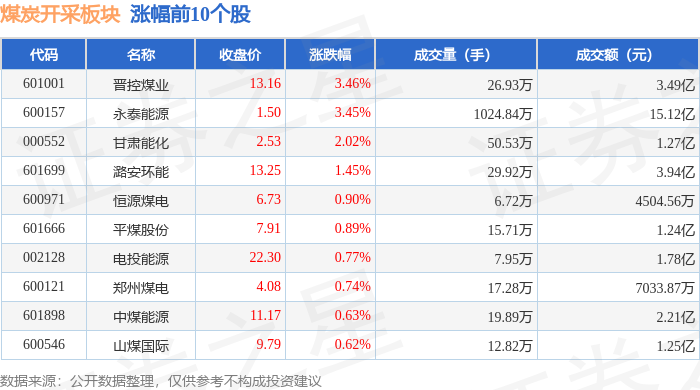
Core Viewpoint - The coal mining sector experienced a slight decline of 0.33% on September 12, with New Dazhou A leading the losses, while the overall market indices showed modest gains [1][2]. Group 1: Market Performance - The Shanghai Composite Index closed at 3883.69, up 0.22%, and the Shenzhen Component Index closed at 12996.38, up 0.13% [1]. - The coal mining sector's individual stock performance varied, with notable gainers including Jin Kong Coal Industry (up 3.46%) and Yongtai Energy (up 3.45%) [1]. Group 2: Stock Details - Key stocks in the coal mining sector included: - Jin Kong Coal Industry: Closing price 13.16, volume 269,300, turnover 3.49 billion [1]. - Yongtai Energy: Closing price 1.50, volume 10,248,400, turnover 1.51 billion [1]. - New Dazhou A: Closing price 5.11, down 2.11%, volume 126,600, turnover 65.03 million [2]. Group 3: Capital Flow - The coal mining sector saw a net outflow of 161 million from main funds, while retail investors contributed a net inflow of 115 million [2][3]. - Notable capital flows included: - Yongtai Energy: Main funds net inflow of 152 million, retail net outflow of 61.77 million [3]. - Shaanxi Coal Industry: Main funds net inflow of 52.84 million, retail net outflow of 40.82 million [3].




海通证券晨报-20250912
Haitong Securities· 2025-09-12 07:09
Fixed Income Research - The bond market may have completed a "five-wave" cycle and is now entering an adjustment phase, with historical data suggesting that the decline from the peak could be around 30%-35% of the previous gains [1][3][30] Coal Mining Research - The fundamental reason for the frequent global electricity shortages is the rapid growth in electricity demand, while structural bottlenecks on the supply side remain unresolved. Traditional energy sources, particularly coal-fired power, will continue to be the ballast of the global electricity system in the medium to long term [5][7][8] - Global electricity demand is expected to grow at a rate of 4.4% in 2024, significantly outpacing the global GDP growth of 2.9%. This growth is driven by deep electrification in the industrial sector, rapid expansion of data centers driven by artificial intelligence, and increased extreme weather events due to global climate change [6][7] Power Equipment and New Energy Research - Solid-state batteries are identified as the next generation of high-performance batteries, with increasing demand for oxide semi-solid batteries and the potential for sulfide all-solid-state batteries to demonstrate their capabilities. Continuous advancements in the industry are expected to enhance the trend of solid-state battery markets [9][10][11] - The solid-state battery market has transitioned from being demand-driven to being driven by new technologies, with significant developments expected in various fields, including consumer batteries and electric vehicles [12][13]
国泰海通:从全球视角看电力供需 煤电仍是压舱石
智通财经网· 2025-09-12 06:41
Group 1 - The core viewpoint is that the fundamental reason for the frequent global power shortages is the rapid growth in global electricity demand, while the supply side's structural bottlenecks have not been effectively resolved. Traditional energy generation, represented by coal power, will remain a stabilizing force in the global electricity system in the medium to long term [1][3] - Global electricity demand is expected to grow at a rate of 4.4% in 2024, significantly outpacing the global GDP growth of 2.9%. This growth is driven by three deep-seated factors: deep electrification in the industrial sector, rapid expansion of data centers driven by artificial intelligence, and increased extreme weather events due to global climate change [1][2] - The supply side of the electricity market faces structural bottlenecks, with renewable energy sources like wind and solar power unable to provide stable support for electricity demand due to their intermittent nature. Issues such as aging grid infrastructure and weak regional dispatch capabilities further exacerbate the disconnect between electricity generation and availability [2][3] Group 2 - Traditional energy generation, particularly coal power, is being reconsidered as a necessary stabilizing force to address the growing electricity supply gap. The U.S. is expected to restart coal power generation in 2025, marking a significant shift in energy development strategies among developed countries [3] - The demand for coal resources remains high in developing countries, while developed countries are also adjusting their energy strategies, indicating that the peak pressure for coal phase-out may have passed [3]




2025年1-7月陕西省工业企业有8713个,同比增长5.64%
Chan Ye Xin Xi Wang· 2025-09-12 03:13
Group 1 - The core viewpoint of the article highlights the growth of industrial enterprises in Shaanxi Province, with a total of 8,713 enterprises reported from January to July 2025, marking an increase of 465 enterprises compared to the same period last year, representing a year-on-year growth of 5.64% [1][1][1] - The report indicates that the number of industrial enterprises in Shaanxi Province accounts for 1.67% of the national total [1][1][1] - The data presented is sourced from the National Bureau of Statistics and compiled by Zhiyan Consulting, a leading industry consulting firm in China [1][1][1] Group 2 - The article references a report by Zhiyan Consulting titled "2025-2031 China Industrial Cloud Industry Market Deep Assessment and Investment Opportunity Forecast Report" [1][1][1] - The report emphasizes the importance of providing comprehensive industry solutions to empower investment decisions through in-depth research and market insights [1][1][1] - The article lists several companies related to the industrial sector in Shaanxi, including Shaanxi Coal and Chemical Industry, Shaanxi Natural Gas, and others [1][1][1]

2025年1-4月全国工业出口货值为48793.3亿元,累计增长5.1%
Chan Ye Xin Xi Wang· 2025-09-12 01:03
Group 1 - The core viewpoint of the article highlights the growth in China's industrial export value, with a reported value of 12,468.8 billion yuan in April 2025, reflecting a year-on-year increase of 0.9% [1] - Cumulative industrial export value from January to April 2025 reached 48,793.3 billion yuan, showing a cumulative year-on-year growth of 5.1% [1] - The article references a report by Zhiyan Consulting, which provides a deep assessment of the industrial cloud market in China from 2025 to 2031, indicating potential investment opportunities [1] Group 2 - The listed companies include Gansu Energy (000552), New Dazhou A (000571), Jizhong Energy (000937), and others, indicating a focus on the energy and industrial sectors [1] - Zhiyan Consulting is recognized as a leading industry consulting firm in China, specializing in comprehensive industry research reports and customized services [1] - The data presented is sourced from the National Bureau of Statistics, emphasizing the reliability of the statistics used in the analysis [1]


对话专家:煤炭反内卷政策落地情况和展望
2025-09-11 14:33
Summary of Coal Industry Conference Call Industry Overview - The coal production in the four provinces of Shanxi, Shaanxi, Inner Mongolia, and Xinjiang accounts for 81.4% of the national total, with varying growth rates: Shanxi at 7.2%, Inner Mongolia flat, Xinjiang at 8.2%, and Heilongjiang at 34.1% [1][2][3] - National coal imports decreased by 13% year-on-year in the first seven months, but increased by 20% month-on-month in August, indicating fluctuating demand influenced by price and policy [1][2] - Power generation increased by 1.3% year-on-year in the first seven months, with a notable 3.1% increase in July due to high temperatures [1][2] Key Points on Supply and Demand - Total coal supply for the first seven months was 3.04 billion tons, a 2.1% increase year-on-year, with a 5.8% decrease in July [2] - Coal inventory at enterprises rose by 46% year-on-year in July, while major port inventories decreased by 3% [1][2] - The implementation of Document 108 aims to control overproduction to alleviate market pressure, but its effectiveness is contingent on cooperation from safety supervision departments [1][6][7] Market Dynamics - The trading activity in the thermal coal market has decreased, with power companies maintaining sufficient inventory and non-power sector demand not significantly increasing [5] - The price of 5,500 kcal thermal coal is expected to fluctuate between 650 and 700 RMB/ton in the second half of the year [1][21] Challenges and Risks - The coal industry faces significant downward pressure, with nearly 60% of companies reporting losses, although this is an improvement from 80% during the most challenging years [10] - Legal risks associated with overproduction have increased since the 2019 safety production law reform, making enterprises cautious about exceeding production limits [10] - Local enterprises are under economic pressure, leading to some overproduction, which requires strict regulation [10] Future Outlook - The coal supply is expected to maintain slight growth in the coming months, with production potentially increasing post-October if no further measures are implemented [4][9] - The potential for new import quota policies is low due to ongoing trade tensions, but temporary measures to reduce imports may be considered [22] Additional Insights - The implementation of the 276 working day system for capacity reduction is limited, with only a few mines potentially adopting it due to operational challenges [12] - The current coal production capacity that has not completed necessary procedures is approximately 100 million tons, mainly in Inner Mongolia and Xinjiang [15] - The transportation costs for coal from Xinjiang are high, providing some support for domestic coal prices when port prices fall below 650 RMB/ton [17][18] This summary encapsulates the key insights and data from the conference call regarding the coal industry, highlighting production trends, market dynamics, challenges, and future expectations.
中国股票策略 - 2025 年第二季度业绩回顾-MSCI 中国符合预期,A 股走弱-China Equity Strategy-2Q25 Earnings Review – MSCI China in Line, A-Shares Soften
2025-09-11 12:11
Summary of MSCI China 2Q25 Earnings Review Industry Overview - The report focuses on the **MSCI China** and **A-shares** performance during the second quarter of 2025 (2Q25) - It highlights the earnings results of various sectors within the Chinese equity market Key Findings MSCI China Performance - **Earnings Results**: MSCI China reported earnings in line with consensus forecasts, with a weighted surprise of **+2.7%** and a miss by number of companies of **-2.7%** [2][26] - **Comparison to 1Q25**: The results showed a similar trend to 1Q25, which had a miss of **-3.8%** by number of companies and a weighted surprise of **+3.1%** [2][26] A-Shares Performance - **Earnings Results**: A-shares missed consensus forecasts by number of companies by **-13.8%**, but were in line by weighted surprise at **+0.2%** [3][26] - **Comparison to 1Q25**: This represents a softening compared to 1Q25, which had a miss of **-4.8%** by number of companies and a weighted surprise of **+3.3%** [3][26] Revenue Performance - **MSCI China and A-shares**: Both indices missed consensus revenue estimates by number of companies but posted in-line results by weighted surprise [4][44] - **Cost Control**: The better revenue trends were attributed to improved cost-control measures and self-help strategies [4] Sector Performance - **Strong Performers**: - **Communication Services** and **Financials** led with solid earnings beats [5][26] - **Pharma & Biotech** and **Materials** saw strong returns with earnings upgrades, with gains above **20%** [6] - **Weak Performers**: - **Onshore Real Estate** and **Utilities** posted net earnings misses by both weighted surprise and number of companies [5] Market Returns - **Overall Returns**: MSCI China delivered a **13%** return from end-June to September 9, while MSCI China A onshore gained **15%** [6][18] - **Sector Returns**: Notable sectors with returns above **20%** included Consumer Staples Retailing, Pharma & Biotech, and Semiconductors [15][18] Earnings Revisions - **Upward Revisions**: Sectors such as **Pharma & Biotech**, **Materials**, and **Tech** saw upward revisions to 2025 consensus EPS estimates [6][16] - **Downward Revisions**: The **Semiconductors** sector experienced downward earnings revisions [6][16] Notable Contributors - **Key Contributors to Earnings Beats**: - **Communication Services**: Mango Excellent Media and Giant Network [28] - **Consumer Discretionary**: PDD, XPENG, and TCOM [28] - **Financials**: BOC and CCB [28] - **Key Drags on Earnings**: - **Consumer Staples**: China Feihe, China Mengniu, and Yanghe Brewery [28] - **Energy**: ShaanXi Coal and Yankuang Energy [28] Revenue Surprises - **Aggregate Revenue Miss**: Reported revenue missed consensus by number of companies by **-12.5%**, an improvement from **-16.6%** in 1Q25 [45] - **Sector-Level Revenue Beats**: Only **Communication Services** and **Real Estate** posted beats by number of companies [45] Conclusion - The earnings season for 2Q25 showed mixed results across sectors, with some outperforming expectations while others fell short. The overall market demonstrated resilience with positive returns, but challenges remain in specific sectors, particularly in revenue generation.