南京银行

Search documents
南京高科股份有限公司 关于增持南京银行股份有限公司股份结果的公告
Zhong Guo Zheng Quan Bao - Zhong Zheng Wang· 2025-10-23 00:53
Group 1 - The company has increased its stake in Nanjing Bank by purchasing 148,303,153 shares at an average price of 11.35 yuan per share, totaling an investment of 168,396.39 million yuan, which now represents 9.99% of Nanjing Bank's total share capital [1] - The company's board has authorized management to invest up to 10 billion yuan in listed A-share companies, with an extension to 18 billion yuan approved on August 27, 2025, valid until June 30, 2026 [1] - The increase in stake does not constitute a related party transaction or a major asset restructuring as per the regulations [1] Group 2 - The company has concluded its share purchase of Nanjing Bank, resulting in a non-recurring gain of 41,035.45 million yuan in the third quarter due to the investment, which positively impacted the net profit for that quarter [2] - The total non-recurring income recognized for the year from the purchase of Nanjing Bank shares amounts to 46,920.10 million yuan, also affecting the annual net profit [2] - The non-recurring income from the investment is classified as an extraordinary item and does not have a substantial impact on the company's ongoing profitability or cash flow from operations [2]


国际大行喊出“超配中国”
Shen Zhen Shang Bao· 2025-10-22 23:39
外资机构看好中国市场,增配行业龙头股 王滢建议长期关注高科技板块,包括人工智能、自动化、机器人、生物科技、高端制造等,同时建议投 资者持续配置高质量红利股,以抵御短期的市场波动。 瑞银最新研报指出,在新兴市场中继续给予中国超配评级,理由是与另一新兴市场印度相比,中国企业 营收增长更快,每股收益增长同样较快,当前估值较印度市场折价约33%。 摩根大通同样看好中国股市,估算至2026年底,沪深300指数有24%上行空间,MSCI中国指数则有35% 上行空间。 当前进入上市公司三季报披露季,记者梳理发现,行业龙头成为外资重仓和增仓主要品种。据数据统 计,截至9月底,贵州茅台、中国平安、五粮液最受外资青睐,3家的持股外资机构数量分别达85家、83 家和81家。顺丰控股、京东方A、恒瑞医药、立讯精密、工商银行、美的集团等11只股票也吸引了超过 70家外资机构持有。 从持股数量来看,银行股是外资重仓方向之一。截至9月底,外资持股数量前十的A股公司中,上市银 行占了7席。其中,32家外资合计持有南京银行22.36亿股,75家外资持有工商银行15.65亿股。农业银 行、招商银行、宁波银行的外资持股均超过10亿股。 从持仓市值 ...
供应链金融赋能黄河流域产业,日照启动“三大示范区”建设
Qi Lu Wan Bao Wang· 2025-10-22 15:00
Core Insights - The conference themed "Digital Intelligence Ecology, Win-Win Cooperation" focused on empowering high-quality development of the Yellow River Basin through supply chain finance [1] - The establishment of three demonstration zones in Rizhao: Supply Chain Finance Innovation Zone, Electronic Warehouse Receipt Zone, and Pension Finance Ecosystem Zone was officially launched [1][4] Group 1: Supply Chain Finance Development - Rizhao has seen significant growth in supply chain finance, with 513 core enterprises and 7,224 upstream and downstream enterprises benefiting from financing, totaling a financing balance of 22.8 billion [3] - Rizhao Bank has achieved an AAA credit rating and was recognized as one of the "Best Industrial Digital Financial Banks" at the 9th China Industrial Digital Finance Annual Conference [3] Group 2: Infrastructure and Economic Impact - Rizhao Port's throughput is projected to exceed 600 million tons in 2024, ranking 6th among coastal ports in China and 7th globally, with foreign trade cargo volume reaching 323 million tons, ranking 2nd nationally [2] - The port has become a crucial support for energy security in the Yellow River region and stabilizing the manufacturing supply chain [2] Group 3: Collaborative Initiatives - The conference served as a platform for signing strategic cooperation agreements among banks, enterprises, and technology companies, promoting a collaborative ecosystem in supply chain finance [3] - The launch of the "Yellow River Basin Digital Supply Chain Finance Alliance" aims to deepen the integration of finance and industry for mutual benefits [3]

农行市值达2.75万亿元领涨银行股,估值修复行情能否持续
Di Yi Cai Jing· 2025-10-22 13:16
Core Viewpoint - The A-share banking sector has shown strong performance, with Agricultural Bank of China (ABC) reaching a historical high in stock price and market capitalization, indicating a significant valuation recovery in the banking sector [1][2]. Group 1: Agricultural Bank of China Performance - On October 22, ABC's stock price closed at 8.09 yuan, marking a historical high and a total market capitalization of 2.75 trillion yuan, with a price-to-book ratio of 1.06, breaking the long-standing "below book value" situation of state-owned banks [1][2]. - ABC has experienced a "14 consecutive days of gains" trend, with a year-to-date increase of 51.05%, significantly outperforming Industrial and Commercial Bank of China (ICBC), which has a year-to-date increase of 12.14% [2]. - The stock's strong performance is attributed to high dividend yields from quality assets and stable earnings, which provide solid support for the stock price [2]. Group 2: Factors Driving Valuation Recovery - The recovery in the banking sector's valuation is driven by three main factors: sustained inflow of long-term capital, stabilization of fundamentals, and a shift in market style [4]. - Long-term capital inflows, particularly from insurance companies, asset management companies (AMCs), and industrial capital, have provided robust purchasing power for bank stocks [4][5]. - The fundamental recovery is reflected in improved revenue growth and profitability forecasts for listed banks, with expected revenue growth of 1% and profit growth of 1.5% for the first three quarters of 2025 [5]. Group 3: Market Conditions and Investor Sentiment - The market's perception of bank stocks has shifted, with a historical tendency to undervalue banks at a price-to-book ratio below 1, now being reassessed due to the banks' operational resilience and compounding effects [3]. - The recent increase in global risk aversion, particularly following U.S. trade policy announcements, has led to a defensive shift towards bank stocks, which are characterized by low valuations and high dividends [6]. - Analysts suggest that the banking sector is entering a bottoming phase, with expectations of a more certain investment window in the fourth quarter and early next year, despite ongoing uncertainties in performance and external environments [7].

金信智能中国2025跑输大盘20%:“智能主题”基金却重仓银行,三季度踏空行情
Feng Huang Wang Cai Jing· 2025-10-22 12:58
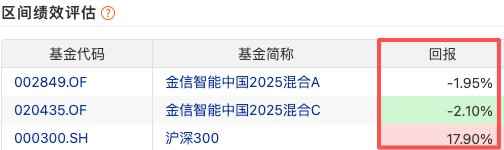
Core Viewpoint - The phenomenon of investment style drift is evident in the third-quarter report of the Jinxin Fund's Intelligent China 2025 Flexible Allocation Mixed Fund, which, despite its stated investment goal of focusing on intelligent enterprises, has heavily invested in traditional financial stocks, leading to poor performance and significant underperformance compared to peers [1][10]. Fund Performance - Jinxin Intelligent China 2025 Mixed Fund reported returns of -1.95% for Class A and -2.10% for Class C in the third quarter, while the benchmark return was 12.19%, and the CSI 300 index rose by 17.90%, indicating a nearly 20% underperformance against the index [2][3]. - Year-to-date performance as of October 21 shows Class A with a return of 14.90%, ranking 1417 out of 2303 similar products, and a six-month return of 11.87%, lagging the CSI 300 by nearly 10 percentage points [4][5]. Investment Strategy and Holdings - The fund's investment objective is to focus on enterprises providing intelligent production, design, and services, including sectors like smart machinery and smart healthcare [6]. - However, the top ten holdings for the third quarter were entirely traditional financial stocks, including major banks such as Industrial and Commercial Bank of China and China Construction Bank, indicating a significant deviation from its stated investment strategy [8][10]. Investor Sentiment - Investors have expressed concerns regarding the fund's strategy, questioning the rationale behind its heavy allocation to traditional financial stocks instead of intelligent enterprises, leading to skepticism about the fund's alignment with its stated goals [11][13]. Regulatory and Market Implications - The drift in investment style raises compliance concerns, as frequent style changes can mislead investors regarding the product's risk profile, potentially leading to greater scrutiny and pressure on the fund's future performance [14].







金信智能中国2025跑输大盘20%:“智能主题”基金却重仓银行,三季度踏空行情
凤凰网财经· 2025-10-22 12:48
Core Viewpoint - The article highlights the phenomenon of style drift in public funds, specifically focusing on the Jin Xin Fund's "Intelligent China 2025" mixed fund, which has deviated from its stated investment goal of focusing on intelligent enterprises by heavily investing in traditional financial stocks, resulting in poor performance compared to the market [3][4][11]. Group 1: Fund Performance - Jin Xin Intelligent China 2025 mixed fund reported a negative return of -1.95% and -2.10% for its A and C shares respectively in Q3, significantly underperforming the benchmark return of 12.19% and the CSI 300 index which rose by 17.90%, leading to a performance gap of nearly 20% [4][5]. - Year-to-date performance as of October 21 shows the fund's A shares with a return of 14.90%, ranking 1417 out of 2303 similar products, indicating a mid-to-low tier performance [6][7]. - The fund's total management scale decreased by 25.7% from 7.59 billion to 5.64 billion yuan in Q3 [6]. Group 2: Investment Strategy and Holdings - The fund's stated investment objective is to focus on enterprises providing intelligent production, design, and services, including sectors like smart machines and smart healthcare [8]. - However, the top ten holdings in Q3 were entirely traditional financial stocks, including major banks like ICBC and Ping An Bank, indicating a significant deviation from its stated investment strategy [9][10]. - The fund's historical trend shows a consistent increase in bank stock holdings since 2017, with at least 8 out of the top 10 holdings being bank stocks since 2018, demonstrating a long-standing style drift [11]. Group 3: Investor Sentiment and Concerns - Investors have expressed concerns regarding the fund's management and investment strategy, questioning the rationale behind the heavy allocation to traditional financial stocks despite the fund's focus on intelligent enterprises [12][15]. - The fund managers acknowledged the market volatility in Q3 but maintained that their strategy focused on the financial services sector's intelligence, which contrasts sharply with their actual stock selections [14][15]. - The article notes that frequent style shifts can lead to confusion among investors regarding the fund's positioning, potentially misleading them about the risk profile of the product [15].

南京高科(600064.SH):以16.84亿累计完成增持1.48亿股南京银行股份
Ge Long Hui A P P· 2025-10-22 10:00
Core Viewpoint - Nanjing Gaoke has increased its stake in Nanjing Bank, recognizing its investment value, by acquiring 148 million shares at an average price of 11.35 yuan per share, totaling 1.684 billion yuan [1] Summary by Relevant Sections Investment Activity - The company has acquired a total of 148 million shares of Nanjing Bank, bringing its total holdings to 1.236 billion shares, which represents 9.99% of the bank's total equity [1] - The acquisition was conducted through centralized bidding on the Shanghai Stock Exchange [1] Financial Impact - The investment in Nanjing Bank has resulted in a non-recurring gain of 410.3545 million yuan for the third quarter, positively impacting the net profit for that period [1] - For the current fiscal year, the total recognized non-recurring income from the investment amounts to 469.201 million yuan, also affecting the annual net profit [1] - The non-recurring income from this investment is classified as an extraordinary item, indicating it is not expected to have a lasting impact on the company's ongoing profitability or cash flow from operations [1]
10月22日180低贝(000136)指数跌1.2%,成份股山东黄金(600547)领跌
Sou Hu Cai Jing· 2025-10-22 09:16
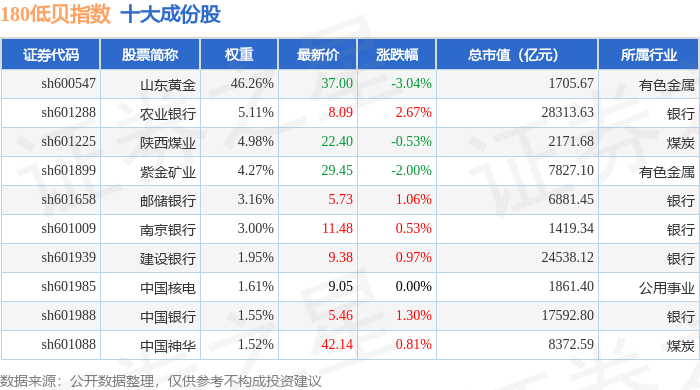
Market Overview - The 180 Low Bei Index closed at 13229.35 points, down 1.2%, with a trading volume of 621.03 billion and a turnover rate of 0.35% [1] - Among the index constituents, 35 stocks rose while 20 stocks fell, with Agricultural Bank leading the gainers at 2.67% and Shandong Gold leading the decliners at 3.04% [1] Key Constituents - The top ten constituents of the 180 Low Bei Index include: - Shandong Gold: 46.26% weight, latest price 37.00, down 3.04%, market cap 1705.67 billion [1] - Agricultural Bank: 5.11% weight, latest price 8.09, up 2.67%, market cap 28313.63 billion [1] - Other notable stocks include Zijin Mining, Postal Savings Bank, and China Nuclear Power, with varying performance [1] Capital Flow - The index constituents experienced a net outflow of 17.22 billion from main funds, while retail investors saw a net inflow of 12.7 billion [1] - Detailed capital flow for key stocks shows significant net inflows for Agricultural Bank and China Nuclear Power, while major banks like Industrial and Commercial Bank and Bank of China faced net outflows [2] ETF Performance - The Gold Stock ETF (product code: 159562) tracks the CSI Hong Kong and Shanghai Gold Industry Index, with a recent five-day decline of 3.62% and a P/E ratio of 24.77 [4] - The ETF's latest share count is 1.34 billion, down by 56 million, with a net inflow of 19.88 million from main funds [4]



农业银行走出14连阳,10月超90亿资金冲进银行ETF,华宝银行ETF、银行ETF易方达和银行ETF天弘“吸金”居前
Sou Hu Cai Jing· 2025-10-22 08:30
Core Insights - The A-share market is witnessing a rise in bank stocks, with notable increases in shares of banks such as Zhejiang Commercial Bank and Agricultural Bank, which has reached a historical high with a year-to-date increase of nearly 56% [1][5] - Hong Kong bank stocks are also on an upward trend, with Agricultural Bank achieving a 10-day consecutive rise and other banks like China Merchants Bank and Industrial and Commercial Bank of China showing gains [1] - Bank ETFs are experiencing positive performance, with various funds recording increases in value, indicating strong investor interest in the banking sector [1][3] Market Performance - A-share bank index has decreased by 4% since early July, underperforming the CSI 300 index by 19.3 percentage points, while the H-share bank index has slightly increased by 2.2%, lagging behind the Hang Seng index by 5.2 percentage points [5] - The average price-to-book (PB) ratio for A-share banks is 0.71, placing it in the 42.4% percentile over the past three months and 77.7% over the past year, while H-share banks have a PB ratio of 0.5, in the 46% and 73.6% percentiles respectively [5] Investment Trends - There is a growing preference for bank stocks due to their low valuations and high dividend yields, as investors seek safety and stable returns amid rising market risk aversion [5] - Since October 21, a total of 93.14 billion yuan has flowed into 10 bank-themed ETFs, with significant inflows into funds managed by Huabao and E Fund [6][8] - Morgan Stanley anticipates a favorable investment opportunity for domestic bank stocks in the fourth quarter and early next year, supported by upcoming dividend distributions and stable interest rates [10]
城商行板块10月22日涨0.48%,长沙银行领涨,主力资金净流出2.69亿元
Zheng Xing Xing Ye Ri Bao· 2025-10-22 08:20
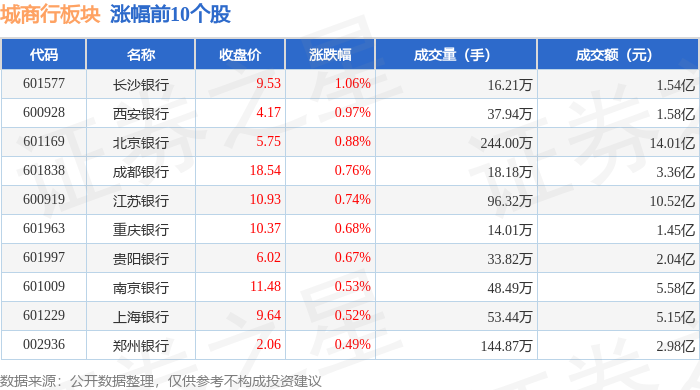
Market Performance - The city commercial bank sector increased by 0.48% on October 22, with Changsha Bank leading the gains [1] - The Shanghai Composite Index closed at 3913.76, down 0.07%, while the Shenzhen Component Index closed at 12996.61, down 0.62% [1] Individual Stock Performance - Changsha Bank closed at 9.53, up 1.06% with a trading volume of 162,100 shares and a transaction value of 154 million [1] - Other notable performers include: - Xi'an Bank: closed at 4.17, up 0.97% [1] - Beijing Bank: closed at 5.75, up 0.88% [1] - Chengdu Bank: closed at 18.54, up 0.76% [1] - Jiangsu Bank: closed at 10.93, up 0.74% [1] Capital Flow Analysis - The city commercial bank sector experienced a net outflow of 269 million from institutional investors, while retail investors saw a net inflow of 165 million [2] - The overall capital flow indicates a mixed sentiment among different investor types [2] Detailed Capital Flow for Selected Banks - Shanghai Bank had a net outflow of 34.67 million from institutional investors, with a retail net inflow of 41.06 million [3] - Qilu Bank saw a net inflow of 22.48 million from institutional investors, while retail investors had a net inflow of 9.09 million [3] - Changsha Bank recorded a net inflow of 2.31 million from institutional investors and a net inflow of 1.55 million from retail investors [3]