易方达基金

Search documents
首批新型浮动费率基金,“成绩单”揭晓
Sou Hu Cai Jing· 2025-12-28 10:03
Core Insights - The first batch of floating rate funds has shown mixed performance, with some funds achieving over 70% returns while others struggled, highlighting the challenges faced by fund managers in adapting to new benchmarks [1][2]. Group 1: Fund Performance - As of December 26, the top-performing fund, Huashang Zhiyuan, achieved a return of approximately 71.75%, followed by Xinao Advantage Industry at 54.44%, with several other funds also exceeding 40% returns [2]. - Despite the overall positive performance, only 10 out of 26 funds managed to outperform their benchmarks, indicating a less than 40% success rate [3]. Group 2: Investment Strategy and Challenges - Fund managers are required to balance the pursuit of excess returns with the need to stay close to benchmarks, which has raised the bar for their research and investment capabilities [5][6]. - The floating fee structure necessitates a focus on risk-adjusted excess returns and the controllability of drawdowns, shifting the emphasis from absolute returns to more nuanced performance metrics [6]. Group 3: Market Trends and Future Outlook - The AI sector has been a significant driver of returns for top-performing funds, with managers emphasizing the ongoing investment and growth in AI applications across various industries [2][4]. - Fund managers are encouraged to actively select stocks based on competitive advantages and cash flow quality, rather than merely following index weightings, to enhance their investment strategies [5][6].
首批新型浮动费率基金,“成绩单”揭晓
券商中国· 2025-12-28 09:30
Core Viewpoint - The first batch of new floating rate funds has shown mixed performance, with some funds achieving over 70% returns while others focusing on consumer and healthcare sectors have struggled, indicating that less than 40% of funds outperformed their benchmarks, highlighting the challenges faced by some fund managers in adapting to this new product structure [2][4]. Group 1: Fund Performance - The first batch of 26 new floating rate funds was launched in May, with 61 such funds established by the end of the year [3]. - As of December 26, the top-performing fund, Huashang Zhiyuan, achieved a return of approximately 71.75%, followed by Xinao Advantage Industry at 54.44%, with eight funds exceeding 20% returns and 15 funds over 10% [3]. - The leading funds heavily invested in the AI sector, with significant holdings in stocks like Zhongji Xuchuang and Dongshan Precision, which performed well throughout the year [3]. Group 2: Benchmark Performance - The CSI 300 index saw a rise of about 18.32% in the second half of the year, benefiting the net asset values of the floating rate funds [4]. - Despite the overall positive performance, only 10 out of 26 funds managed to outperform their benchmarks, representing less than 40% of the total [4]. - Some funds, despite having double-digit returns, still underperformed against their benchmarks, with one fund down nearly 30% relative to a highly elastic index [4]. Group 3: Managerial Challenges - The low percentage of funds outperforming benchmarks indicates that some fund managers are struggling to adapt to the performance-based structure of these products [5]. - Fund managers are required to balance the pursuit of excess returns with the need to control deviations from benchmarks, which raises the bar for their investment decision-making capabilities [5][6]. - The thematic benchmarks allow for significant active management opportunities, enabling fund managers to select stocks with competitive advantages rather than simply following index weights [6]. Group 4: Future Strategies - Fund managers are encouraged to incorporate stocks from the industry chain that benefit from macro themes but are not part of the index, enhancing their ability to capture industry trends [6]. - Active management should focus not only on absolute returns but also on the controllability of excess returns and drawdowns, which are becoming increasingly important metrics for investors [6]. - The ability to adjust positions and sector allocations in response to market conditions is crucial for maintaining performance and protecting against significant downturns [6].

新里程碑!ETF总规模突破6万亿元 “千亿俱乐部”扩容至16家
天天基金网· 2025-12-28 09:00
Core Insights - The total scale of the ETF market in China has surpassed 6 trillion yuan, reaching 6.03 trillion yuan as of December 26, marking a significant milestone in its rapid growth [2][3] - The ETF market has shown accelerated development, crossing from 5 trillion to 6 trillion yuan in just four months, maintaining a strong growth momentum [3][5] - Stock ETFs account for over 63% of the total ETF market, with a latest scale of 3.85 trillion yuan [3][5] ETF Market Growth - The ETF market has grown by 2.3 trillion yuan year-on-year, with an overall increase of 38.11% [5] - The number of ETFs has reached 1,391, with a total asset value of 60,304.77 billion yuan, reflecting a substantial increase in the number of products [4][5] ETF Types and Performance - Stock ETFs have seen the largest growth, increasing by nearly 1 trillion yuan with a growth rate of 25% [4][5] - Bond ETFs have experienced the highest growth rate at 78.38%, adding 6,305.91 billion yuan [5] - Cross-border ETFs have also doubled in size, increasing by 5,148.89 billion yuan [5] Fund Management Companies - The number of fund management companies with ETF assets exceeding 100 billion yuan has expanded to 16, with four new entrants this year [6][8] - Leading companies include Huaxia Fund, E Fund, and Huatai-PB Fund, with ETF management scales of 9,601.38 billion yuan, 8,881.25 billion yuan, and 6,282.97 billion yuan respectively [7][8] Top ETF Products - The largest ETF product is the Huatai-PB Fund's CSI 300 ETF, with a scale of 4,270.67 billion yuan [11] - Other significant products include E Fund's and Huaxia Fund's CSI 300 ETFs, with scales of 3,029.96 billion yuan and 2,302.90 billion yuan respectively [11][12] Market Dynamics - Despite the overall growth, approximately 30% of ETF products have experienced a decline in scale [13] - Many products have seen growth primarily due to net asset value increases, with some ETFs attracting significant inflows by aligning with market trends and investor needs [13]

四强集结!向决战冲击
Zhong Guo Zheng Quan Bao· 2025-12-28 08:28
1/4决赛激战收官 挺进总决赛! 12月27日、12月28日 总决赛 敬请期待! 总决赛在原有"初露锋芒"必答题、"千钧一发"抢答题、"谁与争锋"挑战答题、"巅峰对决"抢答题四轮比赛的基础上,增加第五轮"绝地反击"情景题。最终 积分最高的队伍为冠军,积分第二的队伍为亚军,后两名均为季军。 12月29日 12月28日,第三届大学生基金知识竞赛1/4决赛第三场、第四场比赛播出。经过激烈角逐,南开大学-天弘基金代表队和南京大学-华泰柏瑞基金代表队挺进 总决赛,中央财经大学-建信基金代表队和华东师范大学-万家基金代表队遗憾止步于八强。 在第三场比赛中,南开大学-天弘基金代表队和中央财经大学-建信基金代表队分别获得235积分和200积分;在第四场比赛中,南京大学-华泰柏瑞基金代表 队和华东师范大学-万家基金代表队分别获得220积分和165积分。 让我们一起来看看选手们比赛现场的高光时刻吧! 12月29日,总决赛巅峰之战即将上演。4支队伍展开比拼,争夺本届大赛的冠军。 | 中国人民大学-工银瑞信基金 | 170 | 中山大学-易方达基金 | 200 | | --- | --- | --- | --- | | 第三场 | ...

基金跨年调仓“新宠”,是它!ETF密集布局
券商中国· 2025-12-28 07:31
Core Viewpoint - The commercial aerospace sector is becoming a central battlefield for fund managers as the commercialization inflection point becomes increasingly clear, indicated by the frequent net value deviations and anomalies in fund products [1] Group 1: Fund Performance and Market Signals - Recent significant deviations in net value performance of certain fund products signal a surge of capital into the commercial aerospace sector, suggesting a strategic shift in investment focus [3] - For instance, Dongcai Fund's Dongcai Prosperity Driven Fund saw a net value increase of nearly 8% on December 24, despite its top holdings showing lackluster performance, indicating potential cross-year portfolio adjustments by fund managers [3] - Similar patterns were observed with Changcheng Jiujia Fund and Huian Fund, where net value increases were not aligned with the performance of their top holdings, further suggesting a shift towards the commercial aerospace theme [3][4] Group 2: ETF Launches and Industry Positioning - The public fund industry is increasingly focusing on the commercial aerospace sector, as evidenced by the rapid issuance and establishment of satellite and commercial aerospace-themed ETFs by major fund houses [5] - The recent launch of the Penghua Satellite Industry ETF, which ended its fundraising early due to high market demand, exemplifies the growing consensus around the commercial aerospace theme as a new investment frontier [6] - Public funds are extending their research efforts deeper into the industry chain, conducting targeted investigations into various segments of the commercial aerospace sector, which is crucial for informed investment decisions [6][7] Group 3: Industry Transformation and Future Outlook - The commercial aerospace industry is undergoing a significant transformation from concept to reality, with recent successful rocket launches capturing market attention and indicating a high risk appetite among investors [8] - The successful launch of reusable rockets is seen as a pivotal moment for the commercial aerospace industry, overcoming 90% of technical challenges and paving the way for a new trillion-dollar market [9] - Fund managers anticipate that the rapid advancement of reusable rocket technology will facilitate the launch of thousands of satellites, driving the commercial aerospace sector into a new phase of large-scale development [9]
ETF迈入6万亿!七只基金已成千亿“巨无霸”,今年这些ETF被爆买
Sou Hu Cai Jing· 2025-12-28 06:23
智通财经记者 | 杜萌 中国ETF正式迎来6万亿时刻。 Wind数据显示,截至12月26日,ETF规模合计为6.02万亿元,较去年底增长超2.2万亿元。 1 1000 0 the open 495 36 pp t 20 p 1997 t with the ar a status and the states t 198 1 and States of the - and all r Property the first State The the comment 1 180 the first 具体到单只ETF规模,共有7只"巨无霸"ETF规模超千亿元。华泰柏瑞沪深300ETF(510300.SH)一马当先,规模已经达到了4270.67亿元;易方达沪深 300ETF(510310.SH)紧随其后,达到3029.96亿元。华夏沪深300ETF(510330.SH)、嘉实沪深300ETF(159919.SZ)、华夏上证50ETF(510050.SH)、南 方中证500ETF(510500.SH)、易方达创业板ETF(159915.SZ)的最新规模也突破了1000亿元。 表:截至12月26日,千亿规模以上的ETF有 ...

近百只产品破1%,货币基金还是“宝”吗?
Sou Hu Cai Jing· 2025-12-28 05:15
Core Viewpoint - The article discusses the significant decline in the yields of money market funds in China, highlighting a shift from previously high returns to current low rates, raising concerns about the sustainability of these funds as investment vehicles. Group 1: Yield Decline - As of December 22, the median annualized yield of money market funds is 1.24%, with 93 funds falling below 1% and over 280 funds between 1% and 1.2% [5][6] - The era of 6% yields is over, with historical yields peaking during the "money shortage" in June 2013, where some funds exceeded 6% [3][6] - By late 2024, most money market funds are expected to have yields below 1.5%, with some already dropping below 1% since late last year [3][5] Group 2: Fee Structure and Adjustments - The current market size of money market funds is 14.68 trillion yuan, accounting for 47% of the total public fund market, leading to discussions about whether management fees are too high [6][8] - Some funds have temporarily reduced management fees due to low yields, but these adjustments are often short-lived, raising concerns about the actual benefit to investors [7][8] - Recent regulatory guidance has encouraged the reduction of management and custody fees for money market funds, with some funds announcing fee cuts for the first time in years [8][9] Group 3: Investor Behavior and Market Outlook - Despite low yields, some investors continue to use money market funds for their liquidity and convenience, while others are shifting to short-term bond funds for better returns [9][10] - The total scale of money market funds has seen a slight increase, with expectations for continued growth in the fourth quarter due to high-interest deposits maturing and regulatory changes enhancing liquidity [9][10] - The core value of money market funds remains in liquidity management rather than yield, suggesting that they will continue to attract funds seeking safety and liquidity [10]

指数投资重塑新格局
Xin Lang Cai Jing· 2025-12-28 03:33
Core Insights - The core focus for the public fund market in 2025 is on "index" investments, with index fund scale approaching 8 trillion yuan, marking a significant shift towards index-based asset allocation as a primary investment channel [1][17] - Industry and thematic ETFs have emerged as the most prominent players in the market, driven by a favorable growth trend in the A-share market, with significant capital flowing into sectors aligned with national strategic directions and industrial upgrades [1][3] ETF Market Growth - By the end of Q3 2025, the total market size of non-monetary ETFs, ETF-linked funds, and other off-market index funds reached nearly 8 trillion yuan, reflecting an increase of 2.1 trillion yuan within the year [2][17] - The total ETF market size surpassed 6.6 trillion yuan by Q3 2025, with stock ETFs alone exceeding 3.7 trillion yuan, indicating a rapid growth trajectory [2][17] Industry and Thematic ETFs - Industry ETFs saw a significant increase in market share, with their total on-market shares reaching 326.04 billion units, up from 222.05 billion units at the end of 2024, while thematic ETFs grew to 771.23 billion units from 523.17 billion units [3][18] - The surge in industry and thematic ETFs is attributed to both ongoing net subscriptions of existing funds and the introduction of new funds, with 11 industry ETFs and 87 thematic ETFs launched in 2025 [3][18] Technology Sector Performance - Technology-related ETFs experienced the most rapid growth, with the E Fund Robotics ETF seeing a share increase of over 5700%, and other notable ETFs also achieving substantial growth rates [4][19] - The top-performing ETFs largely focus on AI and technology sectors, with eight out of the ten best-performing stock ETFs targeting the AI space, highlighting the strong market interest in these areas [19] Investment Trends - The current trend in public index funds is characterized by diversification, acceleration, and institutionalization, with a notable increase in the number of ETFs and their total assets [6][21] - Institutional investors now account for an average of 54.6% of non-monetary ETFs, indicating a shift towards more professional investment strategies [21] Future Outlook - The index investment market is expected to continue its rapid expansion, potentially reaching a scale of 10 trillion yuan in the next 5 to 10 years, driven by ongoing demand for ETFs and innovative investment products [29] - The competition among fund companies is anticipated to intensify, focusing on deep industry understanding and product innovation to capture emerging growth opportunities [24][29]
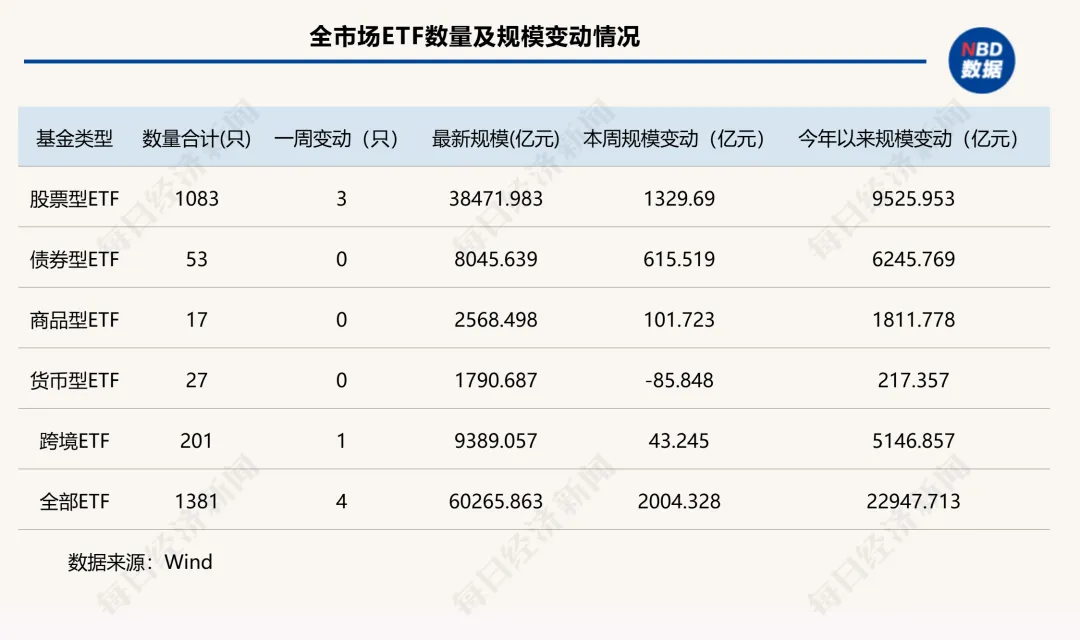
年末冲刺!单周狂增超2000亿元,ETF总规模首次突破6万亿元,“带头大哥”杀疯了!| ETF规模周报
Mei Ri Jing Ji Xin Wen· 2025-12-28 02:17
Core Insights - The A-share market is experiencing a rally, with major indices like the CSI 300 and the CSI A500 showing significant weekly gains of 1.95% and 2.75% respectively, while the ChiNext Index surged by 3.9% [1] - The domestic ETF market has reached a new milestone, surpassing 6 trillion yuan in total scale, with a weekly increase of 200.4 billion yuan [3][16] - The CSI A500 index-linked ETF has been a standout performer, with its scale increasing by over 1.066 billion yuan in December alone, entering the 300 billion yuan club [5][17] ETF Market Overview - The total number of ETFs listed has reached 1,381, with a total scale of 6.03 trillion yuan as of December 27, marking a significant growth trajectory throughout the year [3][4] - The stock-type ETFs have seen a substantial weekly increase of 1.33 billion yuan, contributing over 85% of the total growth, while bond-type ETFs also reached a new high, surpassing 800 billion yuan [3][4][16] - The growth intervals for the ETF market have shortened, with the market moving from 4 trillion to 5 trillion and then to 6 trillion yuan in just four months each time [3] Performance of Major ETFs - The CSI A500 ETF has shown remarkable growth, with a total scale increase of 1.066 billion yuan in December, and a net inflow of over 960 million yuan for the month [5][17] - Other major indices such as the CSI 300, CSI 500, and CSI 1000 also experienced significant scale increases, each surpassing 100 million yuan in growth [5] - The top 20 ETFs have mostly performed well, with only two experiencing a decrease in scale, highlighting the overall positive sentiment in the market [13] Management Institutions - The top seven fund management institutions have ramped up their efforts, with six of them seeing weekly growth exceeding 100 million yuan, led by Southern Fund with an increase of 343 million yuan [2][9] - Huaxia Fund and E Fund have also shown strong performance, with their ETF scales increasing by over 300 million yuan and 235 million yuan respectively [11][12] - The competitive landscape among fund managers remains intense, with both Huaxia and E Fund leading in year-to-date growth figures [12]
历史新高!突破6万亿元!
券商中国· 2025-12-28 01:06
Core Viewpoint - The Chinese ETF market has achieved a significant breakthrough, with total market size surpassing 6 trillion yuan, reflecting a profound evolution in investment structure and participation methods in the capital market [1][2]. Market Size and Growth - As of December 26, the total size of domestic ETFs reached 6.03 trillion yuan, marking a historical high and a growth of over 60% from 3.73 trillion yuan at the beginning of the year [1][2]. - The ETF market has experienced rapid expansion, achieving milestones of 4 trillion, 5 trillion, and 6 trillion yuan in 2025, indicating a faster pace of growth [1][3]. ETF Product Distribution - Among the total of 1,391 ETFs, stock ETFs dominate with a size of 3.85 trillion yuan, accounting for 64% of the total market size [3]. - The number of ETFs with a scale exceeding 100 billion yuan has reached 125, with 7 products classified as "flagship" exceeding 1 trillion yuan [1][6]. Fund Management and Market Share - The top three fund companies hold a combined market share of 41%, while the top ten companies account for 75%, and the top sixteen companies exceed 90%, highlighting a significant "head effect" in the ETF market [4][5]. - The leading ETF managers include Huaxia Fund with 960.14 billion yuan, E Fund with 888.33 billion yuan, and Huatai-PB Fund with 628.30 billion yuan [5]. Investment Trends and Future Outlook - The ETF market is transitioning from a phase of "scale expansion" to a new development cycle focused on "quality improvement," driven by policy support and enhanced registration efficiency for ETF products [10][11]. - The application of AI technology and the involvement of long-term capital are expected to further optimize the ETF market structure and enhance investment strategies [11].