
乐鑫科技

Search documents
浮盈超27亿 52家私募豪掷60亿掘金定增 电子行业最受青睐
2 1 Shi Ji Jing Ji Bao Dao· 2025-12-25 23:11
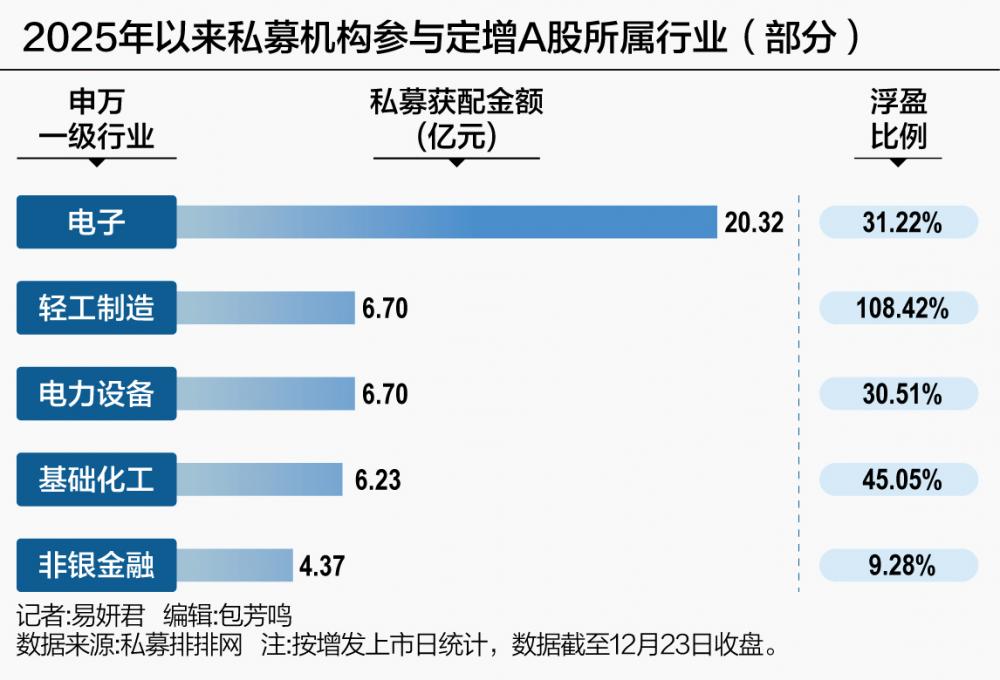
Core Insights - The A-share private placement market has shown significant profitability since 2025, with 52 private equity firms investing nearly 6 billion yuan and achieving a floating profit of over 2.7 billion yuan [1][4][7] - The electronic industry is the most favored sector for private placements, with substantial investments and high floating profits observed [4][5][8] Investment Trends - In 2025, the A-share private placement market rebounded significantly, with 158 companies conducting private placements, raising over 850 billion yuan, a year-on-year increase of more than 400% [4] - Private equity firms have shown high enthusiasm for participating in private placements, with a total allocation amounting to 5.98 billion yuan, a 23.48% increase from the previous year [4][5] - The electronic sector attracted the most investment, with private equity firms allocating 2.03 billion yuan across 10 electronic companies, accounting for 33.98% of total allocations [4][5] Profitability Analysis - As of December 23, 2025, the overall floating profit from private placements reached 2.72 billion yuan, with a floating profit ratio of 45.55% [7] - Among the 58 stocks involved in private placements, 54 are currently in a floating profit state, with 9 stocks showing a floating profit ratio exceeding 100% [8] - Notable performers include Demingli, with a floating profit ratio of 274.19%, contributing nearly 441 million yuan in floating profit [8] Private Equity Firm Performance - Large private equity firms have adopted a more conservative investment style, while smaller firms have favored growth-oriented strategies, achieving higher floating profits [9][10] - Smaller private equity firms, particularly those managing between 5 billion and 20 billion yuan, have reported floating profit ratios exceeding 100% [10][11] - Overall, 50 out of 52 private equity firms involved in private placements have achieved floating profits, with over 30% of firms reporting floating profit ratios above 50% [11] Market Dynamics - The surge in private placement investments is attributed to a combination of market stabilization, policy benefits, and the inherent discount advantages of private placement projects [13][14] - Private equity firms leverage their stock selection capabilities and negotiation advantages to secure excess returns in structural market conditions, further driving their participation in the private placement market [14]

“精准滴灌”新质生产力沃土 再融资改革赋能实体经济高质量发展
Zhong Guo Zheng Quan Bao· 2025-12-25 21:53
Group 1 - The refinancing market in the Shanghai Stock Exchange has shown significant growth in 2025, with over 800 billion yuan raised through equity financing, involving more than 100 companies, marking a substantial increase compared to the same period in 2024 [1][2] - The approval process for refinancing projects has accelerated, with nearly 40 new projects approved in the fourth quarter of 2025, reducing the average review period to around 2 months [1][2] - The Shanghai Stock Exchange has emphasized an open approach to review and regulation, enhancing proactive communication and feedback during the approval process, which has contributed to the rapid growth of refinancing activities [2] Group 2 - In 2025, the Shanghai Stock Exchange's main board raised a total of 715 billion yuan through targeted placements, while the Sci-Tech Innovation Board raised 55.65 billion yuan, both showing significant year-on-year growth [2] - The issuance of convertible bonds also saw substantial fundraising, with the main board raising 29.59 billion yuan and the Sci-Tech Innovation Board raising 8.76 billion yuan [2] - The regulatory support has been crucial for this growth, with specific projects like Xianghe Industrial and Haitai Co. completing their approvals in under 50 days [2] Group 3 - Companies like Cambrian Technology raised over 3.9 billion yuan for projects related to AI chips and software platforms, aligning with national strategic needs and enhancing their competitive edge [3] - Microchip Biotech's fundraising efforts are aimed at accelerating drug development and enhancing product pipelines, reflecting a focus on innovation and strategic alignment [3] Group 4 - The simplified procedures for refinancing have significantly improved efficiency, allowing companies to raise funds quickly, especially for amounts not exceeding 300 million yuan or 20% of net assets [4][5] - The first project under the simplified procedure on the Sci-Tech Innovation Board raised over 200 million yuan for R&D and operational needs, demonstrating the effectiveness of this new approach [4][5] Group 5 - Since the implementation of the "light asset, high R&D investment" standard, 14 companies have submitted refinancing applications totaling 35.12 billion yuan, indicating a positive market response [6] - Companies across various sectors, including new-generation information technology and biomedicine, are leveraging this standard to enhance their R&D capabilities and competitiveness [6][7] Group 6 - The introduction of the "light asset, high R&D investment" standard allows companies to allocate more resources to R&D, fostering innovation and product upgrades [7] - This standard has been particularly beneficial for high-tech companies, enabling them to secure necessary funding for ongoing projects in emerging fields like commercial aerospace and unmanned equipment [7]


再融资改革赋能实体经济高质量发展
Zhong Guo Zheng Quan Bao· 2025-12-25 21:11
Group 1 - The refinancing market in Shanghai has seen significant growth in 2025, with over 800 billion yuan raised through equity financing, involving more than 100 companies, marking a substantial increase compared to the same period in 2024 [1][2] - The approval process for refinancing has accelerated, with nearly 40 new refinancing projects approved in the fourth quarter of 2025, reducing the average review period to about two months [1][2] - The funds raised through refinancing are primarily directed towards expanding production capacity and strengthening supply chains, aligning with national strategic priorities [2][3] Group 2 - The simplified procedures for refinancing have enhanced efficiency, allowing companies to raise funds quickly, especially for amounts not exceeding 300 million yuan or 20% of net assets [3][4] - The introduction of the "light asset, high R&D investment" standard has enabled companies to better allocate resources towards research and development, fostering innovation and competitiveness [5][6] - A total of 14 companies have submitted refinancing applications under the new standard, with a combined intended financing amount of 35.12 billion yuan, indicating a positive market response [5]
浮盈超27亿!52家私募豪掷60亿掘金定增 电子行业最受青睐
2 1 Shi Ji Jing Ji Bao Dao· 2025-12-25 14:18
Core Insights - The A-share private placement market has shown significant profitability since 2025, with 52 private equity firms investing nearly 6 billion yuan and achieving a floating profit of over 2.7 billion yuan [1][2]. Group 1: Market Overview - In 2025, the A-share private placement market experienced a notable recovery, with 158 companies conducting private placements, raising over 850 billion yuan, a year-on-year increase of more than four times [1]. - Over 40% of companies that conducted private placements this year saw their stock prices rise by more than 50% after the shares were listed [1]. Group 2: Investment Strategies - Private equity firms have adopted differentiated investment strategies, with smaller firms achieving over 100% floating profits through high-risk strategies, while larger firms prefer stable investments to build safety margins [1][6]. - The electronic industry is the most favored sector for private placements, with 33.98% of total allocations going to 10 electronic companies, amounting to 2.03 billion yuan [3]. Group 3: Sector Performance - The electronic sector benefits from ongoing domestic innovation and shows competitive advantages in global markets, with significant growth expected due to AI and robotics hardware advancements [3]. - Other sectors attracting private equity investments include power equipment and light industry manufacturing, each receiving 670 million yuan [3]. Group 4: Individual Project Highlights - Several private placement projects attracted over 200 million yuan from private equity firms, including projects from companies like Lexin Technology and TCL Technology [4]. - The overall floating profit from private placements reached 2.72 billion yuan, with a floating profit ratio of 45.55% [4]. Group 5: Performance of Private Equity Firms - Among the 52 private equity firms participating in private placements, 50 achieved floating profits, with over 30% of firms seeing profits exceeding 50% [7]. - Smaller private equity firms have reported higher floating profits, with some achieving over 270% returns on specific investments [7]. Group 6: Market Dynamics - The enthusiasm for private placements is driven by a combination of market stabilization, policy benefits, and the inherent discount advantages of private placement projects [9]. - Private equity firms leverage their stock-picking skills and negotiation advantages to secure excess returns in a structural market [9].
浮盈超27亿!52家私募豪掷60亿掘金定增,电子行业最受青睐
2 1 Shi Ji Jing Ji Bao Dao· 2025-12-25 13:08
Group 1 - The A-share private placement market has shown significant profitability since 2025, with 52 private equity firms investing nearly 6 billion yuan and currently holding a floating profit of over 2.7 billion yuan [1][3] - Among the 58 stocks involved in private placements, 54 are currently in a floating profit state, with 9 stocks having a floating profit ratio exceeding 100% [1][6] - The electronic industry is the most favored sector by private equity firms, with significant investments also flowing into the power equipment sector, indicating a trend of capital gathering towards technological innovation and domestic autonomy [1][4] Group 2 - In 2025, the A-share private placement market has rebounded significantly, with 158 listed companies conducting private placements, raising over 850 billion yuan, a year-on-year increase of more than 4 times [3] - The majority of private placement projects have yielded substantial floating profits, with over 40% of companies seeing their stock prices rise by more than 50% since the issuance of new shares [3][4] - Private equity firms have participated in 58 stocks across 17 primary industries, with the electronic sector receiving the highest allocation of 2.03 billion yuan, accounting for 33.98% of the total allocation [3][4] Group 3 - The electronic industry benefits from ongoing domestic autonomy and shows competitive advantages in global markets, with increased profitability and growth certainty expected in 2025 due to accelerating hardware iterations and supportive policies [4] - Private placements in the electronic sector are primarily used for capacity expansion, technological research and development, and industry chain integration, aligning with the long-term value investment philosophy of private equity firms [4][6] - Other favored sectors include power equipment and light industry manufacturing, each attracting 670 million yuan in private placement investments [4] Group 4 - Smaller private equity firms have achieved higher floating profits, with some firms reporting floating profit ratios exceeding 100%, while larger firms have adopted a more conservative investment style [7][8] - Among the 52 private equity firms involved in private placements, 50 have realized floating profits, with over 30% of firms achieving floating profit ratios above 50% [9][10] - The enthusiasm for private placements is driven by the stability of the A-share market and the advantages of discounted pricing, providing a natural safety net for private equity firms [11][12]


2025年私募定增浮盈45.55% 电子行业最受青睐
Xin Hua Cai Jing· 2025-12-24 09:00
Core Insights - In 2025, private equity firms are increasingly enthusiastic about participating in A-share private placements, with a total investment of 5.98 billion yuan, marking a 23.48% increase from 4.84 billion yuan in 2024 [1] - The overall floating profit from these placements has reached 2.72 billion yuan, with a floating profit ratio of 45.55% [1] Group 1: Private Placement Market Overview - A total of 52 private equity firms have actively engaged in the private placement market, covering 58 A-share targets [1] - The price advantage of private placements provides a natural safety cushion for private equity firms, enhancing the attractiveness of this investment strategy [1] - Continuous optimization of refinancing policies and improved project quality have bolstered confidence in holding shares during the lock-up period [1] Group 2: Individual Stock Performance - There is a high concentration of private placements, with 34 stocks receiving over 50 million yuan in allocations, led by Lexin Technology with 788 million yuan [2] - Notably, the electronics sector has shown remarkable profitability, with some stocks like Demingli achieving a floating profit ratio of 274.19% [2] - Among the 58 stocks, 54 are currently in a floating profit state, with over 90% showing profitability, and 9 stocks exceeding a floating profit ratio of 100% [2] Group 3: Industry Distribution - Private placement funds have covered 17 sectors, with the electronics industry being the primary focus, attracting 2.03 billion yuan, accounting for 33.98% of total allocations [3] - The power equipment and light manufacturing sectors follow closely, each receiving 670 million yuan [3] - The electronics sector benefits from ongoing domestic substitution and has competitive advantages in the global market, with significant growth potential expected in 2025 [3]


【盘中播报】145只个股突破年线
Zheng Quan Shi Bao Wang· 2025-12-24 06:32
Market Overview - The Shanghai Composite Index closed at 3940.67 points, above the annual line, with a gain of 0.53% [1] - The total trading volume of A-shares reached 15,224.97 million yuan [1] Stocks Breaking Annual Line - A total of 145 A-shares have surpassed the annual line today, with notable stocks including: - Supcon Test (300887) with a deviation rate of 15.30% - New Jingang (300629) with a deviation rate of 10.60% - Yongyue Technology (603879) with a deviation rate of 9.68% [1] Deviation Rate Rankings - The top stocks with significant deviation rates from the annual line include: - Supcon Test: Today's price increased by 19.95% with a turnover rate of 15.61% [1] - New Jingang: Today's price increased by 20.02% with a turnover rate of 23.76% [1] - Yongyue Technology: Today's price increased by 10.09% with a turnover rate of 5.48% [1] Additional Notable Stocks - Other stocks that have recently crossed the annual line include: - Zhenzhen Technology (003007) with a deviation rate of 8.41% and a price increase of 9.99% [1] - Jun Da Co., Ltd. (002865) with a deviation rate of 6.95% and a price increase of 10.01% [1] - Daye Co., Ltd. (603278) with a deviation rate of 6.60% and a price increase of 9.98% [1]



震裕科技子公司拟投资两个10亿元,银河通用机器人拿下1000台机器人订单!
Mei Ri Jing Ji Xin Wen· 2025-12-24 01:01
Group 1: Market Performance - The Huaxia Sci-Tech AI ETF (589010) increased by 0.15%, demonstrating resilience amid market fluctuations and outperforming the benchmark index [1] - Leading stocks such as Cambricon Technologies (寒武纪-U) surged nearly 4%, while Qi An Xin (奇安信-U) rose over 2%, effectively offsetting some of the pressure from small and mid-cap stock pullbacks [1] - The Robot ETF (562500) experienced a slight decline of 0.74%, trading at 0.945 yuan, and is undergoing technical consolidation near a key support level [1] - Despite market volatility, stocks like Quick Intelligent (快克智能) and Keri Technology (科瑞技术) hit the daily limit up, indicating a strong internal structural market [1] - The Robot ETF saw significant net inflows totaling nearly 290 million yuan over two days, with a single-day net inflow reaching 156 million yuan, reflecting robust liquidity [1] Group 2: Company Developments - Zhenyu Technology (震裕科技) announced plans to invest no less than 1 billion yuan in projects related to core components for new energy vehicle drives, low-altitude flying vehicle drives, and humanoid robot drives [2] - Galaxy General Robotics (银河通用机器人) has formed a strategic partnership with Baida Precision (百达精工) to deploy over 1,000 robots within Baida's ecosystem, focusing on industrial precision manufacturing [2] - Wanxiang Qianchao (万向钱潮) has established its robotics business as its third strategic business segment, with plans to optimize its supply chain and expand production capacity for various robotic components [3] Group 3: Industry Insights - Guojin Securities emphasizes the importance of dexterous hands, motors, and PEEK materials in the humanoid robot sector, highlighting advancements in tactile sensor technology and processing techniques [4] - The Robot ETF (562500) is noted for being the only ETF in the market with a scale exceeding 20 billion yuan, providing optimal liquidity and comprehensive coverage of the Chinese robotics industry [5] - The Huaxia Sci-Tech AI ETF (589010) is characterized as the "brain" of robotics, capturing the AI industry's potential with a 20% price fluctuation range and flexibility in small-cap stocks [5]


东海证券晨会纪要-20251223
Donghai Securities· 2025-12-23 04:17
Group 1 - The core viewpoint of the report emphasizes that the semiconductor industry is experiencing an upward cycle, driven primarily by high growth in AI, storage, and equipment sectors. The first half of 2026 is expected to continue this structural high growth trend, while the second half will require attention to demand recovery and policy stimulation [5][6][7]. - Global semiconductor product sales from January to October 2025 showed a year-on-year increase of 21.19%, with silicon wafer shipment area increasing by 4.99% in Q1-Q3 2025. Storage module prices have surged between 140% to 600% since the beginning of 2025, indicating a significant supply-demand mismatch that may persist into the first half of 2026 [5][6]. - The report highlights that AI is experiencing a comprehensive resonance from cloud servers to edge applications, with long-term growth trends remaining strong despite short-term concerns about investment overheating. The AI industry is driving rapid growth in various upstream sectors, benefiting domestic companies in China [6][7]. Group 2 - Micron's performance exceeded expectations, with Q1 2026 revenue reaching $13.64 billion, a 57% year-on-year increase. The company anticipates further revenue growth to approximately $18.7 billion in the next quarter, driven by strong demand for high-bandwidth memory (HBM) [11][12]. - Xiaomi has launched its new large model MiMo-V2-Flash, showcasing significant performance improvements and cost-effectiveness in inference, which could accelerate the application of large models in China. The model's API call cost is only 2.5% of comparable closed-source models, indicating a breakthrough in performance-to-cost ratio [13]. - The report suggests focusing on structural opportunities in AI computing, AIOT, semiconductor equipment, and rising storage prices, as the electronic industry continues to recover from previous downturns [11][16].
ETF盘中资讯 | 谁能成为中国的英伟达?寒武纪领涨超3%,重仓国产AI产业链——科创人工智能ETF(589520)盘中摸高0.88%
Jin Rong Jie· 2025-12-23 02:50
Group 1 - The core viewpoint of the news highlights the rapid growth of China's AI industry, particularly following the emergence of DeepSeek, which has led to a new era of domestic AI models [2] - The total market capitalization of China's top three AI chip companies, Cambricon, Moore Threads, and Muxi, has surpassed 1 trillion yuan, but there remains a significant gap compared to Nvidia's market cap of approximately 4.4 trillion USD (around 30 trillion yuan) [2] - The competition among Cambricon, Moore Threads, and Muxi is intensifying, with the potential for one to emerge as a leader in the Chinese AI chip market as market and policy benefits continue to unfold [2] Group 2 - The Sci-Tech Innovation Artificial Intelligence ETF (589520) is focused on the domestic AI industry chain and has shown a price increase of 0.88% in early trading, with a current rise of 0.18% [1] - The ETF's top ten holdings account for over 70% of its weight, with the semiconductor sector representing more than half of this concentration, indicating a strong offensive strategy [3] - East China Securities recommends focusing on the domestic supply chain due to the urgent need for domestic semiconductor production amid comprehensive overseas restrictions on advanced logic and storage industries [2]
