三星电子

Search documents
韩国芯片,赢麻了
半导体行业观察· 2026-01-22 04:05
2025年,韩国各产业部门的境遇喜忧参半。受美国加征关税和俄乌战争的影响,汽车和石化行业举步 维艰;而半导体、造船和国防等行业则因全球需求增长而蓬勃发展。我们将探讨2026年影响全球经济 的关键因素,并预测各行业将受到的影响。[编者注] 公众号记得加星标⭐️,第一时间看推送不会错过。 去年支撑韩国出口增长的是"半导体"行业。随着人工智能(AI)在全球范围内的普及,以三星电子和 SK海力士为首的存储芯片需求激增,并进入繁荣期。半导体出口增长超过30%,抵消了石化和钢铁 等传统制造业的下滑。 今年的前景更为光明。据韩国进出口银行海外经济研究所预测,韩国今年半导体出口额预计将同比增 长11%,达到1880亿美元(约合254万亿韩元),连续第二年创下历史新高。 世界半导体贸易统计(WSTS)预测,2026年全球半导体市场规模将比上年增长超过25%,达到约 9750亿美元。其中,存储器市场预计将实现30%左右的增长,超过整体增速。在DRAM市场,三星 电子和SK海力士合计占据约70%的全球市场份额;在NAND闪存市场,两家公司的市场份额合计约 为50%。 三星电子和SK海力士合并后的营业利润预计将超过200万亿韩元 在 ...

特朗普TACO助推亚太股市上涨,芯片股涨势如虹,韩股突破5000大关!黄金跌破4800
Hua Er Jie Jian Wen· 2026-01-22 03:23
Group 1 - The core sentiment in the market has shifted positively following President Trump's decision to abandon tariffs on Europe and comments regarding a "framework agreement" on Greenland, leading to a rise in stock markets across the Asia-Pacific region and a decline in safe-haven assets like gold [1] - The South Korean Composite Index surged by 2.18% to reach 5017.16 points, marking a significant increase driven primarily by the semiconductor sector [2][5] - Nvidia's CEO highlighted the need for "trillions of dollars" in global AI infrastructure investment, which has led to increased buying interest in the semiconductor sector, with notable gains for companies like Disco in Japan and Samsung Electronics in South Korea [3][7] Group 2 - The strong momentum in chip stocks has propelled the South Korean Composite Index to a historic high, with a month-to-date increase of nearly 20% [5][6] - Reforms aimed at addressing the "Korean discount" issue are gaining traction, boosting investor confidence, as analysts suggest that the Composite Index still has room for further growth due to reasonable valuations [7][10] - The South Korean government is expected to announce measures to curb the voting power of controlling families and increase the rights of minority shareholders, which may enhance overall market dynamics [11]

全球8英寸晶圆供需正步入失衡期,我国国产化力度超预期,集成电路ETF(562820)一键布局全产业链芯片龙头
Xin Lang Cai Jing· 2026-01-22 03:05
Group 1 - The core viewpoint of the articles highlights the current trends and challenges in the semiconductor industry, particularly focusing on the 8-inch wafer supply-demand imbalance and the rise of domestic foundries in China [1] - The China Securities Index for integrated circuits has seen a decline of 0.52%, with mixed performance among constituent stocks, where Longxin Technology led with a 7.04% increase [1] - According to a report by TrendForce, the global 8-inch wafer foundry capacity is expected to shrink by 2.4% due to strategic capacity reductions by TSMC and Samsung [1] Group 2 - The demand for AI-driven power management chips remains strong, contributing to an increase in the average capacity utilization rate in the industry, which is projected to reach 90% [1] - Domestic wafer foundries in China are emerging as alternatives to meet the demand for 8-inch chips, with price adjustments expected to range from 5% to 20% [1] - TSMC plans to significantly increase its capital expenditure to between $52 billion and $56 billion in 2026 to accelerate advanced process capacity construction in response to the ongoing demand for AI computing power chips [1] Group 3 - As of December 31, 2025, the top ten weighted stocks in the China Securities Index for integrated circuits account for 53.66% of the index, including companies like Cambricon, SMIC, and Haiguang Information [2] - The integrated circuit ETF (562820) serves as a convenient tool for investors to gain exposure to leading companies across the entire semiconductor industry chain [2] Group 4 - Investors without stock accounts can also access investment opportunities in the semiconductor sector through the integrated circuit ETF linked fund (022350) [3]

韩元疲软及金融风险上升制约刺激政策空间 韩国四季度经济意外萎缩
Zhi Tong Cai Jing· 2026-01-22 03:01
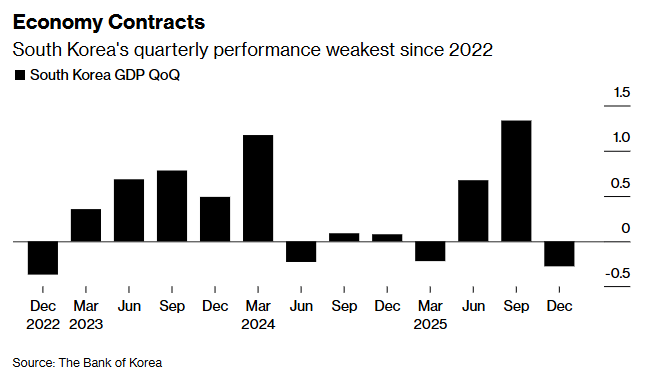
由于需求全面回落,韩国经济在2025年最后一个季度出现萎缩,凸显出当局在刺激经济增长方面面临的 挑战,其政策空间受到韩元走弱与金融风险上升的制约。韩国央行周四表示,截至12月的三个月里,国 内生产总值(GDP)环比收缩0.3%。这一结果较前一季度修正后的1.3%增长大幅放缓,也低于分析师预期 的增长0.2%增长;就2025年全年而言,韩国经济增长1%,与市场预期一致。 与此同时,这些数据也不太可能促使韩国央行转向。去年第三季度经济环比增长1.3%,高于官方估计 的潜在经济增速,使得年末出现回调几乎不可避免。此外,部分数据可能在统计编制过程中被放大。 第四季度净出口环比下降2.1%,扭转了第三季度中2.1%的增长。该季度结果可能反映了将名义数据调 整为实际数据的影响,而期间韩元贬值也可能在统计中抬高了进口成本。 尽管如此,这些数据也凸显出复苏的不均衡性,反映出"K形增长"的迹象——与半导体相关的出口导向 型行业表现持续跑赢,而建筑业和对利率敏感的家庭以及小企业仍在艰难恢复。这一趋势引发了担忧, 即总体增长数据可能掩盖更深层次的结构性失衡。 这种分化在金融市场中愈发明显。继2025年累计飙升76%后,韩国基准股指 ...
AI需求助推韩国综指冲破5000点新高,分析师:“这仅仅是个开始”
Sou Hu Cai Jing· 2026-01-22 02:51
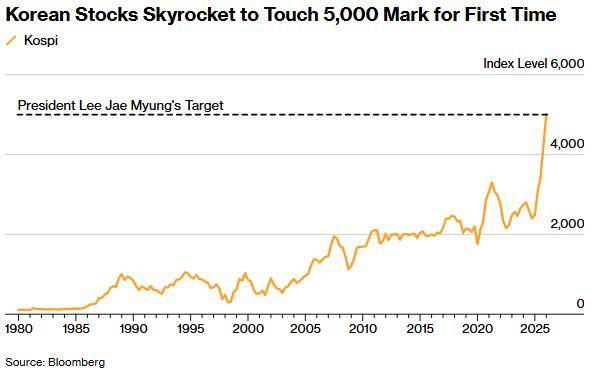
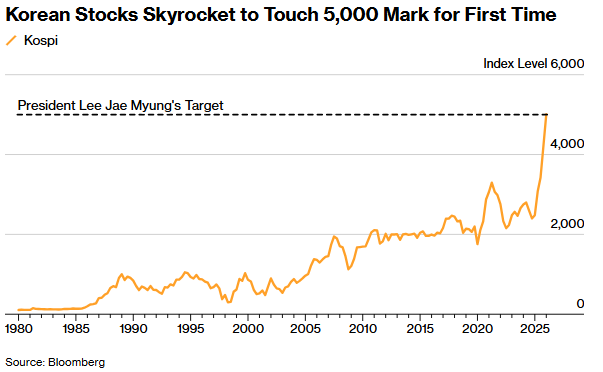
Core Viewpoint - The South Korean stock market, driven by AI demand and easing volatility from geopolitical tensions, has surpassed the 5000-point target set by President Yoon Suk-yeol, with the KOSPI index rising over 95% in the past year, making it the best-performing benchmark globally [1][4]. Group 1: Market Performance - The KOSPI index reached 5019.54 points, up 2.2%, with major contributors including Samsung Electronics, SK Hynix, and Hyundai Motor [1]. - The KOSPI index has shown consistent growth, with all but one trading day in January recording gains, despite external pressures such as U.S. tariff threats [4]. - Analysts predict the KOSPI could reach 6000 points within two months, indicating that the current level is not overly high [4][5]. Group 2: Economic Factors - The surge in the KOSPI reflects South Korea's transition from a cyclical export market to a key beneficiary of the global AI boom, particularly due to its dominance in data center memory chips [1]. - The global shortage of memory chips, driven by increased AI server demand, has significantly boosted profits for companies like Samsung Electronics, which reported a more than twofold increase in quarterly profits [6]. Group 3: Valuation and Governance - Despite reaching record highs, the KOSPI still lags behind regional peers in key valuation metrics, with a price-to-book ratio of approximately 1.6, lower than the MSCI Emerging Markets Index and Taiwan Weighted Index [4]. - The concept of "Korea Discount," referring to the long-standing valuation discount due to weak corporate governance, is expected to diminish, providing further room for market growth [4][9]. - Legislative reforms aimed at enhancing corporate governance and shareholder returns are underway, including amendments to the Commercial Act to strengthen board accountability [8]. Group 4: Market Sentiment and Future Outlook - Market sentiment remains cautious, with retail investors showing restraint compared to previous market peaks, leading to a disconnect between domestic stocks and the Korean won [8]. - Optimism persists regarding structural improvements in the stock market, supported by government-led initiatives to enhance shareholder returns and increase liquidity [8]. - Analysts from Goldman Sachs forecast a 23% return for Korean stocks in USD terms this year, bolstered by a favorable macro environment and expected earnings growth of 53% [5].
AI需求助推韩国综指冲破5000点新高 分析师:“这仅仅是个开始”
智通财经网· 2026-01-22 02:40
Group 1 - The South Korean stock market, driven by demand for artificial intelligence and easing volatility from geopolitical tensions, has surpassed the 5000-point target set by President Yoon Suk-yeol, with the KOSPI index rising 2.2% to 5019.54 points, marking a 95% increase over the past 12 months, making it the best-performing benchmark globally [1] - Major contributors to this surge include leading stocks such as Samsung Electronics, SK Hynix, and Hyundai Motor, with rising memory prices translating into profit growth for these companies [1] - The KOSPI's rise signifies a political milestone, reinforcing the government's commitment to addressing long-standing corporate governance issues that have hindered valuations [1] Group 2 - The Chief Investment Officer of Life Asset Management predicts that the KOSPI could reach 6000 points within two months, suggesting that the current level is not overly high and that the market is normalizing [2] - Despite geopolitical tensions, the KOSPI has shown resilience, with a notable increase in January, and is part of a regional relief rally following a framework agreement between the U.S. and NATO regarding Greenland [2] - President Yoon emphasized that he is not artificially inflating stock prices but rather aiming for market normalization, indicating a responsible investment approach [2] Group 3 - The concept of "Korea Discount," which refers to the valuation discount due to weak corporate governance, is expected to diminish, allowing for further upward movement in the KOSPI [3] - The KOSPI's price-to-book ratio is approximately 1.6 times, lower than the MSCI Emerging Markets Index and Taiwan's weighted stock index, indicating potential for valuation improvement [3] - Market observers remain optimistic, with Goldman Sachs forecasting a 23% return for Korean stocks in USD terms this year, supported by a 53% earnings growth and favorable macro conditions [3] Group 4 - A global shortage of memory chips is a significant tailwind, with AI server demand driving memory prices up, resulting in Samsung Electronics' quarterly profits more than doubling to a record high [5] - The supply-demand dynamics for memory chips are expected to remain "imbalanced" until 2027 due to cautious capital expenditure and new capacity from manufacturers, suggesting further upside potential [5] Group 5 - There are concerns about profit-taking pressure that could lead to sudden sell-offs, as the recent surge has been driven by a limited number of buyers, primarily local institutional investors [8] - Retail investor sentiment is more restrained compared to the post-pandemic market peak in 2021, with many retail investors shifting funds to U.S. stocks, contributing to the weakening of the Korean won and a disconnect from the domestic market [8] - Despite these concerns, there is a prevailing optimism regarding structural improvements in the stock market, supported by government-led initiatives aimed at enhancing shareholder returns and increasing liquidity [8] Group 6 - The South Korean market has historically traded at a significant discount, and ongoing reform progress, coupled with effective execution, may support further valuation re-rating [9]
开盘大涨!
中国基金报· 2026-01-22 02:18
【导读】日韩股市走高,现货白银跌超2% 中国基金报记者 李智 一起来看下日韩股市的最新情况。 韩国股市突破5000点 1月22日,韩国股市KOSPI指数涨超2%,再创历史新高,首次突破韩国总统李在明设立的 5000点目标。 | 首尔综合指数 | | | | | | | | --- | --- | --- | --- | --- | --- | --- | | 指 HQ.KOSPI | | | | | | | | 5013.74 +103.81 +2.11% | | | | | | | | 01-22 08:28:30 | | | | | | | | 今开 4987.06 | | | 最高 5019.54 | | | | | 昨收 4909.93 | | | 最低 4985.69 | | | | | 分时 月K | 日K | 周K | | 室K | 更多, ◎ | | | 均价:5007.79 最新:5013.74 +103.81 +2.11% | | | | | | | | 201854 | | | | | | 2.23% | | 4909.93 | | | | | | 0.00% | | 4800.32 | ...

反攻!全球股市,集体上涨!
券商中国· 2026-01-22 02:13
Core Viewpoint - The article highlights a positive shift in market sentiment, driven by easing geopolitical tensions and strong performances in global stock markets, particularly in the U.S. and Asia [1][2][3]. Market Performance - Asian markets saw a collective rise, with the South Korean KOSPI index surpassing 5000 points for the first time, reaching a peak of 5019.54 points before closing at 4983 points, up 1.49% [1][3]. - The Japanese Nikkei 225 index also increased by over 1%, with significant gains in semiconductor-related stocks [3]. - U.S. markets experienced a broad rally, with the Dow Jones, S&P 500, and Nasdaq all rising by more than 1% [2][4]. Sector Highlights - In the U.S., large technology stocks performed well, with Intel rising over 11% and AMD increasing by over 7% [4]. - Semiconductor stocks, including SanDisk and Western Digital, saw substantial gains, reflecting strong investor interest in the sector [4]. Geopolitical Context - The easing of tensions regarding Greenland between the U.S. and Europe contributed to a reduction in market volatility, with President Trump indicating that military action was not being considered [5][6]. - Trump's comments on economic growth and stock market performance suggest a bullish outlook, with expectations of significant market gains in the future [6].

港股芯片股领涨市场,ASMPT涨超7%
Mei Ri Jing Ji Xin Wen· 2026-01-22 01:57
每经AI快讯,1月22日,港股芯片股领涨市场,ASMPT涨超7%,公司与三星电子讨论供应事宜;英诺 赛科涨超5%,天数智芯涨超4%,壁仞科技涨超3%。 ...

和众汇富研究手记:三星减产叠加AI升级重塑半导体格局
Cai Fu Zai Xian· 2026-01-22 01:56
在终端产品层面,三星同样选择以技术升级来对冲行业波动风险。即将推出的Galaxy S26系列手机,将 首发全新升级的Bixby智能助手,核心卖点聚焦自然对话与情境化控制,强调从"语音指令"向"智能理 解"的跨越。这一变化反映出三星在移动端AI布局上的战略调整,即不再仅依赖硬件参数竞争,而是通 过软件和生态提升用户黏性。和众汇富观察发现,随着生成式AI逐步向终端侧渗透,智能助手的能力 将成为高端手机差异化竞争的重要因素。 从更宏观的视角看,三星电子当前的多线布局,体现了其在复杂周期中的平衡策略。一方面,通过 NAND减产稳定存储业务的盈利预期,避免价格战侵蚀现金流;另一方面,加大在2纳米制程和终端AI 体验上的投入,为未来增长积蓄动能。这种"收与放并行"的策略,在全球半导体龙头中具有一定代表 性。和众汇富认为,在行业不确定性加大的阶段,能够同时兼顾短期盈利与长期技术竞争力的企业,更 有可能在下一轮周期中占据主动。 近期,全球半导体产业链再度迎来关键信号。三星电子与SK海力士相继明确,计划在2026年同步下调 NAND闪存晶圆投片量,其中三星电子预计将年度晶圆投入量由2025年的约490万片降至468万片,SK ...