
洋河股份

Search documents
6亿酱酒项目发布,吃喝板块继续上攻!机构高呼:三重底部或现
Xin Lang Ji Jin· 2025-10-15 06:29
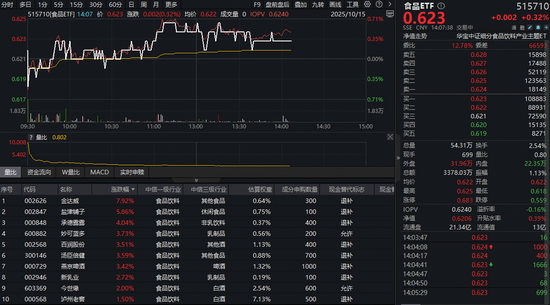
Core Viewpoint - The food and beverage sector is experiencing a positive trend, with the Food ETF (515710) showing an increase of 0.32% as of October 15, 2023, indicating a favorable market sentiment towards this sector [1][2]. Group 1: Market Performance - The Food ETF (515710) has been trading positively, with a price increase of 0.32% during the day [1][2]. - Key stocks in the consumer goods sector have shown significant gains, with Jin Dawei rising nearly 8%, and other companies like Yan Jin Pu Zi and Cheng De Lu Lu increasing over 5% [1][3]. - Major liquor brands also performed well, with Luzhou Laojiao up over 1% and other leading brands like Guizhou Moutai and Shanxi Fenjiu showing slight increases [1][3]. Group 2: Investment Opportunities - The recent announcement of a 600 million yuan investment project in sauce-flavored liquor in Guizhou is seen as a strategic move to enhance the production capacity and cultural display in the region, which could benefit the local industry [3]. - Analysts suggest that the food and beverage sector is currently undervalued, with the Food ETF's price-to-earnings ratio at 20.44, indicating a good opportunity for long-term investment [3][4]. - The sector is characterized by low expectations and low holdings, suggesting that any changes in supply and demand could lead to significant price increases [4]. Group 3: Future Outlook - Securities firms are optimistic about the food and beverage sector, highlighting that the current low base and potential for recovery could lead to a positive market environment [4]. - The focus is on companies with strong fundamentals, particularly in the snack, beverage, and frozen food segments, which are expected to report high growth in their upcoming quarterly results [4][5]. - The Food ETF is recommended as a core asset for investors looking to gain exposure to the food and beverage sector, with a significant portion of its holdings in leading liquor brands and other food-related stocks [5].






超4000家企业参展,十大特色展区精彩纷呈
Nan Jing Ri Bao· 2025-10-15 02:32
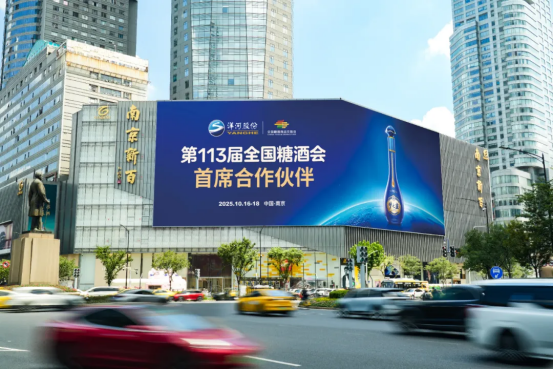
Group 1 - The 113th National Sugar and Wine Products Trade Fair will be held from October 16 to 18 at the Hexi Group Nanjing International Expo Center, attracting over 4,000 exhibitors and covering an exhibition area of 200,000 square meters [1] - The event features ten distinctive exhibition areas, including traditional liquor, international wines and spirits, and snacks, with major brands like Moutai, Yanghe, COFCO, and Three Squirrels participating [2] - The "Autumn Sugar Season" concept extends the fair's impact throughout the city, with over 70 themed activities taking place, allowing citizens and tourists to experience the festive atmosphere even without entering the main venue [2] Group 2 - Key meetings and forums will be held, including the Food and Beverage Industry Development Conference and the first China Food Industry Channel Summit, providing a platform for industry professionals to engage in deep discussions [2] - The fair offers a one-stop experience for global cuisine, with exhibitors presenting authentic flavors, and a local "Autumn Sugar Food Map" featuring limited-time activities from 70 well-known restaurants in Nanjing [3]
2025年南京糖酒会 | 三“洋”开泰!洋河邀您共赴绵柔之约赴绵柔之约
Zhong Guo Jing Ji Wang· 2025-10-14 13:55
Core Viewpoint - The 113th National Sugar and Wine Fair will take place in Nanjing from October 16 to 18, showcasing the vibrant culture and products of the Jiangsu region, with Yanghe as the chief partner, highlighting its status in the industry and commitment to quality and cultural heritage [1][4][5]. Group 1: Event Overview - The National Sugar and Wine Fair is set to be a grand event in Nanjing, with the city adorned in festive decorations to welcome guests [1]. - Yanghe will create an immersive experience at the fair, featuring classic and innovative products, along with special events like the "Autumn Tasting of Soft Aroma" and the "2025 Super Fan Festival" [4][5]. Group 2: Yanghe's Industry Position - Yanghe is recognized as the "ancestor of soft aroma" liquor, establishing a new quality style in the industry and representing the typical characteristics of strong aroma liquor [4]. - The brand is not only a symbol of Jiangsu but also a national icon, reflecting its deep cultural roots and consumer connection [5][8]. Group 3: Consumer Engagement - Yanghe has become a cultural symbol in the hearts of consumers, associated with celebrations and family gatherings, making it a national brand deeply embedded in consumer sentiment [8]. - The "Billion Dollar Product, Annual Sales of 10 Million Bottles" Yanghe Sea Blue has maintained high quality and warmth, becoming an essential classic for consumers [10].

连跌多日的白酒股逆市反弹:大量资金涌入板块,段永平也加仓
Nan Fang Du Shi Bao· 2025-10-14 12:39
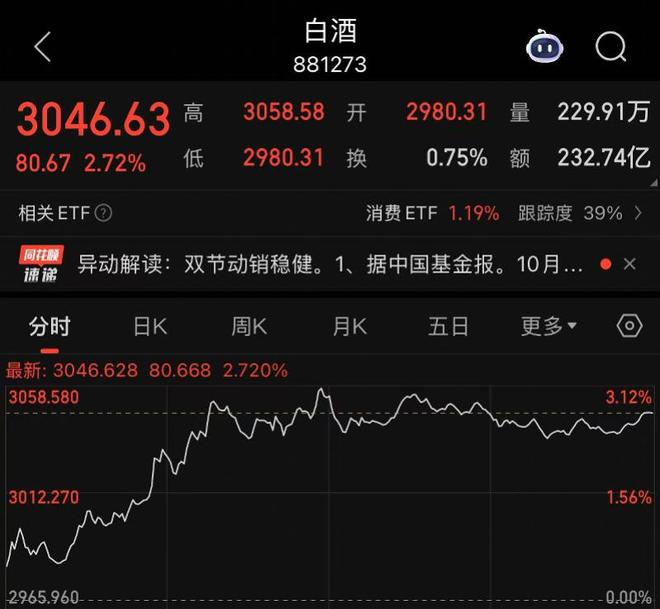
Core Viewpoint - The white liquor sector has experienced a rebound after a period of underperformance during the "Mid-Autumn and National Day" holiday season, with all constituent stocks rising for the first time since September 12 [1][3]. Market Performance - On October 14, the white liquor index closed at 3046.63 points, up 2.72%, with all constituent stocks recording gains [1]. - Notable performers included Jiu Gui Jiu and She De Jiu Ye, which rose by 6.68% and 6.27% respectively, while Lu Zhou Lao Jiao increased by over 4% [1]. Sales Trends - Despite a significant increase in sales volume in August and September, the overall performance during the holiday season was disappointing, with some distributors reporting a year-on-year sales decline of 20% to 30% [3]. - High-end liquor products faced varying degrees of unsold inventory, while mid-range and mass-market products saw increased sales [3]. New Sales Channels - New retail channels have shown strong performance, with one platform reporting an 8-fold increase in white liquor sales during the holiday period, and top brands like Moutai and Wuliangye achieving daily sales exceeding 10 million yuan [3][4]. Investor Sentiment - Market expectations regarding the poor performance of white liquor during the holiday season had already been priced in, leading to profit-taking by investors since early September [4]. - On October 14, the white liquor sector saw a net inflow of 1.07 billion yuan, primarily driven by large orders [4]. Future Outlook - Analysts from Kaiyuan Securities suggest that the white liquor market is showing signs of bottoming out, with negative factors like high social inventory and fluctuating consumption environment being released [5]. - CITIC Securities believes the industry is in a bottoming phase, with a potential turning point in sales expected by Q1 2024 [5]. - The upcoming "Double 11" sales event and year-end sales peak are anticipated to impact the industry's performance, with a focus on inventory digestion and price adjustments as key factors for recovery [5].

全面复盘酒企八大发展阶段,和君万字详解精准破局策略
Sou Hu Cai Jing· 2025-10-14 08:59
Core Insights - The common response strategy for liquor companies at different stages is the synergistic development of "stabilizing the fundamentals" and "seeking innovation" [2][61] - The white liquor industry has experienced eight distinct stages, each facing unique market challenges and core pain points, necessitating the identification of key drivers and factors for successful transitions to the next stage [3][4] Industry Overview - As of June 2025, the number of large-scale white liquor enterprises (annual revenue over 20 million RMB) has decreased from 1,593 in 2017 to 887, indicating a trend of market share and profits concentrating among leading companies [4] - The production of white liquor has seen a decline, with a reported 6.5% year-on-year decrease in June 2025 and a cumulative 5.8% decrease in the first half of 2025 [2] Company Development Stages - The eight stages of liquor company development are characterized by specific sales scales and corresponding market strategies, emphasizing systematic upgrades in products, channels, brands, and organization [3][4] - Each stage has distinct characteristics, market performance, core pain points, and breakthrough strategies, which are essential for companies to navigate their growth effectively [7][13][24][34][40] Market Dynamics - The industry is witnessing a continuous increase in concentration, with a clear "pyramid" structure where a small number of top companies capture most of the industry's profits, while numerous small enterprises struggle for survival and growth [6][12] - The competitive landscape is shifting towards a focus on brand recognition and consumer engagement, moving away from reliance on government-related consumption [53] Strategic Recommendations - Companies are encouraged to integrate artificial intelligence into their strategic planning, organizational structure, and business processes to drive intelligent development and upgrade traditional industries [2][19] - Emphasis on product focus, pricing stability, and channel management is crucial for companies at various stages to enhance their market presence and profitability [9][22][27][37] Conclusion - The liquor industry must adapt to current challenges by restructuring brand, product, regional, and channel strategies while leveraging organizational upgrades and AI technology to overcome growth bottlenecks [61]




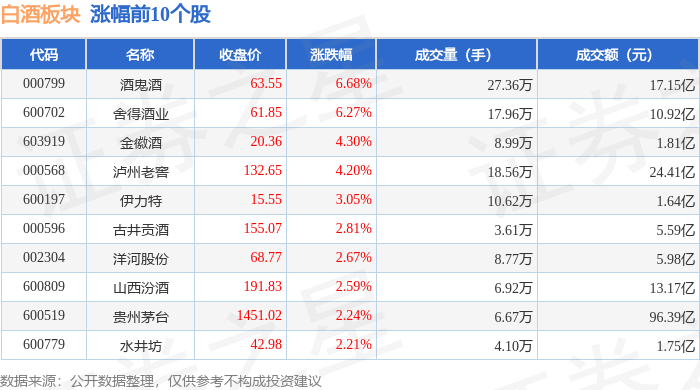
白酒板块10月14日涨2.4%,酒鬼酒领涨,主力资金净流入11.29亿元
Zheng Xing Xing Ye Ri Bao· 2025-10-14 08:39
Core Insights - The liquor sector experienced a 2.4% increase on October 14, with Jiu Gui Jiu leading the gains [1] - The Shanghai Composite Index closed at 3865.23, down 0.62%, while the Shenzhen Component Index closed at 12895.11, down 2.54% [1] Liquor Sector Performance - Jiu Gui Jiu (code: 000799) closed at 63.55, up 6.68% with a trading volume of 273,600 shares and a transaction value of 1.715 billion [1] - She De Jiu Ye (code: 600702) closed at 61.85, up 6.27% with a trading volume of 179,600 shares and a transaction value of 1.092 billion [1] - Jin Hui Jiu (code: 616809) closed at 20.36, up 4.30% with a trading volume of 89,900 shares and a transaction value of 181 million [1] - Lu Zhou Lao Jiao (code: 000568) closed at 132.65, up 4.20% with a trading volume of 185,600 shares and a transaction value of 2.441 billion [1] - Yi Li Te (code: 600197) closed at 15.55, up 3.05% with a trading volume of 106,200 shares and a transaction value of 164 million [1] - Guo Jing Gong Jiu (code: 000596) closed at 155.07, up 2.81% with a trading volume of 36,100 shares and a transaction value of 559 million [1] - Yang He Guo Fen (code: 002304) closed at 68.77, up 2.67% with a trading volume of 87,700 shares and a transaction value of 598 million [1] - Shan Xi Fen Jiu (code: 600809) closed at 191.83, up 2.59% with a trading volume of 69,200 shares and a transaction value of 1.317 billion [1] - Gui Zhou Mao Tai (code: 600519) closed at 1451.02, up 2.24% with a trading volume of 66,700 shares and a transaction value of 9.639 billion [1] - Shui Jing Fang (code: 600779) closed at 42.98, up 2.21% with a trading volume of 41,000 shares and a transaction value of 175 million [1] Capital Flow Analysis - The liquor sector saw a net inflow of 1.129 billion from main funds, while retail funds experienced a net outflow of 664 million [1] - Main fund inflows for Gui Zhou Mao Tai amounted to 529 million, while retail funds saw a net outflow of 382,400 [2] - Main fund inflows for Wu Liang Ye were 326 million, with retail funds experiencing a net outflow of 162 million [2] - She De Jiu Ye had main fund inflows of 85.6 million, while retail funds saw a net outflow of 82.1 million [2] - Lu Zhou Lao Jiao had main fund inflows of 83.7 million, with retail funds experiencing a net outflow of 1.53 billion [2] - Jiu Gui Jiu had main fund inflows of 76.1 million, while retail funds saw a net outflow of 995.3 million [2] - Guo Jing Gong Jiu had main fund inflows of 54.2 million, with retail funds experiencing a net outflow of 612.4 million [2]


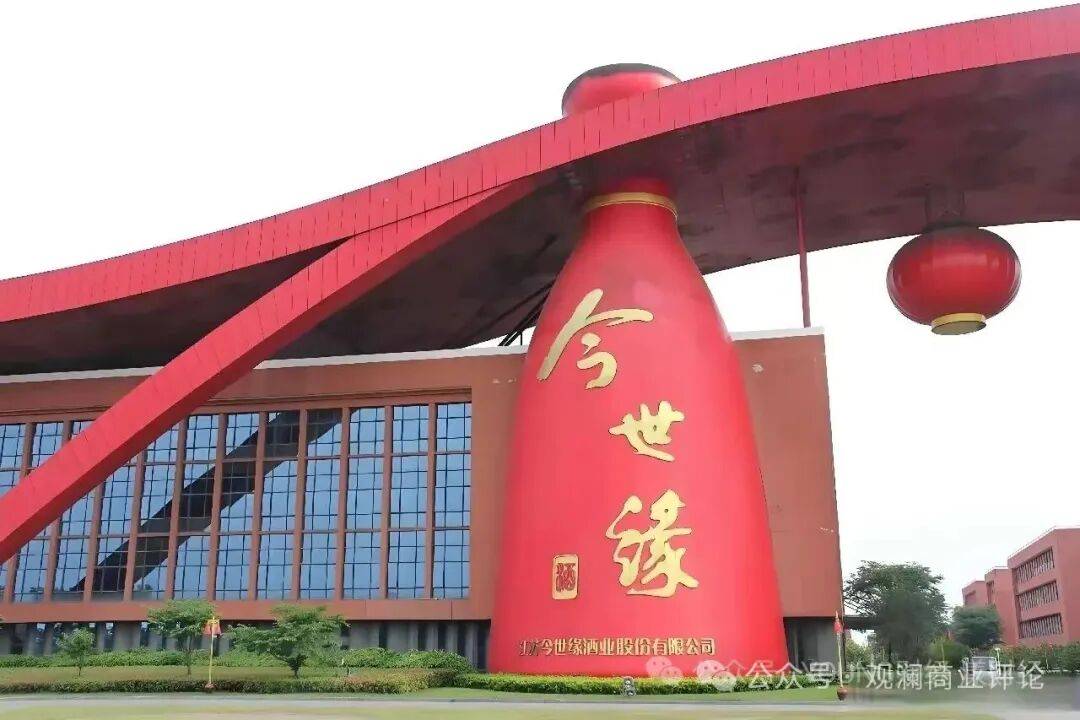
今世缘的困局:省内卷不动,省外拓不开
Sou Hu Cai Jing· 2025-10-14 08:18
Core Viewpoint - The company is facing significant challenges amid a structural adjustment in the liquor industry, with marketing efforts not fully offsetting the pressures from declining sales and profits [2][4]. Group 1: Performance Decline - In the first half of 2025, the company's revenue was 6.95 billion yuan, a year-on-year decrease of 4.84%, and net profit was 2.229 billion yuan, down 9.46% [4][5]. - The company reported a significant drop in second-quarter revenue and net profit, with declines of 29.69% and 37.06% respectively, marking the first time since 2021 that both metrics fell in a half-year report [2][3]. - The company’s revenue growth rate has sharply decreased, with projections indicating that 2025 may be the first year in a decade to see an overall decline in performance [4][6]. Group 2: Market and Product Structure - The company heavily relies on the Jiangsu market, which contributed 90.95% of its revenue in the first half of 2025, indicating a severe imbalance in market distribution [6][7]. - The high-end product segment, particularly the A+ category (priced above 300 yuan), saw a revenue decline of 7.37% in the first half of 2025, with significant pricing issues affecting the ultra-high-end product, Guoyuan V9 [6][7]. - The overall market trend shows a shift in consumer preference towards the 300-500 yuan price range, with sales of products priced above 800 yuan dropping by 28% year-on-year [7]. Group 3: Channel Challenges - The company is experiencing high inventory levels and declining confidence among distributors, with contract liabilities dropping from 1.593 billion yuan at the end of 2024 to 600 million yuan, a decrease of 62.35% [8][9]. - As of mid-2025, the company’s inventory was 5.723 billion yuan, reflecting a buildup of stock and slow sales turnover, with inventory turnover days increasing to 549.8 days from 451.1 days year-on-year [9][10]. - The company’s operating cash flow decreased by 13.75% year-on-year to 1.075 billion yuan, indicating challenges in cash recovery due to sluggish sales [10].
段永平加仓茅台!“茅五泸汾洋”集体飙涨,吃喝板块打响估值修复战!布局机会来了?
Xin Lang Ji Jin· 2025-10-14 03:15
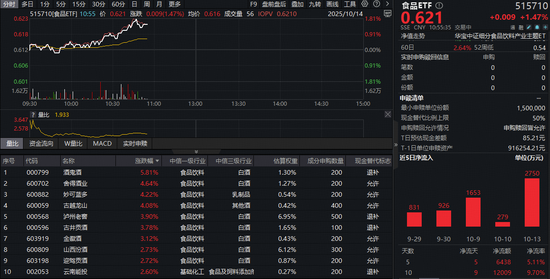
Group 1 - The food and beverage sector experienced a significant rally on October 14, with the Food ETF (515710) showing a price increase of 1.47% after a brief fluctuation, reaching a peak increase of 1.8% during trading [1][2] - Major stocks in the liquor industry saw substantial gains, with brands like Jiu Gui Jiu rising over 5%, She De Jiu Ye increasing over 4%, and several others including Lu Zhou Lao Jiao and Gu Jing Gong Jiu rising over 3% [1][2] Group 2 - Notable investor Duan Yongping publicly expressed support for Kweichow Moutai, indicating his recent purchase of the stock, which aligns with his previous endorsements during periods of price decline [1][3] - Analyst Cai Xuefei noted that the liquor industry is undergoing a deep adjustment with declining overall production, but Moutai's scarcity, brand value, and rigid demand support its long-term value, making it attractive for investors [3] Group 3 - Guosheng Securities highlighted that the demand for liquor is recovering during the Mid-Autumn Festival and National Day, with leading brands performing better and supply-side improvements contributing to the industry's long-term value [4] - According to Fangzheng Securities, while overall liquor consumption during the holiday period was in line with expectations, there were regional performance differences, and the industry is seeing marginal improvements in inventory accumulation [4] Group 4 - The Food ETF (515710) tracks the China Securities Index's segmented food and beverage industry index, with approximately 60% of its holdings in leading high-end and mid-range liquor stocks, and nearly 40% in other beverage and dairy segments [5]
盘点白酒年度业绩目标:茅、五、汾、泸“有惊无险”,剩下的悬
Sou Hu Cai Jing· 2025-10-14 03:00
Core Viewpoint - The performance of the liquor industry during the Mid-Autumn Festival did not exceed expectations, raising concerns about the feasibility of achieving annual targets, with a focus on the challenges in the fourth quarter [1] Company Performance Summaries - **Kweichow Moutai**: The company aims for a revenue growth of approximately 9% for the year, with a high certainty of achieving this target due to its strong brand and clear strategy [2][3] - **Wuliangye**: The company is experiencing pressure to meet its target of maintaining revenue growth in line with GDP, with a 4.19% revenue increase in the first half of the year, slightly below the GDP growth of 5.3% [6][3] - **Shanxi Fenjiu**: The company is on track for steady growth, achieving a 5.35% revenue increase in the first half of the year, indicating a possibility of meeting its targets [4][6] - **Luzhou Laojiao**: The company faces pressure to achieve its goals, with a 2.7% decline in revenue in the first half of the year, prompting a cautious approach to its 2025 development strategy [10][8] - **Jinshiyuan**: The company struggles to meet its target of increasing the proportion of revenue from outside the province to 15%, with a 4.84% decline in total revenue in the first half of the year [11][13] - **Daohuaxiang**: The company aims for sales collections of at least 4.5 billion yuan, but has historically struggled to meet its performance targets, raising doubts about future achievements [14][16] - **Jiananchun**: The company has set an ambitious revenue target of 30 billion yuan by 2025, but faces challenges in achieving this due to reliance on a single product and market conditions [17][19][21] Industry Challenges - The liquor industry is undergoing significant adjustments, facing challenges such as high channel inventory and price inversion, which are pressing issues for many companies [24] - Increased competition and market concentration have led to a "stock competition" era, where leading brands maintain strong positions, making it difficult for regional brands to compete [24] - Changing consumer demand and weakened growth momentum are impacting the industry's performance, with consumers becoming more price-sensitive [24] Strategic Adjustments - In response to these challenges, liquor companies are shifting their strategies from rapid expansion to focusing on high-quality and sustainable development [25] - Companies like Luzhou Laojiao and Jinshiyuan are adopting more cautious growth targets, emphasizing stability and long-term strategies [25]
13家酒企年内狂推近60款新品,价格为何两极分化?
Mei Ri Jing Ji Xin Wen· 2025-10-14 00:34
Core Insights - The Chinese liquor industry has entered a "new product competition" phase in 2025, with 13 companies launching nearly 60 new products this year, particularly concentrated in August and September before the National Day and Mid-Autumn Festival [1][2] Group 1: New Product Launch Strategy - The timing of new product launches aligns with the traditional consumption calendar, maximizing brand exposure and allowing for sufficient channel preparation [2] - Companies are adopting a "precision strike" strategy, focusing resources on key products during peak sales windows, as evidenced by Guizhou Moutai's significant sales growth in August and September [2][3] - The successful trial sales of "Zhenjiu Dazhen" indicate a positive market response, with 100,000 boxes sold across 30 provinces and a revenue of 370 million yuan [2] Group 2: Price Polarization - The product landscape shows a clear polarization, with high-end products like Moutai's commemorative liquor priced at 7,000 yuan and 3,788 yuan, while the mid-range segment remains underrepresented [3][4] - Nearly half of the new products launched this year are priced below 500 yuan, indicating a downward shift in the industry's pricing focus [3][4] - The dual strategy of elevating brand value while penetrating the mass market reflects the industry's response to current consumer segmentation trends [4] Group 3: Cross-Industry Expansion - Companies are exploring "low-alcohol" and "non-alcoholic" products to attract younger consumers and meet health-conscious demands [5][6] - Moutai's "Youmi" brand and other companies are introducing a variety of low-alcohol beverages, targeting diverse consumer scenarios such as home drinking and social gatherings [5][6] - The low-alcohol market is projected to exceed 74 billion yuan by 2025, with a compound annual growth rate of 25%, highlighting its potential as a significant growth area for liquor companies [6]