中国平安

Search documents
ETF盘中资讯|AI应用元年启幕,港股互联网显著跑赢恒生科技!高人气513770暴力揽金逾11亿元
Sou Hu Cai Jing· 2026-01-16 02:06
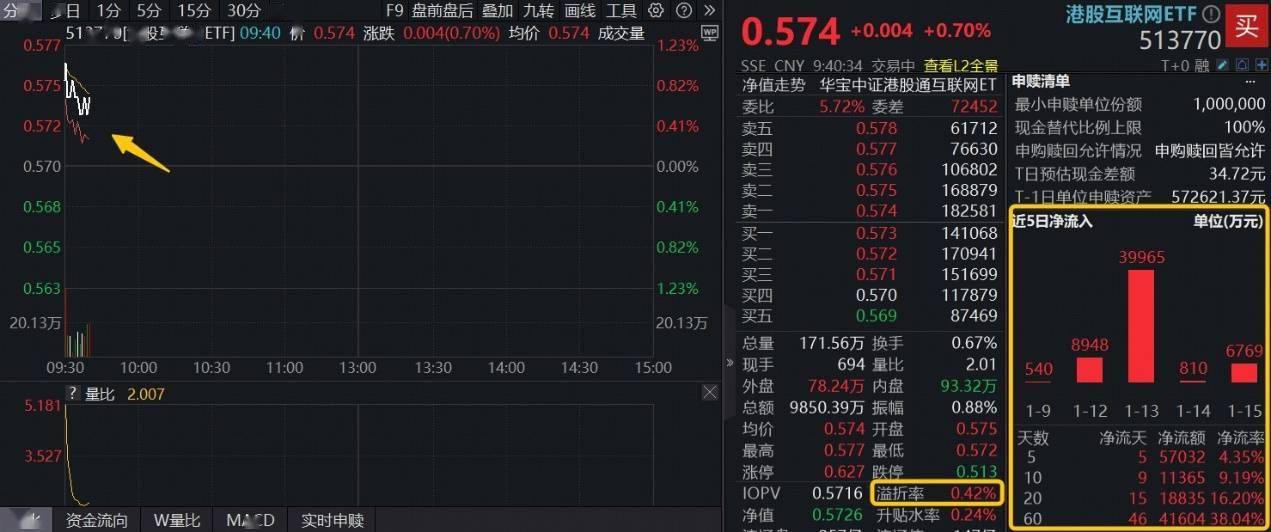
Group 1 - The core viewpoint of the article highlights the strong performance of Hong Kong stocks, particularly in the AI sector, with significant inflows into the Hong Kong Internet ETF (513770) and a notable increase in stock prices for major companies like Alibaba and Tencent [1][4][5] - As of January 15, the Hong Kong Internet ETF has seen a year-to-date increase of 10.15%, outperforming the Hang Seng Tech Index, which rose by 5.66% [1][3] - The fund manager of the Hong Kong Internet ETF noted that the market is currently undervalued, with a price-to-earnings ratio (PE) of 26.29, significantly lower than other major markets, indicating a potential for valuation increases [4][5] Group 2 - Alibaba has announced the integration of its Qianwen App with various platforms within its ecosystem, positioning itself as a leader in AI-driven shopping functionalities [3][5] - The top ten holdings in the Hong Kong Internet ETF include major tech companies such as Alibaba, Tencent, and Xiaomi, which collectively account for nearly 77% of the fund's weight, showcasing the dominance of these firms in the AI application space [5][6] - The total fund size of the Hong Kong Internet ETF reached a historical high of 14.899 billion yuan, reflecting strong investor interest and liquidity in the market [6]

从技术探索到产业共振 人形机器人书写智能经济新篇章
Zhong Guo Zheng Quan Bao· 2026-01-15 22:51
从技术验证的攻坚突破到规模化量产的浪潮奔涌,人形机器人产业在场景化应用的持续深耕与金融力量 的坚实托举中正加速走向成熟,即将跨越商用化的"最后一公里"。 业内人士认为,未来人形机器人产业将步入"技术迭代+场景拓展+生态完善"的协同发展新阶段。一方 面,量产规模的扩大将持续摊薄成本,推动产品更快走向大众市场;另一方面,租赁等创新商业模式的 成熟,将进一步降低应用门槛,加速场景落地进程。随着更多产业链上下游企业参与生态共建,人形机 器人有望从产业新势力成长为经济增长新引擎。 加速场景化应用落地 走进上海市徐汇区"模速空间具身工坊",多台人形机器人正舒展身姿跳街舞、打太极,灵动的姿态吸引 不少行人驻足围观。中国证券报记者上前与其中一台人形机器人互动:"你好,能评价一下我今天的穿 搭吗?"机器人"思索"片刻后,清晰回应:"西装搭配牛仔裤,兼具休闲与商务风格,整体造型既显正式 又不失时尚感。" 这一幕,正是具身智能走出实验室、人形机器人融入真实生活场景的生动缩影。据悉,具身工坊作为国 内首家机器人"卫星实验室",核心使命是打通具身智能从技术创新到商业化落地的"最后一公里",为大 模型产业的具身化应用搭建关键的孵化与加速 ...

人形机器人书写智能经济新篇章
Zhong Guo Zheng Quan Bao· 2026-01-15 20:48
Core Insights - The humanoid robot industry is accelerating towards maturity, overcoming the last mile of commercialization through technological breakthroughs and financial support [1][3] - The future of the humanoid robot industry is expected to enter a new phase characterized by "technological iteration + scene expansion + ecosystem improvement" [1][3] Industry Development - The expansion of mass production will continue to reduce costs, facilitating faster market entry for products [1] - Innovative business models, such as leasing, will lower application barriers and accelerate the implementation of humanoid robots in various scenarios [1][3] - The establishment of the "Mosu Space Embodied Workshop" aims to bridge the gap between technological innovation and commercial application [2] Technological Advancements - The humanoid robots showcased at the workshop are equipped with multimodal models, allowing them to process and respond to various types of information [2] - The industry is moving from early-stage technology demonstrations to a focus on comprehensive ecosystem integration and real-world application [3] Financial Support and Insurance - The high cost of humanoid robots, comparable to that of a car, necessitates financial backing for extensive testing and development [3] - Insurance companies are exploring tailored products to mitigate risks associated with humanoid robots, which can enhance confidence in their deployment [3][4] - A significant collaboration between Ping An Insurance and Shanghai Electric has led to the first insurance policy for humanoid robots, addressing long-standing industry challenges [4] Market Projections - 2025 is anticipated to be a pivotal year for mass production in the humanoid robot sector, with an expected shipment of 13,000 units globally [5] - Chinese manufacturers are expected to excel in mass production and shipment volumes, with companies like Ubtech and ZhiYuan aiming for substantial output increases in 2026 [5] - The integration of generative AI with robotics is driving the evolution of robots towards general embodied intelligence, with a projected exponential market growth over the next decade [6]
连续两个跌停板!华夏幸福股价异动,退市警报拉响
第一财经· 2026-01-15 15:16
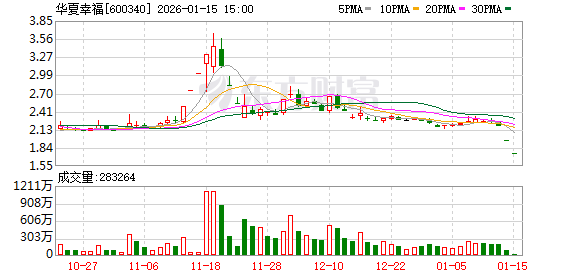
Core Viewpoint - The article discusses the recent stock price decline of Huaxia Happiness and its significant anticipated losses for the fiscal year 2025, highlighting the company's financial instability and ongoing legal issues with Ping An Insurance [3][4][6]. Financial Performance - Huaxia Happiness expects a substantial loss for the fiscal year 2025, with a projected net profit attributable to shareholders ranging from -24 billion to -16 billion yuan, and a net profit excluding non-recurring losses between -25 billion and -17 billion yuan [4]. - The company's net assets are expected to be negative, estimated between -15 billion and -10 billion yuan by the end of 2025, a significant decline from a net asset value of 4.095 billion yuan in 2024 [5]. Reasons for Losses - The anticipated losses are attributed to several factors, including the impact of project turnover timing, a decrease in project turnover, declining revenue, high financial costs due to substantial debt, reduced investment income from debt restructuring, and significant impairment losses on certain assets [5]. Stock Trading and Risk - Following a 20% cumulative decline in stock price over three consecutive trading days, Huaxia Happiness disclosed that this constitutes abnormal stock trading activity as per Shanghai Stock Exchange regulations [3]. - The company may face delisting risk due to the negative net asset situation, which could lead to a warning from the exchange after the 2025 annual report is released [5]. Legal Issues - Huaxia Happiness is currently involved in a pre-restructuring process, which is uncertain, and has not yet received court documents regarding its restructuring application [6]. - The company is also facing arbitration related to performance guarantees with Ping An Insurance, which claims approximately 6.4 billion yuan in compensation for unmet profit targets and associated penalties [7].


连续两个跌停板!华夏幸福股价异动,退市警报拉响
Di Yi Cai Jing· 2026-01-15 14:49
Core Viewpoint - The company, Huaxia Happiness, is facing significant financial difficulties, including a projected large-scale loss for 2025 and potential delisting risks due to negative net assets [3][4]. Group 1: Stock Performance and Trading Activity - Huaxia Happiness disclosed that its stock experienced a cumulative decline of 20% over three consecutive trading days, triggering abnormal trading conditions as per Shanghai Stock Exchange regulations [2]. - The company confirmed that, apart from the previously disclosed major issue regarding creditor applications for pre-restructuring and restructuring, there are no other undisclosed significant matters [2]. Group 2: Financial Forecast and Losses - The company anticipates a net loss attributable to shareholders of between -24 billion and -16 billion yuan for the year 2025, with a net asset value projected to be between -15 billion and -10 billion yuan by year-end [3]. - In 2024, the company also reported losses, with a total profit of -7.432 billion yuan and a net profit of -4.817 billion yuan, but had positive net assets of 4.095 billion yuan [3]. Group 3: Restructuring and Legal Issues - The company is undergoing pre-restructuring, which has been accepted by the Langfang Intermediate Court, but the success of this process remains highly uncertain [4]. - There is an ongoing arbitration case involving the company's controlling shareholder and actual controller, Wang Wenxue, related to a dispute with Ping An Asset Management and Ping An Life Insurance regarding performance compensation [4][5]. Group 4: Performance Guarantee Dispute - The arbitration case concerns performance guarantees tied to the company's financial performance, with Ping An seeking approximately 6.4 billion yuan in compensation and related fees due to unmet profit targets from previous years [5].
港股通净卖出15.15亿港元
Zheng Quan Shi Bao Wang· 2026-01-15 14:49
Market Overview - On January 15, the Hang Seng Index fell by 0.28%, closing at 26,923.62 points, with a total net sell of 1.515 billion HKD through the southbound trading channel [1] - The total trading volume for the southbound trading was 119.834 billion HKD, with a net sell of 1.515 billion HKD [1] Southbound Trading Details - In the Shanghai-Hong Kong Stock Connect, the trading volume was 74.697 billion HKD with a net buy of 1.930 billion HKD, while the Shenzhen-Hong Kong Stock Connect had a trading volume of 45.137 billion HKD with a net sell of 3.446 billion HKD [1] - The top traded stock in the Shanghai-Hong Kong Stock Connect was Alibaba-W, with a trading amount of 84.25 billion HKD and a net buy of 17.90 billion HKD, despite a closing price drop of 2.60% [1] - In the Shenzhen-Hong Kong Stock Connect, Alibaba-W also led with a trading amount of 44.51 billion HKD, followed by Tencent Holdings and Xiaomi Group-W with trading amounts of 17.26 billion HKD and 14.74 billion HKD respectively [2] Stock Performance - The stock with the highest net buy was China National Offshore Oil Corporation, with a net buy of 3.00 billion HKD and a closing price increase of 2.49% [2] - The stock with the highest net sell was Xiaomi Group-W, with a net sell of 4.91 billion HKD, while its closing price increased by 0.21% [2] - Other notable stocks included China Mobile, which had a net sell of 7.91 billion HKD and a closing price drop of 0.25% [1][2]






103家保险公司消保监管评价:一级0家,二级96家,三级7家...
13个精算师· 2026-01-15 14:32
Core Viewpoint - The article discusses the consumer rights protection regulatory evaluation results for insurance companies, highlighting the performance of various firms in this regard and the overall improvement in consumer protection standards within the industry. Group 1: Regulatory Evaluation Results - A total of 103 insurance companies have disclosed their latest consumer rights protection regulatory evaluation results, with 0 rated as Level 1, 96 as Level 2, and 7 as Level 3 [1][16]. - Among the companies directly regulated by the Financial Regulatory Bureau, the highest evaluation is Level 2B, including major firms such as PICC, China Life, Ping An, and Taikang [14][15]. - The number of companies rated Level 2 has increased compared to previous years, with 53 life insurance companies and 43 property insurance companies achieving this rating [16]. Group 2: Evaluation Criteria and Methodology - The consumer rights protection regulatory evaluation is based on a comprehensive assessment of insurance companies' consumer rights protection efforts, which includes five main aspects: system construction, mechanism and operation, operation and service, education and publicity, and dispute resolution [23][24]. - The evaluation scores are weighted, with the corporate and branch evaluations contributing 40% and 60% respectively to the overall score [15]. - The evaluation results are categorized into four levels, with Level 1 indicating leading performance, Level 2 indicating moderate performance, Level 3 indicating below-average performance, and Level 4 indicating poor performance [20][22]. Group 3: Industry Trends and Future Outlook - The article notes that the insurance industry is transitioning towards high-quality development, with a focus on products that offer guaranteed and floating returns, which increases the need for effective sales and claims management [11][12]. - The Financial Regulatory Bureau has announced plans to revise the consumer rights protection regulatory evaluation methods, which will now include a five-level rating system and additional evaluation criteria starting in 2026 [29][26]. - The new evaluation framework aims to enhance consumer protection and ensure that insurance companies are held accountable for their practices [29].

新年首例!太保寿险举牌上海机场,险资入市马不停蹄
Guo Ji Jin Rong Bao· 2026-01-15 14:13
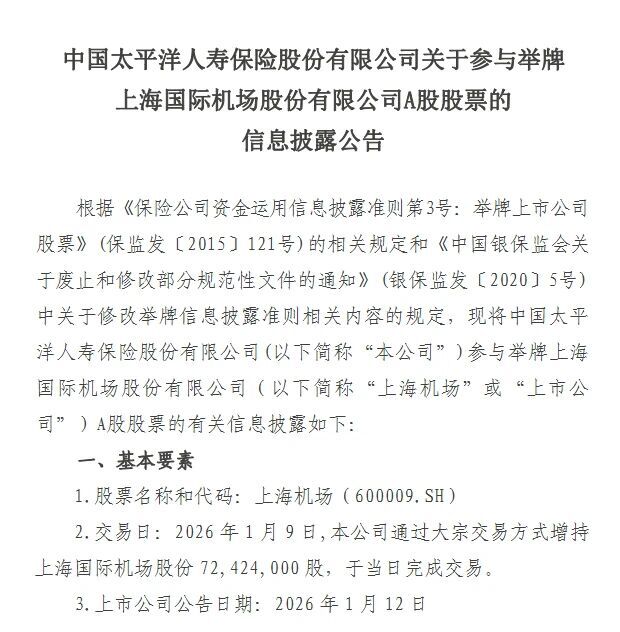
Core Viewpoint - China Pacific Life Insurance Co., Ltd. (CPIC Life) has increased its stake in Shanghai International Airport Co., Ltd. (Shanghai Airport) to 5.00%, triggering a regulatory notification due to the acquisition of 72.424 million A-shares through block trading [1][4]. Group 1: Investment Details - CPIC Life and its affiliates now hold a total of 124 million A-shares of Shanghai Airport, representing 5.00% of the company's A-share capital, up from 51.9917 million shares (2.09%) prior to the acquisition [1][4]. - The market value of CPIC Life's holdings in Shanghai Airport is approximately 4.067 billion yuan, accounting for 0.15% of CPIC Life's total assets as of Q3 2025 [4][5]. Group 2: Company Background - Shanghai Airport was established in May 1997 and listed on the Shanghai Stock Exchange in February 1998. The company underwent a significant asset restructuring in 2022, unifying the management of its air transport business [5]. - For the first three quarters of 2025, Shanghai Airport reported total revenue of 9.714 billion yuan, a year-on-year increase of 5.69%, and a net profit of 1.634 billion yuan, up 35.98% [5]. Group 3: Industry Trends - The insurance sector has seen a significant increase in equity market participation, with 20 instances of stake acquisitions in 2024 and 36 in 2025, marking a new high since 2016 [6][7]. - Analysts suggest that insurance companies are motivated by two main factors for these acquisitions: stable dividend cash flows and investments in companies with strong return on equity (ROE) and market positions [6][7].


非车险“见费出单”标准化落地:监管破局与行业价值重构
Xin Lang Cai Jing· 2026-01-15 14:09
Core Viewpoint - The regulatory transformation in the non-auto insurance sector, driven by risk prevention, is moving from fragmented exploration to a nationwide compliance consensus, addressing long-standing issues such as receivable premium misrepresentation and improper commission payments, while reshaping the competitive logic and value orientation of the property insurance industry [2][11]. Group 1: Policy Evolution - The concept of "fee-for-service" is not new, but its comprehensive implementation in the non-auto insurance sector has progressed from principle-based requirements to detailed execution [3][12]. - Local practices in Shandong and Yunnan have laid the groundwork for national standards, with Yunnan specifying full coverage for ten types of insurance and requiring a minimum of 40% upfront payment for certain policies [3][12]. - The recent issuance of guidelines by the Financial Regulatory Bureau clarifies the execution boundaries, distinguishing between different types of insurance and ensuring compliance with the "fee-for-service" principle [3][12][13]. Group 2: Market Resonance - The rigid constraints of "fee-for-service" are reshaping the cash flow management models of property insurance companies, moving away from irrational competition based on premium advances [5][14]. - Larger insurance firms are leveraging their capital and technological advantages to quickly adapt to new regulations, while smaller firms are focusing on niche markets to differentiate themselves [6][16]. - Insurance intermediaries are facing pressure to transition from commission-dependent models to professional service-oriented approaches, enhancing value-added services such as risk control and customer service [6][16]. Group 3: Value Return - The regulatory changes aim to guide the non-auto insurance industry back to its core function of risk protection, addressing issues like high receivable premiums and chaotic expense management [7][17]. - The restructuring of the industry ecosystem requires collaborative efforts, with companies implementing operational, assessment, and ecological strategies to ensure compliance and enhance service quality [8][17]. - The standardization of "fee-for-service" is seen as the starting point for high-quality development in the non-auto insurance sector, promoting a competitive landscape focused on professional capabilities and service quality [9][18].

债券ETF业务发展现状及展望
Xin Hua Cai Jing· 2026-01-15 13:59
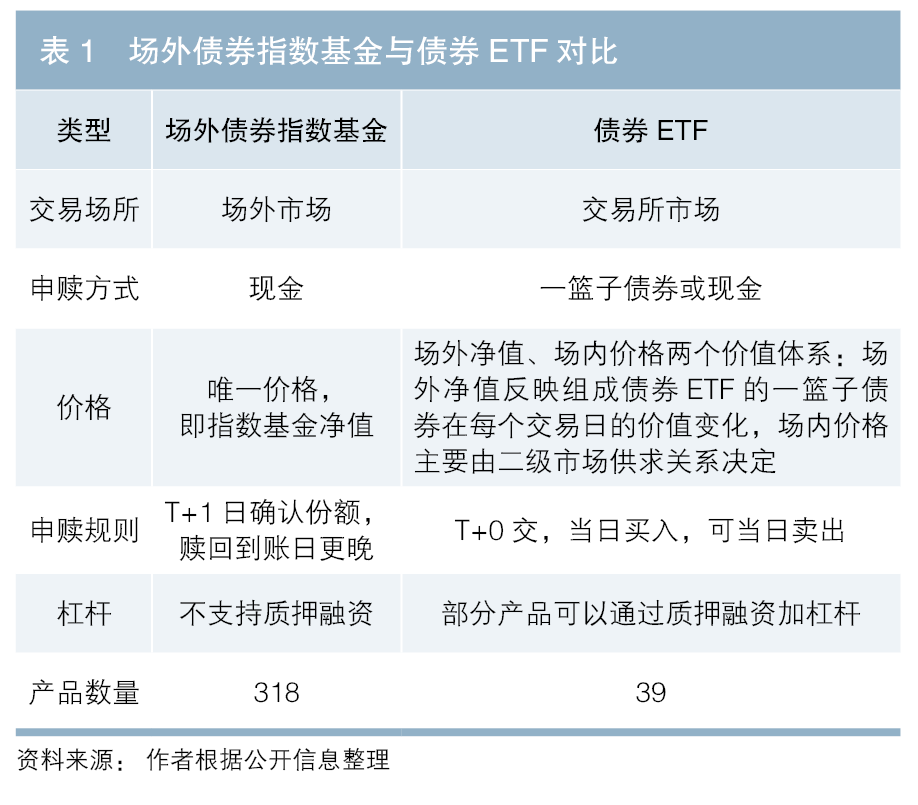
Core Viewpoint - The Chinese bond ETF market is experiencing rapid growth due to a low interest rate environment and accelerated passive transformation in the asset management industry, with significant policy support and product innovation driving this expansion [1][6][20]. Group 1: Market Development - The first batch of 8 benchmark market-making credit bond ETFs was listed on January 7, 2025, on both the Shanghai and Shenzhen Stock Exchanges [1]. - On July 17, 2025, the China Securities Regulatory Commission announced the acceleration of the launch of Sci-Tech Innovation Bond ETFs, with 10 such ETFs approved for listing [1]. - As of August 2025, the total size of existing bond ETFs reached 564.31 billion yuan, with a compound annual growth rate of 137.04% from 2021 [7][9]. Group 2: Bond ETF Characteristics - Bond ETFs are passive index bond funds that trade on exchanges, consisting of a basket of bonds, and allow for T+0 trading [2][4]. - The transparency of bond ETF components is high, with regular disclosures from index companies and fund managers [4]. - Bond ETFs can engage in general pledge-style repurchase agreements, enhancing liquidity, with 9 credit bond ETFs included in the pledge library as of May 29, 2025 [5]. Group 3: Types and Structure of Bond ETFs - As of August 2025, there are 39 bond ETFs categorized into three main types: interest rate bond ETFs, credit bond ETFs, and convertible bond ETFs, with credit bond ETFs dominating in both number and scale [9][11]. - The credit bond ETF market saw significant growth in 2025, with the scale increasing from 54.1 billion yuan at the end of 2024 to 350.4 billion yuan by August 2025 [11]. - Convertible bond ETFs experienced growth from 6.6 billion yuan at the end of 2023 to 43.9 billion yuan at the end of 2024, maintaining a steady increase into 2025 [12]. Group 4: Challenges in the Bond ETF Market - The liquidity of bond ETFs is characterized by a concentration at the top, with the top 5 ETFs accounting for 62.30% of total market turnover, while many products have low trading volumes [16]. - The investor structure is predominantly institutional, with low participation from individual investors, leading to homogeneity in trading behavior [17]. - There is significant product homogeneity, with many ETFs tracking similar indices, which can lead to resource wastage and liquidity issues for smaller products [18]. Group 5: Future Outlook and Recommendations - Recommendations include optimizing market maker arrangements to improve liquidity, such as adjusting assessment criteria and providing subsidies for market makers [20]. - Diversifying the types of products offered can attract a broader range of investors, including individual and overseas investors, enhancing market stability [21]. - Improving regulatory frameworks and infrastructure is essential for encouraging product innovation and facilitating smoother cross-market operations [22][23].