
中国海外发展

Search documents
中国海外发展(00688) - 截至2026年1月31日之月报表
2026-02-03 07:01
股份發行人及根據《上市規則》第十九B章上市的香港預託證券發行人的證券變動月報表 | 截至月份: | 2026年1月31日 | 狀態: 新提交 | | --- | --- | --- | | 致:香港交易及結算所有限公司 | | | | 公司名稱: | 中國海外發展有限公司 | | | 呈交日期: | 2026年2月3日 | | | I. 法定/註冊股本變動 不適用 | | | FF301 第 1 頁 共 10 頁 v 1.2.0 FF301 II. 已發行股份及/或庫存股份變動及足夠公眾持股量的確認 1. 股份分類 普通股 股份類別 不適用 於香港聯交所上市 (註1) 是 證券代號 (如上市) 00688 說明 已發行股份(不包括庫存股份)數目 庫存股份數目 已發行股份總數 上月底結存 10,944,883,535 0 10,944,883,535 增加 / 減少 (-) 0 0 本月底結存 10,944,883,535 0 10,944,883,535 足夠公眾持股量的確認(註4) (A). 股份期權(根據發行人的股份期權計劃) | 1. 股份分類 | | 普通股 | | 股份類別 | 不適用 | | 於香 ...
西部证券晨会纪要-20260203
Western Securities· 2026-02-03 03:06
Group 1: Domestic Policy - The unified market policy will become an important policy line for 2026 and the "14th Five-Year Plan," emphasizing the need to deepen and transcend "involution" [1][5][6] - The focus will be on governance of local government behavior and related reform measures, covering areas such as anti-monopoly, local government investment attraction, and tax system reform [5][6][27] - The policy's impact will extend from industries like photovoltaics, lithium batteries, and new energy vehicles to electricity, transportation, technology, and data [5][6] Group 2: Company Analysis - Yum China (09987.HK) - The Western fast food market is expected to exceed 300 billion yuan by 2025, with a growth rate of 10.3%, led by the hamburger segment, which holds a 70.6% market share [8][9] - Yum China maintains a strong market position with a 27.5% share, and the market concentration is high, with the top five companies accounting for 44% of the market [8][9] - The company has a large store network with a low closure rate, reaching 17,514 stores by Q3 2025, and a compound annual growth rate (CAGR) of 9% from 2014 to 2024 [9] - The company has a strong local innovation capability, with 5.75 million members contributing to 57% of sales, and maintains healthy profit margins of 18.5% for KFC and 13.4% for Pizza Hut [9][10] - The company is expected to generate revenues of $11.7 billion, $12.4 billion, and $13.1 billion from 2025 to 2027, with net profits of $900 million, $1 billion, and $1.1 billion respectively, leading to a price-to-earnings ratio of 19, 18, and 16 times [8][10] Group 3: Real Estate Industry - In January 2026, the top 100 real estate companies saw a 24.7% year-on-year decline in sales, although the decline was less severe than in previous months [18][20] - The sales area also decreased by 29.5% year-on-year, indicating a continued downward trend in the market [18][20] - The top three companies in the industry achieved a slight year-on-year increase of 0.2%, while other segments experienced significant declines [18][20] - Companies focused on first and second-tier cities showed a smaller decline in sales compared to those in lower-tier cities, with a difference of approximately 11% [19][20] - Recommendations include focusing on second-hand housing intermediaries like Beike and quality state-owned enterprises such as China Resources Land and China Overseas Development [20]
1月房地产市场解读及展望
2026-02-03 02:05
Summary of Real Estate Market Conference Call Industry Overview - The conference call discusses the real estate market in January 2026, highlighting significant trends and changes in the sector, particularly among the top 100 real estate companies [1][3][4]. Key Points Market Performance - In January 2026, the sales amount of the top 100 real estate companies decreased by 27.3% year-on-year and 49% month-on-month, indicating a significant market contraction [1][3]. - The top three companies experienced only a 1.7% decline, showcasing their stronger risk resilience compared to others [1][3]. - The second-hand housing market exceeded expectations, achieving a four-month consecutive increase, with transaction volumes reaching the second-highest point in 13 months [1][7]. New Housing Market - The new housing market in first-tier cities saw the largest decline, with transaction areas down by 28% year-on-year [1][12]. - In second-tier cities, Chengdu performed relatively well with a 39% decline, while third and fourth-tier cities maintained stable transaction volumes [1][12][13]. - New housing supply in 50 key cities dropped by 55% year-on-year and 62% month-on-month, marking the lowest level in 13 months [1][10]. Supply and Demand Dynamics - The supply and demand for new homes have significantly contracted, with developers showing low enthusiasm for launching new projects [1][6]. - High-quality projects in core urban areas, such as low-density villas, continue to perform well, while most new projects face pressure due to reduced demand [1][6][15]. Second-Hand Housing Market - The second-hand housing market is characterized by a price-driven demand, with many buyers opting for lower-priced homes [1][18][23]. - The market is experiencing a mismatch between new and old housing demands, with buyers favoring newer, more affordable second-hand homes [1][19]. Future Expectations - The market is expected to see a decline in new home sales in February 2026 due to the impact of the Spring Festival, with a continued divergence between new and second-hand homes [2][22]. - There is a noticeable trend of buyers, including those looking for improvements, shifting towards purchasing second-hand homes [22]. Land Market - The land market is currently not strongly correlated with the housing market, with low supply and demand levels observed [20][21]. - Developers are focusing on comprehensive value assessments for land acquisitions, which may not significantly boost new project launches [20][21]. Investment and Sales Forecast - The real estate sales growth for 2026 is projected to be around 5%, while investment growth is expected to be between 10% and 15% [26]. - The overall supply of new homes is anticipated to constrain sales, with significant limitations on the volume of land available for development [24][26]. Additional Insights - The market is witnessing a shift in buyer preferences, with a growing inclination towards larger, well-located properties, particularly in the second-hand market [22][23]. - The rental market dynamics are changing, with new rental properties becoming more appealing to younger generations compared to older housing stock [25]. This summary encapsulates the critical insights from the conference call, providing a comprehensive overview of the current state and future expectations of the real estate market.
中银晨会聚焦-20260203-20260203
Bank of China Securities· 2026-02-03 00:55
Core Insights - The public REITs market in China is expanding from infrastructure to commercial real estate, marking a new phase of development as per the announcement by the China Securities Regulatory Commission (CSRC) on December 31, 2025 [5][6][18] - The announcement defines commercial real estate REITs and outlines requirements for fund registration, management, and regulatory responsibilities, while still adhering to previous guidelines for infrastructure securities [5][6] - The first batch of commercial real estate REITs is expected to raise a total of 31.47 billion yuan, covering various commercial formats such as hotels, office buildings, and shopping centers [7][18] Summary by Sections Commercial Real Estate REITs Overview - The CSRC's announcement on December 31, 2025, signifies the dual development of commercial real estate and infrastructure REITs in China [5] - Commercial real estate REITs are defined as closed-end public funds that invest in commercial real estate asset-backed securities to acquire ownership or operational rights, generating stable cash flows from rents and fees [5][6] Regulatory Framework - The new business guidelines include the expansion of applicable scope to include commercial real estate REITs, with specific requirements for operational and financial disclosures [6] - Funds raised through public REITs can be used for acquiring existing assets, new investments, debt repayment, and working capital, but not for purchasing residential land [6] Initial Batch of REITs - Eight commercial real estate REITs have been submitted for approval, with expected fundraising ranging from 1.703 billion yuan to 7.47 billion yuan [7][8] - The underlying assets for these REITs are primarily located in core urban areas, with operational performance generally strong [7] Specific REITs Details - **Hua'an Jinjiang REIT**: Expected to raise 1.703 billion yuan, focusing on 21 hotels across 18 cities, with an average occupancy rate of 61.58% [8] - **Huitianfu Shanghai Real Estate REIT**: Expected to raise 4.002 billion yuan, with two office buildings in Shanghai showing a 100% occupancy rate [9] - **CICC Vipshop REIT**: Expected to raise 7.47 billion yuan, focusing on two outlet projects with high operational performance [10] - **Hua'an Lujiazui REIT**: Expected to raise 2.810 billion yuan, with assets including office and commercial projects in Shanghai [11] - **Hua'an Poly Development REIT**: Expected to raise 2.093 billion yuan, with assets in Guangzhou and Foshan [12] - **Hua'an Yintai REIT**: Expected to raise 4.2785 billion yuan, focusing on a shopping center in Hefei [13] - **Hua'an CapitaLand REIT**: Expected to raise 4.054 billion yuan, with assets in Shenzhen and Mianyang [14] - **Guotai Haitong Sasseur REIT**: Expected to raise 5.064 billion yuan, focusing on an outlet project in Xi'an [15] Market Potential - The commercial real estate sector in China has a substantial existing asset base, with over 9,000 retail properties and a total area exceeding 667 million square meters [18] - The introduction of commercial real estate REITs is expected to enhance asset liquidity and broaden financing channels for companies [18] Investment Recommendations - Companies that have proactively assessed and prepared for REIT issuance, such as Poly Development and Maoye Commercial, are likely to have a competitive advantage [19] - Focus on firms with stable and mature assets, such as China Resources Land and China Overseas Development, for potential investment opportunities [19]
百强房企再洗牌:7家新面孔杀入
Feng Huang Wang· 2026-02-03 00:41
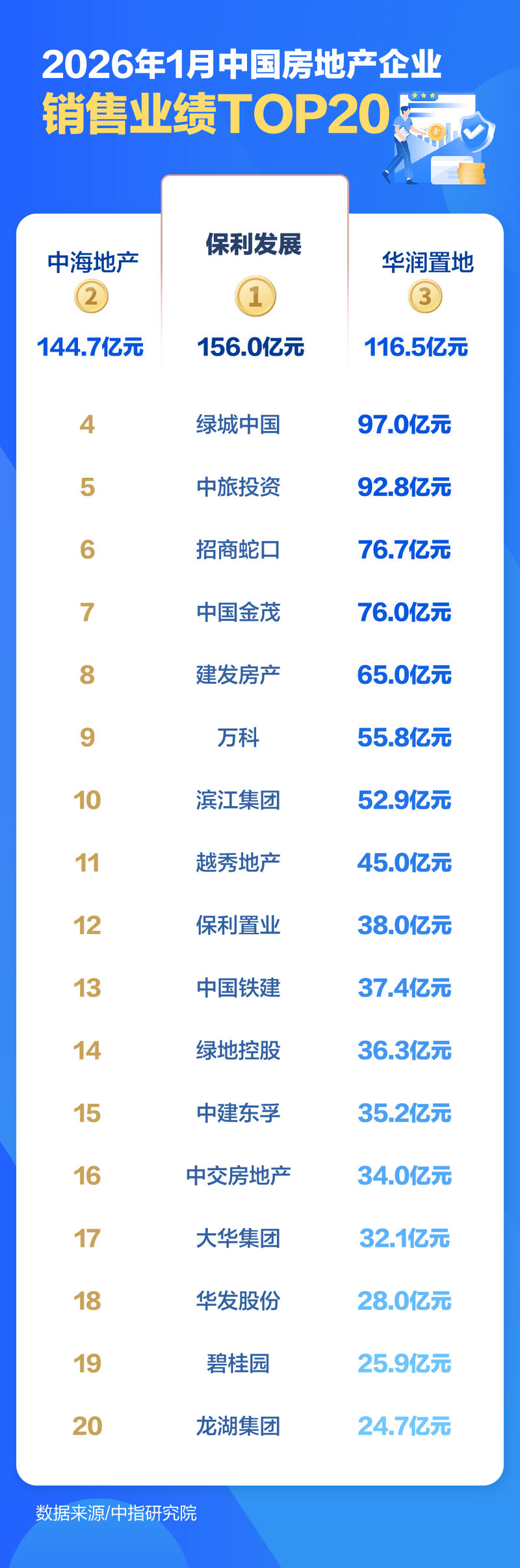
Core Viewpoint - The top 100 real estate companies in China are experiencing a significant reshuffling in their rankings as of January 2026, with a notable decline in overall sales figures compared to the previous year [2][3]. Group 1: Sales Performance - In January 2026, the total sales of the top 100 real estate companies reached 190.52 billion yuan, representing an 18.9% year-on-year decline [2]. - Only three companies achieved sales exceeding 10 billion yuan in January, a decrease of two compared to the same period last year [2]. - The number of companies with sales over 5 billion yuan increased to ten, up by two from the previous year [2]. Group 2: Ranking Changes - The top 10 rankings saw significant changes, with Poly Developments, China Overseas, and China Resources remaining in the top four, while Vanke dropped from fifth to ninth place [3]. - China Travel Investment emerged as a major dark horse, jumping from outside the top 40 to fifth place [3]. - China Jinmao rose from thirteenth to seventh, indicating intensified competition within the top tier [3]. Group 3: Performance of Private Enterprises - Among the 32 companies that experienced year-on-year growth in January, six private enterprises had growth rates exceeding 100% [3]. - Bangtai Group and China Construction Yipin entered the top 20 in sales, benefiting from strategic investments during market lows [3]. Group 4: New Entrants and Market Dynamics - Seven new companies entered the top 100 list in January, with four being small to medium-sized private enterprises [4]. - State-owned enterprises continue to dominate land acquisition, with companies like Yuexiu Property and China Resources maintaining strong investment levels [4]. Group 5: Policy and Market Outlook - The policy environment is shifting towards stabilizing expectations, with measures such as extended tax rebates and loan extensions being implemented [4]. - The market is expected to see a gradual release of demand in March, driven by promotional activities from real estate companies before the Spring Festival [5].




房企开年排位生变:“保中华”格局延续 最大黑马竟是它?
Xin Jing Bao· 2026-02-02 13:33
Core Viewpoint - In January 2026, the sales performance of the top 100 real estate companies in China showed a total sales amount of 190.5 billion yuan, reflecting a year-on-year decline of 18.9%, indicating a stable continuation of the downward trend observed in the previous year [5][10]. Group 1: Sales Performance - The total sales amount for the top 100 real estate companies in January 2026 was 190.5 billion yuan, which is a year-on-year decrease of 18.9%, consistent with the decline observed throughout the previous year [5][10]. - The top three companies in terms of total sales were Poly Developments (15.6 billion yuan), China Overseas Land & Investment (14.47 billion yuan), and China Resources Land (11.65 billion yuan) [5][10]. - The average sales amount for the top 10 companies was 9.33 billion yuan, down 11.6% year-on-year, while the average for companies ranked 11-30 was 2.6 billion yuan, down 25.6% [10]. Group 2: Market Dynamics - The decline in sales is attributed to a high base from January of the previous year, where core city markets were notably active [5][9]. - The new entrant, China Travel Investment, ranked 5th with a sales amount of 9.28 billion yuan, marking a significant rise from previous years [9]. - The sales performance of the top 10 companies remained relatively stable, with three companies showing year-on-year increases, while seven experienced declines [10]. Group 3: Future Outlook - Analysts expect that as the Chinese New Year approaches, real estate companies may increase marketing efforts, which could lead to a temporary boost in market activity [11]. - There is a need for coordinated policy efforts from both demand and supply sides to effectively restore market confidence [11].


商业不动产REITs点评:首批商业不动产REITs发行在即,存量盘活规模可期
Bank of China Securities· 2026-02-02 11:28
Investment Rating - The industry investment rating is "Outperform the Market," indicating that the industry index is expected to perform better than the benchmark index over the next 6-12 months [12]. Core Insights - The report highlights the imminent issuance of the first batch of commercial real estate REITs, with significant potential for revitalizing existing assets [1]. - The expansion of the public REITs market from infrastructure to commercial real estate marks a new phase in China's REITs development, with regulatory support aimed at enhancing issuance efficiency and encouraging asset integration [3]. - The report anticipates that commercial real estate REITs will accelerate in 2026, driven by policy support and the performance of initial projects, while emphasizing the importance of asset quality and operational capabilities for long-term success [3]. Summary by Sections Commercial Real Estate REITs Overview - The first batch of commercial real estate REITs is set to raise a total of approximately 314.7 billion yuan, covering various commercial formats such as hotels, office buildings, and shopping centers [3]. - The report details eight commercial real estate REITs that have been submitted for approval, with expected fundraising sizes ranging from 17.03 billion yuan to 74.7 billion yuan [5][6]. Specific REITs Details - **Huitianfu Shanghai Real Estate REIT**: Expected to raise 40.02 billion yuan, with underlying assets including two office buildings in Shanghai [5]. - **Huazhong Jinjiang REIT**: Expected to raise 17.03 billion yuan, focusing on 21 hotels across 18 cities [5]. - **CICC Vipshop REIT**: Expected to raise 74.7 billion yuan, with underlying assets in Zhengzhou and Harbin [5]. - **Huazhong Lujiazui REIT**: Expected to raise 28.10 billion yuan, with assets in Shanghai [6]. - **Huazhong Poly Development REIT**: Expected to raise 20.93 billion yuan, with assets in Guangzhou and Foshan [6]. - **Huazhong Yintai REIT**: Expected to raise 42.785 billion yuan, focusing on the Hefei Yintai Center [6]. - **Huazhong CapitaLand REIT**: Expected to raise 40.54 billion yuan, with assets in Shenzhen and Mianyang [6]. - **Guotai Haitong Sazhi Chuan REIT**: Expected to raise 50.64 billion yuan, focusing on the Sazhi Chuan outlet in Xi'an [6]. Market Potential and Future Outlook - The report emphasizes the substantial existing stock of commercial real estate in China, which provides a solid foundation for the development of commercial real estate REITs [3]. - The retail sector alone has over 9,000 concentrated commercial properties, while the hotel sector has approximately 1.764 million rooms, indicating a strong demand for asset revitalization through REITs [3]. - The report suggests that companies with mature and stable assets, such as Poly Development and Meiyue Commercial, are likely to have a competitive advantage in the REITs market [3].


上海新房淡季低位运行 高端项目成为抗跌主力
Zhong Guo Jin Rong Xin Xi Wang· 2026-02-02 08:05
Group 1 - The Shanghai new housing market entered a traditional sales off-season in January 2026, with both supply and demand showing a relatively weak performance. The total transaction area of commercial residential properties fell to 257,100 square meters, with 1,939 transactions, reflecting seasonal lows [1] - The land market also cooled down, with five residential land plots sold at the base price, indicating a more cautious investment strategy among real estate companies [1] - High-end projects in core areas showed resilience, highlighting a structural differentiation in the market despite the overall sluggishness [1] Group 2 - The top 30 real estate companies in Shanghai achieved a total sales revenue of 24.83 billion yuan in January 2026, with eight companies exceeding 1 billion yuan in sales. China Overseas Land & Investment led with 2.58 billion yuan, followed by China Merchants Shekou and Shanghai Xuhui City Investment [2] - In terms of sales area, eight companies sold over 20,000 square meters, with China Resources Land leading at 40,000 square meters. The top three in equity sales were China Overseas Land & Investment, Poly Developments, and China Resources Land [2] - High-end improvement projects became the absolute mainstay of the Shanghai new housing market, with the top 20 projects generating a total sales amount of 10.82 billion yuan. Anlan Shanghai topped the list with 2.18 billion yuan in sales [3] Group 3 - The land market showed a rational bottoming trend, with a total of 283,700 square meters of various land types launched in January, and 1.65 million square meters transacted. The residential land transaction area was 32,750 square meters, reflecting a cautious attitude among real estate companies in their investment decisions [3] - The market is expected to experience a "small spring" after the traditional off-season, as high-quality land parcels gradually enter the supply sequence. The focus will be on product value extraction in core locations [4]

房地产开发与服务26年第5周:坚定看好地产行情,商业不动产REITs首批挂牌
GF SECURITIES· 2026-02-02 06:53
Core Insights - The report maintains a bullish outlook on the real estate market, highlighting the significant debut of commercial real estate REITs, with the first batch of applications exceeding 32.1 billion RMB, accounting for 14% of the existing C-REITs market [5] - The cancellation of the "three red lines" policy marks a pivotal shift, indicating a return to orderly market development and improved financing channels for real estate companies [16][20] - The report notes a strong year-on-year increase in transaction volumes for both new and second-hand homes, with new home transactions in 50 cities up 3.3% week-on-week and 37.2% year-on-year [5][9] Group 1: Central Policies - The cancellation of the "three red lines" policy allows for a more market-oriented development of the real estate sector, which had previously constrained financing for weaker firms [16] - The central government is actively managing expectations and stabilizing the policy environment to facilitate a turning point in the real estate cycle [16] Group 2: Transaction Performance - New home transactions saw a week-on-week increase of 3.3% and a year-on-year increase of 37.2%, reflecting a recovery from last year's low base due to the Spring Festival [5][9] - Second-hand home transactions also showed significant growth, with a year-on-year increase of 154.9%, driven by a favorable comparison to last year's figures [9] Group 3: Market Dynamics - The report indicates that the new home supply has improved, with a week-on-week increase of 34.5%, which is unusual before the Spring Festival, suggesting increased developer confidence [5] - The second-hand market remains robust, with a year-on-year increase in visits and transactions, indicating sustained demand [5] Group 4: Land Market Performance - The land market showed weaker performance, with total land sales in 300 cities amounting to 12.7 billion RMB, down 20% week-on-week and 69% year-on-year [5] - The report highlights a supply of 7.93 million square meters, with a land absorption rate of 51%, indicating a dual weakness in supply and demand [5] Group 5: Company Performance and Recommendations - The report suggests that companies with strong investment fundamentals and low valuations, such as China Jinmao and China Overseas, are leading the sector [5] - The property management sector also performed well, with a 2.6% increase, outperforming the Hang Seng Index [5] Group 6: C-REITs Overview - The C-REITs composite return index rose by 0.36%, with 41 out of 78 REITs showing gains, particularly in the renewable energy and highway sectors [5]

中金预计2025年内房股盈利续降15%至20%
Xin Lang Cai Jing· 2026-02-02 06:16
报告具体指出,华润置地、中国海外发展、建发国际三家龙头2025年盈利或按年跌15%至20%,但利润 规模仍属可观;绿城中国、越秀地产、中海宏洋、保利置业、新城控股等有望录得正向利润,惟幅度微 薄;龙湖集团、城建发展或出现小幅亏损;滨江集团与中国金茂核心利润则有望稳中有增。展望2026 年,中金认为房企将维持审慎经营策略,后续视销售走势动态调整。 来源:观点地产网 观点网讯:2月2日,中金公司发布最新房地产行业研究报告,预计2025年覆盖房企整体盈利较2024年继 续明显下行,平均销售额同比下降20%,拿地强度仅37%,低于市场预期。 免责声明:本文内容与数据由观点根据公开信息整理,不构成投资建议,使用前请核实。 ...