海信视像

Search documents
海信视像(600060):投资价值分析报告:专注显示产业,突破高端市场,领跑全球同行
EBSCN· 2026-02-04 03:15
Investment Rating - The report assigns a "Buy" rating to Hisense Visual Technology with a target price of 29.87 CNY, based on its strong market position and growth potential [5][7][15]. Core Insights - Hisense Visual Technology is a leading global provider of display solutions, focusing on high-end markets and technological innovation. The company aims to enhance its global market share through a multi-scenario display strategy, covering home, commercial, and automotive applications [1][3][24]. - The company has achieved significant growth in both domestic and international markets, with a projected revenue of 58.5 billion CNY and a net profit of 2.2 billion CNY for 2024. Its global TV shipment market share is expected to reach 14.9% by mid-2025 [1][3][5]. Summary by Sections Company Overview - Hisense Visual Technology is a top-tier display technology provider, focusing on innovation in LCD, laser display, and LED technologies. The company has a comprehensive product range, including TVs and commercial displays, and is expanding into next-generation technologies like 8K and Mini/Micro LED [24][25]. Competitive Position in China - In the first half of 2025, Hisense's online and offline retail market shares in China reached 24.1% and 29.6%, respectively, showing significant growth since 2019. The launch of the Vidda brand has targeted younger consumers, contributing to a 11% market share in online retail by 2024 [2][3][5]. Global Expansion Strategy - Hisense's international revenue has grown from 5.8 billion CNY in 2013 to 28 billion CNY in 2024, accounting for 48% of total revenue. The company aims to become the world's leading TV brand, with a market share of 14.9% in global shipments by mid-2025 [3][5][24]. Business Model and Governance - The company underwent a mixed-ownership reform in 2020, introducing strategic investors to enhance operational efficiency. The implementation of employee stock ownership plans aims to align employee interests with company performance [4][6][24]. Financial Performance and Projections - Hisense's revenue is projected to grow from 53.6 billion CNY in 2023 to 74.3 billion CNY by 2027, with a compound annual growth rate (CAGR) of 8.43%. The net profit is expected to increase from 2.1 billion CNY in 2023 to 3 billion CNY in 2027 [6][15][5]. Valuation and Investment Thesis - The report concludes that Hisense's strong brand influence and continuous technological advancements justify a target price of 29.87 CNY, supported by both relative and absolute valuation methods [5][15].

半导体测试设备“体检师”IPO注册生效,联讯仪器专利诉讼、财务风险待解
Xin Lang Cai Jing· 2026-02-03 12:53
半导体设备"专业体检师"苏州联讯仪器股份有限公司(以下简称"联讯仪器")距离资本市场更近了。 1月29日,联讯仪器科创板IPO注册生效。据悉,公司聚焦高端电子测量与半导体测试设备,大客户包括中际旭创、新易盛、海信集团等。 站上国产替代的风口,公司业绩在2024年实现扭亏为盈。 不过,面临专利侵权诉讼二审悬而未决、实控人与前东家的纠纷未充分披露、应收账款与存货双高引发的资金周转困难等压力。 登录新浪财经APP 搜索【信披】查看更多考评等级 上市之后,联讯仪器如何化解这些问题? 1 成立仅9年,市占率第三 联讯仪器的前身联讯有限成立于2017年。同年6月,公司发布100G误码仪,并在10月推出400G PAM4误码仪,快速切入高速光通信测试市场。 2018年至2020年,公司持续迭代产品,推出光采样示波器、CoC可靠性测试系统等产品。2022年9月,联讯有限整体变更为股份有限公司。 目前,联讯仪器的主营业务为电子测量仪器和半导体测试设备的研发、制造、销售及服务。 中国制造业迎来数字化、网络化、智能化变革浪潮,半导体、通信等行业蓬勃发展,催生了对电子测量仪器的大量需求,也给联讯仪器带来了巨大的市场 机遇。 根据Fr ...


原材料价格上涨对白电龙头影响有限,白电1-2月排产增速环比改善 | 投研报告
Zhong Guo Neng Yuan Wang· 2026-02-03 09:51
Core Viewpoint - Recent increases in copper and other raw material prices have raised concerns about the profitability of leading white goods companies, but historical analysis shows that the negative impact of rising raw material costs on gross margins has gradually diminished, suggesting that these companies can maintain profitability through structural adjustments and cost savings [1][2]. Raw Material Price Impact - Since 2008, the home appliance industry has experienced three significant raw material price increase cycles, with the impact on gross margins decreasing over time: during 2009-2011, the maximum quarterly gross margin decline for leading white goods companies was 5-7 percentage points; in 2016-2017, it was around 5 percentage points; and from 2020-2022, it was about 2 percentage points [2]. - In January 2026, the average monthly closing prices for copper and aluminum on the SHFE showed year-on-year increases of 36.7% and 20.9%, respectively, which are lower than the increases seen from 2020-2022, indicating that the current raw material cost increase may have a lesser impact on white goods companies [2]. Production and Demand Trends - In February, the total production of white goods in China reached 23.79 million units, a year-on-year decrease of 22.1%, with a cumulative decline of 5.0% for January-February [3]. - The production of air conditioners, refrigerators, and washing machines showed varying degrees of decline compared to the previous year, with air conditioners down 31.6%, refrigerators down 17.0%, and washing machines down 3.2% [3]. - The impact of the Spring Festival timing has put pressure on production, but cumulative growth rates have shown slight improvement, and demand is expected to stabilize due to the effects of national subsidy policies [3]. Retail Market Performance - In 2025, the retail scale of China's home appliance market was 893.1 billion yuan, a year-on-year decline of 4.3%, with specific categories like air conditioners and refrigerators experiencing declines of 0.4% and 11.5%, respectively [4]. - Small home appliances performed relatively well, with an overall retail growth of 3.8%, indicating resilience in this segment despite the overall market downturn [4]. Investment Recommendations - The report recommends investing in leading white goods companies such as Midea Group, Haier Smart Home, TCL Technology, and Hisense Home Appliances, as well as in black goods and small appliances [4].
黑色家电板块2月3日涨2.14%,兆驰股份领涨,主力资金净流入1.23亿元
Zheng Xing Xing Ye Ri Bao· 2026-02-03 09:03
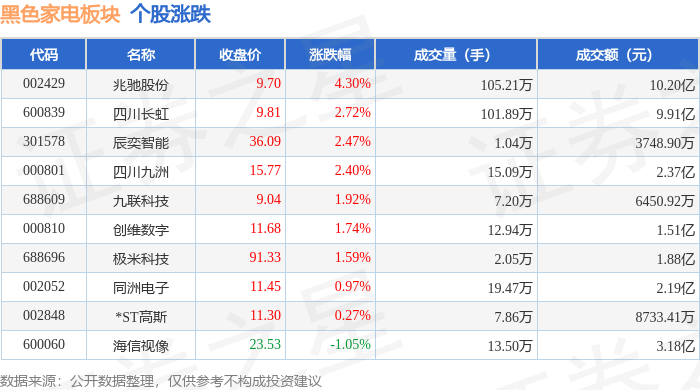
Market Overview - The black home appliance sector increased by 2.14% on February 3, with Zhao Chi Co., Ltd. leading the gains [1] - The Shanghai Composite Index closed at 4067.74, up 1.29%, while the Shenzhen Component Index closed at 14127.1, up 2.19% [1] Stock Performance - Notable stock performances in the black home appliance sector include: - Beichi Co., Ltd. (002429) closed at 9.70, up 4.30% with a trading volume of 1.0521 million shares and a transaction value of 1.02 billion [1] - Sichuan Changhong (600839) closed at 9.81, up 2.72% with a trading volume of 1.0189 million shares and a transaction value of 0.991 billion [1] - Other companies like Chenyiy Smart (301578) and Sichuan Jiuzhou (000801) also showed positive growth [1] Capital Flow - The black home appliance sector saw a net inflow of 123 million in main funds, while retail funds experienced a net outflow of 141 million [1] - Retail investors contributed a net inflow of 17.67 million [1] Individual Stock Capital Flow - Zhao Chi Co., Ltd. (002429) had a main fund net inflow of 103 million, but retail funds saw a net outflow of 35.24 million [2] - Sichuan Changhong (600839) experienced a main fund net inflow of 49.56 million, with retail funds showing a net outflow of 24.08 million [2] - Sichuan Jiuzhou (000801) had a main fund net inflow of 21.44 million, while retail funds saw a net outflow of 11.41 million [2]


探究海信的“信”循环:质量将信仰转化为信任
Zhong Guo Zhi Liang Xin Wen Wang· 2026-02-03 07:59
转自:中国质量报 【编者按】 质量不仅是制造业的生命线,更是企业在全球化竞争中占据主动、赢得未来的重要支撑。企业如何超越将质量视为单一管理指标的固化认知,将其内化为驱 动自身持续成长的文化基因,形成战略优势?这既是时代之问,也是每一家志在长远的企业必须直面的课题。 始于信 成于质 终于信 —— 探究海信的"信"循环:质量将信仰转化为信任 □ 本报记者 朱文达 在推动中国制造向中国创造转变、中国速度向中国质量转变、中国产品向中国品牌转变的时代浪潮中,如何将"质量"从一个管理目标,升华为驱动企业永续 发展的核心信仰与竞争优势?近日,记者走进海信国际中心大楼,一幅挂在墙上的图给出了答案——画面中央是一枚清晰的指纹,而在指纹的核心处,巧妙 地嵌着一个汉字"信"。 海信集团控股股份有限公司(以下简称"海信")为这一问题提供了清晰而有力的回应:以"信"为内核驱动质量,以质量为行动兑现信任,最终在用户信任与 品牌信念的共鸣中,实现"信信相生"的飞轮加速。这条路径,不仅是海信基业长青的密码,也为中国制造业的高质量发展提供了一份可资借鉴的生动范本。 以信立质: 为了探寻这一课题的答案,海信已求索多年。海信的实践,不仅为其自身发 ...

在喧嚣中守住良心
Zhong Guo Zhi Liang Xin Wen Wang· 2026-02-03 07:59
Core Viewpoint - The article emphasizes the importance of quality in business, highlighting how Hisense has built a comprehensive quality assurance system and digital management platform to ensure continuous improvement and customer trust [4][5]. Group 1: Historical Context and Evolution - Hisense's commitment to quality began after a significant setback in 1977 when a product failure led to the realization that "quality is the life of the enterprise" [5]. - The company strategically introduced advanced television production lines post-reform, allowing it to stabilize during industry upheavals [5]. - In the mid-1990s, amidst fierce price wars, Hisense chose to maintain quality over short-term profits, which ultimately became a pivotal decision for its growth [5][6]. Group 2: Quality Philosophy and Recognition - Hisense has ingrained its quality philosophy into its corporate culture, defining it as "quality is character" and establishing "seven quality rules" to guide employees [6]. - The company has received multiple accolades, including nominations for the China Quality Award and recognition as a high-level quality management enterprise by the Ministry of Industry and Information Technology [6]. Group 3: Global Strategy and Market Presence - Hisense began its international expansion in 1996, establishing a strong presence in South Africa through local sales companies and production facilities, which has led to significant market leadership [6]. - The company's approach in South Africa has been recognized as a model for practical cooperation between China and South Africa, showcasing the global reach of Chinese quality standards [6]. Group 4: Technological Advancements in Quality Management - In the AI era, Hisense has transformed its quality management by implementing AI visual recognition systems, drastically reducing inspection times from 10 minutes to 0.2 milliseconds [7]. - The company has increased automation rates in production lines from 30% to 71%, shifting quality control from reactive to proactive measures [7]. - Hisense has established itself as a "lighthouse factory" in the global television industry, leading in digital transformation with a user-centered and AI-driven manufacturing approach [7].

人机协同 质效双升 海信QC小组重筑制造质量防线引领智能检验新浪潮
Zhong Guo Zhi Liang Xin Wen Wang· 2026-02-03 07:59
转自:中国质量报 这个转变始于一个简单的疑问:人检得再快再准,总有极限,为什么不让机器学会自己检,让数据学会 自己判断?这个看似直白的问题,却引领QC小组走上了一条充满挑战的革新之路。 海信QC小组重筑制造质量防线引领智能检验新浪潮 QC小组并未满足于对现有流程的优化。他们与产品研发端紧密协同,共同研究推出了"主动式质量检 验"新模式。这一模式颠覆了"一刀切"式的检测标准,实现了根据不同类型、不同系列产品的独特技术 特点,自定义专属的检测方案与参数。这意味着,质量检验不再是一个被动验证的终点,而是深度融入 产品设计链条的主动环节,从源头上确保产品性能得到最优展现,实现质量保障能力的又一次维度提 升。 □ 本报记者 朱文达 在制造业的生产流程中,质量检验常常被视为产品流向市场前的最后一道关卡,关乎企业的生命与声 誉。而这一环节依赖人工操作与经验判断,效率受限、数据孤岛成为常态。在海信,有这样一个团队 ——空气产业黄岛工厂质量管理(QC)小组(以下简称"QC小组"),正通过技术创新重新定义这一环 节,将传统依赖人工的检验模式,改造为自动化、智能化的新型检测体系。 "我们不是简单地解决技术问题。"QC小组组长在接受 ...
黑猫投诉2025年日用电器领域投诉数据报告:投诉量超3万件 智能清洁机器人投诉量居首
Xin Lang Cai Jing· 2026-02-03 07:52
Group 1 - The core complaint volume in the daily appliance industry exceeded 32,000 cases in 2025, marking a 23.07% increase compared to 2024, driven by enhanced national subsidy policies that expanded appliance consumption [1][11] - The complaint trend showed a clear pattern of "promotion-driven, summer peak," with significant spikes during major promotional events like "618" and "Double 11," and a peak of 192 complaints per day in July due to the arrival of the second batch of subsidy funds and high summer temperatures [1][11] Group 2 - The main complaint issues in the daily appliance industry include after-sales service problems, product quality issues, and difficulties with returns/refunds [2][12] - After-sales service problems accounted for 40.33% of complaints, while product quality issues made up 25.52%, and difficulties with returns/refunds constituted 25.31% [3][13] Group 3 - Smart cleaning robots had the highest complaint rate at 23.33%, primarily due to issues with navigation and obstacle avoidance, while air conditioning complaints accounted for 17.91%, focusing on installation fee disputes and cooling/heating failures [4][15] - Complaints involving amounts between 1,001 and 5,000 yuan represented the highest proportion at 42.17%, with issues centered on high-end smart appliances and major appliances like air conditioners and refrigerators [5][16] Group 4 - The overall complaint handling situation was positive, with a high response rate from most companies, exceeding 98%, including brands like Tineco, Ecovacs, and Midea, which had response rates above 99% [6][17]

2025“越来越好”国际设计大赛颁奖典礼举行
Huan Qiu Wang· 2026-02-03 07:45
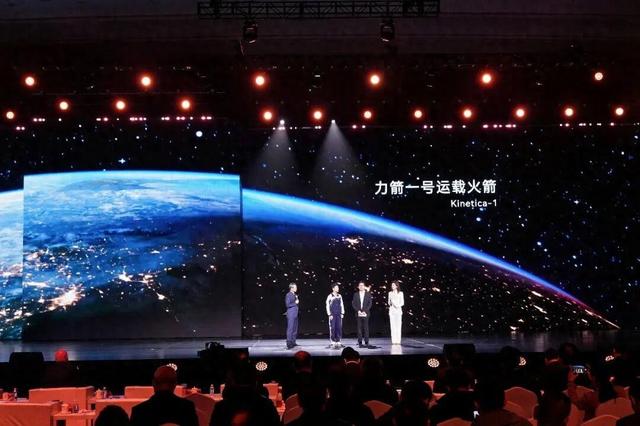
Core Insights - The "2025 Better and Better" International Design Competition emphasizes designs that address national strategies, solve real pain points, and enhance human happiness and dignity [1][12] - The competition showcases innovative designs that integrate national strategy, technological independence, and humanistic care, addressing contemporary issues such as energy security and space exploration [4] Group 1: Awarded Designs - The "Mingyang Tiancheng" floating wind power platform offers a low-cost, reliable, and eco-friendly solution for deep-sea wind power development, transforming typhoons into clean energy [5] - The "Exploration No. 3" research vessel redefines polar research equipment with a 90% autonomy rate, addressing technical monopolies and emphasizing ecological protection [5] - The "Lijian No. 1" rocket significantly reduces launch costs through innovative design, making space technology accessible for agriculture and meteorology, thus embodying the concept of "inclusive sharing" in commercial space [5] Group 2: Design Values - The first value of design is its scope, addressing major contemporary challenges while integrating national strategy and humanistic concerns [4] - The second value is its penetrative ability, enhancing efficiency in various settings while restoring the human scale [7] - The third value is its ability to be unobtrusive, allowing complex technologies to serve human instincts and emotional connections [9] Group 3: Cross-Disciplinary Perspectives - Experts from various fields emphasize the need for design to overcome engineering barriers and serve national projects effectively [10] - Industrial design is highlighted as a crucial engine for cultivating new productive forces, requiring market relevance and competitiveness [10] - The importance of designs that resonate with cultural heritage and human care is underscored, particularly in the medical field [10]
国信证券:原材料价格上涨对白电龙头影响有限 白电排产表现有所修复
智通财经网· 2026-02-03 07:32
Core Viewpoint - Recent increases in raw material prices, particularly copper and aluminum, have raised concerns about the profitability of leading white goods companies, but historical data suggests that the negative impact on gross margins may diminish over time [1][2] Group 1: Raw Material Price Impact - Since 2008, the home appliance industry has experienced three significant raw material price increase cycles, with the impact on gross margins decreasing over time: the highest quarterly gross margin decline was 5-7 percentage points during 2009-2011, around 5 percentage points in 2016-2017, and approximately 2 percentage points from 2020-2022 [1] - In January 2026, copper and aluminum prices increased by 36.7% and 20.9% year-on-year, respectively, which is lower than the increases seen from 2020-2022, suggesting that the current raw material cost impact on white goods companies may be less severe [2] Group 2: Production and Demand Trends - In February, the total production of white goods in China reached 23.79 million units, a 22.1% decrease compared to the same period last year, with a projected 5.0% decline for January-February combined [3] - The production performance of white goods has shown signs of recovery, with the impact of the Spring Festival timing affecting February production, but cumulative growth for January-February has slightly improved [3] Group 3: Retail Market Performance - In 2025, the retail scale of China's home appliance market is expected to decline by 4.3% year-on-year to 893.1 billion yuan, with specific categories like air conditioners and refrigerators experiencing declines of 0.4% and 11.5%, respectively [4] - Small home appliances are expected to perform better, with an overall retail growth of 3.8%, indicating a relative resilience compared to larger appliances [4] Group 4: Key Data Tracking - In January, the home appliance sector experienced a relative return of -2.6%, with raw material prices for copper and aluminum increasing by 7.8% and 4.8% month-on-month, respectively [5] Group 5: Investment Recommendations - Recommended stocks in the white goods sector include Midea Group, Haier Smart Home, TCL Smart Home, and Hisense Home Appliances, while TCL Electronics and Hisense Visual are recommended in the black goods sector [6]