招商银行

Search documents
国信证券:银行业净息差或于2026年见底 板块估值修复可期
智通财经网· 2026-01-16 01:34
Core Viewpoint - The report from Guosen Securities indicates that the decline in net interest margin (NIM) for China's banking industry is expected to significantly converge by 2026, suggesting that the current downtrend in NIM may be nearing its end, contrasting sharply with the previous two years of uncertainty in the industry [1] Group 1: Banking Sector Outlook - Guosen Securities predicts that the fundamental bottoming of the banking sector will drive a valuation premium recovery for quality individual stocks [1] - The report emphasizes that resident confidence is the core variable influencing the flow of funds, rather than the performance of financial products, as evidenced by trends in Japanese asset allocation [2] Group 2: Historical Context and Confidence Impact - The report draws parallels with Japan's experience, noting that from 1995 to 2003, despite a significant decline in deposit rates, there was no major shift in deposits due to a lack of resident confidence amid economic downturns [2][3] - It highlights that the shift in asset allocation towards higher-risk assets in Japan only occurred after a substantial recovery in resident confidence from 2003 to 2004, reinforcing the idea that confidence drives asset allocation [3] Group 3: Current Trends in Japan - Japanese residents have not moved their deposits out, but the trend of activating deposits has intensified as the proportion of transferable deposits has increased from 11.4% in 1994 to 65% by the end of the 2024 fiscal year [4] - The report suggests a strategic investment approach of "stable base + offensive combination," recommending banks such as China Merchants Bank, CITIC Bank, Ningbo Bank, Changsha Bank, and Chongqing Rural Commercial Bank for the offensive combination [4]

国信证券晨会纪要-20260116
Guoxin Securities· 2026-01-16 01:25
Macro and Strategy - December financial data shows a significant recovery in corporate financing, with new social financing reaching 2.21 trillion yuan, exceeding expectations of 1.82 trillion yuan, and new RMB loans at 910 billion yuan, surpassing the forecast of 679.4 billion yuan. M2 growth year-on-year was 8.5%, above the expected 7.9% [7][8] - The improvement in corporate loans indicates a recovery in financing demand, aligning with the manufacturing PMI returning to expansion territory, suggesting a positive economic outlook towards the end of the year [7][8] - The People's Bank of China announced a reduction in structural monetary policy tool rates, effective January 19, 2026, to enhance support for key sectors and stabilize expectations for bank net interest margins [12][8] Industry and Company - The banking sector is expected to see a significant reduction in the decline of net interest margins in 2026, indicating a potential end to the current downtrend cycle. This is contrasted with the previous two years of uncertainty regarding the bottom line of net interest margins [13][17] - The acquisition of 67.48% of Zhejiang Jiali Industrial Co., Ltd. by Debang Lighting for 1.454 billion yuan is aimed at expanding its presence in the automotive lighting sector, which is expected to grow significantly [18] - The banking industry is focusing on risk resolution, with the regulatory framework remaining consistent with previous years, emphasizing the need to mitigate risks in small financial institutions and the real estate sector [13][17]
黄金热居高不下 多家银行发行挂钩黄金的结构性存款
Xin Lang Cai Jing· 2026-01-16 00:17
Core Viewpoint - In 2025, international gold prices experienced a historic bull market, with London spot gold prices rising from approximately $2646 per ounce at the beginning of the year to over $4367.8 per ounce by year-end, marking an annual increase of about 65% [1][6]. Group 1: Market Trends - The current domestic bank deposit rates are at a low, with some short-term deposit rates starting with "0", such as the Industrial and Commercial Bank of China's 3-month deposit rate at 0.65% and large-denomination certificates of deposit at only 0.9% [2][7]. - In contrast, the gold market has been on the rise, prompting multiple banks to launch gold-linked structured deposit products to cater to risk-averse investors seeking higher returns [2][8]. Group 2: Structured Deposit Products - Banks like China Merchants Bank and Bank of Communications have introduced various gold-linked structured deposit products, offering features like "principal protection + floating returns" and flexible term options [2][8]. - For instance, China Merchants Bank's "Point Gold" series includes products with terms ranging from 7 to 181 days, with expected annualized returns of 1%, 1.58%, or 1.78% based on gold price fluctuations [2][8]. - Bank of Communications offers a series of structured deposits with annualized returns ranging from 0.5% to 3.2%, depending on the performance of the Shanghai Gold Exchange AU99.99 contract [2][8]. Group 3: Investment Considerations - While structured deposits are generally considered safe with principal protection, the potential for returns is tied to the performance of the underlying assets, such as gold prices [4][10]. - Analysts suggest that the first quarter of 2026 will see a peak in the maturity of higher-rate fixed deposits, making structured deposits an attractive option for banks to maintain funding stability [4][10]. - Investors are advised to thoroughly understand the terms and risks associated with structured deposits, as they cannot be withdrawn early and the highest advertised returns may not be guaranteed [5][11].
“十万亿银行圈”再添新成员
Nan Fang Du Shi Bao· 2026-01-15 23:13
中信银行业绩快报显示,去年,该行营业总收入2124.75亿元,比上年下降0.55%;归属于股东的净利润 706.18亿元,比上年增长2.98%。 资产质量方面,截至2025年末,中信银行不良贷款率1.15%,比上年末下降0.01个百分点;拨备覆盖率 203.61%,比上年末下降5.82个百分点。 "十万亿银行圈"再添新成员!1月14日晚间,中信银行发布2025年业绩快报。去年,该行营收同比微降 0.55%至2124.75亿元,归母净利润同比增长2.98%至706.18亿元。截至去年末,该行资产总额达到 101316.58亿元。 就在前一天,浦发银行也发布业绩快报,官宣总资产突破十万亿元大关。至此,12家全国性股份制银行 中,已有招商银行、兴业银行、浦发银行和中信银行4家总资产超过十万亿元。如果加上6家国有行,则 我国银行业已形成"6家国有大行+4家股份行"的十万亿资产阵营。在专家看来,已跨入十万亿门槛的股 份行,其发展逻辑必须从"规模驱动"彻底转向"质量驱动"。未来的核心任务不再是资产扩张,而是在财 富管理、投资银行、金融科技等高附加值领域构筑坚实的护城河。 中信银行现状:营收微降,行长一职仍空缺 中信银行不 ...



今年以来78只公募产品启动募集
Zheng Quan Ri Bao· 2026-01-15 16:43
Group 1 - The public fund issuance has accelerated entering 2026, with 78 new funds launched as of January 15, reflecting a strong market interest in economic transformation opportunities [1][4] - Among the new funds, 31 are equity funds, 27 are mixed funds, 10 are bond funds, 8 are FOFs (funds of funds), and 2 are QDII funds, indicating a diverse product offering [2] - Six funds achieved "one-day sell-out" status, showcasing a rapid fundraising pace and strong investor demand [2][3] Group 2 - FOF products have shown strong fundraising capabilities, with notable examples including the Guangfa Yueying Stable Three-Month Holding Mixed Fund (FOF) raising over 3.2 billion units in just two days [3] - The popularity of FOFs is attributed to their alignment with investors' needs for stability and risk diversification, particularly in a low-interest-rate environment [3] - Over 20 new funds focus on themes such as technology and innovation, indicating a market trend towards growth sectors [3][4] Group 3 - The fund issuance market is seen as a positive signal for the economy, with a notable influx of funds into stable products like FOFs and a clear market optimism towards technology growth themes [4][5] - The top fund issuers include Guotai Fund with 5 new products, followed by Yongying Fund with 4, highlighting competitive dynamics among public fund institutions [4] - The industry is encouraged to enhance core competitiveness through improved research capabilities and diversified product offerings to support sustainable wealth growth for residents [4][5]
银行业点评:精准滴灌,稳定银行息差预期
Guoxin Securities· 2026-01-15 15:32
核心观点 锚定经济结构性矛盾,精准落地结构性货币政策工具。此次结构性货币政策利率调整,既是对中央经济工 作会议精神的快速响应,也是破解我国当前经济结构性矛盾的关键抓手。结构性货币政策多年来持续加码, 以抵押补充贷款(PSL)利率调整为例,自 2022 年以来其利率已累计调降过 3 次,从最初的 2.80%逐步降 至 2025 年 5 月的 2.00%,此次再次调降至 1.75%。这一持续调降的背后,是政策对重点领域支持的连贯性, 以增强市场预期稳定性。这既畅通了货币政策传导机制,缓解了重点领域与薄弱环节的融资压力,又从根 本上防范总量宽松可能带来的风险积累,充分彰显结构性货币政策在平衡稳增长与调结构中的核心作用。 证券研究报告 | 2026年01月15日 银行业点评 精准滴灌,稳定银行息差预期 | 行业研究·行业快评 | | | 银行 | 投资评级:优于大市(维持) | | --- | --- | --- | --- | --- | | 证券分析师: | 田维韦 | 021-60875161 | tianweiwei@guosen.com.cn | 执证编码:S0980520030002 | | ...
继续聚焦风险化解:金融监管总局 2026 年监管工作会议学习体会
Guoxin Securities· 2026-01-15 15:17
Investment Rating - The investment rating for the industry is "Outperform the Market" (maintained) [1][5]. Core Insights - The Financial Regulatory Bureau held a meeting to summarize the work of 2025 and arrange key tasks for 2026, with a continued focus on risk resolution, particularly for small and medium-sized financial institutions [2][3]. - The meeting emphasized five main areas: risk resolution for small financial institutions, prevention of risks in real estate and financing platforms, enhancement of high-quality development capabilities, improvement of financial regulation, and better financial services for economic and social quality [3][4]. - Compared to 2025, the requirements for 2026 remain largely unchanged, with a strong emphasis on preventing "explosive" risks in small financial institutions and a focus on normalizing the operation of real estate financing coordination mechanisms [3][6]. Summary by Sections Risk Resolution - The primary focus remains on resolving risks in small and medium-sized financial institutions, with a goal to firmly maintain the bottom line of preventing "explosive" risks [3][6]. - In 2025, nearly 400 banks were approved for dissolution or merger, and this trend is expected to continue into 2026 [3]. High-Quality Development - The requirement to enhance the industry's high-quality development capabilities remains unchanged, with new directives to cautiously advance the reduction and quality improvement of small financial institutions and to address disorderly competition [4][6]. Financial Regulation - There is a strong emphasis on strengthening and improving financial regulation, focusing on substantive risks and practical issues, and enhancing regulatory capabilities [4][6]. Financial Services - The meeting called for continuous improvement in financial services to enhance economic and social quality, including support for major strategies and sectors [4][6]. Investment Recommendations - The industry is expected to benefit from a narrowing of net interest margin declines, leading to an improvement in fundamentals for 2026, maintaining the "Outperform the Market" rating. Recommended stocks include Ningbo Bank and Changshu Bank, with attention to Changsha Bank and Chongqing Rural Commercial Bank. Stable high-dividend stocks such as China Merchants Bank, Industrial and Commercial Bank of China, and Jiangsu Bank are also considered valuable for allocation [7].
银行财富管理架构变阵 抢滩300万亿居民资产
2 1 Shi Ji Jing Ji Bao Dao· 2026-01-15 15:07
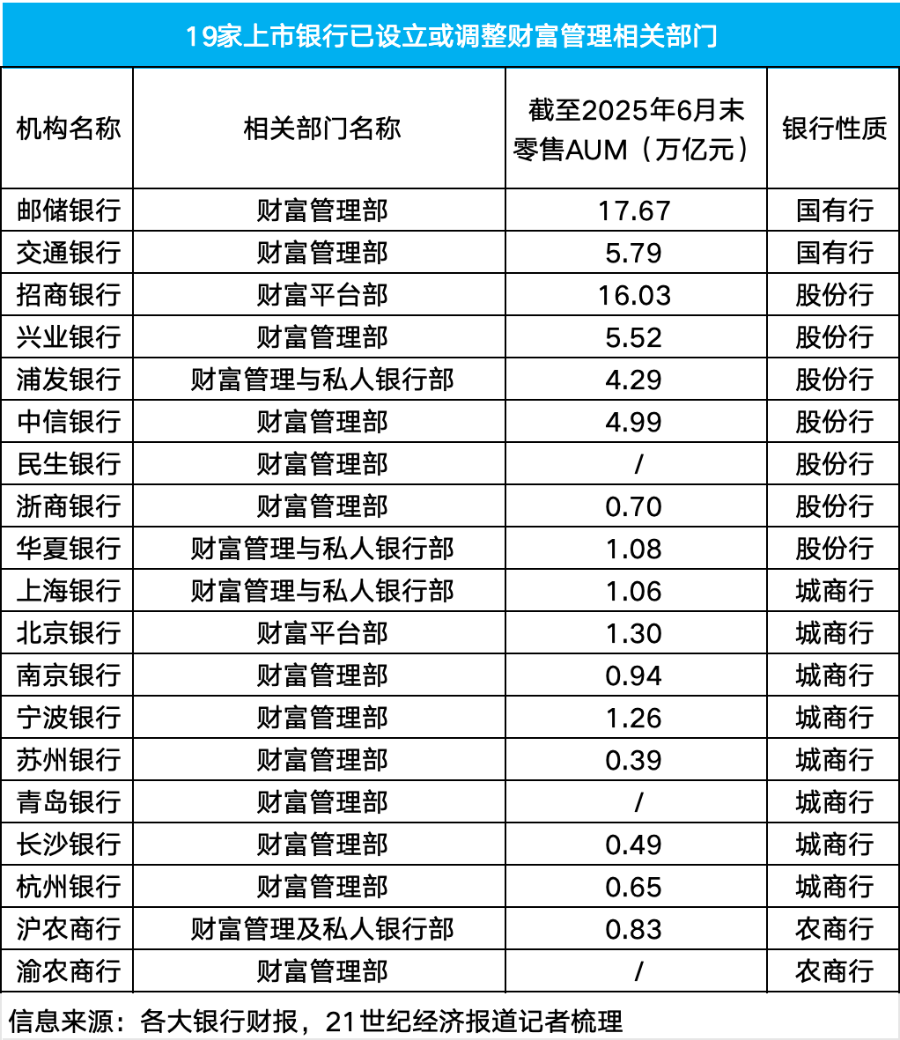
Core Insights - The wealth management market is heating up, with banks accelerating the integration of their wealth management departments to capture this promising market [1][2] - By June 2025, China's investable assets are expected to exceed 300 trillion yuan, indicating significant growth potential in wealth management as many assets remain "asleep" [1] - Major banks are restructuring their organizational frameworks to enhance their wealth management strategies and business layouts [1] Group 1: Bank Actions and Adjustments - In 2025, several major banks, including Bank of Communications and Postal Savings Bank, announced the establishment of wealth management departments at the head office level [3] - As of June 2025, 19 listed banks have established or adjusted their wealth management-related departments, including 2 state-owned banks, 7 joint-stock banks, 8 city commercial banks, and 2 rural commercial banks [3][4] - The establishment of these departments is seen as a key move for state-owned banks to deepen their wealth management strategies and promote digital transformation [3] Group 2: Strategic Focus and Market Dynamics - Different banks are focusing on various aspects of wealth management, with some emphasizing the establishment of wealth management departments as a core strategy [5] - The restructuring of wealth management departments signals a strategic shift in response to narrowing interest margins and evolving customer demands for diversified asset allocation [6][7] - The actions of major state-owned banks serve as a bellwether for the industry, indicating a shift from incremental competition to in-depth management of existing clients [8] Group 3: Wealth Management Market Landscape - As of June 2025, the retail asset management scale (AUM) among 42 listed banks shows a clear tiered structure, with state-owned banks leading the market [11] - The first tier includes major state-owned banks like ICBC, ABC, and CCB, with AUMs of 24 trillion yuan, 23.68 trillion yuan, and 22 trillion yuan respectively [11] - The second tier consists mainly of joint-stock banks, while the third tier includes city commercial banks and rural commercial banks, which are crucial for local wealth management ecosystems [11] Group 4: Future Competition and Technological Integration - Future competition in wealth management will focus on service quality, technological capabilities, and comprehensive financial ecosystems [13] - The establishment of wealth management departments aims to shift banks from product-driven to customer-driven models, enhancing service consistency and customer loyalty [13] - Financial technology is expected to play a critical role in enhancing service depth and breadth, with AI being utilized for investment advisory and customer experience management [14][15]
“首刷”大战一触即发!中国发行的Visa信用卡,首次登陆Apple Pay
券商中国· 2026-01-15 14:27
Core Viewpoint - Visa has announced support for Chinese-issued Visa cards to be linked to Apple Pay, breaking the previous exclusivity of UnionPay cards in China [1][2][3] Group 1: Initial Banks and Partnerships - The first eight banks to support this initiative include Industrial and Commercial Bank of China, Bank of China, Agricultural Bank of China, Bank of Communications, China Merchants Bank, CITIC Bank, Ping An Bank, and Industrial Bank [2] - Visa is also collaborating with Shanghai Pudong Development Bank, China Construction Bank, Minsheng Bank, and China Everbright Bank for future support [2] Group 2: Consumer Benefits and Promotions - Consumers can now use Apple Pay with Visa cards for contactless payments abroad, eliminating the need to carry a physical Visa card [2][4] - Various promotional activities have been launched by the initial banks to attract customers, including cashback offers and incentives for using Apple Pay with Visa cards [4][5] - For example, China Merchants Bank offers a 1% cashback on all overseas transactions made with Apple Pay linked Visa cards, while Ping An Bank provides a $5 cashback for transactions over $5.01 [4][5] Group 3: Technological Advancements - Visa has emphasized its investment in data and payment security, introducing payment tokenization services to enhance security in cross-border transactions [6][8] - Payment tokenization removes sensitive information during online or mobile shopping, significantly reducing fraud risks [6] - The integration of Visa cards with Apple Pay allows for the application of payment tokenization in more overseas payment scenarios, improving convenience and security for cardholders [6][7] Group 4: Security Features - When a China Merchants Bank Visa card is linked to Apple Pay, the actual card number is not stored on the device or Apple's servers, enhancing security [8] - A unique Device Account Number is generated and encrypted for secure storage, ensuring that payment information is protected [8]




同股不同价 银行A/H股近五月为何分化了
2 1 Shi Ji Jing Ji Bao Dao· 2026-01-15 14:09
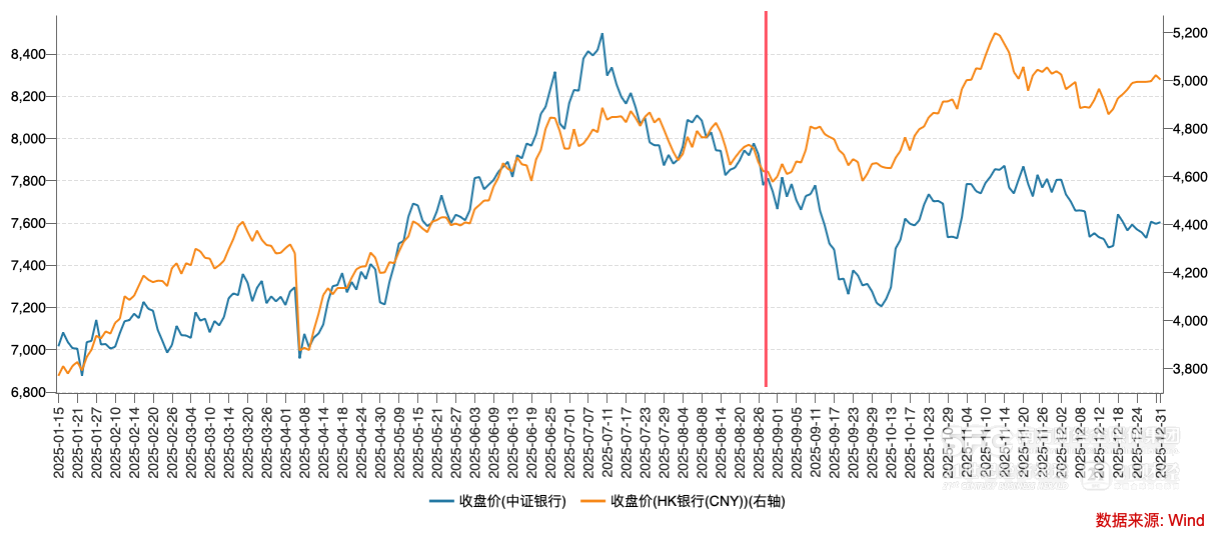
Core Viewpoint - In a low-interest-rate environment, bank stocks are seen as representatives of dividend style investments, offering medium to long-term allocation value due to their high dividend characteristics [1] Group 1: Bank Indices Performance - The main bank indices in A-share and Hong Kong markets include the China Securities Bank Index, the China Securities Hong Kong Bank Index, and the China Securities AH Bank Index [2] - The China Securities Hong Kong Bank Index is expected to significantly outperform the China Securities Bank Index in 2025 [3] - From January 1 to December 31, 2025, the Hong Kong Bank Index recorded a growth of 28.94%, which is substantially higher than the 6.79% increase of the China Securities Bank Index and the 9.60% of the AH Bank Index [4] Group 2: Investment Trends and Fund Flows - In Q3 2025, the Hong Kong banking sector saw significant buying from insurance capital, while the A-share banking sector experienced substantial selling by public funds [10] - The proportion of active equity funds' holdings in A-share banks dropped from 3.91% to 1.49%, with the market value decreasing from 64.1 billion yuan to 30.8 billion yuan [10] - In contrast, insurance capital made 41 significant investments in banks throughout 2025, with 33 of these targeting H-share banks [10] Group 3: Stock Performance and Dividend Yields - The strong performance of the Hong Kong Bank Index is attributed to the notable gains of key stocks such as HSBC Holdings, which rose by 25.53%, and Standard Chartered, which increased by 30.66% [11] - The dividend yield for Hong Kong banks remains above 6%, making them attractive to insurance capital, while A-share banks generally have yields between 3% and 4% [13] - Historical data indicates that buying bank stocks before the Spring Festival has an 80% success rate, with quality joint-stock banks and city commercial banks often yielding excess returns [13] Group 4: Future Outlook - Looking ahead to 2026, insurance capital is expected to remain a significant source of funding, but bank stocks may underperform the broader market in the first quarter due to a growth-oriented market style [15] - The return on tangible equity (ROTE) for Hong Kong banks is projected to slightly decline in 2026, yet the combined return from dividends and buybacks is still expected to exceed 7%, maintaining their investment appeal [15]