重庆银行

Search documents
银行周报(0526-0601):全国农信社改革再下一城
Tai Ping Yang Zheng Quan· 2025-06-03 04:15
Investment Rating - The industry investment rating is "Positive," indicating an expected overall return exceeding 5% above the CSI 300 index in the next six months [41]. Core Viewpoints - The report highlights that the banking sector remains attractive as a dividend asset under a moderately loose monetary policy environment. It suggests focusing on companies benefiting from incremental policy improvements and those with strong fundamentals and regional advantages [6][39]. Summary by Sections Market Review - The Shanghai Composite Index and CSI 300 Index experienced slight declines of -0.03% and -1.08%, respectively, while the Shenwan Banking Index rose by 0.04%, outperforming the CSI 300 by 1.12 percentage points [4][10]. - Among the major banking sectors, state-owned banks, joint-stock banks, city commercial banks, and rural commercial banks had varying performances, with the rural commercial banks showing a positive change of 0.41% [12][13]. Data Tracking - As of May 30, 2025, the banking sector's PB-LF valuation stands at 0.67 times, placing it in the 74.50 percentile over the past five years. The median dividend yield for individual stocks is 4.40%, exceeding the 10-year government bond yield by 2.73 percentage points [5][23]. - The total social financing stock reached 424 trillion yuan, reflecting a year-on-year increase of 8.70%. The loan and deposit balances of Chinese banks were 258.36 trillion yuan and 293.94 trillion yuan, respectively, with year-on-year growth rates of 7.73% and 7.99% [5][39]. Industry Dynamics - The report notes the establishment of the Inner Mongolia Rural Commercial Bank, marking the completion of rural financial institution reforms in ten provinces. This bank has a registered capital of 58 billion yuan and represents a significant milestone in local financial reform [40]. - The National Development and Reform Commission announced a reduction in credit report inquiry fees, which is expected to save users approximately 1.1 billion yuan annually [39][40]. Recommended Companies and Ratings - The report recommends the following companies with respective ratings: - CITIC Bank: "Increase" - China Merchants Bank: "Buy" - Chongqing Bank: "Increase" - Yunnan Rural Commercial Bank: "Buy" [3][40].


房地产贷款增速转正,按揭多增——银行业周度追踪2025年第21周
Changjiang Securities· 2025-06-03 00:20
Investment Rating - The industry investment rating is "Positive" and maintained [8] Core Insights - As of the week ending May 30, the banking index has increased by 0.1%, outperforming the CSI 300 index by 1.2% and the ChiNext index by 1.5%. The market's focus on bank stocks has notably increased due to active fund allocation, with a continued upward trend in the sector, particularly for city commercial banks with relatively strong performance [3][14] - The growth rate of real estate loans has turned positive for the first time since the end of Q3 2023, with a year-on-year increase of 0.04% as of the end of March, primarily driven by a recovery in mortgage demand. In Q1, new personal housing loans amounted to 2,144 billion, a year-on-year increase of 2,093 billion, mainly due to a rebound in second-hand housing sales and improved early repayments [4][30] - Recently, the inclusion of Chongqing Rural Commercial Bank and Shanghai Rural Commercial Bank into the CSI 300 index is expected to attract more index funds, providing a positive outlook for these constituent stocks [5][44] - The focus on convertible bond banks is increasing, with significant valuation recovery and trading opportunities. Hangzhou Bank's stock price has risen significantly after triggering the strong redemption clause for its convertible bonds, indicating high investor confidence [6][44] Summary by Sections Banking Sector Performance - The banking index has shown a cumulative increase of 0.1% as of May 30, outperforming the CSI 300 index by 1.2% and the ChiNext index by 1.5% [3][14] - Individual stocks such as Hangzhou Bank have led the gains, with its stock price reaching a new high after the convertible bond triggered strong redemption conditions [3][14] Loan Trends - The growth rate of real estate loans has turned positive, with a year-on-year increase of 0.04% as of the end of March, driven by a recovery in mortgage demand [4][30] - In Q1, new personal housing loans totaled 2,144 billion, a year-on-year increase of 2,093 billion, attributed to improved second-hand housing sales and early repayments [4][30] Index Adjustments - Chongqing Rural Commercial Bank and Shanghai Rural Commercial Bank have been included in the CSI 300 index, effective June 13, 2025, which is expected to lead to increased capital inflow into these stocks [5][44] Convertible Bonds - The focus on banks issuing convertible bonds has intensified, with Hangzhou Bank's stock price showing significant gains after the strong redemption clause was triggered [6][44]


银行业周度追踪2025年第21周:房地产贷款增速转正,按揭多增-20250603
Changjiang Securities· 2025-06-02 23:30
Investment Rating - The investment rating for the banking industry is "Positive" and maintained [11] Core Insights - The banking index increased by 0.1% as of May 30, 2025, outperforming the CSI 300 index by 1.2% and the ChiNext index by 1.5%. The market's focus on bank stocks has increased significantly due to active fund allocation, with a continued upward trend in the sector, particularly for city commercial banks with relatively strong performance [2][6][19] - The growth rate of real estate loans turned positive for the first time since Q3 2023, with a year-on-year increase of 0.04% as of the end of March. This was primarily driven by a recovery in mortgage demand, with new personal housing loans amounting to 2,144 billion, a year-on-year increase of 2,093 billion [7][34][40] - The inclusion of Chongqing Rural Commercial Bank and Shanghai Rural Commercial Bank into the CSI 300 index is expected to attract more index funds, providing a positive outlook for these constituent stocks [8][47] Summary by Sections Market Performance - As of May 30, 2025, the banking index has shown a cumulative increase of 0.1%, with significant gains in city commercial banks like Hangzhou Bank, which saw its stock price rise after triggering a strong redemption condition for its convertible bonds [2][6][19] Loan Trends - In Q1 2025, the growth of corporate medium and long-term loans decreased, with industrial loans adding 1.52 trillion, down 140 billion year-on-year, and service sector loans adding 2.99 trillion, down 550 billion year-on-year. However, personal housing loans saw a significant increase, indicating a recovery in the housing market [7][34][40] Index Adjustments - The adjustment of the CSI 300 index, which includes Chongqing Rural Commercial Bank and Shanghai Rural Commercial Bank, is expected to lead to increased capital inflow into these stocks, enhancing their market performance [8][47] Convertible Bonds - The recent surge in bank stocks has narrowed the price gap to the strong redemption price for banks issuing convertible bonds. Hangzhou Bank's stock price has remained above the strong redemption price for 15 consecutive trading days, indicating strong investor confidence [9][48]
重庆银行(601963) - 关于股东权益变动的提示性公告
2025-05-30 09:18
证券代码:601963 证券简称:重庆银行 公告编号:2025-039 可转债代码:113056 可转债简称:重银转债 重庆银行股份有限公司 关于股东权益变动的提示性公告 本行董事会及全体董事保证本公告内容不存在任何虚假记载、误导性陈述或 者重大遗漏,并对其内容的真实性、准确性和完整性承担法律责任。 重要内容提示: 本次权益变动未触及要约收购,未导致本行第一大股东发生变化。 一、本次权益变动情况 近日,重庆银行股份有限公司(以下简称"本行")收到本行第一大股东重 庆渝富资本运营集团有限公司(以下简称"渝富资本")发来的关于权益变动的 告知函。渝富资本控股股东重庆渝富控股集团有限公司(以下简称"渝富控股") 与中国机械工业集团有限公司(以下简称"国机集团")、国机仪器仪表(重庆) 有限公司(以下简称"国机仪器仪表")签订《表决权委托协议》,中国四联仪 器仪表集团有限公司与国机集团、国机仪器仪表签订《中国四联仪器仪表集团有 限公司与国机仪器仪表(重庆)有限公司与中国机械工业集团有限公司关于重庆 川仪自动化股份有限公司之股份转让框架协议的补充协议》。上述协议签署后, 国机仪器仪表合计取得重庆川仪自动化股份有限公司( ...
深度|银行营收结构全景图!
券商中国· 2025-05-30 07:12
Core Viewpoint - The banking industry is facing significant challenges in maintaining profitability due to declining net interest income and pressure on intermediary income, leading to a reliance on investment income from bond trading to support revenue growth [2][4][5]. Group 1: Interest Income and Profitability - A new round of deposit rate cuts has been initiated by major state-owned banks to reduce funding costs and alleviate pressure on net interest margins, with one-year fixed deposit rates entering the "1" era [2][3]. - Over 80% of A-share listed banks reported either negative or minimal growth in revenue year-on-year in Q1, with nearly half experiencing a decline in net interest income [2][3]. - The average net interest margin for commercial banks in China decreased by over 9 basis points in Q1, reflecting ongoing pressure on profitability [4]. Group 2: Intermediary Income Trends - The net income from fees and commissions, a key component of non-interest income, has been under pressure, with Q1 figures showing a decline compared to the previous year [5][7]. - The number of banks reporting negative growth in intermediary income has decreased, indicating a slight improvement in this area compared to previous years [7]. Group 3: Investment Income and Market Conditions - The bond market has provided a significant boost to banks' revenues, with many banks reporting substantial increases in investment income due to favorable trading conditions [8][9]. - In Q1, 34 out of 42 listed banks saw positive growth in investment income, with some banks reporting increases of over 100% [9][10]. - However, the fair value changes of financial assets have shown mixed results, with many banks experiencing losses that offset gains from investment income [10][11]. Group 4: Future Outlook and Challenges - The ability of banks to continue relying on bond sales for revenue is uncertain, as future performance will depend on market conditions and the banks' existing bond portfolios [13][14]. - Analysts suggest that banks may need to sell more bonds to realize gains, but this could lead to greater pressure on future earnings if not managed carefully [13][14]. - The overall sentiment in the market indicates that while significant adjustments in bond prices are unlikely, moderate fluctuations could still pose risks to banks' profitability [14].


100家银行年报里的中国
虎嗅APP· 2025-05-29 23:59
Core Viewpoint - The article emphasizes the performance of regional banks in China, particularly focusing on city commercial banks and rural commercial banks, highlighting the economic vitality of regions like Jiangsu and Zhejiang compared to others like Guangdong and Shanghai [3][4][10]. Group 1: Regional Bank Performance - Jiangsu and Zhejiang regions are identified as having strong city commercial banks, with institutions like Jiangsu Bank and Ningbo Bank showing robust performance, indicating high economic vitality [8][9]. - In contrast, banks headquartered in Shanghai, such as Shanghai Bank and Hu'nong Bank, have underperformed, attributed to the city's "deposit surplus" characteristic and intense competition [17][21]. - Guangdong, despite being the largest economy, lacks representation in the top city commercial banks, with local banks like Guangzhou Bank showing poor performance and significant declines in revenue and profit [23][25][28]. Group 2: Economic Indicators - Jiangsu and Zhejiang's GDP growth rates are 5.8% and 5.5% respectively, outperforming Guangdong's 3.5%, showcasing their economic competitiveness [9][28]. - The article suggests that examining local bank performance can provide a clearer picture of regional economic health than GDP figures alone [6][10]. Group 3: Specific Bank Analysis - Jiangsu Bank reported a 16.12% growth in asset scale, with a net profit of 31.84 billion yuan, while Ningbo Bank achieved a 15.25% growth with a net profit of 27.12 billion yuan [11]. - Chengdu Bank has shown significant growth, with a 14.56% increase in asset scale and a 10.17% rise in net profit, attributed to its focus on local infrastructure projects [38][40]. - In contrast, Guangzhou Bank's asset scale grew only 2.77%, with a net profit decline of 66%, reflecting its struggles in retail and corporate sectors [25][26]. Group 4: Risk and Asset Quality - The article notes that banks in Jiangsu and Zhejiang maintain non-performing loan ratios below 1%, indicating strong asset quality, while banks in regions like Northeast China face higher non-performing rates [5][14][58]. - The article highlights that many banks in Jiangsu and Zhejiang have high provision coverage ratios, often exceeding 300%, which helps mitigate risks associated with potential loan defaults [14][15]. Group 5: Governance and Management Issues - Governance issues are prevalent in some central region banks, with several high-level executives facing investigations, impacting their performance [70][71]. - In contrast, banks in Jiangsu and Zhejiang have fewer governance issues, contributing to their stronger performance [31][72].




100家银行年报里的中国
Hu Xiu· 2025-05-29 22:12
Core Viewpoint - The banking sector in China serves as a crucial economic barometer, reflecting regional economic conditions more accurately than the stock market, especially in the context of the new normal of slower economic growth [1][2][3]. Group 1: Regional Banking Performance - Over 100 city commercial banks and rural commercial banks released annual reports, revealing that banks in economically vibrant regions like Jiangsu and Zhejiang maintain low non-performing loan (NPL) ratios, often below 1% [2][4]. - Jiangsu and Zhejiang provinces rank second and fourth in GDP size, with growth rates of 5.8% and 5.5% respectively, outperforming Guangdong's 3.5% growth rate [5]. - Jiangsu Bank, Ningbo Bank, Nanjing Bank, and Hangzhou Bank are among the top city commercial banks, demonstrating strong performance despite macroeconomic pressures [4][6]. Group 2: Financial Metrics of Key Banks - Jiangsu Bank reported an asset scale of 3.95 trillion with a growth rate of 16.12%, revenue of 808.15 billion, and a net profit of 318.43 billion, reflecting a net profit growth of 10.76% [6]. - Ningbo Bank's asset scale reached 3.13 trillion, with a revenue of 666.31 billion and a net profit of 271.27 billion, showing a net profit growth of 6.23% [6]. - Hangzhou Bank's net profit growth was notably high at 18.07%, despite a lower net interest margin due to its focus on low-risk local government financing [8]. Group 3: Challenges in Other Regions - In contrast, banks in Guangdong, despite being in the top economic province, show poor performance, with Guangzhou Bank's asset scale growing only 2.77% and a significant drop in revenue and net profit [17][19]. - The performance of banks in the Northeast is hindered by high NPL ratios, often exceeding 2%, and low net interest margins, with some banks like Shengjing Bank reporting as low as 0.8% [56][58]. - The banking sector in the Northwest faces similar challenges, with low growth rates and high NPL ratios, reflecting a lack of quality projects and competition with larger state-owned banks [51][53]. Group 4: Governance Issues - Governance issues are prevalent in the central region, with several banks experiencing high-profile executive investigations, impacting their performance [68][70]. - Despite governance challenges, Huishang Bank has shown significant growth, with revenue increasing over 180% in the past decade, driven by the local economy [69][71]. Group 5: Emerging Opportunities - The banking sector in Fujian is thriving, with banks like Xiamen International Bank showing a 150% growth in asset scale over the past decade, supported by a robust private economy [26][28]. - Chengdu Bank has also seen substantial growth, with a 14.56% increase in asset scale, driven by a focus on local infrastructure projects [38][39].
又一千亿上市银行,触发强赎!
Zhong Guo Ji Jin Bao· 2025-05-27 14:08
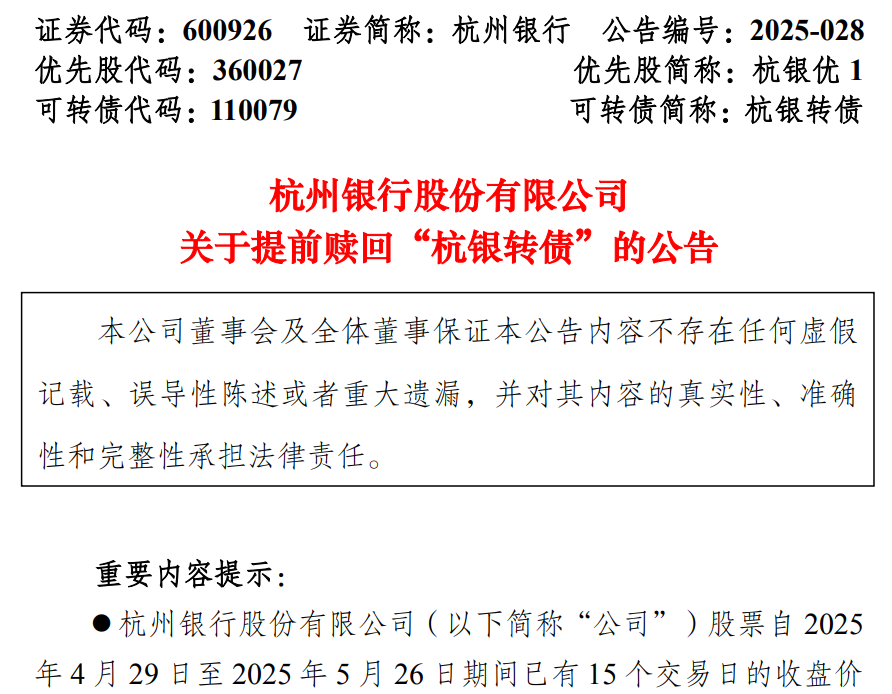
Core Viewpoint - Hangzhou Bank has announced the early redemption of its convertible bonds, indicating a potential further shrinkage in the scale of bank convertible bonds in China [1][7]. Group 1: Early Redemption Announcement - Hangzhou Bank triggered the conditional redemption clause for its convertible bonds (Hangyin Convertible Bonds) on May 26, as the stock price exceeded the conversion price for 15 trading days [3][5]. - The conversion price for the bonds is set at 11.35 CNY, while the stock price reached a new high of 16.02 CNY on May 27, resulting in a conversion premium rate of approximately -0.11% [1][3]. Group 2: Financial Implications - The early redemption allows Hangzhou Bank to utilize the funds to strengthen its capital base, enhancing its financial stability [1][7]. - The mechanism of forced redemption is designed to protect both the issuing company and investors, while also maintaining market stability [5]. Group 3: Market Trends - The market for bank convertible bonds has been declining, with several small and medium-sized banks opting for early redemption as their stock prices rise [7][10]. - Currently, there are only 10 types of bank convertible bonds remaining in the market, indicating a significant reduction in the overall scale of bank convertible bonds [8][9].
银行:消费贷走出“规模竞赛”
Bei Jing Shang Bao· 2025-05-27 13:39
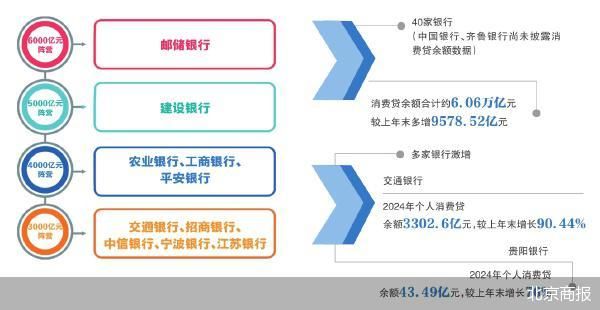
Core Viewpoint - The competition in consumer loans among banks has shifted from a focus on low interest rates to enhancing loan limits and extending loan terms, as banks seek to adapt to changing market conditions and regulatory guidance [1][11][15] Consumer Loan Growth - In 2024, the total consumer loan balance of 40 A-share listed banks increased by over 950 billion yuan, with some banks experiencing growth rates exceeding 90% compared to the previous year [1][3] - The consumer loan balance for these banks reached approximately 6.06 trillion yuan by the end of 2024, marking an increase of 957.85 billion yuan from the previous year [3][4] Interest Rate Trends - Consumer loan interest rates dropped to the "2" range, with some banks offering rates as low as 1.88% for select customers, but this trend has reversed with many banks raising rates to no less than 3% by April 2024 [1][9][10] - The shift back to "3" range interest rates is aimed at preventing excessive competition and potential financial risks associated with low-rate loans [10][11] Bank Strategies - Banks are now focusing on enhancing consumer loan products by increasing limits and extending terms, responding to government initiatives to boost consumption [11][12] - Various banks have begun to raise loan limits and extend repayment periods, with some institutions increasing the maximum loan amount from 300,000 yuan to 500,000 yuan and extending terms from five to seven years [12][16] Market Segmentation - The consumer loan market is showing significant differentiation, with some banks rapidly expanding their loan portfolios through low-rate strategies, while others are contracting due to concerns over rising non-performing loan rates [5][10] - Banks are increasingly targeting specific consumer scenarios, such as home renovations and electric vehicle purchases, to drive loan growth [15][16] Risk Management - The rise in consumer loan balances has led to an increase in non-performing loans, prompting banks to enhance their risk management practices and focus on quality customer segments [9][10][14] - Regulatory bodies are emphasizing the need for banks to monitor the flow of consumer loan funds to mitigate systemic risks [14]


又见银行转债强赎!
证券时报· 2025-05-27 13:14
Core Viewpoint - Hangzhou Bank has decided to exercise the early redemption rights of its convertible bonds, marking the third bank convertible bond to be redeemed early this year, following Chengyin and Suhang convertible bonds [1][3]. Group 1: Early Redemption of Hangzhou Bank Convertible Bonds - Hangzhou Bank's convertible bonds (Hangyin Convertible Bonds) will be redeemed at face value plus accrued interest, as the stock price has exceeded 130% of the conversion price for 15 trading days [3][4]. - The Hangyin Convertible Bonds were issued on March 29, 2021, with a total of 150 million bonds, each with a face value of 100 yuan, and a maturity date of March 29, 2027 [4]. Group 2: Market Context and Trends - The early redemption of bank convertible bonds is linked to the recent strong performance of bank stocks, which have seen a significant recovery from previous undervaluation [4]. - Hangzhou Bank's stock has increased over 70% since the beginning of 2024, contributing to the favorable conditions for early redemption [4]. Group 3: Trends in AAA-rated Convertible Bonds - The scale of AAA-rated convertible bonds has decreased from 2,912.69 billion yuan at the end of 2024 to approximately 2,527.34 billion yuan as of May 27, 2023, a reduction of nearly 400 billion yuan in less than six months [7][8]. - The number of AAA-rated convertible bonds has also decreased, indicating a shrinking market for high-quality convertible bonds [8]. Group 4: Supply and Demand Dynamics - The demand for bank convertible bonds is expected to strengthen due to regulatory changes that emphasize performance benchmarks for public funds, leading to a potential decrease in the total outstanding amount of bank convertible bonds from around 1,700 billion yuan to approximately 1,000 billion yuan [9]. - The lack of new bank convertible bond issuances since 2023, combined with the upcoming maturity of existing bonds, is likely to create a supply-demand imbalance in the market [10].