
吉利汽车

Search documents
9系双旗舰重塑50万级豪华市场,极氪的“破壁”方法论
Jing Ji Guan Cha Wang· 2026-01-16 10:58
Core Insights - The Chinese luxury car market is undergoing significant changes, with traditional luxury brands experiencing a decline in sales while domestic brands like Zeekr are gaining market share [1][2][3] Group 1: Market Dynamics - In 2025, traditional luxury brands saw a decline in imported car sales, with some brands experiencing a drop of over 60% year-on-year due to inventory pressure and slow electrification [2] - Conversely, Chinese high-end brands such as Zeekr, NIO, and Li Auto are steadily increasing their market share in the 300,000 to 500,000 yuan price range [2] - The shift in consumer perception among high-net-worth individuals in China is a key driver of this change, moving from valuing brand history to prioritizing technological advancement and smart experiences [3] Group 2: Product Innovation - The Zeekr 9X is recognized for its technological superiority over traditional luxury SUVs, achieving over 1,000 kilometers of range and exceptional performance through its 900V architecture [4] - The Zeekr 009 has also established itself as a leader in the MPV segment, demonstrating the brand's understanding of luxury beyond vehicle categories [5] Group 3: Global Expansion - Zeekr is transitioning from merely exporting products to a comprehensive global strategy that includes localizing products, channels, and services in various markets [7] - The brand has received international recognition, being praised as a leading global brand from China, indicating a shift from manufacturing to intelligent manufacturing and branding [8] Group 4: Strategic Integration - Zeekr's integration with its parent company Geely has allowed it to focus on long-term product development and user experience without the pressures of short-term profitability [9] - This integration provides Zeekr access to Geely's extensive resources, enhancing its ability to compete in the luxury market [9] Group 5: User Engagement - Zeekr has initiated a "communication transparency revolution," making key information accessible to users and inviting them to supervise service processes [11] - The brand's "mystery experience officer" program engages users in the feedback process, ensuring quality control from the customer's perspective [12] Group 6: Brand Evolution - Zeekr has successfully transitioned from a nascent brand to a significant player in the luxury market, showcasing that Chinese automotive brands can achieve high market scale and brand value [13]
天海电子深主板IPO过会 拟募资24.6亿元
Zheng Quan Shi Bao Wang· 2026-01-16 10:35
Group 1 - The core viewpoint of the article is that Tianhai Electronics has successfully passed the IPO review by the Shenzhen Stock Exchange, marking a significant milestone for the company [1] - Tianhai Electronics, established in the 1970s, initially focused on traditional fuel vehicle wiring harnesses and has since expanded into core areas such as connectors and intelligent control systems, laying a solid foundation for future growth [3] - The company provides automotive transmission systems, connection systems, and intelligent control solutions, with its main products including automotive wiring harnesses, connectors, and electronics, primarily used in both new energy and traditional fuel vehicles [3] Group 2 - The brand "THB" is recognized in the market, reflecting the company's technical strength, with the per vehicle value of its products increasing significantly from 2500 yuan to over 5000 yuan, demonstrating a clear technology premium effect [3] - In 2024, the Chinese automotive wiring harness market is projected to reach 119.6 billion yuan, with Tianhai Electronics holding a leading market share of 8.45%, while it ranks among the top three in the 47.8 billion yuan automotive connector market with a 3.52% share [3] - Tianhai Electronics has established long-term stable partnerships with major automotive manufacturers such as Chery, SAIC Group, Geely, and General Motors, and has also collaborated with leading new energy vehicle companies like Li Auto and NIO [4] Group 3 - For the first three quarters of 2023 to 2025, Tianhai Electronics reported revenues of 11.549 billion yuan, 12.523 billion yuan, and 10.898 billion yuan, with net profits of 0.652 billion yuan, 0.614 billion yuan, and 0.537 billion yuan respectively [4] - The company plans to raise 2.46 billion yuan through its IPO to invest in projects including connector technology upgrades, wiring harness production bases, automotive electronics production bases, and the Tianhai Intelligent Connected Vehicle Industry Research Institute [4] - The construction of these projects is expected to enhance the company's R&D capabilities, improve the intelligence and informatization of production processes, and expand existing production capacity, thereby strengthening its core competitiveness and profitability [4]

2025中国企业ESG“金责奖”评选结果揭晓 共筑可持续发展新生态
新浪财经· 2026-01-16 10:15
Core Viewpoint - By 2025, China's ESG development has transitioned from "setting standards" to "strengthening regulations," with ESG performance becoming a compliance requirement and a crucial link between commercial and social value [2] Group 1: ESG Awards Overview - The 2025 China Enterprise ESG "Golden Responsibility Award" was launched by Sina Finance to recognize companies and institutions that have made outstanding contributions to ESG [2] - The awards include ten categories: Best Environmental Responsibility Award, Best Social Responsibility Award, Best Corporate Governance Responsibility Award, Best Responsibility Initiative Award, Annual Sustainable Development Award, Best Responsible Investment Bank Award, Best Responsible Investment Securities Company Award, Best Responsible Investment Insurance Company Award, Best Responsible Investment Fund Company Award, and Best Responsible Investment Asset Management Institution Award [2] Group 2: Award Winners - Best Environmental Responsibility Award winners include: Sungrow Power Supply, Industrial Fulian, Kweichow Moutai, Geely Automobile, Haier Smart Home, Hisense Visual, Linyang Electronics, Tongwei Co., Weichai Power, and Luxshare Precision [11] - Best Social Responsibility Award winners include: China Shenhua, China General Nuclear Power, China Resources Sanjiu, Sinopec, Shougang Group, Wuliangye, Yangtze Power, China Telecom, China Oilfield Services, and LONGi Green Energy [12] - Best Corporate Governance Responsibility Award winners include: Zijin Mining, SF Holding, ZTE Corporation, Industrial Fulian, JA Solar, SANY Heavy Industry, Nanjing Steel, Bright Dairy, TCL Zhonghuan, and Fuyao Glass [14] - Best Responsibility Initiative Award winners include: FiberHome Technologies, Wens Foodstuff, Haitian Flavoring, Aier Eye Hospital, Yunnan Baiyao, Anke Innovation, and Kingfa Sci. & Tech. [15] - Annual Sustainable Development Award winners include: China General Nuclear Power, Sungrow Power Supply, Kweichow Moutai, Contemporary Amperex Technology, Zijin Mining, Hikvision, Yili Group, Baosteel, Zhejiang Chint Electrics, and China Mobile [15] - Best Responsible Investment Bank Award winners include: Agricultural Bank of China, Industrial and Commercial Bank of China, China Construction Bank, China Merchants Bank, Industrial Bank, and Bank of China [16] - Best Responsible Investment Securities Company Award winners include: Huatai Securities, CICC, Dongfang Securities, CITIC Securities, Guotai Junan, and Haitong Securities [17] - Best Responsible Investment Insurance Company Award winners include: China Life Insurance, Ping An Insurance, China Pacific Insurance, China Re, Sunshine Insurance, and China Life [18] - Best Responsible Investment Fund Company Award winners include: Bosera Funds, Southern Funds, Huaxia Funds, Penghua Funds, Huitianfu Funds, and E Fund [19] - Best Responsible Investment Asset Management Institution Award winners include: China Life Asset Management, Huaxia Wealth, Xingyin Wealth, Taikang Asset, Taiping Asset, and Galaxy Investment [20] Group 3: Outstanding Awards - Outstanding Environmental Responsibility Award winners include: Great Wall Motors, Hikvision, Goldwind, Trina Solar, Midea Group, Tianqi Lithium, Luzhou Laojiao, CIMC, Sinopec, and China Resources Sanjiu [32] - Outstanding Social Responsibility Award winners include: FiberHome Technologies, ZTE Corporation, Contemporary Amperex Technology, Yili Group, Lijun Group, CNOOC Development, State Grid Nanjing, China Railway, Weichai Power, and China National Petroleum [33] - Outstanding Corporate Governance Responsibility Award winners include: Sinopec, China Resources Sanjiu, Hikvision, WuXi AppTec, China Railway Construction, BOE Technology, West Mining, Tongwei Co., Huaxi Bio, and Goldwind [34] - Outstanding Responsibility Initiative Award winners include: ZTE Corporation, Sungrow Power Supply, Hisense Visual, China Merchants Port, Industrial and Commercial Bank of China, Zijin Mining, Shanghai Petrochemical, Lead Intelligent, Inspur Information, and Wuliangye [35] - Outstanding Sustainable Development Award winners include: Wanhu Chemical, Bank of China, Sinopec, ZTE Corporation, Muyuan Foods, Industrial and Commercial Bank of China, Agricultural Bank of China, Weichai Power, Golden Dragon Fish, and JD Logistics [36] - Outstanding Responsible Investment Bank Award winners include: CITIC Bank, Minsheng Bank, Bank of Communications, Pudong Development Bank, Ping An Bank, and Postal Savings Bank [37] - Outstanding Responsible Investment Securities Company Award winners include: Shenwan Hongyuan, Cinda Securities, Galaxy Securities, China Merchants Securities, GF Securities, and Tianfeng Securities [38] - Outstanding Responsible Investment Insurance Company Award winners include: New China Life, AIA, Taikang Insurance, China Pacific Insurance, Industrial and Commercial Bank of China, and China Life Insurance [39] - Outstanding Responsible Investment Fund Company Award winners include: Xingquan Fund, Invesco Great Wall Fund, Chuangjin Hexin Fund, China Merchants Fund, Yinhua Fund, and Industrial Fund [40] - Outstanding Responsible Investment Asset Management Institution Award winners include: Ping An Asset Management, Sunshine Asset, Great Wall Wealth Insurance Asset Management, Agricultural Bank of China Wealth Management, China Life Asset Management, and Jianxin Wealth [41] Group 4: Future Outlook - The committee encourages more Chinese enterprises to integrate ESG concepts into every aspect of production, operation, supply chain collaboration, and strategic planning, emphasizing the importance of sustainable development models that balance commercial and social value [42]





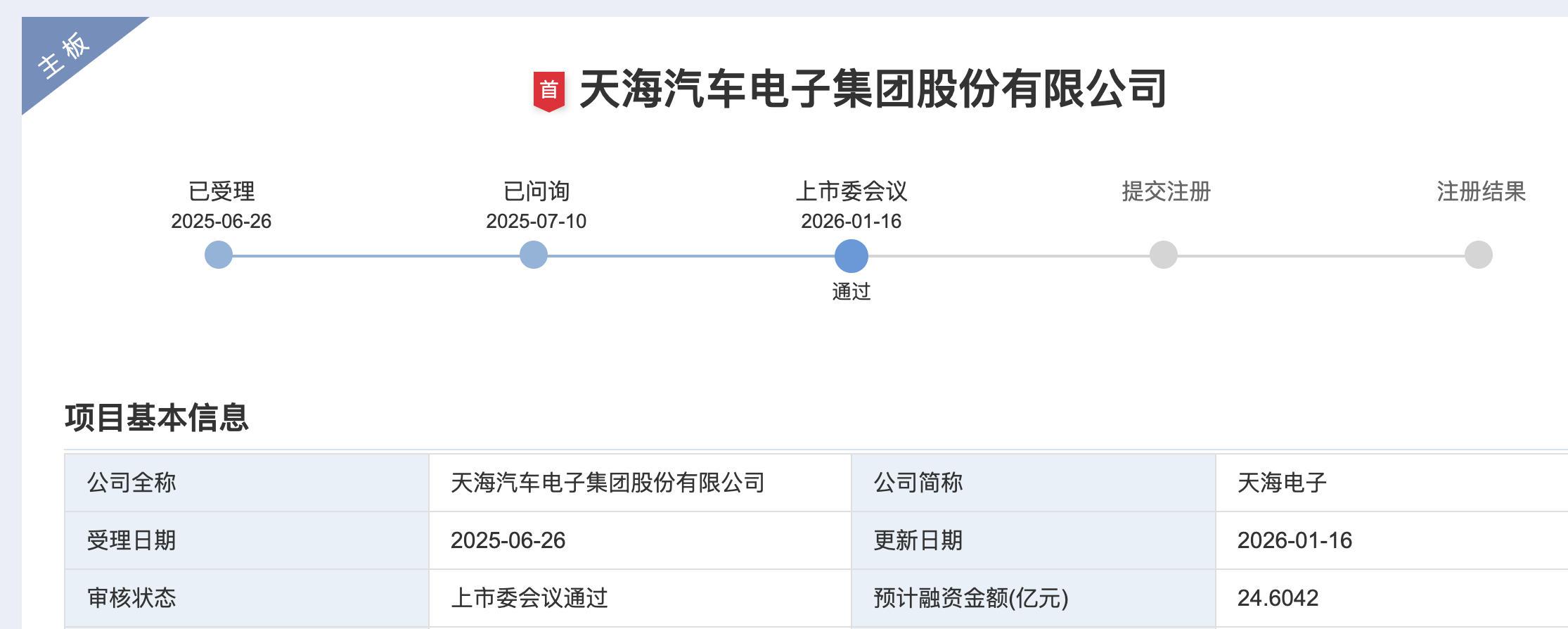
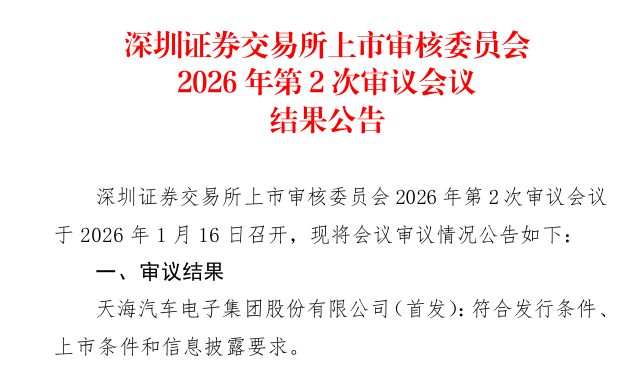
刚刚!天海电子主板IPO过会
Sou Hu Cai Jing· 2026-01-16 10:01
Group 1 - The Shenzhen Stock Exchange's Listing Review Committee has approved Tianhai Automotive Electronics Group Co., Ltd.'s IPO application, confirming it meets the issuance and listing conditions as well as information disclosure requirements [1] - Tianhai Electronics, located in Hebi Economic and Technological Development Zone, specializes in the R&D, production, and sales of automotive wiring harnesses, connectors, and electronic components, holding a market share of 8.45% in the automotive wiring harness industry and 3.52% in the automotive connector industry in China [2] - The company has established long-term stable partnerships with major automakers such as Chery Automobile, SAIC Group, Geely Automobile, Changan Automobile, and General Motors, as well as collaborations with leading new energy vehicle manufacturers like Li Auto, NIO, Leap Motor, and Xpeng Motors [2] Group 2 - In 2024, Tianhai Electronics achieved a revenue of 12.523 billion yuan and a net profit attributable to shareholders of 614 million yuan. In the first half of 2025, the company reported a revenue of 6.557 billion yuan and a net profit of 315 million yuan [2] - The company completed its A-share listing guidance in June 2025 and plans to raise 2.46 billion yuan through its IPO on the Shenzhen Stock Exchange, which will be used for various projects including connector technology upgrades, production base construction, and the establishment of an intelligent connected vehicle research institute [2]
信用赋能添动力 税务精准培育助企业驶入发展快车道
Sou Hu Cai Jing· 2026-01-16 09:41
Core Viewpoint - Hunan Yuhong New Material Technology Co., Ltd. has rapidly increased its annual output value from over 20 million to 250 million yuan within a few years, supported by tax credit cultivation and policy guidance from local tax authorities [1][2] Group 1: Company Growth - The company has achieved full-capacity production, showcasing its vigorous vitality with efficient operations in its new production workshop [1] - The annual output value has surged from over 20 million yuan to 250 million yuan since its establishment in 2021 [1] Group 2: Tax Credit and Support - The local tax bureau has integrated tax credit cultivation into the policy guidance process, providing one-on-one support to help the company establish a robust tax compliance system [1] - The company received timely reminders from tax authorities regarding tax declaration issues, which helped them maintain their credit score [1] Group 3: Benefits of A-Class Taxpayer Status - Achieving A-Class taxpayer status has enhanced the company's credibility, facilitating partnerships with major automotive companies like Geely, BAIC, GAC, and BYD [2] - The company has accessed credit loans through the "bank-tax interaction" mechanism, enabling significant upgrades to its automated production lines and new workshop construction, increasing production efficiency by four times [2] - As a national high-tech enterprise, the company benefits from tax incentives such as R&D expense deductions and corporate income tax reductions, alleviating the burden of innovation [2] Group 4: Future Outlook - The local tax bureau plans to deepen credit empowerment measures to help more enterprises leverage honest tax practices for growth, contributing to high-quality local industrial development [2]
质量责任如何科学界定?困扰欣旺达等企业的电池安全归因话题受关注
Zhong Guo Jin Rong Xin Xi Wang· 2026-01-16 09:27
Core Viewpoint - A lawsuit involving the quality of battery cells supplied by Xinwanda Power to Geely's subsidiary, Weirui Electric, has raised concerns about the long-standing issue of defining quality responsibility within the electric vehicle supply chain [1][2]. Group 1: Lawsuit Details - Xinwanda announced that it is being sued for 2.314 billion yuan due to alleged quality issues with battery cells delivered between June 2021 and December 2023 [2]. - Weirui Electric, a subsidiary of Geely, is involved in the lawsuit and is a key player in the high-end electric vehicle market [2]. - The lawsuit highlights the complexity of battery safety, which cannot be solely attributed to the battery cells, as it involves multiple components and systems [3]. Group 2: Quality Responsibility - The safety of power batteries is recognized as a complex system that includes battery pack design, battery management systems, and vehicle integration [3]. - Xinwanda asserts that similar battery cells supplied to other clients have not experienced quality issues, suggesting that the problem may not lie solely with the battery cells [3]. - The industry is urged to avoid one-sided blame and to analyze the complexities of automotive batteries to foster healthy development [3]. Group 3: Supply Chain and Responsibility - The recall of Volvo's EX30 vehicles, which reportedly used battery cells from Xinwanda, has further complicated the situation, with Xinwanda clarifying that it is not directly involved in the battery system sold to Volvo [4]. - The incidents are seen as critical examples for examining quality, responsibility, and risk within the electric vehicle supply chain, impacting corporate survival and industry ecology [4]. - There is a call for establishing a fair responsibility-sharing mechanism within the supply chain to enhance resilience and competitiveness in the global market [4][5].

特朗普底特律喊话:欢迎中国车企来美建厂
第一财经· 2026-01-16 08:35
Core Viewpoint - The article discusses the potential entry of Chinese automotive manufacturers into the U.S. market, highlighting the implications of U.S. tariffs and the recent statements made by President Trump regarding foreign manufacturers [3][4]. Group 1: U.S. Market Dynamics - The Detroit Auto Show has become a focal point for discussions about when Chinese manufacturers will enter the U.S. market, with companies like Geely and Great Wall Motors showcasing their electric vehicles [3]. - President Trump welcomed the idea of Chinese companies building factories in the U.S. to create jobs, while reiterating the imposition of high tariffs on imported vehicles to encourage domestic production [3][4]. Group 2: Tariff Implications - The U.S. currently imposes a 25% tariff on imported vehicles, effective from April 3, 2025, which applies to all countries, including China. Additionally, tariffs on Chinese electric vehicles will increase from 25% to 100% starting in 2024 [4]. - In 2025, the value of U.S. imports of passenger cars from China significantly decreased, with a reported total of approximately $1.31 billion from January to October, marking a 52% year-on-year decline [5]. Group 3: Opportunities for Chinese Manufacturers - Analysts suggest that Trump's statements may signal new opportunities for Chinese automotive manufacturers in the U.S. market, emphasizing that the quality of products will ultimately be determined by consumer preferences [6]. - Geely is reportedly considering leveraging its subsidiary Volvo's factory in South Carolina for production, which has an annual capacity of 150,000 vehicles, and may announce its U.S. market entry plans within the next 2 to 3 years [6].
吉利汽车(00175) - 翌日披露报表
2026-01-16 08:28
FF305 翌日披露報表 (股份發行人 ── 已發行股份或庫存股份變動、股份購回及/或在場内出售庫存股份) 表格類別: 股票 狀態: 新提交 公司名稱: 吉利汽車控股有限公司 呈交日期: 2026年1月16日 如上市發行人的已發行股份或庫存股份出現變動而須根據《香港聯合交易所有限公司(「香港聯交所」)證券上市規則》(「《主板上市規則》」)第13.25A條 / 《香港聯合交易所有限公司GEM證券 上市規則》(「《GEM上市規則》」)第17.27A條作出披露,必須填妥第一章節 。 | 第一章節 | | | | | | | | | --- | --- | --- | --- | --- | --- | --- | --- | | 1. 股份分類 | 普通股 | 股份類別 | 不適用 | | 於香港聯交所上市 | 是 | | | 證券代號 (如上市) | 00175 | 說明 | | | | | | | 多櫃檯證券代號 | 80175 | RMB 說明 | | | | | | | A. 已發行股份或庫存股份變動 | | | | | | | | | | | | 已發行股份(不包括庫存股份)變動 | | 庫存股份變動 | ...
去年中国车市销量2093.6万辆创新高,TOP5车企拿下半个市场
21世纪经济报道· 2026-01-16 08:24
Core Viewpoint - In 2025, China's automotive market is expected to achieve structural growth, with production and sales reaching 34.53 million and 34.40 million units respectively, marking a year-on-year increase of 10.4% and 9.4%, maintaining its position as the world's largest market for 17 consecutive years [1][2]. Group 1: Market Performance - The significant growth in the automotive sector is driven by the rise of new energy vehicles (NEVs), with domestic sales projected to reach 13.88 million units in 2025, a year-on-year increase of 19.8%, resulting in a penetration rate of 54% for new energy passenger cars [1][2]. - Chinese brands are a core engine of growth, with sales of domestic passenger cars expected to reach 20.94 million units, a 16.5% increase, raising market share to 69.5%, the highest since 2018 [1][2]. Group 2: Market Dynamics - The automotive industry has shifted away from aggressive price wars, with only 156 new models seeing price reductions in the first ten months of 2025, indicating a more rational market order [2]. - Growth is primarily fueled by government policies such as "trade-in" programs that effectively stimulate demand for vehicle upgrades [2]. Group 3: Profitability and Competition - Despite the expansion in sales, the automotive industry's profitability remains under pressure, with revenues exceeding 10 trillion yuan and profits reaching 440.3 billion yuan, a 7.5% increase, but with a profit margin of 4.4%, below the average of 6% for downstream industrial enterprises [2]. - The competition landscape is increasingly concentrated, with the top three companies—BYD, SAIC, and Geely—accounting for 36.6% of the market share, while the top 15 companies collectively hold 92.3% of total sales [10][12]. Group 4: New Energy Vehicle Trends - In 2025, the sales of new energy passenger vehicles are projected to reach 13.01 million units, a 17.7% increase, while traditional fuel vehicles are expected to decline to 11.06 million units, a decrease of 4.3% [4][6]. - The mainstream market for new energy vehicles is concentrated in the price range of 100,000 to 200,000 yuan, with sales in this segment expected to reach 6.94 million units, a 24% increase, representing half of the total new energy vehicle sales [4][6]. Group 5: Brand Strategies - BYD continues to dominate the 100,000 to 200,000 yuan market segment, with significant sales from its Dynasty and Ocean series, while Geely's Galaxy brand has seen a 150% increase in sales, enhancing its market penetration [6][13]. - New entrants like Leap Motor and Xpeng are also making significant strides, with Leap Motor achieving a 104.7% year-on-year growth, focusing on cost control and technology [14][19]. Group 6: Future Outlook - For 2026, the automotive market is expected to see a modest growth of 1%, with total sales projected at 34.75 million units, while new energy vehicles are anticipated to grow by 15.2% to 1.9 million units [16][17]. - The competitive landscape is expected to intensify, with traditional automakers setting ambitious sales targets, while new entrants aim for aggressive growth, indicating a fierce battle for market share [19].


特朗普底特律喊话:欢迎中国车企来美建厂
Di Yi Cai Jing· 2026-01-16 07:52
Group 1 - The core topic of discussion at the Detroit Auto Show was the potential entry of Chinese automakers into the U.S. market, with companies like Geely and Great Wall Motors showcasing their electric vehicles [1] - President Trump expressed a welcoming attitude towards Chinese manufacturers entering the U.S. market, provided they build factories and create jobs locally [1] - Despite the welcoming remarks, Trump reiterated the continuation of high tariffs on imported vehicles to ensure that cars sold in the U.S. are produced domestically [1] Group 2 - The U.S. currently imposes a 25% tariff on imported vehicles, effective from April 3, 2025, which applies to all countries, including China [2] - Starting in 2024, tariffs on Chinese electric vehicles will increase from 25% to 100%, aimed at forcing the automotive supply chain back to the U.S. [2] - In 2025, the value of U.S. imports of passenger cars from China is expected to drop significantly, with a reported 52% year-on-year decline in the first ten months, totaling approximately $1.31 billion [2] - Analysts suggest that Trump's recent comments may indicate new opportunities for Chinese automakers in the U.S. market, with the entry of these companies seen as a matter of time [2] - Geely is considering expanding into the U.S. market and may announce plans within the next 2-3 years, with potential brands for introduction including Zeekr and Lynk & Co [2] - Geely is also exploring the possibility of utilizing its subsidiary Volvo's factory in South Carolina for production, which has an annual capacity of 150,000 vehicles [2]