吉利汽车

Search documents
特朗普底特律喊话:欢迎中国车企来美建厂
第一财经· 2026-01-16 08:35
Core Viewpoint - The article discusses the potential entry of Chinese automotive manufacturers into the U.S. market, highlighting the implications of U.S. tariffs and the recent statements made by President Trump regarding foreign manufacturers [3][4]. Group 1: U.S. Market Dynamics - The Detroit Auto Show has become a focal point for discussions about when Chinese manufacturers will enter the U.S. market, with companies like Geely and Great Wall Motors showcasing their electric vehicles [3]. - President Trump welcomed the idea of Chinese companies building factories in the U.S. to create jobs, while reiterating the imposition of high tariffs on imported vehicles to encourage domestic production [3][4]. Group 2: Tariff Implications - The U.S. currently imposes a 25% tariff on imported vehicles, effective from April 3, 2025, which applies to all countries, including China. Additionally, tariffs on Chinese electric vehicles will increase from 25% to 100% starting in 2024 [4]. - In 2025, the value of U.S. imports of passenger cars from China significantly decreased, with a reported total of approximately $1.31 billion from January to October, marking a 52% year-on-year decline [5]. Group 3: Opportunities for Chinese Manufacturers - Analysts suggest that Trump's statements may signal new opportunities for Chinese automotive manufacturers in the U.S. market, emphasizing that the quality of products will ultimately be determined by consumer preferences [6]. - Geely is reportedly considering leveraging its subsidiary Volvo's factory in South Carolina for production, which has an annual capacity of 150,000 vehicles, and may announce its U.S. market entry plans within the next 2 to 3 years [6].


吉利汽车(00175) - 翌日披露报表
2026-01-16 08:28
FF305 翌日披露報表 (股份發行人 ── 已發行股份或庫存股份變動、股份購回及/或在場内出售庫存股份) 表格類別: 股票 狀態: 新提交 公司名稱: 吉利汽車控股有限公司 呈交日期: 2026年1月16日 如上市發行人的已發行股份或庫存股份出現變動而須根據《香港聯合交易所有限公司(「香港聯交所」)證券上市規則》(「《主板上市規則》」)第13.25A條 / 《香港聯合交易所有限公司GEM證券 上市規則》(「《GEM上市規則》」)第17.27A條作出披露,必須填妥第一章節 。 | 第一章節 | | | | | | | | | --- | --- | --- | --- | --- | --- | --- | --- | | 1. 股份分類 | 普通股 | 股份類別 | 不適用 | | 於香港聯交所上市 | 是 | | | 證券代號 (如上市) | 00175 | 說明 | | | | | | | 多櫃檯證券代號 | 80175 | RMB 說明 | | | | | | | A. 已發行股份或庫存股份變動 | | | | | | | | | | | | 已發行股份(不包括庫存股份)變動 | | 庫存股份變動 | ...
去年中国车市销量2093.6万辆创新高,TOP5车企拿下半个市场
21世纪经济报道· 2026-01-16 08:24
Core Viewpoint - In 2025, China's automotive market is expected to achieve structural growth, with production and sales reaching 34.53 million and 34.40 million units respectively, marking a year-on-year increase of 10.4% and 9.4%, maintaining its position as the world's largest market for 17 consecutive years [1][2]. Group 1: Market Performance - The significant growth in the automotive sector is driven by the rise of new energy vehicles (NEVs), with domestic sales projected to reach 13.88 million units in 2025, a year-on-year increase of 19.8%, resulting in a penetration rate of 54% for new energy passenger cars [1][2]. - Chinese brands are a core engine of growth, with sales of domestic passenger cars expected to reach 20.94 million units, a 16.5% increase, raising market share to 69.5%, the highest since 2018 [1][2]. Group 2: Market Dynamics - The automotive industry has shifted away from aggressive price wars, with only 156 new models seeing price reductions in the first ten months of 2025, indicating a more rational market order [2]. - Growth is primarily fueled by government policies such as "trade-in" programs that effectively stimulate demand for vehicle upgrades [2]. Group 3: Profitability and Competition - Despite the expansion in sales, the automotive industry's profitability remains under pressure, with revenues exceeding 10 trillion yuan and profits reaching 440.3 billion yuan, a 7.5% increase, but with a profit margin of 4.4%, below the average of 6% for downstream industrial enterprises [2]. - The competition landscape is increasingly concentrated, with the top three companies—BYD, SAIC, and Geely—accounting for 36.6% of the market share, while the top 15 companies collectively hold 92.3% of total sales [10][12]. Group 4: New Energy Vehicle Trends - In 2025, the sales of new energy passenger vehicles are projected to reach 13.01 million units, a 17.7% increase, while traditional fuel vehicles are expected to decline to 11.06 million units, a decrease of 4.3% [4][6]. - The mainstream market for new energy vehicles is concentrated in the price range of 100,000 to 200,000 yuan, with sales in this segment expected to reach 6.94 million units, a 24% increase, representing half of the total new energy vehicle sales [4][6]. Group 5: Brand Strategies - BYD continues to dominate the 100,000 to 200,000 yuan market segment, with significant sales from its Dynasty and Ocean series, while Geely's Galaxy brand has seen a 150% increase in sales, enhancing its market penetration [6][13]. - New entrants like Leap Motor and Xpeng are also making significant strides, with Leap Motor achieving a 104.7% year-on-year growth, focusing on cost control and technology [14][19]. Group 6: Future Outlook - For 2026, the automotive market is expected to see a modest growth of 1%, with total sales projected at 34.75 million units, while new energy vehicles are anticipated to grow by 15.2% to 1.9 million units [16][17]. - The competitive landscape is expected to intensify, with traditional automakers setting ambitious sales targets, while new entrants aim for aggressive growth, indicating a fierce battle for market share [19].



特朗普底特律喊话:欢迎中国车企来美建厂
Di Yi Cai Jing· 2026-01-16 07:52
Group 1 - The core topic of discussion at the Detroit Auto Show was the potential entry of Chinese automakers into the U.S. market, with companies like Geely and Great Wall Motors showcasing their electric vehicles [1] - President Trump expressed a welcoming attitude towards Chinese manufacturers entering the U.S. market, provided they build factories and create jobs locally [1] - Despite the welcoming remarks, Trump reiterated the continuation of high tariffs on imported vehicles to ensure that cars sold in the U.S. are produced domestically [1] Group 2 - The U.S. currently imposes a 25% tariff on imported vehicles, effective from April 3, 2025, which applies to all countries, including China [2] - Starting in 2024, tariffs on Chinese electric vehicles will increase from 25% to 100%, aimed at forcing the automotive supply chain back to the U.S. [2] - In 2025, the value of U.S. imports of passenger cars from China is expected to drop significantly, with a reported 52% year-on-year decline in the first ten months, totaling approximately $1.31 billion [2] - Analysts suggest that Trump's recent comments may indicate new opportunities for Chinese automakers in the U.S. market, with the entry of these companies seen as a matter of time [2] - Geely is considering expanding into the U.S. market and may announce plans within the next 2-3 years, with potential brands for introduction including Zeekr and Lynk & Co [2] - Geely is also exploring the possibility of utilizing its subsidiary Volvo's factory in South Carolina for production, which has an annual capacity of 150,000 vehicles [2]
汽车ETF(516110)涨超1.6%,新能源汽车行业供需向好
Mei Ri Jing Ji Xin Wen· 2026-01-16 06:23
广发证券指出,从供给端来看,比亚迪、吉利汽车、长城汽车、奇瑞汽车多款20万元以下长续航PHEV 车型将陆续推出,供给端的快速增加有望进一步拉动该细分市场的需求提升。政策端,新能源购置税技 术调整要求插电式混合动力乘用车纯电动续驶里程不低于100公里方可享受减免;需求端,长续航版本 能有效降低用户充电频次,其销量占比呈现环比提升趋势,因此20万元以下长续航PHEV销量占比有望 继续提升。此外,在反内卷和原材料成本上涨的外在双重约束下,预计后续车企将以"增配提价"的形式 参与竞争,竞争策略的变化将有助于2026年乘用车行业实现"价升量稳"。 汽车ETF(516110)跟踪的是800汽车指数(H30015),该指数从沪深市场中选取涉及整车制造、零部 件供应及相关服务等业务的上市公司证券作为指数样本,以反映汽车行业内优质上市公司证券的整体表 现,行业配置侧重于乘用车、商用车及新能源车领域,风格偏向成长与价值均衡。 (文章来源:每日经济新闻) ...
有“锂”走遍天下,180天内十家主机厂牵手“宁王”
Feng Huang Wang· 2026-01-16 06:13
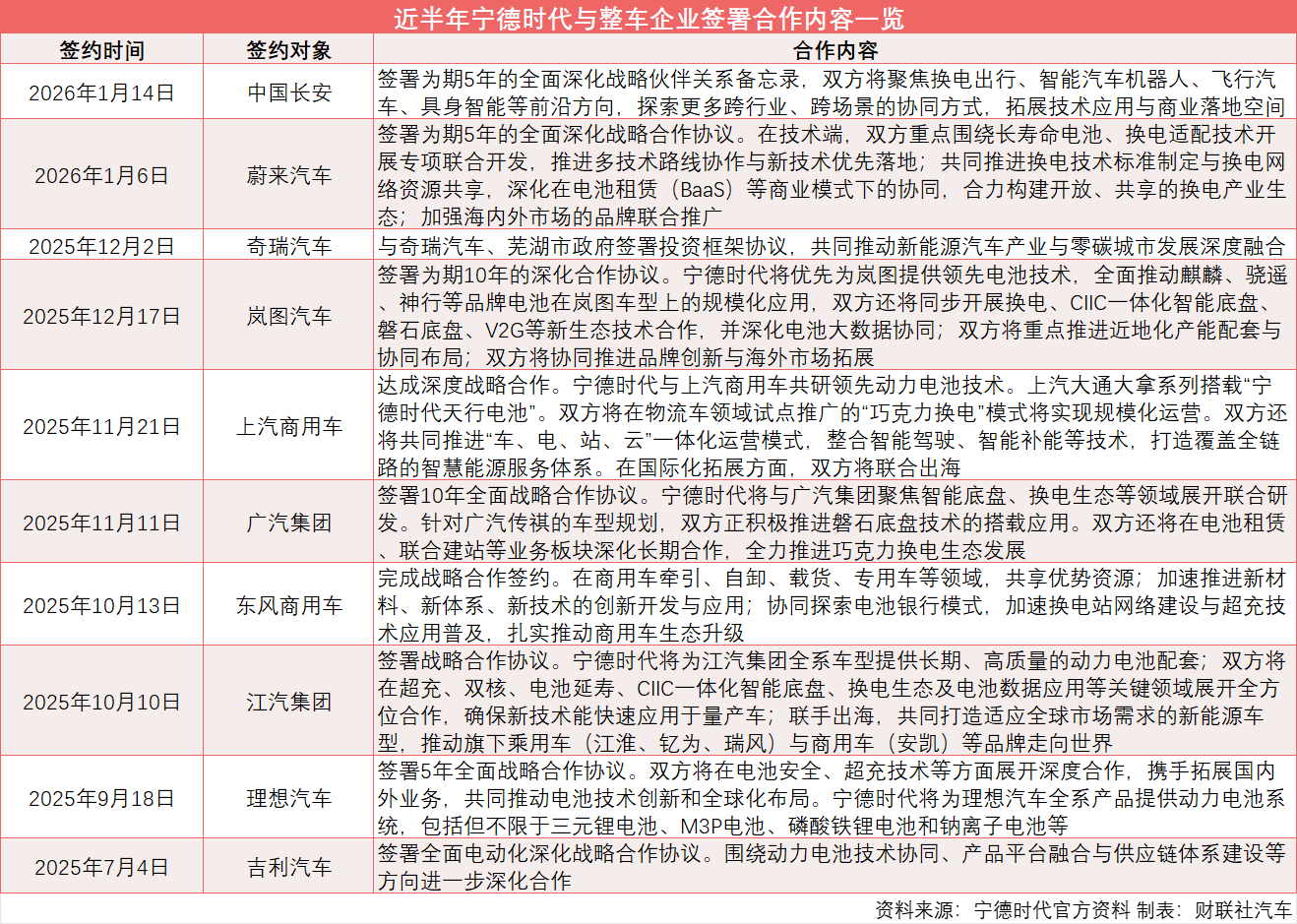
Core Insights - The article highlights the strategic partnerships between multiple automotive companies and CATL, aimed at stabilizing supply chains and enhancing competitive advantages in the context of rising lithium carbonate prices and the expanding electric vehicle market [1][4]. Group 1: Strategic Partnerships - CATL signed a five-year strategic partnership memorandum with Changan Automobile, focusing on advanced areas such as battery swapping, smart vehicles, and flying cars [1][2]. - Since the second half of last year, ten automotive companies, including Changan, have entered into long-term agreements with CATL, covering various segments like passenger cars, commercial vehicles, and intelligent technologies [1][2]. - Notable agreements include a ten-year partnership with Lantu Automotive and GAC Group, emphasizing long-term collaboration in battery technology and market expansion [1][2]. Group 2: Market Dynamics - Lithium carbonate prices have shown significant volatility, dropping to a low of 59,000 yuan/ton in June 2025 before surging to a peak of 134,500 yuan/ton by December 2025, and further rising to 174,100 yuan/ton in 2026 [3]. - The demand for electric vehicles is projected to grow, with the China Association of Automobile Manufacturers estimating production and sales of 16.62 million and 16.49 million units respectively in 2025, marking a year-on-year increase of 29% and 28.2% [3]. Group 3: Technological Collaboration - CATL is leveraging its battery technology to collaborate with automotive manufacturers on innovations such as ultra-fast charging, long-life batteries, and integrated smart chassis [4][6]. - The partnerships aim to create a shared ecosystem around battery swapping, battery-as-a-service (BaaS), and vehicle-to-grid (V2G) technologies, enhancing operational efficiency and market reach [5][6]. Group 4: Industry Transformation - By establishing deep binding relationships with automotive companies, CATL is transitioning from a battery supplier to a comprehensive energy solutions provider, solidifying its market leadership [6].

进阶第一梯队,陕西汽车产业“换道超车”
Xin Lang Cai Jing· 2026-01-16 06:11
Core Viewpoint - The automotive industry in Shaanxi has significantly transformed, moving from 16th to 7th in national production rankings, with a strong focus on electric vehicles, which now account for over 63% of total production [2][15]. Industry Transformation - Shaanxi's automotive production increased from 342,000 units in 2015 to 1,576,000 units by November 2025, with a total industrial output value growth of 14.4% [14][20]. - The shift towards electric vehicles represents a strategic pivot, as traditional fuel vehicles were not competitive for Shaanxi [5][7]. Strategic Focus - Shaanxi's strategy involved deep partnerships with key players like BYD and Shaanxi Automobile, focusing on enhancing the entire supply chain rather than merely investing capital [9][11]. - The local government provided substantial support to these core enterprises, creating a robust industrial ecosystem [10][13]. Supply Chain Development - The local supply chain has reached a 57% self-sufficiency rate, indicating a strong foundation for sustainable growth in the electric vehicle sector [17][25]. - The strategy emphasizes the importance of local component manufacturing, which has led to a comprehensive industrial cluster around electric vehicles [18][20]. Export Growth - In 2024, Shaanxi's automotive exports reached 240,000 units, marking a 215% increase, with significant market share in Central Asia for heavy-duty trucks [23]. - The combination of electric vehicles, commercial vehicles, and the Belt and Road Initiative has created a unique competitive advantage for Shaanxi in international markets [23][24]. Long-term Vision - Shaanxi's approach to the electric vehicle industry is characterized by a long-term perspective, focusing on building a complete industrial system rather than just competing for immediate gains [24][26]. - The region's historical strengths in coal chemical, new materials, and power equipment provide a solid foundation for the upstream segments of the electric vehicle supply chain [25][26].
崔东树:新能源高增长下汽车发动机市场仍稳步增长
智通财经网· 2026-01-16 05:51
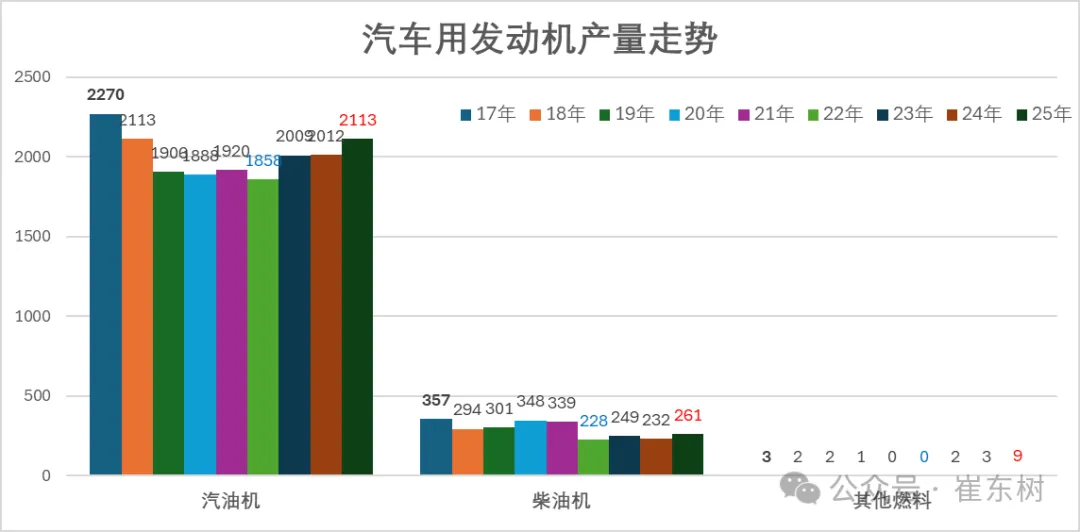
Group 1 - The overall automotive engine market is stable with a slight upward trend, driven by the demand for gasoline engines and the impact of hybrid vehicles [1][4][12] - Gasoline engines maintain a dominant position in the market, with production expected to reach approximately 21.13 million units by 2025, despite minor fluctuations [4][12] - Diesel engine production is declining, from 3.57 million units in 2017 to an estimated 2.61 million units in 2025, primarily due to changes in commercial vehicle demand and stricter environmental regulations [4][12] Group 2 - The gasoline engine market is supported by major manufacturers, while independent manufacturers face significant challenges [6][8] - Major manufacturers have stable production levels, benefiting from strong market competitiveness and ongoing technological upgrades [7][12] - Independent gasoline engine manufacturers are experiencing a decline in production, attributed to increased vertical integration by vehicle manufacturers and the competitive pressure from electric vehicles [8][12] Group 3 - Diesel engine production is stabilizing at low levels, with leading companies gradually recovering after previous declines [9][10] - The market for independent diesel engine manufacturers is increasingly polarized, with some achieving stability while others face exit from the market [11][12] - The shift towards electric commercial vehicles is further squeezing the market for smaller independent diesel engine manufacturers, accelerating industry differentiation [11][12]
—汽车整车2026年年度策略:景气度收敛,聚焦超豪华车型、出口等结构性机会
Hua Yuan Zheng Quan· 2026-01-16 05:02
Industry Overview - The domestic automotive market is under pressure, with a projected decline of 2% in overall passenger vehicle insurance in 2026, while new energy vehicles (NEVs) are expected to see a growth of 6% [4] - The growth in passenger vehicle exports is anticipated to reach nearly 1 million units in 2026, primarily driven by NEV exports, supported by several manufacturers' quality products and channel expansions [4][12] - The penetration rate of NEVs is expected to exceed 50%, leading to a slowdown in growth as the market matures [4][18] Stock Recommendations - Focus on structural opportunities in ultra-luxury models and exports, as companies with strong product cycles may navigate the industry's weak sentiment [4] - Recommended stocks include Jianghuai Automobile (Zun Jie), Geely Automobile, Great Wall Motors, Leap Motor, and Xiaomi Group-W, which are expected to benefit from structural opportunities and product cycles [4][12] Valuation Insights - Companies with strong product cycles may experience valuation re-evaluations if there are revolutionary changes in autonomous driving technology, particularly if Tesla's Full Self-Driving (FSD) technology sees significant advancements [4] - Companies like XPeng Motors, Li Auto, and Seres are highlighted as potential beneficiaries of this valuation shift [4] Market Dynamics - The 2026 domestic market is expected to be influenced significantly by the replacement demand, which has surpassed 50% in 2025, indicating a shift in consumer behavior towards vehicle replacement rather than new purchases [12][14] - The old-for-new vehicle policy is set to decline, which may further impact the sales performance of passenger vehicles in 2026, with expectations of a weak market performance [14][16] Energy Structure Outlook - The reduction of NEV purchase tax subsidies and high penetration rates are likely to slow down the growth of NEVs in 2026, with increased costs due to rising battery material prices [18][20] - The anticipated changes in subsidy structures may lead to higher retail prices for NEVs, affecting consumer purchasing decisions [18][20]
比亚迪登陆美国之日
日经中文网· 2026-01-16 03:05
(资料图) 在1月14日在美国底特律开幕的车展上,纯电动汽车消失,很多美国企业让非电动汽车成为主角,但在 车展上热门话题不是特朗普,而是"中国厂商何时登陆美国"。考虑进入美国市场的中国车企正在摸索三 种方式…… 在1月14日在美国中西部密歇根州底特律开幕的车展上。美国总统特朗普也在车展前亲临现场,强调其 成果称,"我前所未有地一直支持美国的汽车工人"。 总部设在底特律的通用汽车(GM)等"底特律概念股"并没有欢迎的氛围。截至上周,宣布由于特朗普 政策的影响,纯电动汽车 (EV) 的损失扩大,这一消息产生明显影响,从特朗普访问前至15日的股价来 看,通用汽车下跌3%,福特汽车下跌4%,斯特兰蒂斯下跌11%。 在车展的会场,热门话题不是特朗普,而是"中国厂商何时登陆美国"。 契机是车展前一周在美国拉斯维加斯举行的科技博览会"CES"上发生的事情。 生产自动驾驶传感器的中国速腾聚创(RoboSense)北美市场总裁赵培培表示,考虑进入美国市场的中 国车企正在摸索三种方式,一是提高质量,赢得美国客户的青睐,二是利用与美国企业的合作,三是作 为与中国完全分离的企业进入。 尽管进入美国市场的时间无法确定,但"实惠的价格" ...