三生制药

Search documents
四大因素驱动中国生物医药崛起
Zheng Quan Shi Bao· 2025-08-28 22:40
Core Insights - The Chinese biopharmaceutical industry is poised for significant growth in 2025, driven by increased licensing agreements and international expansion [1][2] - The Hong Kong capital market has seen a surge in investment activity, with a notable increase in IPOs and fundraising amounts [2] - Four key driving factors are identified for the rise of the Chinese biopharmaceutical sector: government support, innovative talent, a vibrant venture capital ecosystem, and a comprehensive infrastructure [3][4] Group 1: Market Performance - In 2024, Chinese biopharmaceutical companies engaged in 94 business development transactions totaling $51.9 billion, accounting for nearly one-third of the global market [1] - The first half of 2025 saw licensing agreements nearing $66 billion, surpassing the total for 2024 [1] - Hong Kong's IPO market led globally in the first half of 2025 with 42 IPOs, raising $13.9 billion, a 700% increase year-on-year [2] Group 2: Driving Factors - Long-term national strategy support positions biotechnology as a key component of China's "strategic emerging industries," with significant funding for basic research and drug approval reforms [3] - The return of overseas talent has fostered innovation, with many scientists and executives establishing biotech firms in China [3] - A robust venture capital ecosystem, including domestic and international funds, plays a crucial role in supporting early-stage innovations [4] Group 3: Challenges and Opportunities - There is a mismatch between China's innovation output and domestic market absorption, with only 5% of the global innovative drug market share [5] - Recent policy changes, such as new procurement regulations favoring innovative drugs, are expected to support the continued development of biotechnology in China [5] - Collaboration with multinational companies and emerging markets is essential for Chinese biopharmaceutical firms to thrive globally [6]
【头条话题】 四大因素驱动中国生物医药崛起
Zheng Quan Shi Bao· 2025-08-28 17:58
中国生物医药蛰伏数年后,在2025年迎来了扬眉吐气的时刻,引发全球产业界和资本市场瞩目。中国生 物医药爆发的引信,是近年来企业License-out(许可授权)合作和出海。根据中邮证券数据,2024年全 年中国生物医药企业商务拓展交易共计94笔,金额达到519亿美元,占比全球近1/3份额;2025年上半年 增长趋势更甚,许可授权总金额接近660亿美元,超过2024年全年商务拓展(BD)交易总额,占比全球 份额进一步提升,其中不乏辉瑞与三生制药60亿美元癌症药物合作成最大单笔交易,以及阿斯利康与中 国五家公司签署超136亿美元授权交易(其中与石药集团达成52亿美元协议)。 "春江水暖鸭先知"。中国生物医药行业许可授权和出海的大额交易,也激发了香港资本市场的投资情 绪。根据KPMG统计,香港联交所成为全球2025年上半年的募资之王:IPO共计42宗,同比增长40%, 共计募资金额139亿美元,同比增长700%;中国生物医药企业在各个资本市场合计有25家企业上市,其 中香港交易所主板上市15家,总募集金额达到156亿港元;恒生医疗保健指数近一年上涨96.23%,远远 跑赢恒生指数42.23%的涨幅,以及A股申万医药 ...
港股创新药ETF(159567)跌1.26%,成交额22.27亿元
Xin Lang Cai Jing· 2025-08-28 10:18
Group 1 - The Hong Kong Innovative Drug ETF (159567) closed down 1.26% on August 28, with a trading volume of 2.227 billion yuan [1] - The fund was established on January 3, 2024, with a management fee of 0.50% per year and a custody fee of 0.10% per year [1] - As of August 27, 2024, the fund's latest share count was 6.506 billion shares, with a total size of 6.134 billion yuan, reflecting a year-to-date increase of 1545.50% in shares and 1523.46% in size compared to December 31, 2023 [1] Group 2 - The current fund manager is Ma Jun, who has managed the fund since its inception, achieving a return of 88.56% during the tenure [2] - The top holdings of the fund include Innovent Biologics (9.52%), WuXi Biologics (9.47%), BeiGene (8.73%), and others, with their respective market values and share counts detailed [2] - The fund's liquidity is strong, with a cumulative trading amount of 35.359 billion yuan over the last 20 trading days, averaging 1.768 billion yuan per day [1][2]


9.5亿美元BD交易后,百济神州股价为何跌了
Jing Ji Guan Cha Bao· 2025-08-28 06:39
Core Viewpoint - BeiGene, a leading innovative drug company, has entered the innovative drug business development (BD) wave by selling a portion of the royalty rights for a cancer drug for up to $950 million, marking a significant transaction in the Chinese innovative drug sector [1] Group 1: Transaction Details - BeiGene announced the sale of royalty rights for a cancer drug, receiving an upfront payment of $885 million, which accounts for 36% of its revenue for the first half of the year [1] - The drug, Talazoparib, is set to launch in the U.S. in May 2024 for small cell lung cancer treatment, with the overseas sales managed by Amgen [2] - Royalty Pharma, the buyer, expects a return on investment of 10%-15% from this transaction, with total sales of Talazoparib projected to reach $19.6 billion from 2025 to 2035 [3] Group 2: Market Impact and Analysis - The transaction is significant as it is BeiGene's first drug rights sale in four years and introduces a new BD model in the Chinese innovative drug industry, focusing solely on royalty rights [1][5] - Despite the substantial upfront payment, BeiGene's stock did not rise post-announcement, contrasting with other companies that saw stock increases following similar transactions [6] - Analysts suggest that the transaction may not create long-term value for BeiGene, as it resembles a debt financing rather than a value-generating deal [6] Group 3: Financial Position and Future Outlook - BeiGene's CFO emphasized the importance of a robust balance sheet, stating that the transaction enhances operational and strategic flexibility [7] - The company has over 30 drug candidates in its pipeline, with more than 10 in Phase III clinical trials, necessitating significant R&D investment [7] - As of June 30, 2025, BeiGene had approximately $2.8 billion in cash, down $170 million year-over-year, with liabilities around $2.5 billion [7]
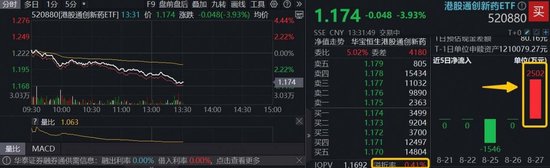
盘中深跌4%后又回拉!港股通创新药ETF(520880)连日回落之际,巨额资金反向加仓
Mei Ri Jing Ji Xin Wen· 2025-08-28 06:22
Group 1 - The Hong Kong innovative drug sector is experiencing a significant pullback, with the Hang Seng Hong Kong Stock Connect Innovative Drug Select Index dropping nearly 4% and most constituent stocks declining [1] - Major stocks such as Kelun-Botai Biopharmaceutical, CanSino Biologics, and Zai Lab fell over 5%, while China Biologic Products and 3SBio dropped over 4% [1] - The Hong Kong Stock Connect Innovative Drug ETF (520880) saw a price drop of over 4% but later reduced its decline, indicating positive buying sentiment with a real-time premium rate exceeding 0.4% [1] Group 2 - The Hang Seng Hong Kong Stock Connect Innovative Drug Select Index has risen 101.58% year-to-date as of July 31, significantly outperforming the Hang Seng Index and Hang Seng Technology Index by 78.08 and 79.53 percentage points, respectively [2] - The ETF is the first in the market to track this index, focusing on the innovative drug industry chain with a high concentration of leading companies [2]
港股通创新药ETF(520880)深度回调4%,关税扰动影响有多大?资金高溢价介入,单日吸金超2500万
Xin Lang Ji Jin· 2025-08-28 05:56
Core Viewpoint - The Hong Kong innovative drug sector is experiencing a significant pullback, with the Hang Seng Hong Kong Stock Connect Innovative Drug Selective Index dropping nearly 4% on August 28, 2023, primarily due to concerns over potential U.S. tariffs on imported drugs [1][3]. Group 1: Market Performance - The Hang Seng Hong Kong Stock Connect Innovative Drug ETF (520880) saw a decline of 3.93% and experienced a significant premium during trading, indicating positive buying sentiment [1]. - The ETF recorded a net inflow of over 25 million yuan in a single day, suggesting active buying interest despite the market downturn [1]. - The index has shown a remarkable year-to-date increase of 101.58%, outperforming the Hang Seng Index and Hang Seng Tech Index by 78.08% and 79.53%, respectively [6]. Group 2: Market Sentiment and Future Outlook - Recent pullbacks in the innovative drug sector may be linked to tariff uncertainties, as U.S. President Trump has reiterated the possibility of imposing tariffs as high as 250% on imported drugs [3]. - Analysts suggest that while short-term market sentiment may fluctuate due to uncertainties, the Chinese pharmaceutical industry is expected to find new growth opportunities in the global market due to its innovative capabilities and supply chain advantages [3]. - The earnings outlook for the innovative drug sector remains positive, with many companies meeting expectations during the recent reporting season, and there are ongoing developments in external licensing transactions [3]. Group 3: Liquidity and Investment Strategy - Recent improvements in liquidity conditions are expected to support a phase of rebound in the Hong Kong stock market, narrowing the gap with the rapidly rising A-share market [4]. - The current earnings forecast rate for the Hong Kong market is at its highest since 2022, indicating a favorable environment for investment [4]. - Investment strategies should focus on sectors with differentiation from A-shares, starting with innovative drugs, followed by the internet sector, and finally new consumption as macroeconomic and profit turning points are awaited [4].

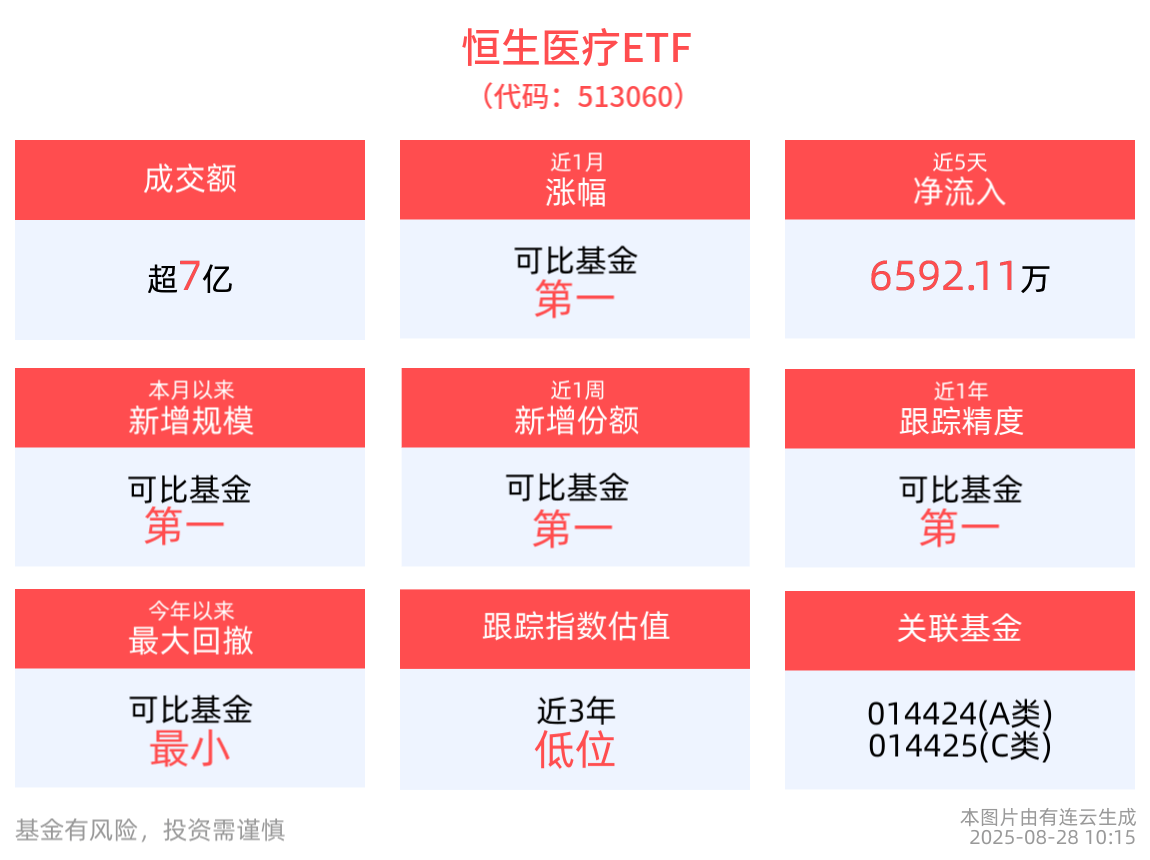
恒生医疗ETF(513060)交投高度活跃,本月以来新增规模同类居首,国产创新药资产国际含金量稳步提升
Sou Hu Cai Jing· 2025-08-28 02:45
Market Performance - The Hang Seng Healthcare Index (HSHCI) decreased by 1.23% as of August 28, 2025, with mixed performance among constituent stocks [3] - The Hang Seng Medical ETF (513060) fell by 1.15%, with a latest price of 0.69 yuan, but showed a 6.26% increase over the past month, ranking in the top third among comparable funds [3] - The Hang Seng Hong Kong Stock Connect Innovative Drug Selection Index (HSSCPB) dropped by 1.02%, with the Hong Kong Innovative Drug Selection ETF (520690) down by 0.81% to 0.98 yuan [4] Company Highlights - Innovent Biologics reported a 50.6% year-on-year revenue increase to 5.95 billion yuan for the first half of 2025, achieving a gross margin of 86% and a net profit of 830 million yuan, driven by pipeline expansion in oncology and new product launches [4] - The company has over 2 billion USD in cash reserves to support future innovation pipeline advancements [4] Policy and Industry Developments - The Ministry of Commerce and Jiangsu Provincial Government issued a plan to enhance the biopharmaceutical industry in Jiangsu Free Trade Zone by 2030, focusing on large molecule biologics, cell and gene therapy, and innovative medical devices [5] - Recent market pressure on the pharmaceutical sector was noted, with the Hang Seng Healthcare Index dropping over 2.1%, influenced by U.S. tariff proposals on imported drugs that could disrupt the global pharmaceutical industry [5] Analyst Insights - Analysts suggest that the recent decline in the Hong Kong pharmaceutical sector is a short-term fluctuation and does not alter the long-term industry outlook, with ongoing favorable policies expected to drive more cross-border business development transactions [6] - The Chinese innovative drug assets are gaining international recognition, presenting structural opportunities in the medium to long term [6] ETF Performance and Metrics - The Hang Seng Medical ETF has seen a significant increase in scale by 46.87 million yuan this month, ranking in the top third among comparable funds [8] - The ETF's share count increased by 92.5 million shares over the past week, also ranking in the top third [9] - The ETF recorded a net inflow of 74.96 million yuan recently, with a total of 65.92 million yuan accumulated over the last five trading days [10] - The ETF's financing net purchase reached 2.5072 million yuan this month, with a financing balance of 268 million yuan [11] Risk and Return Metrics - The Hang Seng Medical ETF has achieved a 48.60% net value increase over the past two years, with a maximum monthly return of 28.34% since inception [11] - The ETF's Sharpe ratio for the past year is 2.41, indicating strong risk-adjusted returns [12] - The ETF has the lowest relative drawdown among comparable funds, with a drawdown of 0.63% year-to-date [13] Valuation Insights - The latest price-to-earnings ratio (PE-TTM) for the Hang Seng Medical ETF is 30.9, which is below the historical average, indicating a potentially undervalued position [15]

财新周刊-第33期2025
2025-08-27 15:20
本文由第三方AI基于财新文章 [https://a.caixin.com/NtM18Wrx](https://a.caixin.com/NtM18Wrx) 提炼总结而成,可能与原文真实意图存在偏差。不代表财新观点和立场。推荐点击链接阅读原文细致比对和校验 Summary of Key Points Company or Industry Involved - The report focuses on the mental health of left-behind children in rural China, particularly in Hunan Province, highlighting the challenges faced by students in these areas [20][22][35]. Core Points and Arguments - **Mental Health Risks**: The report indicates that the depression risk detection rate among rural students is higher than the national average, with 21.5% of students showing mild depression risk and 8.1% at high risk [27][35]. - **Family Structure Impact**: Children with both parents working away from home have the highest depression risk, emphasizing the importance of parental presence and communication [45][46]. - **Economic Factors**: Economic difficulties significantly affect children's mental health, with students from lower-income families exhibiting higher levels of anxiety and depression [46][47]. - **Educational Environment**: Poor school conditions, such as inadequate hygiene and lack of resources, correlate with higher rates of depression and bullying among students [49][50]. - **Psychological Support Deficiency**: There is a notable lack of professional psychological support in rural schools, which exacerbates the mental health issues faced by students [35][54]. - **Behavioral Issues**: High rates of behavioral problems, such as not completing homework and engaging in conflicts, are prevalent among rural students, indicating a need for better behavioral management and support [51]. Other Important but Possibly Overlooked Content - **Technology and Social Media Influence**: Many students are heavily influenced by social media and online gaming, leading to issues such as addiction and decreased academic performance [36][39]. - **Long-term Consequences**: The report warns that the lack of emotional support and the prevalence of mental health issues could have long-term implications for the future of these children, affecting their educational and career prospects [55][56]. - **Need for Preventive Measures**: Emphasis is placed on the importance of early intervention and preventive measures, such as incorporating mental health education into the school curriculum [57][59]. This summary encapsulates the critical insights from the report on the mental health challenges faced by left-behind children in rural China, highlighting the multifaceted issues stemming from family dynamics, economic conditions, and educational environments.
9.5亿美元BD交易后 百济神州股价为何跌了
经济观察报· 2025-08-27 15:16
Core Viewpoint - The recent BD transaction by BeiGene is perceived as weak in attractiveness for investors, as it does not create value but is akin to a debt financing operation [1][10]. Group 1: Transaction Details - BeiGene announced the sale of partial royalty rights for a cancer drug for up to $950 million, with an upfront payment of $885 million [2][3]. - The upfront payment represents 36% of BeiGene's revenue for the first half of the year [3]. - The drug involved, Talazoparib, is set to launch in the U.S. in May 2024 for small cell lung cancer treatment [5]. Group 2: Financial Implications - The transaction is expected to enhance BeiGene's balance sheet stability and provide a steady cash flow, which is a critical goal for the company [10]. - As of June 30, 2025, BeiGene had approximately $2.8 billion in cash, a decrease of $170 million year-over-year, with liabilities around $2.5 billion [11]. Group 3: Market Reaction and Comparisons - Following the announcement, BeiGene's stock price declined alongside the broader innovative drug sector, contrasting with other companies that saw stock price increases after similar transactions [3][9]. - The transaction structure is unique as it only involves the sale of royalty rights, differing from typical BD transactions that include upfront payments, milestone payments, and royalties over the drug's lifecycle [9]. Group 4: Future Outlook - Royalty Pharma, the buyer, anticipates a return on investment of 10%-15% from this transaction, with projected total sales of Talazoparib estimated at $19.6 billion from 2025 to 2035 [4][7]. - The deal is seen as a significant move for BeiGene, marking its first drug rights sale in four years, and it sets a precedent in the Chinese innovative drug industry [3][10].

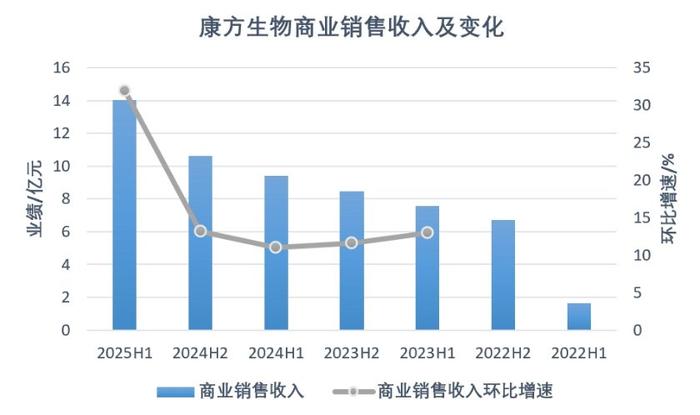
康方生物的“最热双抗”交出大涨业绩
Xin Lang Cai Jing· 2025-08-27 14:39
Core Viewpoint - Kangfang Biopharma reported a revenue of 1.412 billion yuan for the first half of 2025, marking a year-on-year increase of 37.75%, while the loss expanded to 588 million yuan from 249 million yuan in the same period last year [1][3] Financial Performance - Revenue for the period was 1.412 billion yuan, a 37.75% increase year-on-year [1] - Commercial sales revenue reached 1.402 billion yuan, up 49.20% year-on-year [1] - The company incurred a loss of 588 million yuan, which is an increase from the previous year's loss of 249 million yuan [1][3] Revenue Drivers - The growth in commercial sales revenue was primarily driven by the inclusion of AK104 and AK112 in the national medical insurance since January, leading to increased sales volume [1] - The increase in losses was attributed to a rise in equity investment losses from a partnership with Summit, which increased from 32.6 million yuan to 192 million yuan, as well as higher R&D expenses and stock incentive costs [3] Product Pipeline and Market Position - Kangfang Biopharma has received approval for seven products, including AK104 and AK112, which are key dual antibodies, and has expanded its commercial product range to include metabolic and autoimmune areas [4] - The sales team has grown from over 800 to 1,200 members, covering oncology and specialty drug sectors [4] - The company is focusing on AK112, which has shown promising results in clinical trials for non-small cell lung cancer [5][8] Clinical Development and Strategy - AK112 has achieved significant clinical endpoints in trials, including a statistically significant improvement in progression-free survival (PFS) [8][9] - The company is pursuing a strategy termed "IO2.0+ADC2.0," which aims to integrate dual antibodies with antibody-drug conjugates (ADCs) [12][13] - Kangfang Biopharma's pipeline includes ongoing clinical trials for various indications, with a focus on enhancing the efficacy of existing treatments [12][16]