
浦发银行

Search documents
——25Q3公募基金可转债持仓点评:二级债基增持显著,电新转债占比提升
Huachuang Securities· 2025-11-19 02:35
1. Report Investment Rating No investment rating information is provided in the report. 2. Core Viewpoints - In 2025Q3, the market value of convertible bonds held by public - funds increased, with the bond - type funds being the main force of the increase, and they mainly added positions in power equipment convertible bonds. The position of convertible bonds held by public - funds also rose. Although the convertible bond market continued to shrink, the convertible bond assets still had considerable returns under the catalysis of equity enthusiasm [2][8][9]. - The performance of convertible bond funds outperformed the index in 2025Q3, showing net subscriptions and scale expansion. However, the overall position and leverage ratio of these funds declined. Both public - funds and convertible bond funds focused on adding positions in power equipment convertible bonds [5][8][9]. 3. Summary by Directory 3.1 Public - funds Increase Convertible Bond Positions and Add Positions in Power Equipment Convertible Bonds 3.1.1 Market Value of Convertible Bonds Held by Public - funds Increases Month - on - Month, and Positions Rise - In 2025Q3, the market value of convertible bonds held by public - funds was 316.618 billion yuan, a month - on - month increase of 16.09% and a year - on - year increase of 12.72%. The ratio of the market value of convertible bonds held by public - funds to the market value of bond investments was 1.57%, a 0.28 - percentage - point increase from 25Q2; the ratio to net worth was 0.87%, a 0.07 - percentage - point increase from 25Q2 [13]. - The market value changes of convertible bonds held by different types of funds varied month - on - month. Stock - type and secondary bond - type funds significantly increased their positions. From the perspective of absolute amount changes, the bond - type funds had the largest increase in market value, with a month - on - month increase of 48.61 billion yuan in 25Q3 [17][19]. - The overall position of public - funds in convertible bonds increased, but the position of convertible bond funds was diluted. According to the Wind fund primary classification, the convertible bond position of stock - type funds remained flat at 0.02% month - on - month, that of hybrid funds decreased by 0.26 percentage points to 0.59%, and that of bond - type funds increased by 0.49 percentage points to 2.73% [23][25]. 3.1.2 Public - funds Inversely Increase Positions, while Insurance Funds, Enterprise Annuities, and Securities Firms' Proprietary Trading Reduce Positions - As of the end of 2025Q3, the total face value of convertible bonds held by the Shanghai and Shenzhen Stock Exchanges was 599.489 billion yuan, a decrease of 55.679 billion yuan from the end of 25Q2, a month - on - month decrease of 8.50%. Insurance institutions, enterprise annuities, and securities firms' proprietary trading significantly reduced their positions, while public - funds significantly increased their positions inversely, with a month - on - month increase of 7.68% to 233.561 billion yuan [35]. 3.1.3 Public - funds Mainly Add Positions in Power Equipment, and Bank Convertible Bonds Further Shrink - In terms of industry layout in 25Q3, banks were still the primary layout sector, but the overall position market value shrank significantly under the early redemption of multiple bank convertible bonds, with only a 233 - million - yuan difference from the power equipment market value. From the perspective of the market value month - on - month change rate, 24 industries had positive month - on - month changes, with the petrochemical, power equipment, and beauty care industries leading in growth [42]. 3.1.4 Industrial Convertible Bonds Maintain the First - Positioned Heavy - Position Bond - Industrial convertible bonds were the first - positioned heavy - position bond of public - funds, and EVE and Industrial convertible bonds led in terms of incremental positions. Among the top ten convertible bonds in terms of total position market value, there were 3 bank convertible bonds, which was fewer than in Q2. The types of bottom - position bonds gradually diversified [50]. 3.2 Convertible Bond Funds' Performance Outperforms the Index, and Convertible Bond Positions and Leverage Ratios Decline 3.2.1 Net Asset Value after Reinvestment Increases, and Overall Net Subscriptions Occur - As of 2025Q3, there were 39 convertible bond funds in the market. The performance of convertible bond funds outperformed the convertible bond index, showing net subscriptions and scale expansion. The scale of convertible bond funds in 25Q3 was 63.284 billion yuan, a significant increase of 11.635 billion yuan from 25Q2, a month - on - month increase of 22.53% [55]. - By observing the asset allocation changes of high - performing convertible bond funds, most of the larger - scale funds had reduced convertible bond positions. The top five funds in terms of net value performance in 25Q3 all had a certain scale, and most of them reduced their positions in stocks and convertible bond assets [57][58]. 3.2.2 Convertible Bond Positions Slightly Decrease Month - on - Month, and Leverage Ratios Decline Month - on - Month - The overall position of 39 convertible bond funds slightly decreased, and the leverage ratio declined month - on - month. In the third quarter of 2025, the ratio of the market value of convertible bonds to the net value of convertible bond funds was 84.18%, a month - on - month decrease of 1.16 percentage points; the median position was 85.54%, a more obvious month - on - month decrease of 6.14 percentage points. The average leverage ratio of 39 convertible bond funds was 114.13%, a decrease of 2.79 percentage points month - on - month, continuing the downward trend [5][68]. 3.2.3 Convertible Bond Funds Focus on Adding Positions in Power Equipment - From the perspective of the quarterly change in the number of times funds held convertible bonds, more than half of the industries had an increase in the number of holdings in 25Q3, with power equipment, electronics, and machinery leading in the increase. From the perspective of the quarterly change in the proportion of the market value of fund positions, the proportion of power equipment increased by 4.46 percentage points, leading by a large margin [6]. - Among the 39 convertible bond funds, Industrial convertible bonds were still the main heavy - position bond and increased in position. The banking and power equipment industries remained at the forefront of heavy - position industries [6].


又有银行股创新高!中国银行涨近3%创历史新高
Ge Long Hui A P P· 2025-11-19 02:34
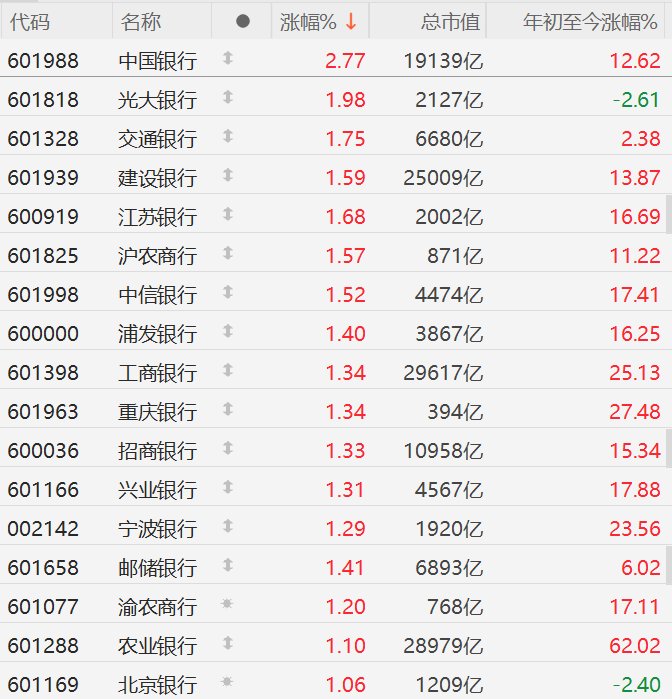
Core Insights - The A-share market saw a collective rise in bank stocks, with notable increases in China Bank, which rose nearly 3%, and other banks like Everbright Bank, Bank of Communications, and Agricultural Bank of China also showing gains of over 1% [1] Summary by Category Stock Performance - China Bank increased by 2.77%, reaching a total market capitalization of 191.39 billion, with a year-to-date increase of 12.62% [2] - Everbright Bank rose by 1.98%, with a market cap of 21.27 billion and a year-to-date decline of 2.61% [2] - Bank of Communications saw a 1.75% increase, with a market cap of 66.80 billion and a year-to-date increase of 2.38% [2] - Agricultural Bank of China increased by 1.10%, with a market cap of 289.79 billion and a year-to-date increase of 62.02% [2] - Other banks such as Construction Bank, Jiangsu Bank, and Industrial and Commercial Bank of China also reported gains, with year-to-date increases ranging from 15.34% to 25.13% [2] Historical Performance - China Bank reached a new historical high, following similar achievements by Agricultural Bank and Industrial and Commercial Bank [1]





今日金价!11月18日调整后,全国珠宝店,黄金最新售价
Sou Hu Cai Jing· 2025-11-19 00:35
Core Viewpoint - The divergence between international and domestic gold prices continues, with international gold prices experiencing significant volatility while domestic prices remain relatively stable [2][5][9]. Group 1: International Gold Price Trends - On November 18, 2025, the international gold price was $4045.50 per ounce, down $39.30 or 0.96% from the previous trading day, with intraday fluctuations exceeding $100 [2]. - The international gold price has shown high volatility, with a notable drop of 6.3% on October 21, 2025, marking the largest single-day decline since April 2013 [5][7]. - Recent fluctuations in international gold prices are primarily driven by changes in U.S. Federal Reserve monetary policy expectations, with a significant drop in the probability of a rate cut in December [7]. Group 2: Domestic Gold Price Stability - In contrast to international trends, domestic gold prices showed minimal change, with a slight decrease of 0.18 yuan or 0.02% on the same day [2]. - Major retail brands in the domestic market, such as Chow Tai Fook and Luk Fook, maintain stable pricing, with gold jewelry prices significantly higher than the converted international prices by 300-350 yuan per gram [2][4]. - The domestic gold market exhibits a price hierarchy, with brand retail prices at the top, followed by bank investment gold bars, and lower prices for gold recycling [4][5]. Group 3: Market Dynamics and Consumer Behavior - The domestic gold market is supported by strong physical demand, with gold bar and coin consumption increasing by 24.55% year-on-year in the first three quarters of 2025, despite a decline in gold jewelry consumption [9][10]. - The shift in consumer behavior towards smaller, higher-value gold products is evident, with products weighing 10 grams or less accounting for 45% of sales in the first half of 2025 [9][12]. - The recent tax policy adjustments affecting gold transactions have also influenced market dynamics, with increased costs for non-investment gold purchases [10].

险资三季度进一步增配股票和证券投资基金!
Zheng Quan Ri Bao· 2025-11-19 00:19
Core Viewpoint - The National Financial Regulatory Administration has reported that as of the end of Q3, the total investment balance of insurance funds exceeded 37 trillion yuan, with an increased allocation to equity assets by both life and property insurance companies due to various factors including pressure from interest rate spreads, improved investment returns, a recovering equity market, and regulatory encouragement [1][3]. Group 1: Investment Allocation - As of the end of Q3, property insurance companies had an investment balance of 23.875 trillion yuan, with bonds and bank deposits accounting for 40.62% and 15.67% respectively, while equity investments (stocks, securities investment funds, and long-term equity investments) accounted for 8.74%, 8.23%, and 6.16% respectively [2]. - Life insurance companies had an investment balance of 33.73 trillion yuan, with bonds and stocks making up 51.02% and 10.12% respectively, and other allocations including bank deposits, securities investment funds, and long-term equity investments at 7.37%, 5.26%, and 8.00% respectively [2]. Group 2: Changes in Allocation - Compared to the end of Q2, property insurance companies increased their allocation to stocks, securities investment funds, and long-term equity investments, with the stock allocation seeing the largest increase of 0.41 percentage points [3]. - Life insurance companies also increased their allocations to stocks and securities investment funds by 1.31 percentage points and 0.73 percentage points respectively, while their bond allocation decreased by 0.88 percentage points [3]. Group 3: Factors Influencing Investment Decisions - Experts attribute the increased allocation to equity assets to three main factors: the continuous decline in interest rates leading to lower returns on traditional fixed-income assets, a steady upward trend in the equity market since Q1, and regulatory changes in April that raised the upper limit for equity asset allocation [3][4]. - The sticky nature of insurance liability costs and the faster decline in interest rates compared to these costs have made equity markets more attractive, with a shift in consumer demand towards dividend insurance products [4]. Group 4: Investment Preferences - Insurance institutions continue to favor bank stocks, with significant holdings in companies such as Minsheng Bank, SPDB, Agricultural Bank of China, and others, while also showing interest in sectors like infrastructure, energy, and logistics [5]. - The preference for stable, high-dividend, and liquid stocks aligns with the characteristics of bank stocks, which are currently favored by insurance capital [5]. Group 5: Future Investment Trends - It is expected that the scale and proportion of equity investments by insurance capital will continue to rise, with a richer variety of investment channels and a focus on stable dividend stocks and technology growth stocks [6]. - As insurance capital gains more experience in equity investments, there will likely be an increase in allocations to Hong Kong stocks and other equity assets [6].
告别流量依赖、握紧风控自主权 中小银行与助贷机构合作逻辑生变
Zhong Guo Zheng Quan Bao· 2025-11-18 23:31
Core Viewpoint - The implementation of the "New Regulations on Internet Lending by Commercial Banks" since October 1 has led to significant adjustments in the internet lending business of commercial banks, shifting from broad cooperation to stringent selection of partners [1][4]. Group 1: Changes in Cooperation - Several regional banks, including Urumqi Bank, Longjiang Bank, and Guiyang Bank, have announced the suspension of new internet lending partnerships, indicating a trend towards reducing the number of cooperative institutions [1][2]. - Jilin Yilian Bank has significantly reduced its number of cooperative institutions from 56 to 10 over the past year, reflecting a broader trend of "thinning" partnerships in the industry [3]. - Some banks, like Jiangxi Yumin Bank, have increased the number of cooperative institutions while still making selective adjustments to their partnerships [3]. Group 2: Regulatory Environment - The regulatory environment for internet lending has tightened, with several banks facing penalties for non-compliance with regulations [5][6]. - The new regulations require banks to implement a list management system for cooperative institutions, emphasizing the importance of careful selection and management of partners [6][8]. Group 3: Strategic Shifts - The new regulations are seen as a challenge for banks, particularly smaller ones that heavily relied on internet lending, pushing them to refocus on core business and improve internal capabilities [4][7]. - Industry experts suggest that banks should develop core competencies to reduce reliance on lending partners, including enhancing customer acquisition and risk management capabilities [8]. Group 4: Future Outlook - The future of internet finance is expected to focus on scenario-based finance, small and micro finance, and enhancing data asset operations, with AI playing a crucial role in improving risk management [9].
告别流量依赖 握紧风控自主权 中小银行与助贷机构合作逻辑生变
Zhong Guo Zheng Quan Bao· 2025-11-18 22:16
Core Viewpoint - The implementation of the "New Regulations on Internet Lending by Commercial Banks" has led to significant adjustments in the internet lending business of commercial banks, shifting from broad cooperation to stringent selection of partners [1][4]. Group 1: Changes in Cooperation - Several regional banks, including Urumqi Bank, Longjiang Bank, and Guiyang Bank, have announced the suspension of new internet lending partnerships since the regulations took effect on October 1 [1][2]. - Urumqi Bank has stopped its personal internet consumer loan cooperation, which previously involved 9 platform operators and 8 credit enhancement service providers [2]. - Longjiang Bank has ceased its collaboration with its only platform operator, Shenzhen Shoufu Bao Financial Technology Co., Ltd. [2]. - Guiyang Bank has adjusted its business strategy, ending new collaborations with internet banks while managing existing loans [2]. Group 2: Reduction in Partner Institutions - Jilin Yilian Bank has significantly reduced its number of cooperative institutions from 56 to 10 over the past year, focusing on major platforms like Fenqile and Meituan [3]. - Some banks, like Jiangxi Yumin Bank, have increased their number of partners but made selective adjustments, removing one credit enhancement service provider while adding others [3]. Group 3: Regulatory Environment - The regulatory environment for internet lending has tightened, with several banks facing penalties for non-compliance with regulations [5][6]. - The Financial Regulatory Bureau has fined Ping An Bank and Shanghai Pudong Development Bank for imprudent management of internet lending and related services [6]. - The new regulations require banks to implement a list management system for platform operators and credit enhancement service providers, ensuring that only approved entities are engaged in internet lending [3][7]. Group 4: Strategic Shifts and Risk Management - The new regulations compel banks to enhance their risk management capabilities and reduce reliance on external lending partners [4][9]. - Banks are encouraged to develop their own customer acquisition and brand-building strategies, moving towards a more self-sufficient operational model [9]. - The focus is shifting towards building intelligent risk control systems and utilizing diverse data sources for better risk assessment [9][10]. Group 5: Future Outlook - The future of internet finance is expected to concentrate on scenario-based finance, small and micro finance, and enhancing data asset operations [10]. - The integration of AI in financial services is anticipated to improve risk control precision, although challenges related to data quality and organizational change remain [10].
告别流量依赖 握紧风控自主权中小银行与助贷机构合作逻辑生变
Zhong Guo Zheng Quan Bao· 2025-11-18 20:05
Core Viewpoint - The implementation of the "New Regulations on Internet Lending by Commercial Banks" since October 1 has led to significant adjustments in the internet lending business of commercial banks, with a shift from broad cooperation to stringent selection of partners [1][2][3]. Summary by Sections Adjustments in Lending Partnerships - Several regional banks, including Urumqi Bank, Longjiang Bank, and Guiyang Bank, have announced the suspension of new internet lending partnerships, indicating a trend towards reducing the number of cooperative institutions [1][2]. - Urumqi Bank has stopped its cooperative personal internet consumer loan business, affecting nine platform operators and eight credit enhancement service providers [1]. - Longjiang Bank has ceased its only partnership with Shenzhen Shoufu Bao Financial Technology Co., Ltd., while Guiyang Bank has not renewed its internet platform business partnerships [2]. Regulatory Impact and Compliance - The new regulations require banks to implement a list management system for platform operators and credit enhancement service providers, which has led to a tightening of partnerships [3][4]. - The recent regulatory environment has resulted in penalties for banks like Ping An Bank and SPDB for improper management of internet lending activities [4]. - The regulations emphasize that banks must not outsource core functions such as loan issuance and risk control, pushing them to enhance their internal capabilities [5]. Risk Management and Strategic Shifts - The new regulations are seen as a catalyst for banks, especially smaller ones, to improve their risk management and operational capabilities, moving from passive reliance on lending partners to active collaboration [5][6]. - Analysts suggest that smaller banks should focus on building their own customer acquisition and brand development capabilities while diversifying their partnerships to mitigate risks [5]. - The future of internet finance is expected to focus on scenario-based finance, small and micro finance, and enhanced data asset management, with AI playing a crucial role in improving risk control [6].
关于新增华宝证券为万家国证港股通科技交易型开放式指数证券投资基金发起式联接基金销售机构的公告
Shang Hai Zheng Quan Bao· 2025-11-18 18:23
Group 1 - The fund "Wanjia Guozheng Hong Kong Stock Connect Technology ETF Initiation Fund" will be publicly offered from November 19 to November 26, 2025, through designated sales institutions [1] - Starting from November 19, 2025, Huabao Securities will be added as a sales agent for the fund, allowing investors to subscribe and manage other fund-related transactions through Huabao Securities [1] - Investors can consult details through Huabao Securities and Wanjia Fund Management Company via their respective customer service numbers and websites [1] Group 2 - Wanjia Fund Management Company has announced the addition of Guoxin Securities as a liquidity service provider for several ETFs, effective November 19, 2025, to enhance market liquidity and stability [2] - The ETFs affected include the "Wanjia Zhongzheng Semiconductor Materials and Equipment Theme ETF," "Wanjia Guozheng 2000 ETF," "Wanjia Guozheng Aerospace Industry ETF," and "Wanjia Zhongzheng Artificial Intelligence Theme ETF" [2] Group 3 - Wanjia Fund Management Company has disclosed that the "Wanjia Tiantianbao Money Market Fund" participated in the issuance of a short-term financing bond by Guotai Haitong Securities, with a face value of 100.00 yuan per bond and an interest rate of 1.67% [4] - The bond issuance is associated with the fund's custodian, Shanghai Pudong Development Bank, and follows the necessary approval procedures [4]
关于鹏华创兴增利债券型证券投资基金增设E类基金份额并修改基金合同及托管协议等事项的公告
Shang Hai Zheng Quan Bao· 2025-11-18 18:12
Core Viewpoint - Penghua Fund Management Company announced the addition of E-class fund shares for the Penghua Chuangxing增利债券型证券投资基金, effective from November 20, 2025, along with updates to the fund management information and corresponding modifications to the fund contract and custody agreement [1][3]. Group 1: E-Class Fund Shares - The E-class fund shares will have a separate fund code (E-class fund share code: 026080) and will apply the same management and custody fee rates as existing fund shares, with no sales service fee charged [1]. - The redemption fee structure for E-class fund shares is as follows: 1.50% for investors holding for less than 7 days, 0.50% for those holding between 7 and 30 days, and no fee for those holding for 30 days or more. The redemption fees for holdings of less than 7 days will be fully allocated to the fund property, while 25% of the total redemption fees for longer holdings will be allocated to the fund property [1]. Group 2: Fund Contract and Custody Agreement Modifications - The modifications to the fund contract and custody agreement are made to ensure compliance with legal and regulatory requirements and do not require a meeting of fund shareholders for approval, as they do not adversely affect the interests of existing shareholders [3]. - The revised fund contract will take effect on the next working day following the announcement, which is November 20, 2025, and the fund management company will update the prospectus and related documents accordingly [3][4]. Group 3: Investor Information - Investors can consult relevant information through the Penghua Fund Management Company's website or customer service hotline [4]. - The announcement specifically addresses the addition of E-class fund shares and updates to the fund management information, encouraging investors to read the updated fund contract and prospectus for detailed information [4].
险资三季度进一步增配股票和证券投资基金
Zheng Quan Ri Bao Zhi Sheng· 2025-11-18 16:06
Core Viewpoint - The National Financial Regulatory Administration reported that as of the end of Q3, the total investment balance of insurance funds exceeded 37 trillion yuan, with an increased allocation to equity assets by life and property insurance companies due to various factors including interest rate pressure and regulatory encouragement [1][3]. Group 1: Investment Allocation - As of the end of Q3, property insurance companies had an investment balance of 23,875 billion yuan, with bonds and bank deposits accounting for 40.62% and 15.67% respectively, while equity investments (stocks, securities investment funds, and long-term equity investments) accounted for 8.74%, 8.23%, and 6.16% respectively [2]. - Life insurance companies had an investment balance of 33.73 trillion yuan, with bonds and stocks making up 51.02% and 10.12% respectively, and other investments including bank deposits, securities investment funds, and long-term equity investments accounting for 7.37%, 5.26%, and 8.00% respectively [2]. Group 2: Changes in Investment Strategy - Compared to the end of Q2, property insurance companies increased their allocation to stocks, securities investment funds, and long-term equity investments, with the stock allocation seeing the largest increase of 0.41 percentage points [3]. - Life insurance companies also increased their allocation to stocks and securities investment funds by 1.31 percentage points and 0.73 percentage points respectively, while their bond allocation decreased by 0.88 percentage points [3]. Group 3: Factors Influencing Investment Decisions - Experts attribute the increased allocation to equity assets to three main factors: declining yields on traditional fixed-income assets, a recovering equity market since Q1, and regulatory changes that raised the upper limit for equity asset allocation [3][4]. - The current interest rate decline is perceived to be outpacing the decrease in insurance liability costs, making equity markets more attractive [4]. Group 4: Stock Preferences - Insurance institutions continue to favor bank stocks, with significant holdings in companies such as Minsheng Bank, SPDB, Agricultural Bank, and others, reflecting a preference for stable, high-dividend, and liquid stocks [5]. - In Q3, insurance funds increased their holdings in Postal Savings Bank, Hualing Steel, and others, indicating a focus on companies with strong fundamentals and growth potential [5]. Group 5: Future Investment Trends - It is anticipated that the scale and proportion of equity investments by insurance funds will continue to rise, with a diversification of investment channels [6]. - Insurance companies are expected to increase their allocation to stable dividend-paying stocks and technology growth stocks, as well as expand their investments in Hong Kong equities [6].