传音控股

Search documents
“非洲手机之王”传音去年净利预降超五成,存储涨价致承压
Nan Fang Du Shi Bao· 2026-01-30 10:37
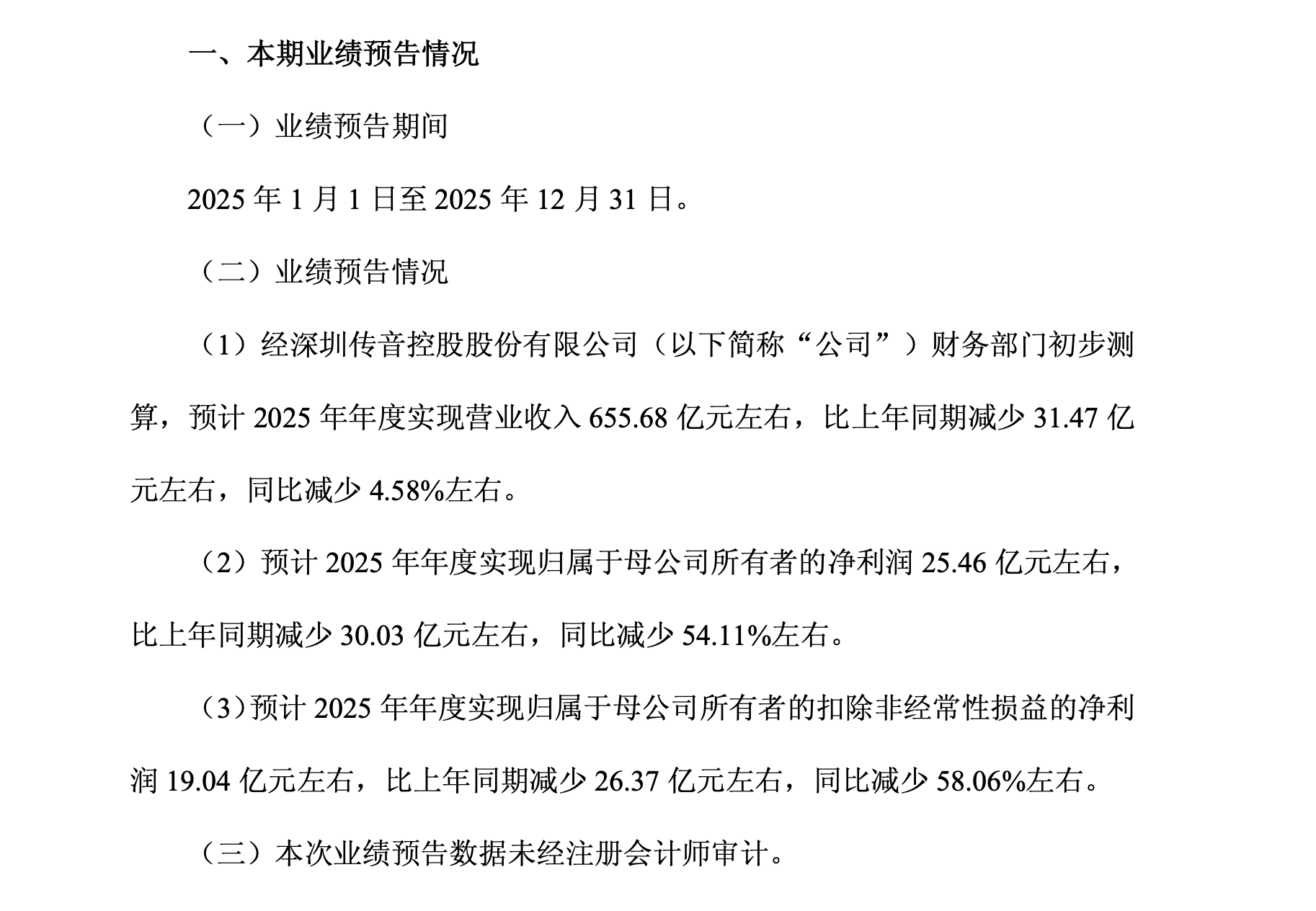
Core Viewpoint - Transsion Holdings, known as the "King of African Mobile Phones," is facing significant challenges due to rising supply chain costs and intensified market competition, leading to a projected net profit decline of approximately 54.11% for 2025 compared to the previous year [2][3]. Financial Performance - The company expects to achieve an annual revenue of approximately 655.68 billion yuan for 2025, a decrease of about 4.58% from 687.15 billion yuan in 2024 [4]. - The projected net profit attributable to shareholders is around 25.46 billion yuan, down approximately 30.03 billion yuan year-on-year [4]. - The non-GAAP net profit, which excludes non-recurring gains and losses, is expected to be about 19.04 billion yuan, reflecting a significant decrease of 58.06% compared to the previous year [4]. Cost and Margin Pressures - The decline in profitability is attributed to rising costs of components, particularly storage chips, which have seen price increases due to a "super cycle" in the semiconductor industry [5]. - The company's overall gross margin has been negatively impacted by these rising costs, particularly affecting its mid-to-low-end product lines [5]. Competitive Landscape - Despite maintaining over 40% market share in the African smartphone market, Transsion is facing increased competition from Chinese brands like Xiaomi, Honor, and OPPO, which are expanding aggressively in Africa [6]. - Competitors have shown faster sales growth, prompting Transsion to increase marketing and R&D expenditures, further compressing profit margins [6]. Legal Challenges - Since 2025, Transsion has been embroiled in multiple patent infringement lawsuits globally, involving major technology companies such as Qualcomm and Huawei, which poses additional risks to its operations [7]. Strategic Initiatives - In response to financial pressures and a complex external environment, Transsion is seeking new financing avenues and has submitted an application for an IPO on the Hong Kong Stock Exchange, aiming for a dual listing [7]. - This move is seen as a strategic effort to secure international capital and enhance its competitive position in the global market [7]. Market Performance - As of January 30, the company's A-share price was reported at 58.13 yuan, reflecting a decline of 3.93%, with a total market capitalization of approximately 669.2 billion yuan [8].


2025年报业绩预告开箱(五):三股不可逆的趋势力量驱动增长
市值风云· 2026-01-30 10:09
Core Viewpoint - The report highlights the performance forecasts of various A-share listed companies, indicating potential investment opportunities and risks across different sectors, with a focus on companies showing significant profit growth and those facing substantial losses [4]. Group 1: Companies with Notable Profit Growth - **Southern Power Storage (600995.SH)**: Expected net profit of 1.5-1.8 billion yuan, a year-on-year increase of 55%-85%, driven by large-scale energy storage projects and favorable electricity pricing policies [7]. - **Transsion Holdings (688036.SH)**: Anticipated net profit of 4.2-4.8 billion yuan, a year-on-year increase of 75%-100%, due to increased market share in emerging markets and product optimization [8]. - **Green Harmonic (688017.SH)**: Projected net profit of 150-180 million yuan, a year-on-year increase of 80%-116%, supported by rising demand for humanoid robots and improved product margins [10]. - **Shengyi Technology (600183.SH)**: Expected net profit of 3.25-3.45 billion yuan, a year-on-year increase of 87%-98%, attributed to the recovery in the PCB industry [11]. - **Century Huatong (002602.SZ)**: Forecasted net profit of 5.55-6.98 billion yuan, a year-on-year increase of 357.47%-475.34%, driven by strong performance in mobile gaming [12]. - **Shenzhen Huaqiang (000062.SZ)**: Expected net profit of 426-490 million yuan, a year-on-year increase of 100%-130%, due to deepening collaborations in key product lines [13]. - **Jiumuwang (601566.SH)**: Projected net profit of 250-280 million yuan, a year-on-year increase of 65%-85%, supported by brand upgrades and improved online sales [14]. - **Panjiang Coal (600395.SH)**: Anticipated net profit of 2.5-2.8 billion yuan, a year-on-year increase of 50%-68%, due to rising coal prices and effective cost control [15]. - **Tongkun Co. (601233.SH)**: Expected net profit of 1.5-1.8 billion yuan, a year-on-year increase of 70%-104%, driven by the recovery in the PTA-polyester chain [16]. - **Shenghe Resources (600392.SH)**: Projected net profit of 800-1,000 million yuan, a year-on-year increase of 120%-175%, supported by rising rare earth prices [17]. - **Wanfeng Aowei (002085.SZ)**: Expected net profit of 850-1,050 million yuan, a year-on-year increase of 85%-128%, driven by increased demand for magnesium alloy wheels [18]. - **Biosan (688796.SH)**: Projected net profit of 80-120 million yuan, turning profitable due to progress in new drug development [19]. - **Wantai Biological Pharmacy (603392.SH)**: Expected net profit of 53-159 million yuan, a year-on-year increase of 60%-140%, driven by the recovery of vaccine sales [20]. - **Ninebot (689009.SH)**: Anticipated net profit of 1.67-1.85 billion yuan, a year-on-year increase of 54.04%-70.64%, due to growing demand for smart mobility products [22]. - **China Shipbuilding (600150.SH)**: Expected net profit of 7-8.4 billion yuan, a year-on-year increase of 65.89%-132.42%, due to an upgrade in order structure [23]. - **Foton Motor (600166.SH)**: Projected net profit of 1.33 billion yuan, with a significant year-on-year increase of approximately 1551%, driven by sales growth in new energy vehicles [24]. - **Youyan New Materials (600206.SH)**: Expected net profit of 255-280 million yuan, a year-on-year increase of 73%-90%, supported by growth in target markets [26]. - **Huakang Clean (301235.SZ)**: Anticipated net profit of 280-320 million yuan, a year-on-year increase of 85%-111%, due to increased demand in the biopharmaceutical sector [28]. - **Mars Man (300894.SZ)**: Expected net profit of 180-220 million yuan, a year-on-year increase of 60%-95%, driven by strong sales of integrated stoves [29]. - **Jifeng Co. (603997.SH)**: Projected net profit of 410-495 million yuan, turning profitable due to increased orders in the automotive sector [30]. - **Fosda (603173.SH)**: Expected net profit of 180-220 million yuan, a year-on-year increase of 55%-90%, driven by demand for deep-cooling equipment [32]. - **Zhongshun Jierou (002511.SZ)**: Anticipated net profit of 300-330 million yuan, a year-on-year increase of 288.69%-327.56%, due to effective cost control [33]. - **Shunbo Alloy (002996.SZ)**: Expected net profit of 210-270 million yuan, a year-on-year increase of 222.96%-315.23%, driven by rising aluminum prices [35]. - **Ruitai New Materials (301238.SZ)**: Projected net profit of 185-240 million yuan, a year-on-year increase of 118.67%-183.68%, due to significant non-recurring gains [36]. - **Goodway (688390.SH)**: Expected net profit of 125-162 million yuan, turning profitable due to the domestic photovoltaic installation surge [37]. - **Gao De Infrared (002414.SZ)**: Projected net profit of 700-900 million yuan, turning profitable due to expanded applications of infrared thermal imaging [39]. Group 2: Companies with Significant Losses - **Qidi Environment (000826.SZ)**: Expected net loss of 2.8-3.5 billion yuan, with losses widening due to substantial investment losses and increased credit impairment [44]. - **Meike Home (600337.SH)**: Projected net loss of 1.2-1.8 billion yuan, with losses widening due to a downturn in the home furnishing industry [46]. - **Shapais (603168.SH)**: Expected net loss of 319-213 million yuan, with losses widening due to goodwill impairment [47]. - **Zhixiang Jintai (688443.SH)**: Projected net loss of 400-500 million yuan, with losses widening due to high clinical trial costs and limited revenue [48]. - **Jinpu Titanium Industry (000545.SZ)**: Expected net loss of 490-430 million yuan, with losses widening due to intense competition in the titanium dioxide market [50]. - **Guozhong Water (600187)**: Projected net loss of 10.4-13 million yuan, with losses due to asset impairment and operational challenges [51]. - **Juguang Technology (300203.SZ)**: Expected net loss of 20-25 million yuan, with losses due to industry demand decline and increased competition [54]. - **Jingjin Electric (688280.SH)**: Projected net loss of 30-35 million yuan, with losses due to intense competition in the new energy vehicle sector [55]. - **Liaoning Energy (600758.SH)**: Expected net loss of 50-60 million yuan, with losses due to falling coal prices and increased environmental costs [57]. - **Huachang Chemical (002274.SZ)**: Projected net loss of 25-30 million yuan, with losses due to delayed project launches and rising raw material costs [58]. - **Hengyuan Coal Power (600971.SH)**: Expected net loss of 35-45 million yuan, with losses due to falling coal prices and increased costs [59]. - **Yuanjie Technology (688498.SH)**: Projected net loss of 12-15 million yuan, with losses due to high inventory and competitive pressures [61]. - **Hongchuan Wisdom (002930.SZ)**: Expected net loss of 44.3-47.5 million yuan, with losses due to declining demand in the chemical storage sector [62]. - **Haitian High-tech (002023.SZ)**: Projected net loss of 39-58 million yuan, with losses due to asset impairment [64]. - **Kew Flower Pharmaceutical (002737.SZ)**: Expected net loss of 24-38 million yuan, with losses due to channel adjustments and rising sales expenses [65]. - **Jinyuan Co. (000546.SZ)**: Projected net loss of 18-36 million yuan, with losses due to asset impairment [66]. - **Tianshun Wind Power (002531.SZ)**: Expected net loss of 19-25 million yuan, with losses due to asset impairment [67]. - **Rainbow Co. (600707.SZ)**: Projected net profit of 330-390 million yuan, a year-on-year decrease of 68.55%-73.39%, due to falling panel prices and high inventory [68]. - **Ningbo Huaxiang (002048.SZ)**: Expected net profit of 120-150 million yuan, a year-on-year decrease of 43.5%-56.34%, due to rising costs and competitive pressures [70]. - **Jingsheng Mechanical and Electrical (300316.SZ)**: Projected net profit of 878-1,255 million yuan, a year-on-year decrease of 50%-65%, due to cyclical fluctuations in the photovoltaic industry [71]. Group 3: Industry Trends and Drivers - **Driver One: Technological Breakthroughs and Domestic Substitution**: This is currently the most growth-oriented theme, with companies like Green Harmonic and Transsion Holdings benefiting from advancements in technology and market understanding [72]. - **Driver Two: Cost Reduction and Efficiency Improvement**: In stable demand sectors, companies with superior cost control and operational efficiency, such as Zhongshun Jierou and Foton Motor, are achieving significant alpha returns [73]. - **Driver Three: Price Cycles and Policy Benefits**: Price fluctuations in resource commodities and supportive policies continue to influence industry performance, with companies like Shenghe Resources and Panjiang Coal benefiting from price increases [74]. - **Trend Divergence and Potential Turning Points**: The new energy vehicle supply chain shows stronger performance in upstream components compared to downstream integrators, while the pharmaceutical sector is experiencing significant internal differentiation [75].




“非洲手机之王”传音控股预期净利润大跳水
Bei Ke Cai Jing· 2026-01-30 09:33
Group 1 - The core viewpoint of the news is that Transsion Holdings, known as the "King of Mobile Phones in Africa," is experiencing a significant decline in its 2025 performance, with a projected revenue of approximately 65.568 billion yuan, a decrease of 3.147 billion yuan compared to the previous year [1] - The company's net profit attributable to shareholders is expected to be 2.546 billion yuan, representing a sharp decline of about 54.11% year-on-year, a reduction of 3.003 billion yuan [1][2] Group 2 - The main reason for the profit decline is attributed to the impact of supply chain costs, particularly the significant increase in prices of components such as storage, which has affected the company's costs and gross margin [2] - To maintain long-term competitiveness, the company has increased its sales and research and development expenses during the reporting period [2] Group 3 - As of the report date, Transsion Holdings (688036.SH) is trading at 58.48 yuan per share, down 3.35% from the opening, with a total market capitalization of 67.321 billion yuan [3]
第一波存储涨价的手机受害者出现了
Di Yi Cai Jing· 2026-01-30 04:36
Core Viewpoint - The global storage chip prices are rising, significantly impacting smartphone manufacturers, with Transsion Holdings reporting a notable decline in revenue and profit due to increased component costs [3][5]. Company Summary - Transsion Holdings expects a revenue of approximately 65.568 billion yuan for 2025, a year-on-year decrease of about 4.6%, and a net profit of around 2.546 billion yuan, down 54.11% year-on-year, marking the first time the company has experienced such a significant profit drop since its listing [3][5]. - The company attributes the decline to rising supply chain costs, particularly for storage components, which have negatively affected product costs and gross margins [3][5]. - As of January 30, Transsion's stock price was 57.79 yuan, down 4.50%, reflecting a 44% decline from its one-year high [3][5]. Industry Summary - In the first three quarters of the previous year, Transsion's net profit fell by 44.97%, indicating a trend of increasing revenue without corresponding profit growth [5]. - Other smartphone manufacturers, such as Xiaomi and realme, have also reported challenges in fully passing on the increased costs of storage components to consumers [5][6]. - UBS forecasts that by Q4 2026, the cost of memory in the BOM (Bill of Materials) for mid-range smartphones will rise to 34%, up from 22% in Q4 2024 and 27% in Q4 2025, with an expected increase of about $16 per unit, representing a 37% rise [6]. - Counterpoint Research predicts that the increase in DRAM prices will raise BOM costs for smartphones across all price segments, with low, mid, and high-end models seeing increases of approximately 25%, 15%, and 10%, respectively, and further increases of 10% to 15% expected by Q2 2026 [6][7]. - The anticipated rise in component costs is expected to lead to a 2.1% decline in global smartphone shipments in 2026, particularly affecting lower-priced models where price adjustment options are limited [7].

Omdia:小米2025年出货1.654亿部,全球第三
Feng Huang Wang· 2026-01-30 04:23
Core Insights - The report from Omdia indicates that Xiaomi is projected to ship 165.4 million units in 2025, maintaining its position as the third-largest smartphone manufacturer globally, despite a 2% decrease from 168.6 million units in 2024 [1] Group 1: Shipment Forecast - Xiaomi's shipment volume for Q4 2025 is expected to be 37.8 million units, which represents an 11% decline compared to 42.7 million units in Q4 2024 [1] - The decline in shipments is attributed to weak demand for entry-level models and significant contraction in key markets [1] Group 2: Market Share - In 2025, the global smartphone market share for the top ten manufacturers is projected as follows: Apple 19%, Samsung 19%, Xiaomi 13%, Vivo 8%, OPPO 8%, Transsion 8%, Honor 6%, Lenovo 5%, Huawei 4%, and Realme 3% [1] Group 3: Cost Impact - The report notes that rising costs of key components and memory have begun to suppress shipment expectations for 2026 [1]


第一波存储涨价的手机受害者出现了
第一财经· 2026-01-30 04:21
2026.01. 30 本文字数:1354,阅读时长大约2分钟 作者 | 第一财经 李娜 全球存储芯片价格持续走高,智能手机厂商开始率先感受到成本涨价带来的"寒意"。 1月29日晚,深圳传音控股股份有限公司(688036.SH)发布2025年年度业绩预告,预计全年实现营 业收入约655.68亿元,同比下降约4.6%;归属于母公司股东的净利润约25.46亿元,同比大幅下降 54.11%。这也是该公司上市以来首次出现净利润"腰斩"。 传音在公告中称,受供应链成本上升影响,存储等元器件价格上涨较多,对产品成本和毛利率造成一 定影响,导致报告期内公司整体毛利率出现下滑态势,叠加销售费用和研发投入增加,拖累了整体盈 利表现。截至30日午间收盘,传音控股股价为57.79元,跌4.50%,距近一年高点,跌幅达到44%。 Counterpoint Research则预测,DRAM价格上涨将持续推升手机BoM成本(物料成本),低、中、 高价位段机型分别增加约25%、15%与10%,且至2026年第二季仍可能再增10% 到15%。 "在较低价格段,价格上调的空间有限,若成本无法完全转嫁,OEM可能调整产品策略,目前已经观 察到部 ...

Omdia:2025年OPPO出货1.007亿部,全球第五
Feng Huang Wang· 2026-01-30 04:20
2025年全球智能手机前十大厂商市场份额排名:苹果19%、三星19%、小米13%、vivo8%、OPPO8%、 传音8%、荣耀6%、联想5%、华为4%、realme3%。 2025年第四季度,OPPO出货量2680万部,相较于2024年第四季度的2460万部,同比增长9%。 报告称,随着realme自2026年并入OPPO后,OPPO体系将更为庞大,有望取得更高排名。 凤凰网科技讯1月30日,根据市场研究机构Omdia最新报告,2025年OPPO出货量达1.007亿部,同比下 降3%,全球排名第五。 ...
传音预警利润腰斩,第一波存储涨价的手机受害者出现了
Di Yi Cai Jing· 2026-01-30 04:07
受存储涨价影响,千元机市场阵营开始失守。 全球存储芯片价格持续走高,智能手机厂商开始率先感受到成本涨价带来的"寒意"。 1月29日晚,深圳传音控股股份有限公司(688036.SH)发布2025年年度业绩预告,预计全年实现营业收入约655.68亿元,同比下降约4.6%;归属于母公司股 东的净利润约25.46亿元,同比大幅下降54.11%。这也是该公司上市以来首次出现净利润"腰斩"。 传音在公告中称,受供应链成本上升影响,存储等元器件价格上涨较多,对产品成本和毛利率造成一定影响,导致报告期内公司整体毛利率出现下滑态势, 叠加销售费用和研发投入增加,拖累了整体盈利表现。截至30日午间收盘,传音控股股价为57.79元,跌4.50%,距近一年高点,跌幅达到44%。 在分析机构看来,与高端机型相比,存储成本上涨对千元机等中低端产品的冲击更为直接。由于产品售价和利润空间有限,存储等核心元器件成本在整机物 料成本中的占比上升,会迅速侵蚀厂商的盈利能力。 瑞银在去年年底发布的一份行业报告中测算,到2026年第四季度,内存成本在中低端智能手机BOM(物料清单)中的占比预计将升至34%,明显高于2024 年第四季度的22%和202 ...
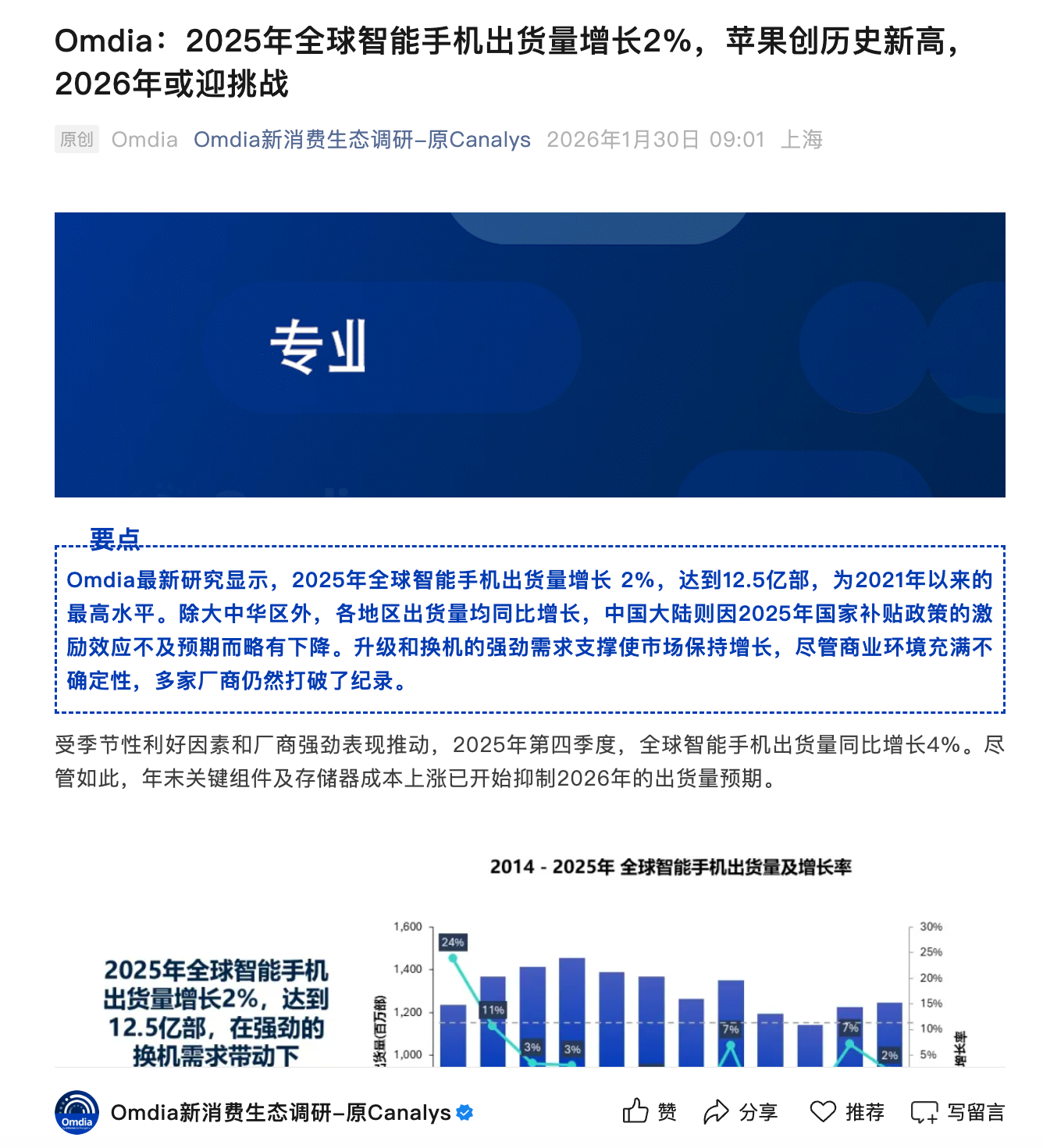
Omdia:苹果手机2025年出货超2.4亿部创新高,vivo首次跻身全球第四
Feng Huang Wang· 2026-01-30 03:15
Group 1 - Apple achieved a record annual shipment of 240.6 million iPhones in 2025, marking a 7% year-on-year increase and maintaining its position as the global leader for the third consecutive year [5] - In Q4, Apple set a new quarterly shipment record, with a 26% year-on-year growth in the Chinese mainland market, driven primarily by demand for the iPhone 17 series [5] Group 2 - Xiaomi shipped 165.4 million units in 2025, retaining its position as the third-largest global smartphone manufacturer, although its Q4 shipments declined by 2% [6] - Vivo entered the global top four for the first time with shipments of 105.3 million units, reflecting a 4% year-on-year growth [6] - OPPO shipped 100.7 million units, experiencing a 3% year-on-year decline, but returned to growth in Q4 due to new product launches [6] Group 3 - The report indicates that rising costs of key components and memory chips at the end of the year have begun to suppress shipment expectations for 2026 [6] Group 4 - In 2025, the market share of the top ten global smartphone manufacturers was as follows: Apple 19%, Samsung 19%, Xiaomi 13%, Vivo 8%, OPPO 8%, Transsion 8%, Honor 6%, Lenovo 5%, Huawei 4%, and Realme 3% [7]

存储寡头才是“罪魁祸首”
虎嗅APP· 2026-01-30 00:50
Core Viewpoint - The article discusses the unprecedented profits of storage giants Samsung and SK Hynix, driven by soaring memory prices, and highlights the implications for the broader electronics industry and investment opportunities [5][10]. Group 1: Storage Industry Performance - Samsung Electronics reported an operating profit of 20.1 trillion KRW (approximately 32.37 billion RMB) for Q4 2025, a 209% increase year-on-year, setting a new record for quarterly operating profit in South Korea [6]. - SK Hynix achieved an operating profit of 19.16 trillion KRW for Q4 2025, exceeding initial expectations, with year-end bonuses reaching 640,000 RMB per employee, the highest in the company's history [6]. - The surge in profits is attributed to a significant increase in memory prices, with Samsung raising NAND flash supply prices by over 100% for Q1 2026 [8][7]. Group 2: Market Dynamics and Pricing Power - The storage industry is characterized by oligopoly, with SK Hynix, Samsung, and Micron controlling 93% of the DRAM market share as of Q3 2025 [12]. - The construction of storage wafer fabs takes 2-3 years, making capacity expansion slow and difficult, which contributes to the pricing power of the leading firms [13]. - The competitive landscape has led to a cautious approach to capacity expansion among smaller players, while the three major firms maintain high profit margins through coordinated production strategies [15][16]. Group 3: Future Trends and Investment Opportunities - The demand for high-bandwidth memory (HBM) is expected to grow due to AI applications, with HBM prices typically 3-4 times higher than traditional DRAM [24]. - The article predicts that the storage supercycle will continue until 2027, with ongoing revenue growth for both domestic and international storage companies [29]. - Investment institutions are optimistic about storage manufacturers, with BNP Paribas raising Micron Technology's target price from $270 to $500 [30]. Group 4: Impact on Downstream Industries - The rising storage prices are expected to lead to a significant impact on consumer electronics, with predictions of a decline in smartphone shipments by 7% in 2026 [40]. - Companies like Xiaomi and OPPO have adjusted their shipment targets downward due to increased costs, particularly affecting mid-range devices [43]. - The inflationary pressure from rising storage prices is also anticipated to hinder the rollout of AI hardware in various sectors, including automotive and home appliances [45][51].