新城控股

Search documents
当前时点如何看消费顺周期
2026-01-30 03:12
当前时点如何看消费顺周期?20260129 摘要 房地产市场:预计 2027 年接近底部,短期一线城市二手房成交量回升, 价格跌幅收窄,政策稳定预期,显示边际向好信号。关注未来超常规政 策如房贷结构性工具、公积金降息及城市更新货币化安置。 货币政策与流动性:央行维持低利率,定期存款到期或转向理财及权益 市场,活期存款增加,资金更易流入资本市场。地产板块持仓比例仅 0.4%,刷新历史新低,估值修复迅速。 财政政策与消费:财政支出倾斜社保民生等领域,多地发放消费券支撑 春节消费,1 月政府债同比多增,表明财政前置发力。2026 年一季度经 济量价预计整体提升。 通胀预期:春节临近及季节性因素致蔬菜、水果、白酒价格上涨,国际 金属价格上行推动 PPI 向 CPI 传导,预计 2026 年 CPI 中枢高于去年。 白酒板块持仓降至新低,有望迎来反弹。 消费品市场:大众品复苏节奏超前于白酒,连锁业态维持高景气,规模 效应提升利润率。调味品板块库存消化完毕,进入发货周期,餐饮供应 链复苏,经销商备货积极。 Q&A 当前如何看待消费顺周期的表现? 当前消费顺周期的表现主要受到几个因素的影响。首先,从地产层面来看,我 们总结 ...
地产-十五五-新启航-掘金地产-定位变革新纪元
2026-01-30 03:11
Summary of Conference Call on Real Estate Industry Industry Overview - The conference call focuses on the real estate industry in China, particularly the impact of policies and market dynamics on the sector's performance and future outlook [1][2][4]. Core Insights and Arguments - The issuance of real estate REITs by the China Securities Regulatory Commission (CSRC) is expected to significantly change the real estate industry by improving liquidity, reducing financing costs (expected at 3.6%), and re-evaluating land assets [1][5]. - The "14th Five-Year Plan" emphasizes high-quality development in real estate, requiring state-owned enterprises to avoid large-scale losses and high debt levels, with real estate investment growth expected to align with GDP growth (projected at least 4.5%) [1][6][7]. - The secondary market is anticipated to focus on fundamentals in March and April, with a potential stabilization in the second half of the year, particularly for leading companies and core cities [1][8]. - Despite a general pessimism in the real estate sector, the disclosure of risk performance has been thorough, leading to a valuation recovery and an upward trend in the overall market index [1][9]. Important but Overlooked Content - The real estate sector's stock performance has been in line with expectations, with stock prices typically leading transaction volumes, which in turn precede property prices [3]. - The property sector's dividend and special dividend rates remain strong, with an expected rise in CPI to around 1.5%, enhancing price stability and service trade elasticity for property companies [3][11]. - Companies benefiting from supply-side reforms and high-quality development, such as China Resources, Poly, and China Overseas, are highlighted as key investment opportunities [10]. - The potential for companies like Beike and Wo Ai Wo Jia to show resilience in the second quarter is noted, especially if policy expectations are realized [12]. - The focus on internal renovations rather than just external facade improvements is emphasized as a more certain path for enhancing living experiences and driving industry growth [14]. Conclusion - The real estate industry is at a pivotal moment, with policy changes and market dynamics creating both challenges and opportunities. Investors are encouraged to focus on companies that align with high-quality development goals and those that can leverage the benefits of REITs to improve their financial positions.


上证50指数大涨1.65% 白酒地产联袂走强激活蓝筹主线
Shang Hai Zheng Quan Bao· 2026-01-29 18:42
1月29日,A股市场呈现沪强深弱分化格局,资金向低估值蓝筹集中特征显著。截至收盘,上证指数报 4157.98点,微涨0.16%;深证成指报14300.08点,小幅回调0.30%;创业板指报3304.51点,下跌0.57%; 上证50指数逆势走强,上涨1.65%领跑宽基指数。沪深北三市成交额达3.26万亿元,较上一交易日放量 2671亿元,市场量能维持高位。白酒、地产板块联袂大涨成为当日盘面核心亮点,有效支撑市场情绪。 白酒板块掀涨停潮 白酒板块昨日全线爆发,板块内20只个股强势涨停,头部酒企集体冲高引领行情。贵州茅台单日大涨 8.61%,收盘价报1437.72元,成交额达263亿元,总市值重回1.8万亿元关口;五粮液、山西汾酒、泸州 老窖、洋河股份、古井贡酒等核心酒企悉数涨停,板块整体涨幅居全市场首位。 此次白酒板块走强,源于旺季动销预期与行业拐点预期形成共振。一方面,近期飞天茅台市场批发价格 逐步回暖。1月29日,第三方平台数据显示,53度、500ml飞天茅台酒批发价格继续上涨。其中,2025 年飞天茅台原箱较上一日上涨20元/瓶,至1620元/瓶。另一方面,因白酒行业处于深度调整期,已有多 家白酒企业预计 ...
房地产板块集体爆发,多只个股涨停
Xin Jing Bao· 2026-01-29 14:25
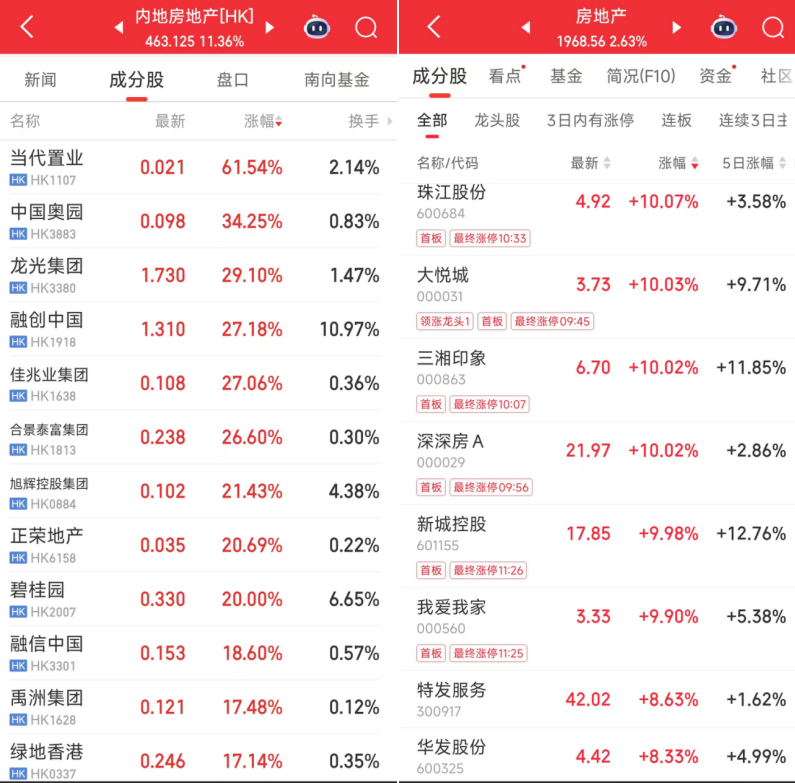
新京报贝壳财经讯(记者徐倩)1月29日,房地产板块集体爆发。港股内房股持续走强,截至今日收盘, 中国奥园上涨32.88%,融创中国上涨29.13%,富力地产上涨20.75%,佳兆业集团上涨20%,时代中国 控股上涨15.91%,越秀地产、万科企业也有较大幅度上涨。 A股房地产板块亦大幅拉升。截至收盘,新城控股(601155)、大悦城(000031)、珠江股份 (600684)、深深房A等涨停,滨江集团(002244)、华发股份(600325)、城投控股(600649)、万 科A等大涨。房地产ETF一度大涨近3%。 消息面上,据新京报贝壳财经昨日报道,多家房企相关人士表示,目前其所在公司已不被监管部门要求 每月上报"三条红线"指标。不过,部分出险房企被要求向总部所在城市专班组定期汇报企业动态。 ...
房地产开发板块1月29日涨2.89%,大悦城领涨,主力资金净流入12.25亿元
Zheng Xing Xing Ye Ri Bao· 2026-01-29 09:03
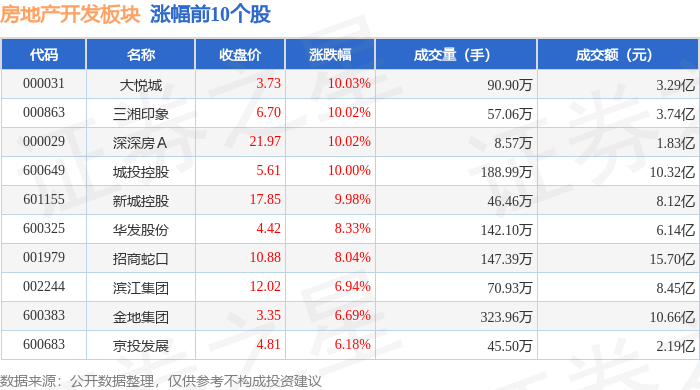
Market Performance - The real estate development sector increased by 2.89% compared to the previous trading day, with Dayuecheng leading the gains [1] - The Shanghai Composite Index closed at 4157.98, up 0.16%, while the Shenzhen Component Index closed at 14300.08, down 0.3% [1] Top Gainers in Real Estate Sector - Dayuecheng (000031) closed at 3.73, up 10.03% with a trading volume of 909,000 shares and a transaction value of 329 million [1] - Sanxiang Impression (000863) closed at 6.70, up 10.02% with a trading volume of 570,600 shares and a transaction value of 374 million [1] - Deep Shenzhen A (000029) closed at 21.97, up 10.02% with a trading volume of 85,700 shares and a transaction value of 183 million [1] - Chengdu Investment Holdings (600649) closed at 5.61, up 10.00% with a trading volume of 1,889,900 shares and a transaction value of 1.032 billion [1] - New Town Holdings (601155) closed at 17.85, up 9.98% with a trading volume of 464,600 shares and a transaction value of 812 million [1] Top Losers in Real Estate Sector - Yuehongyuan A (000573) closed at 4.44, down 8.45% with a trading volume of 1,597,200 shares and a transaction value of 719 million [2] - Hefei Urban Construction (002208) closed at 13.97, down 5.10% with a trading volume of 622,900 shares and a transaction value of 886 million [2] - Shunfa Hengneng (000631) closed at 4.09, down 4.66% with a trading volume of 718,800 shares and a transaction value of 302 million [2] Capital Flow in Real Estate Sector - The real estate development sector saw a net inflow of 1.225 billion in main funds, while retail funds experienced a net outflow of 598 million [2] - Main funds showed significant inflows in major companies such as Vanke A (000002) with a net inflow of 475 million, accounting for 15.58% [3] - Poly Development (600048) had a net inflow of 334 million, representing 10.82% of the total [3]




【每日收评】上证50涨超1.5%,资源类周期股延续强势,白酒、地产板块迎暴力反弹
Xin Lang Cai Jing· 2026-01-29 08:53
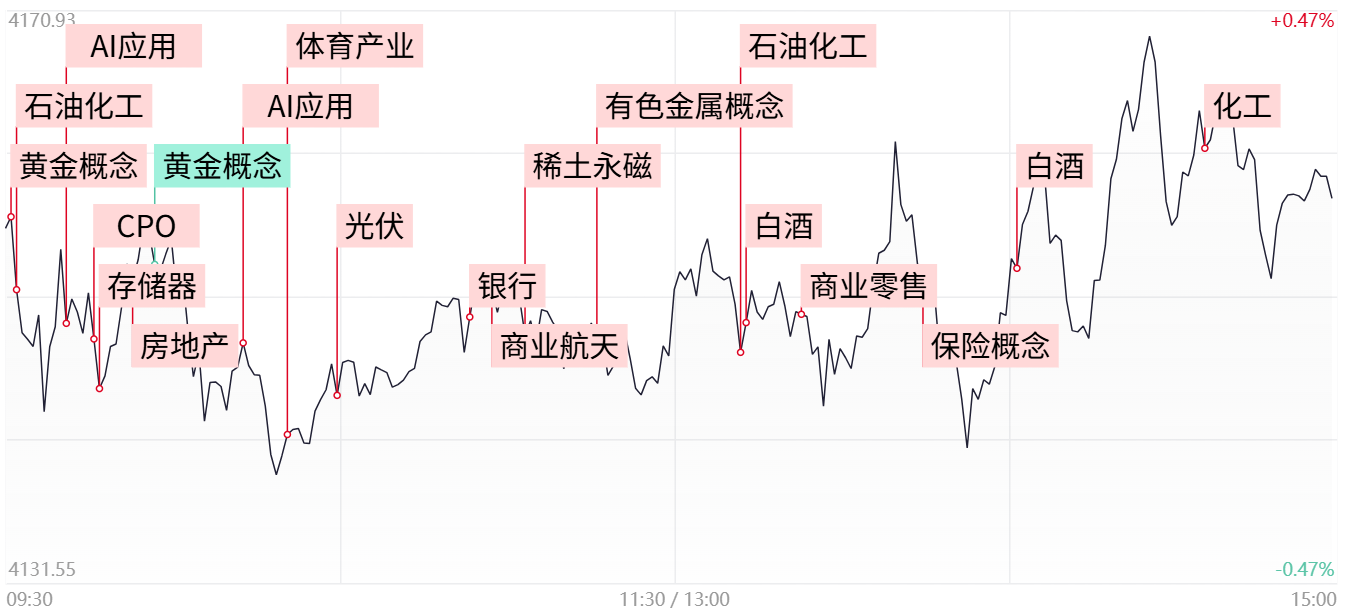
Market Overview - The three major indices showed mixed performance, with the Shanghai Composite Index experiencing slight fluctuations, the SSE 50 Index rising over 1%, while the ChiNext Index fell by over 3% [1] - The total trading volume in the Shanghai and Shenzhen markets reached 3.23 trillion yuan, an increase of 264.6 billion yuan compared to the previous trading day [1] - Over 3,500 stocks in the market declined, indicating a rapid rotation of market hotspots [1] Sector Performance - The liquor sector saw a significant surge in the afternoon, with stocks like Luzhou Laojiao, Shui Jing Fang, and Shede Liquor hitting the daily limit [1] - The non-ferrous metals sector remained active, with copper and precious metals leading the gains, and several companies like Western Gold and China Gold achieving consecutive daily limits [1] - The oil and gas sector continued its strong performance, with stocks like Intercontinental Oil and Zhongman Petroleum showing notable gains [1] - The real estate sector rebounded, with stocks such as Diyi City and I Love My Home hitting the daily limit [1] Individual Stock Highlights - Resource stocks, particularly in gold, continued to perform strongly, with companies like China Gold and Western Gold achieving multiple consecutive daily limits [5] - Copper stocks also strengthened, with the main copper futures contract rising over 6% to reach a new high [5] - The oil and gas sector saw active trading, with Intercontinental Oil achieving five daily limits in seven days [5] Future Market Analysis - The market is experiencing a notable shift in style, with funds moving from high-valuation growth stocks to low-valuation consumer and real estate stocks [3][7] - The liquor sector is expected to benefit from the upcoming Spring Festival demand, with reports indicating that some distributors have sold out their quotas of Moutai [2][3] - The overall market style transition is not expected to happen overnight, and the sustainability of the recent performance in value stocks remains to be observed [3][7] Industry Insights - The liquor industry is anticipated to see stable sales during the 2026 Spring Festival, supported by favorable demand conditions and the experience gained from leading companies [2] - The real estate sector is also showing signs of recovery, with easing pressures on leading companies and improved market expectations due to recent policy changes [2]
新城控股涨停,房地产ETF(512200)持续走强涨近4%,房地产行业迎来多重政策利好共振
Xin Lang Cai Jing· 2026-01-29 07:09
Core Viewpoint - The real estate sector is experiencing a significant recovery driven by regulatory optimization, policy benefits, and a shift towards high-quality development, leading to valuation restoration and structural reconfiguration opportunities. Group 1: Market Performance - As of January 29, 2026, the Real Estate ETF (512200) saw an intraday increase of nearly 4%, currently up by 3.09%, with a turnover rate of 16.92% and a transaction volume of 994 million yuan, indicating active market trading [1] - Key stocks in the index, such as Zhujiang Holdings, Tefa Services, and Dayuecheng, saw increases of 10.07%, 10.06%, and 10.03% respectively, reflecting strong performance in the sector [1] Group 2: Regulatory and Policy Environment - The cancellation of the monthly reporting requirements for the "three red lines" indicates a shift in regulatory focus from universal deleveraging to differentiated and refined control, allowing financially sound companies more operational freedom and improving the financing environment [1] - The extension of the financing "white list" for five years provides real estate companies with a buffer for cash flow, effectively alleviating liquidity pressures [2] - The initiation of commercial real estate REITs trials is expected to activate existing assets and reduce reliance on financing, contributing to a comprehensive support system for the industry [2] Group 3: Industry Outlook - Despite current pressures on sales and prices, the accelerated release of policy benefits is driving the industry away from high leverage and expansion towards a new phase of quality development focused on asset optimization and operational efficiency [2] - The Ministry of Finance and other departments have extended tax refund incentives for home purchases until the end of 2027, reducing transaction costs for improvement demand [2] - The central bank has lowered the down payment ratio for commercial properties from 50% to 30%, directly stimulating liquidity in the commercial market [2] - A "small spring" in the real estate market is emerging, with policy efforts and demand in core cities creating a positive feedback loop, leading to a rebound in the secondary housing market [2]
多股涨停!地产股集体冲高,房企告别“三道红线”监管
Nan Fang Du Shi Bao· 2026-01-29 06:25
Core Viewpoint - The real estate sector is experiencing a significant rebound in stock prices, with many companies seeing substantial gains, indicating a potential recovery in the market [1][2]. Group 1: Stock Performance - A-share real estate companies such as Zhujiang Holdings, Dayuecheng, Sanxiang Impression, and Shen Shen Fang A have risen over 10% [1]. - In the Hong Kong market, Contemporary Land has surged over 61%, while China Aoyuan and Longguang Group have increased by over 34% and 25%, respectively [1][2]. Group 2: Regulatory Changes - Reports indicate that some real estate companies are no longer required to report the "three red lines" indicators to regulatory authorities, which were previously mandatory since mid-2020 [2][3]. - The "three red lines" policy aimed to control leverage and prevent financial risks in real estate, with key metrics including asset-liability ratios and net debt ratios [3]. Group 3: Market Dynamics - The current market environment has led to a decline in funding for real estate companies, with a four-year average decrease of 17.5% in funds received, surpassing the 15.7% decline in new housing sales [4]. - The shift in the market has resulted in a focus on low-leverage, high-quality asset management by leading real estate firms, moving away from previous high-leverage expansion models [4][5]. Group 4: Future Financing Models - A new financing model is emerging, characterized by the "lead bank system," where a designated bank or syndicate oversees project financing, ensuring that funds are allocated appropriately [6]. - As of December 2025, 21 distressed real estate companies have undergone debt restructuring, with a total debt relief of approximately 1.2 trillion yuan, easing short-term repayment pressures [6].



一阳穿多阴!贵州茅台大涨超6%,房地产板块掀涨停潮
Mei Ri Jing Ji Xin Wen· 2026-01-29 06:22
Group 1 - The core viewpoint of the article highlights a strong performance in the liquor and real estate sectors, with Kweichow Moutai rising over 6% and other liquor stocks following suit, indicating a bullish trend in these cyclical industries [1] - The real estate sector also saw significant gains, with multiple companies such as Shenzhen Housing A and Joy City hitting the daily limit up, reflecting a positive market sentiment [1] - The Food and Beverage ETF (515170.SH) experienced an increase of over 4% during the trading session, driven by substantial single-day purchases, and it holds a basket of quality liquor stocks, with Kweichow Moutai and Luzhou Laojiao being major components [1] Group 2 - Recent regulatory changes indicate that many real estate companies are no longer required to report "three red lines" data monthly, which may ease operational pressures for these firms [1] - Historical trends show that the real estate and food and beverage sectors typically move in tandem, suggesting a potential for synchronized recovery [1] - The government has prioritized expanding domestic demand as a key task for 2026, aiming to stabilize the real estate market and potentially boost consumer demand, which could benefit both sectors [1]

突然,集体爆发!股市“大变局”,三大信号!
券商中国· 2026-01-29 05:38
Core Viewpoint - The real estate sector has experienced a significant surge in both A-shares and Hong Kong stocks, indicating a potential shift in market dynamics and investor sentiment [1][5][9]. Group 1: Real Estate Sector Performance - A-shares real estate ETF rose nearly 3%, while Hong Kong's property stocks surged over 6%, with notable increases in companies like Sunac China and Hongyang Real Estate, both rising over 20% [1][5]. - Specific stock performances included China Aoyuan up 27.4%, Sunac China up 23.3%, and Hongyang Real Estate up 22.58% [5][6]. - The overall performance of the real estate sector suggests a clean clearing of chips, with low valuations attracting investor interest [9]. Group 2: Market Dynamics and Signals - The rise in real estate stocks coincides with a notable increase in the liquor sector, indicating structural volatility in the market as these sectors are seen as lagging behind in previous downturns [1][9]. - The recent surge in commodities, including gold and copper, reflects heightened inflation expectations, which could impact sectors like AI negatively [2][9]. - The performance of 30-year treasury futures has been unexpectedly strong, suggesting a complex market narrative that does not align with traditional economic theories regarding inflation and bond prices [3][9]. Group 3: Policy and Regulatory Environment - Reports indicate that several real estate companies are no longer required to report "three red lines" metrics monthly, suggesting a more lenient regulatory environment [7]. - Analysts believe that recent policy adjustments, such as the reduction of the value-added tax on second-hand homes and the lowering of commercial property loan down payments, may support a stabilization in the real estate market [7].