
智元机器人

Search documents
投资者:产品必须围绕场景落地 三条技术路线并行竞速,各有瓶颈
Mei Ri Jing Ji Xin Wen· 2026-02-09 15:19
Core Viewpoint - The humanoid robot industry is shifting focus from entertainment to practical applications, with a significant increase in production expected in the coming years, driven by the need for robots to demonstrate real-world value rather than just perform on stage [1][3][4]. Industry Trends - The humanoid robot market is projected to see a shipment increase of over 650% in 2025, reaching approximately 18,000 units, and is expected to rise to 62,500 units in 2026 [3]. - The industry is moving past a phase of "wild growth," where mere performance was sufficient for sales, to a more mature phase where practical applications and real-world scenarios are essential for success [4][14]. Technology Development - Three main technical routes are emerging in the humanoid robot sector: VLA (Visual Language Action) model, world model, and layered decision-making with hardware-software collaboration, each with distinct advantages and challenges [7][9][10]. - The VLA model aims for general intelligence, relying on vast data for training, while the world model focuses on simulating physical environments to predict actions [9][10]. - The layered decision-making approach breaks down complex tasks into manageable components, enhancing reliability and efficiency in real-world applications [9][10]. Market Demand - There is a growing demand for robots that can operate in specific scenarios, such as factories and logistics, where they can perform tasks like assembly and packaging, thus providing tangible economic value [13][14]. - Users are increasingly looking for robots that can reduce production costs and alleviate humans from repetitive or hazardous tasks, indicating a shift towards practical applications [13][14]. Investment Focus - Investors are prioritizing companies that can demonstrate viable application scenarios and tangible products, moving away from those that lack a clear path to market [4][5]. - The consensus among investors is that companies must integrate their technology with real-world applications to avoid being sidelined in a competitive landscape [4][5]. Future Outlook - The next 3 to 5 years are critical for the practical deployment of humanoid robots, with expectations that they will increasingly complement human labor rather than replace it [13][19]. - The industry is expected to see rapid technological advancements, with a focus on improving the stability and reliability of robots in various operational environments [18][19].
投资者:产品必须围绕场景落地 三条技术路线并行竞速 各有瓶颈
Mei Ri Jing Ji Xin Wen· 2026-02-09 15:10
Core Viewpoint - The humanoid robot industry is transitioning from entertainment-focused applications to practical, value-creating roles in various sectors, with a significant increase in production expected in the coming years [1][2][3]. Industry Outlook - The humanoid robot shipment in China is projected to reach 18,000 units in 2025, a surge of over 650% compared to 2024, and is expected to rise to 62,500 units in 2026 [2]. - The industry is moving towards practical applications, with robots expected to perform tasks in factories, construction sites, and logistics warehouses, rather than just serving as performers [2][3]. Investment Trends - Investors are now prioritizing companies that can demonstrate real-world applications and stable products, moving away from those that lack a solid business model or rely on minimal teams [3][4]. - The focus has shifted from merely having advanced technology to ensuring that robots can effectively operate in real-world scenarios and generate economic value [4][12]. Technological Development - Three main technical paths are emerging in the humanoid robot sector: VLA (Visual Language Action) model, world model, and layered decision-making with hardware-software collaboration [6][8]. - The VLA model aims for general intelligence, allowing robots to understand and execute complex commands, but faces challenges in computational demands and data requirements [6][7]. - The world model approach, exemplified by Tesla, focuses on creating a digital simulation of the physical world to predict actions and outcomes, reducing reliance on real-world data [8]. - The layered decision-making approach breaks down tasks into manageable components, enhancing reliability and efficiency in real-world applications [8][15]. Market Dynamics - The industry is witnessing a shift towards practical applications, with a growing demand for robots that can operate in specific environments and perform tasks like assembly and logistics [12][16]. - The market is increasingly focused on B2B solutions, where robots can work alongside humans without requiring significant infrastructure changes [16][18]. Future Trends - The next 3 to 5 years are critical for the deployment of robots in specific scenarios, with an emphasis on enhancing their operational capabilities and reliability [12][17]. - The industry is expected to see a convergence of technology paths, with a focus on integrating hardware and software to improve performance and adaptability [17][18]. - There is a growing trend towards domestic production of key components, which will support the development of more cost-effective and efficient robotic solutions [18].
机器人的春晚战事:有人氪金 有人“手搓”
Bei Jing Shang Bao· 2026-02-09 15:02
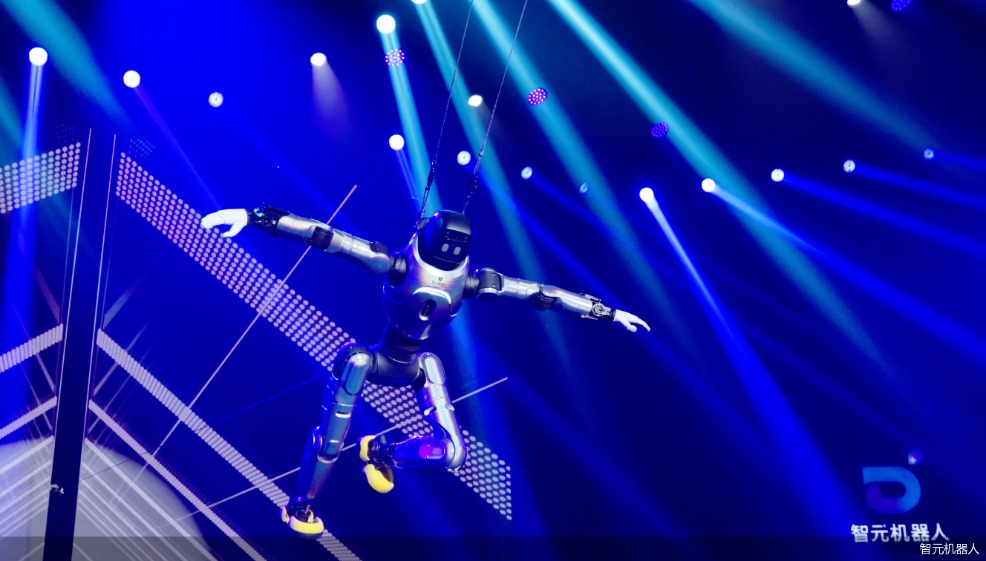
关于"机器人春晚"的一切,起源于一个想法,和一堆待解的问题。 2025年12月下旬,在确认全年销售额与发展目标均顺利达成后,一个颇为大胆也颇有难度的念头在智元机器人内部悄然成形,团队希望用行 业独有的方式庆祝成果,也向客户伙伴、大众表达谢意。 "所以,办一场完全由机器人主导的晚会,成了这个想法最直接的落地方式。"智元机器人CMO邱恒告诉北京商报记者。 在那之后,邱恒新添了一层身份——《机器人奇妙夜》总监制。2月8日晚8点,这场全球首个大型机器人晚会如期开播,200多台涵盖人形、 四足等多个系列的机器人,在武术、小品、魔术等不同类型的节目中轮番献艺。 由于形式和规模几乎都是全球首创,没有太多现成案例可供参考,很多节目都是智元抱着"试一试"的心态设计摸索、边打磨边调整。吊威 亚、耍火棍、演小品、变魔术,这些人类晚会上的常见形式,被团队搬到了机器人的舞台上,甚至台下的观众也是硅基生命。 总时长约一小时的晚会在全体机器人谢场后落幕,但将视野放宽至整个"春节档",智元登台只是大戏的一章——在此之前,魔法原子、银河 通用、宇树科技、松延动力4家具身智能企业已先后确认将登上央视马年春晚舞台,创下春晚历史上机器人品牌集中亮相 ...


机器人的春晚战事:有人氪金,有人“手搓”
Bei Jing Shang Bao· 2026-02-09 14:46
"所以,办一场完全由机器人主导的晚会,成了这个想法最直接的落地方式。"智元机器人CMO邱恒告诉北京商报记者。 在那之后,邱恒新添了一层身份——《机器人奇妙夜》总监制。2月8日晚8点,这场全球首个大型机器人晚会如期开播,200多台涵盖人形、四足等多个系列 的机器人,在武术、小品、魔术等不同类型的节目中轮番献艺。 关于"机器人春晚"的一切,起源于一个想法,和一堆待解的问题。 2025年12月下旬,在确认全年销售额与发展目标均顺利达成后,一个颇为大胆也颇有难度的念头在智元机器人内部悄然成形,团队希望用行业独有的方式庆 祝成果,也向客户伙伴、大众表达谢意。 由于形式和规模几乎都是全球首创,没有太多现成案例可供参考,很多节目都是智元抱着"试一试"的心态设计摸索、边打磨边调整。吊威亚、耍火棍、演小 品、变魔术,这些人类晚会上的常见形式,被团队搬到了机器人的舞台上,甚至台下的观众也是硅基生命。 总时长约一小时的晚会在全体机器人谢场后落幕,但将视野放宽至整个"春节档",智元登台只是大戏的一章——在此之前,魔法原子、银河通用、宇树科 技、松延动力4家具身智能企业已先后确认将登上央视马年春晚舞台,创下春晚历史上机器人品牌集中亮相 ...
200多台机器人上演“硅基春晚” 全网播放量已破500万
Zheng Quan Ri Bao Wang· 2026-02-09 12:49
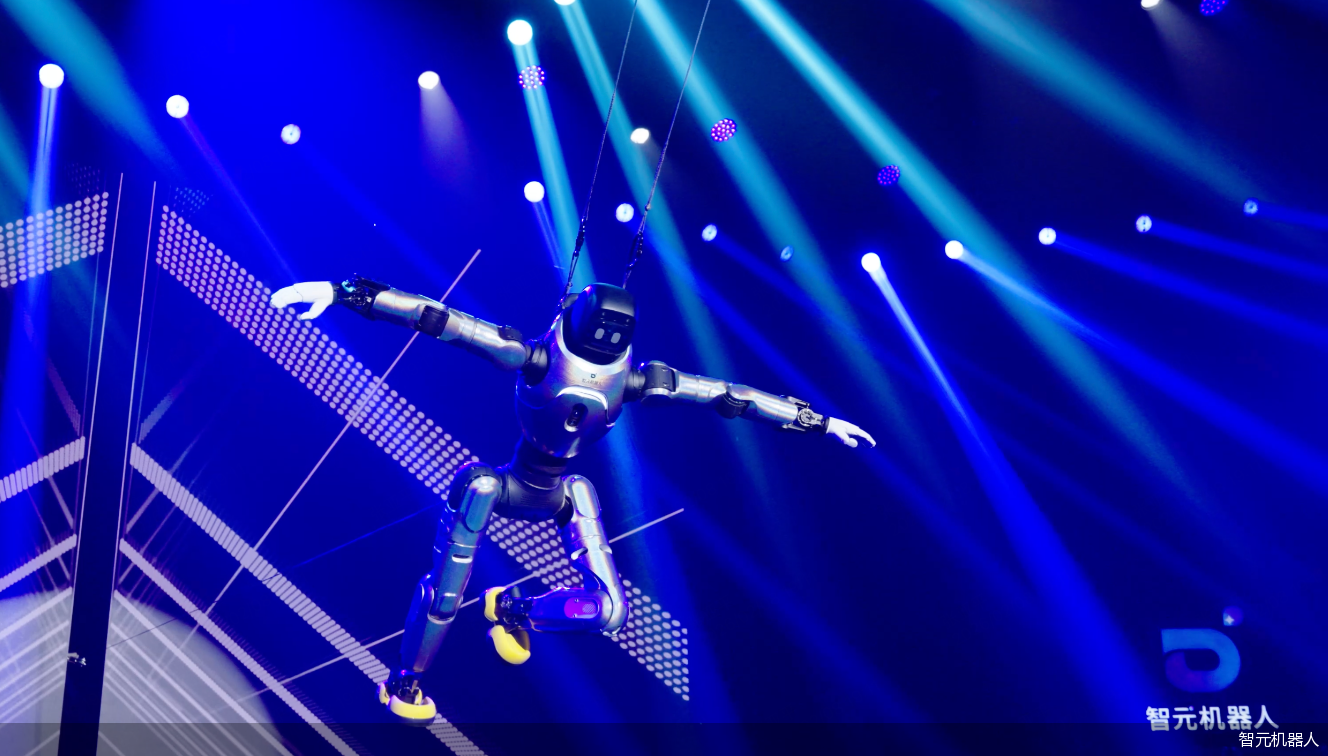
Core Viewpoint - The event "Robot Wonderful Night" showcased the capabilities of humanoid robots in a performance setting, highlighting their potential for commercial applications and audience engagement [1][3]. Group 1: Event Overview - The event featured over 200 robots performing various acts, including dance and martial arts, with a total online viewership exceeding 5 million [1][2]. - The performance included innovative segments such as a group dance with 24 robots and a robot-hosted program that demonstrated emotional expressions [2]. - The event aimed to promote the artistic and functional aspects of robots, with plans to develop it into a long-term intellectual property for various applications [3]. Group 2: Industry Insights - There has been a noticeable increase in professionals entering the robotics field, particularly in embodied intelligence, indicating a rapid acceleration in the industry [4]. - The next 3 to 5 years are expected to be a golden window for the development of robotics and embodied intelligence, focusing on transforming technological breakthroughs into measurable commercial value [4]. - The demand for robot rentals has surged, with a reported 30% increase in orders during a specific week, driven by corporate events and tourism [3].
马斯克「吹爆」中国AI:美国将不战而败?
创业邦· 2026-02-09 10:37
Core Viewpoint - Elon Musk expresses admiration for China's manufacturing capabilities and energy infrastructure, suggesting that without significant innovation, the U.S. may fall behind in AI and robotics, particularly in the context of a potential SpaceX IPO and the establishment of a space-based computing center [5][27]. Group 1: AI and Energy Infrastructure - Musk believes that the efficiency of solar energy generation in space could be five times greater than on Earth, which could address power shortages faced by U.S. data centers [7][13]. - He highlights that the U.S. is experiencing power shortages due to outdated infrastructure, while China's energy supply is more stable and efficient, making it a competitive advantage in AI development [7][11]. - Musk warns that without breakthrough innovations, China could surpass the U.S. in AI and robotics, as both countries are the primary players in this field [8][13]. Group 2: Robotics and Manufacturing - Musk identifies robots with full autonomy as crucial for the U.S. to regain its competitive edge in productivity against China, which is advancing in smart factory deployments [15][17]. - Data from the International Federation of Robotics indicates that by 2024, China will account for over 50% of global industrial robot installations, with significant growth projected for 2025 [17][18]. - In the humanoid robot sector, Chinese companies are leading, with significant market shares and production capabilities compared to Tesla's Optimus, which is still in testing phases [18][20]. Group 3: Space Computing Center Challenges - Musk's vision for a space-based computing center faces numerous challenges, including heat dissipation and maintenance logistics in space, which could complicate the feasibility of such a project [23][25]. - The ambitious timeline set by Musk for resolving these issues within 30 months raises skepticism about the practicality of the plan [25]. - The competition between the U.S. and China in technology is evolving beyond just chips to encompass energy, manufacturing, aerospace, and AI, indicating a broader strategic rivalry [27].


金固股份(002488):深耕车轮制造30年,向“新材料科技平台”战略升级
NORTHEAST SECURITIES· 2026-02-09 06:45
Investment Rating - The report maintains a "Buy" rating for the company [4][5][6] Core Insights - The company has developed a revolutionary new material, Avatar Niobium Microalloy, which offers high strength, good toughness, low cost, and reduced carbon emissions, marking a new era for high-performance wheel hubs [1][16] - The company is transitioning from a "single product supplier" to a "new materials technology platform," aligning with national policies promoting high-end, intelligent, and green manufacturing [16] - The company is rapidly expanding its production capacity both domestically and internationally, with significant projects in collaboration with major automotive manufacturers [2][31] Summary by Sections 1. Company Overview and Strategy - The company has been deeply involved in wheel manufacturing for 30 years and is now upgrading its strategy to focus on new materials technology [16] - The Avatar Niobium Microalloy is being mass-produced and has broad application potential, effectively replacing traditional steel and aluminum wheels [1][3] 2. Production Capacity and Market Expansion - The company is accelerating capacity expansion through new production lines in various domestic locations and overseas, particularly in Thailand [2][31] - The customer base is continuously optimizing, with deepening collaborations with major domestic automakers like BYD and Chery [2] 3. New Market Opportunities - The company is expanding into the two-wheeler and robotics markets, leveraging its technology and experience from the four-wheeler sector [3][21] - Strategic partnerships have been established with companies in the electric two-wheeler and robotics sectors, indicating potential for significant future contributions [3][21] 4. Financial Projections - The company is expected to achieve net profits of 0.67 billion, 2.41 billion, and 4.60 billion yuan from 2025 to 2027, with corresponding P/E ratios of 197.30X, 55.20X, and 28.92X [4][5] - Revenue is projected to grow significantly, with a forecasted increase from 3.36 billion yuan in 2024 to 7.84 billion yuan in 2027 [5][6] 5. Product and Market Trends - The wheel hub industry is experiencing a shift towards lightweight, energy-saving, and aesthetically designed products, driven by environmental concerns and regulatory changes [64][65] - The global wheel hub market is expected to grow from 28.1 billion USD in 2024 to 35 billion USD by 2032, with a CAGR of approximately 2.78% [58][60]

IDC:2025年全球人形机器人出货量接近1.8万台 同比增长约508%
Zhi Tong Cai Jing· 2026-02-09 05:50
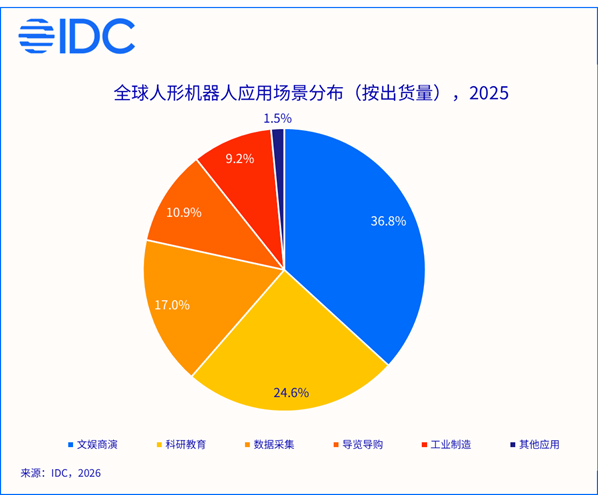
Core Insights - The global humanoid robot market is set to reach a significant scale in 2025, with an expected shipment of nearly 18,000 units, representing a year-on-year growth of approximately 508%, and sales revenue projected at around $440 million [1] - Chinese manufacturers are leading the market with a robust manufacturing system, rapid iteration capabilities, and cost advantages, establishing a dominant position globally [2] - The market is primarily driven by bipedal humanoid robots, which contribute 66.3% of the total sales revenue, with full-sized bipedal robots accounting for 41.6% of the sales [3] Market Dynamics - In 2025, the demand for humanoid robots is mainly driven by applications in entertainment, education, and data collection, emphasizing display effects and interactive experiences [4] - The industry is transitioning from one-time hardware sales to a model that includes Robot as a Service (RaaS), operational services, and a platform ecosystem, creating conditions for scalable applications and sustained revenue [6] Technological Advancements - Humanoid robots are advancing towards engineering and scalable applications, with a focus on enhancing intelligent collaboration capabilities [7] - The integration of upper limb dexterity and the fusion of cognitive models are key breakthroughs that will enhance autonomous operations and human-robot collaboration [7]
周期淬炼龙头韧性,永臻股份多维蓄力拓新程
Quan Jing Wang· 2026-02-09 05:42
Core Viewpoint - The photovoltaic industry is undergoing a phase of adjustment, and companies are focusing on how to navigate through cycles, accumulate momentum, and explore new opportunities [1] Group 1: Company Performance - Yongzhen Co., a leading manufacturer of aluminum alloy structural components, expects a net profit of -235 to -175 million yuan for 2025, reflecting the industry's overall performance during this cyclical adjustment [1] - Despite the challenging environment, Yongzhen has expanded its market share in the photovoltaic sector, leveraging its advantages in cost control, financial strength, and capacity layout [1] Group 2: Strategic Initiatives - Yongzhen's strategic initiatives include a stock incentive plan with clear shipment targets, indicating management's confidence in the long-term growth prospects of its photovoltaic business [1] - The company has established a production base in Vietnam, which has significantly higher profitability compared to domestic operations, and is expected to contribute strong profit potential moving forward [2] Group 3: Diversification and New Ventures - Yongzhen's acquisition of Zhejiang Jienow Automotive Lightweight Technology Co. allows it to enter the thermal management liquid cooling sector, expanding its applications in electric vehicle battery trays and liquid cooling systems [3] - The company is also investing in a new energy storage project in Inner Mongolia, which is expected to benefit from stable revenue models and long-term policy support [3] Group 4: Emerging Technologies - Yongzhen is becoming a key supplier in the humanoid robotics sector, leveraging its expertise in aluminum alloy materials to supply critical components [4] - The company plans to collaborate with downstream clients to innovate new materials for robotics, positioning itself for future growth as the industry moves towards mass production [4] Group 5: Industry Outlook - The photovoltaic industry is expected to recover as supply-demand structures improve through capacity control, price stabilization, and innovation [1] - Yongzhen's diverse business layout and strategic foresight are being re-evaluated in the context of energy transition and industrial upgrades, providing a model for other companies navigating similar challenges [4]
2025年全球人形机器人出货量近1.8万台 智元、宇树等中企产品占据主导
Feng Huang Wang· 2026-02-09 04:50
Core Insights - The global humanoid robot shipment is projected to reach nearly 18,000 units by 2025, representing a year-on-year growth of approximately 508%, with a market size of around $440 million [1] - Cumulative order volume is expected to exceed 35,000 units during the same period [1] Company Landscape - Chinese companies dominate the shipment volume, with Zhiyuan Robotics and Yuzhu Technology each shipping around 5,000 units [1] - Other companies such as Leju Robotics, Accelerated Evolution, and Songyan Power shipped approximately 1,000 units each [1] - Companies like Galaxy General, UBTECH, Zhongqing Robotics, and Stardust Intelligence shipped between 400 to 1,000 units [1] - Emerging companies including Xingdong Jiyuan, Magic Atom, Beijing Humanoid Robot Innovation Center, Xinghai Map, Mojia Zhichuang, and Zhujiji Power achieved shipments of over 100 units [1] - In contrast, international firms like Apptronik and Figure AI are still in pilot testing phases, with shipment volumes in the tens [1] - Tesla's humanoid robot is expected to begin large-scale production in 2026 [1] Product Form Factor - Bipedal robots (including full-size and small-to-medium size) contribute to 66.3% of market sales [1] - Full-size humanoid robots account for the highest sales proportion at 41.6%, with Zhiyuan Robotics leading in this segment [1] Industry Analysis - IDC analysis indicates that Chinese manufacturers hold a first-mover advantage in the current stage of humanoid robot commercialization due to a complete industrial chain, rapid iteration capabilities, and cost advantages [1] - Future industry competition is expected to shift from hardware sales to dimensions such as technical services and ecosystem development [1]
