
甘源食品

Search documents
休闲食品行业专题报告之一:大浪淘沙,沉者为金
Guoxin Securities· 2025-11-11 11:18
Investment Rating - The report maintains an "Outperform" rating for the leisure food industry and specific companies such as Wei Long Mei Wei, Yan Jin Pu Zi, Jin Zai Food, and Wan Chen Group [4][5]. Core Insights - The leisure food market in China is projected to reach 1.344 trillion yuan in 2024, with a year-on-year growth of 5.3% and a CAGR of 4.4% from 2019 to 2024, expected to increase to 5.5% from 2025 to 2029 [1][15]. - The industry is characterized by a highly fragmented competitive landscape, with the top five and ten companies holding only 5.9% and 10.4% of the market share, respectively [1][22]. - Structural changes are reshaping the industry, including the rise of new retail channels, increased health consciousness among consumers, vertical integration in supply chains, and accelerated globalization efforts by leading companies [1][2][33]. Summary by Sections Industry Overview - The leisure food sector is a multi-billion market with diverse product categories, including snacks, nuts, and baked goods, focusing on fulfilling various consumer needs beyond mere hunger [15][18]. - The market is expected to continue expanding, with significant room for growth in per capita consumption, currently at 954.4 yuan, which is substantially lower than in the US and Japan [2][15]. Competitive Landscape - The industry is marked by intense competition and low concentration, with major players like Mars and Mondelez holding a small market share compared to their counterparts in the US [22][23]. - The competitive dynamics are shifting from price wars to differentiation and efficiency battles, as consumer demands become more diverse and nuanced [2][3]. Structural Changes - New retail formats such as bulk snack stores and instant retail are emerging, challenging traditional retail channels [33][34]. - Health awareness is driving innovation in product offerings, with a notable rise in demand for healthier snack options like konjac products, which are low in calories and high in dietary fiber [66][70]. Future Outlook - The report identifies three core drivers for industry growth: product innovation, scenario extension, and international expansion [2][3]. - Leading brands are expected to strengthen their market positions, with opportunities for both manufacturing and channel-focused companies to benefit from evolving consumer preferences and retail dynamics [2][3][4]. Company-Specific Insights - Wei Long Mei Wei and Yan Jin Pu Zi are highlighted as key players in the konjac snack segment, with significant revenue growth anticipated [3][70]. - Jin Zai Food is undergoing channel reforms and launching new products, while Wan Chen Group is expanding its discount supermarket presence, indicating potential for long-term growth [3][4].
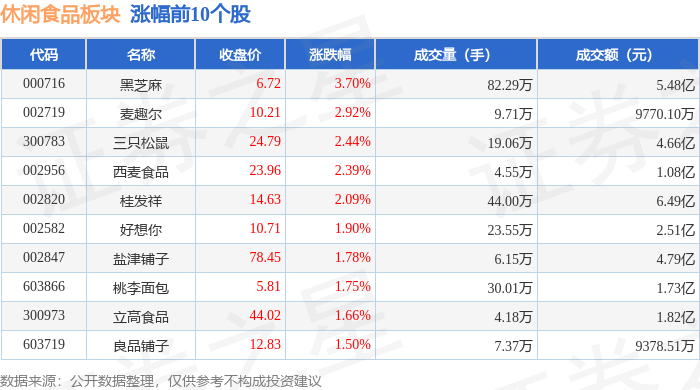
休闲食品板块11月11日涨0.93%,黑芝麻领涨,主力资金净流入3460.97万元
Zheng Xing Xing Ye Ri Bao· 2025-11-11 08:37
Market Overview - The leisure food sector increased by 0.93% on November 11, with Hei Zhima leading the gains [1] - The Shanghai Composite Index closed at 4002.76, down 0.39%, while the Shenzhen Component Index closed at 13289.0, down 1.03% [1] Stock Performance - Hei Zhima (000716) closed at 6.72, up 3.70% with a trading volume of 822,900 shares and a transaction value of 548 million [1] - Other notable performers include: - Mai Jiao Er (002719) at 10.21, up 2.92% [1] - San Zhi Song Shu (300783) at 24.79, up 2.44% [1] - Xi Mai Food (002956) at 23.96, up 2.39% [1] - Gui You Xiang (002820) at 14.63, up 2.09% [1] Capital Flow - The leisure food sector saw a net inflow of 34.61 million from main funds, while retail funds experienced a net outflow of 25.13 million [2] - The main funds' net inflow for Hei Zhima was 39.29 million, representing 7.17% of its total trading volume [3] - San Zhi Song Shu had a main fund net inflow of 30.52 million, accounting for 6.55% of its trading volume [3] Individual Stock Analysis - Hei Zhima experienced a significant net outflow from retail investors of 42.06 million, indicating a divergence in investor sentiment [3] - San Zhi Song Shu also faced a retail net outflow of 26.17 million, suggesting potential concerns among smaller investors [3] - Other stocks like Yan Jin Pu Zi (002847) and Xi Mai Food (002956) showed mixed capital flows, with Yan Jin Pu Zi having a net inflow from main funds of 13.91 million [3]


消费赛道复苏预期升温 多只消费股估值具备优势
Zheng Quan Shi Bao· 2025-11-10 23:10
Core Viewpoint - The consumer sector is experiencing a collective rebound, driven by government policies aimed at boosting consumption and supporting key industries [1][3]. Group 1: Market Performance - As of November 10, 2023, various consumer indices, including food and beverage, beauty care, and retail, have shown less than 10% growth year-to-date, underperforming the Shanghai Composite Index [2]. - The food and beverage sector has been the weakest performer, with its index in a downward trend for the year [2]. Group 2: Institutional Outlook - Institutions are becoming increasingly optimistic about the future performance of the consumer sector, with several brokerages identifying potential investment opportunities [3]. - Open Source Securities notes that the food and beverage sector is nearing a bottom, with recovery expectations rising as negative factors have largely been released and policy impacts are slowing [3]. - Huachuang Securities highlights that service consumption is in a transformative phase, with strong policy support expected to make it a key investment theme [3]. - Galaxy Securities emphasizes the importance of enhancing consumer power and expanding quality consumption supply during the 14th Five-Year Plan period, as new consumption trends emerge [3]. Group 3: Valuation and Stock Performance - Many consumer stocks are currently seen as undervalued, with 123 stocks having a rolling P/E ratio below 30 and underperforming the Shanghai Composite Index year-to-date [4]. - Notable large-cap stocks include Kweichow Moutai, Midea Group, and Wuliangye, among others [4]. - 23 stocks have seen a cumulative decline of over 10% this year, with Ganyuan Food experiencing the largest drop at 33.79% [4]. Group 4: Future Growth Potential - From an institutional perspective, 43 of the 123 identified consumer stocks have an upside potential exceeding 20% based on consensus target prices [5]. - Proya Cosmetics leads with a projected upside of 49.05%, supported by its international expansion plans [5]. - Xueda Education follows with an expected upside of 48.6%, driven by its clear business expansion strategy in personalized education [5][6].






消费赛道复苏预期升温多只消费股估值具备优势
Zheng Quan Shi Bao· 2025-11-10 18:20
Core Viewpoint - The consumer sector is experiencing a collective rebound, driven by government policies aimed at boosting consumption and supporting key industries [1][3]. Group 1: Market Performance - As of November 10, 2023, various consumer indices, including food and beverage, beauty care, and retail, have shown less than 10% growth year-to-date, underperforming the Shanghai Composite Index [2]. - The food and beverage sector has been the weakest performer, with its index in a downward trend for the year [2]. Group 2: Institutional Optimism - Institutions are gradually becoming optimistic about the future performance of the consumer sector, with several brokerages identifying potential investment opportunities [3]. - Open Source Securities notes that the food and beverage sector is nearing a bottom, with recovery expectations rising as negative factors have largely been released and policy impacts are slowing [3]. - Huachuang Securities highlights that service consumption is in a transformative phase, supported by strong policy guidance, making it a promising investment focus [3]. - Galaxy Securities emphasizes the importance of enhancing consumer power and expanding quality supply during the 14th Five-Year Plan period, with new consumption trends emerging as key growth points [3]. Group 3: Valuation Advantages - Many consumer stocks currently exhibit valuation advantages, with 123 stocks having a rolling P/E ratio below 30 and underperforming the Shanghai Composite Index year-to-date [4]. - Notable large-cap stocks include Kweichow Moutai, Midea Group, and Wuliangye, among others [4]. - 23 stocks have seen a cumulative decline of over 10% this year, with Ganyuan Food experiencing the largest drop at 33.79% [4]. Group 4: Upside Potential - From an institutional perspective, several consumer stocks with low rolling P/E ratios have significant upside potential, with 43 stocks projected to rise over 20% [5]. - Proya Cosmetics leads with a projected upside of 49.05%, supported by its international expansion plans [5]. - Xueda Education follows with an expected increase of 48.6%, driven by its clear business expansion strategy in personalized education [5][6].
拟终止重大资产重组,300950,“一”字跌停!大消费板块集中爆发,低估值滞涨股揭晓
Zheng Quan Shi Bao Wang· 2025-11-10 10:33
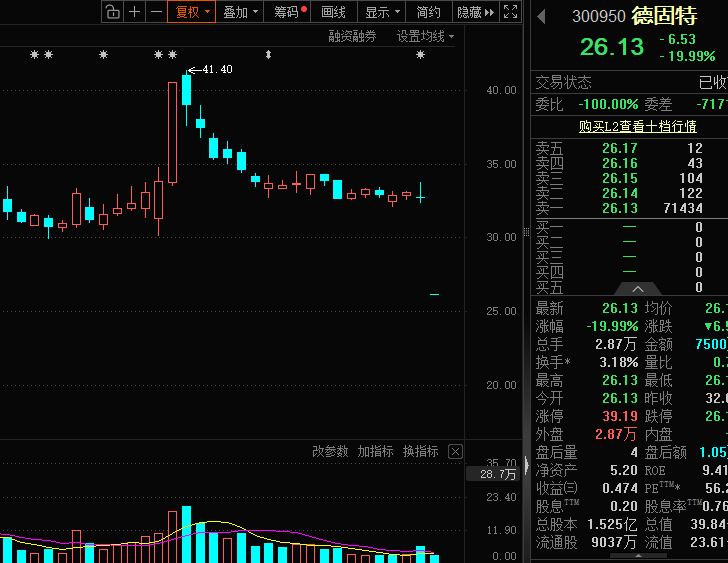
Group 1: Company Developments - DeguTech (300950) experienced its first "limit down" since its listing, closing with a drop of 7.14 million shares, primarily due to the potential termination of a significant asset restructuring plan [1][3] - On November 6, DeguTech announced it would discuss terminating the major asset restructuring transaction after receiving feedback from Haowei Cloud Computing Technology Co., Ltd., indicating difficulties in meeting the demands of all parties involved [3] Group 2: Market Performance - On November 10, the Shanghai Composite Index closed up 0.53%, surpassing the 4000-point mark, with the consumer sector showing strong performance across various sub-industries, including beauty care, food and beverage, retail, and tourism [4] - The beauty care sector leader, Aimeike, saw an intraday increase of over 8%, closing with a gain of 4.92%. The food and beverage sector also had notable performers, with Huanlejia hitting a "limit up" [4] Group 3: Consumer Sector Analysis - As of November 10, the food and beverage, beauty care, and retail sectors have shown underperformance, with year-to-date index gains of less than 10%, lagging behind the Shanghai Composite Index [6] - The food and beverage industry has been particularly weak, with its index ranking at the bottom among all industry indices, indicating a potential opportunity for investment as the sector approaches a recovery phase [6] Group 4: Low PE Stocks - A total of 123 consumer stocks with rolling P/E ratios below 30 and year-to-date performance lagging behind the Shanghai Composite Index have been identified, including major companies like Kweichow Moutai and Gree Electric [7][8] - Among these, 43 stocks are projected to have over 20% upside potential based on institutional forecasts, with companies like Perla and Xueda Education showing significant expected growth [9][10]
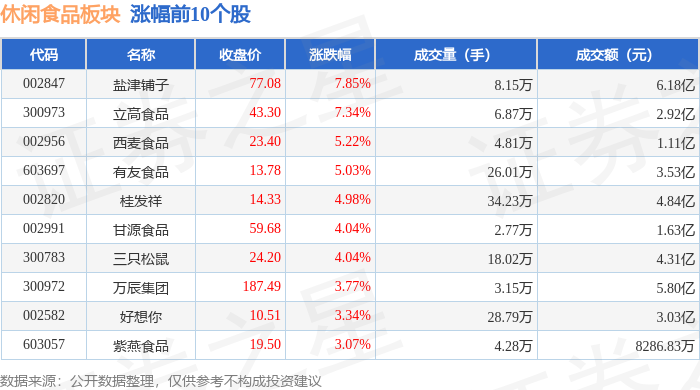
休闲食品板块11月10日涨3.63%,盐津铺子领涨,主力资金净流入1.99亿元
Zheng Xing Xing Ye Ri Bao· 2025-11-10 08:48
Core Insights - The leisure food sector experienced a significant increase of 3.63% on November 10, with Yanjinpuzi leading the gains [1] - The Shanghai Composite Index closed at 4018.6, up 0.53%, while the Shenzhen Component Index closed at 13427.61, up 0.18% [1] Sector Performance - Yanjinpuzi (002847) saw a closing price of 77.08, with a rise of 7.85% and a trading volume of 81,500 shares, amounting to a transaction value of 618 million yuan [1] - Ligao Food (300973) closed at 43.30, increasing by 7.34% with a trading volume of 68,700 shares, totaling 292 million yuan [1] - Ximai Food (002956) closed at 23.40, up 5.22%, with a trading volume of 48,100 shares and a transaction value of 111 million yuan [1] - Youyou Food (603697) closed at 13.78, increasing by 5.03% with a trading volume of 126,010 shares, amounting to 353 million yuan [1] - Guifaxiang (002820) closed at 14.33, up 4.98%, with a trading volume of 342,300 shares and a transaction value of 484 million yuan [1] Capital Flow - The leisure food sector saw a net inflow of 199 million yuan from main funds, while retail investors experienced a net outflow of 213 million yuan [1] - Youyou Food (603697) had a main fund net inflow of 39.92 million yuan, but retail investors had a net outflow of 37.03 million yuan [2] - Guifaxiang (002820) recorded a main fund net inflow of 34.32 million yuan, with retail investors seeing a net outflow of 51.87 million yuan [2] - Sanzi Songshu (300783) had a main fund net inflow of 30.50 million yuan, while retail investors faced a net outflow of 36.72 million yuan [2]

太原市市场监督管理局关于2025年第4期“你点我检 服务惠民生”食品安全专项监督抽检情况的通告
Zhong Guo Zhi Liang Xin Wen Wang· 2025-11-10 08:13
Core Points - The announcement details the results of the food safety supervision sampling conducted by the Taiyuan Market Supervision Administration, indicating that all 140 samples from seven categories of food passed inspection [2][3][4]. Group 1: Food Safety Supervision - The "You Point, I Check" initiative allows consumers to suggest food categories for inspection, reflecting a consumer-driven approach to food safety [2]. - The sampling covered seven categories: health foods, grain products, nut products, condiments, dairy products, meat products, and edible oils, totaling 140 samples [2][3]. - All tested samples were found to be compliant with safety standards, indicating a positive outcome for food safety in the region [2][4]. Group 2: Sample Details - The announcement includes a detailed list of sampled products, including their manufacturers, specifications, and production dates, ensuring transparency in the inspection process [3][4]. - Notable products sampled include various types of flour, dairy products, and condiments from well-known manufacturers such as Hebei Jingsha River Flour Group and Lee Kum Kee [3][4]. - The inspection results contribute to consumer confidence in food safety and quality in Taiyuan [2][3].
甘源食品“增收不增利” 盈利下滑背后面临多重挑战
Xin Lang Cai Jing· 2025-11-07 10:32
Core Insights - Ganyuan Foods reported a total revenue of 1.533 billion yuan for the first three quarters of 2025, a year-on-year decline of 4.53%, and a net profit attributable to shareholders of 156 million yuan, down 43.66% year-on-year [1][4] Revenue Performance - In Q3, Ganyuan Foods experienced a positive revenue growth, marking a turning point after a decline in the first half of the year, although the overall revenue decline for the first three quarters has significantly narrowed [2] - The growth in Q3 was primarily driven by the launch of new products and the collaboration with high-potential channels, with online channels becoming a crucial focus [2][3] - The company has seen success in its differentiated layout for membership stores and bulk snack channels, with specific products achieving significant online sales [2] Challenges in Traditional Business - Despite the positive growth in new channels, traditional products like green peas and sunflower seeds continue to see revenue declines, with traditional retail channels still undergoing adjustments [3] - The overall decline in traditional channels remains a major factor affecting total revenue, and while new channels are growing rapidly, their scale is still limited and cannot provide comprehensive support in the short term [3] Profitability Issues - Ganyuan Foods faced a stark contrast between revenue growth and a significant drop in net profit, attributed to the phase of investment in new product development and channel expansion that has not yet translated into substantial profits [4] - Rising costs, particularly from core raw materials like palm oil, have exerted continuous pressure on profitability, compounded by increased sales expenses that have not yielded the expected results [4] - The company is transitioning from a distribution model to a direct sales model, with a net increase of 354 distributors, but terminal sales have simultaneously slowed down [4] Competitive Landscape - The competitive environment in the snack food market is intensifying, with leading companies and emerging brands capturing market share through scale advantages and channel networks [5] - The homogenization of products in the snack wholesale sector poses challenges for Ganyuan Foods, as its new product differentiation is under scrutiny, and new series like health beans are still in the testing phase [5] - While Q3 revenue growth is a positive sign, the significant drop in net profit raises concerns about the balance between high investment and returns, as well as the need for traditional channels to recover [5]

甘源食品:公司进一步加深与零食量贩店、商超会员店等系统合作
Zheng Quan Ri Bao Zhi Sheng· 2025-11-07 10:17
Core Viewpoint - Ganyuan Foods announced on November 7 that it has deepened cooperation with snack wholesale stores and supermarket membership stores during the third quarter, promoting the launch of new products [1] Group 1: Sales and Growth Strategies - The company is focusing on expanding its sales scale by enhancing collaboration with traditional supermarkets and developing new business models such as online e-commerce, short videos, live streaming, and partnerships with online distributors [1] - The overall sales scale of the company has further expanded during the reporting period [1]
甘源食品:公司第三季度营业收入同比以及环比均有所提升
Zheng Quan Ri Bao Zhi Sheng· 2025-11-07 10:07
Core Viewpoint - Ganyuan Food reported an increase in both year-on-year and quarter-on-quarter revenue for the third quarter, along with an improvement in the non-net profit margin compared to the first half of the year, despite a decline in net profit due to investments in new product promotion and channel expansion [1] Financial Performance - The third quarter revenue showed a year-on-year and quarter-on-quarter increase [1] - The non-net profit margin improved compared to the first half of the year [1] - Net profit decreased in the third quarter primarily due to initial investments in business expansion [1] Business Strategy - The company is focusing on nurturing future growth points through investments in new product promotion and channel expansion [1] - New products, while having market potential, are still in the early stages of promotion and have not yet achieved scale [1] - The company plans to accelerate the pace of new product launches across various channels and improve market penetration [1]