Canva

Search documents
"Cherry Blossoms" Bloom of IPO Spring: Klarna Debut, Trends & IPOs to Come
Youtube· 2025-09-10 16:01
Time now to spotlight the IPO pipeline, state of the IPO market with Clara set to make its debut here at the big board. Joining us now is Jim Niss, managing partner at Connor Group. Jim, thank you so much for joining us here. Diane, thank you.All right, so let's talk about this IPO. Got a little bag of goodies here from Clara representing on the floor today. Um, I didn't have to put that on BNPL.Uh so look, it's one of the most anticipated IPOs this year coming in at a roughly $15 billion IPO. What is it ab ...



Cramer's Stop Trading: Adobe
CNBC Television· 2025-09-05 14:30
Market Trends & Industry Dynamics - The report highlights a battle between software as a service (SaaS) companies and traditional software companies [1] - The market perceives companies like Adobe and Salesforce as being negatively impacted by AI, leading to concerns about their future [3] - The fundamental technology shift, particularly the rise of AI, is impacting the business models of companies like Salesforce, potentially reducing the need for human capital [5] - The report suggests a shift from a per-person payment model to a consumption-based model in the software industry [5] Company Performance & Strategy - Adobe is scheduled to report earnings on the 11th, making it a key focus of the discussion [1] - The potential acquisition of Figma by Adobe was considered too expensive [2] - Salesforce's decision to lay off 4,000 people is attributed to the efficiency gains from its technology [5] - The report questions the current market valuation of companies like Adobe and Salesforce, despite their historical success and the perceived intelligence of their leadership [6][8] Investment Opportunities & Potential Risks - The report suggests exploring potential investment opportunities in companies like Lululemon (Lulu), which are seen as cost-effective [7][9] - The market has negatively viewed Adobe and Salesforce, leading to a perception that they are not creating value [6] - The report expresses a belief that the leaders of Adobe and Salesforce are capable of adapting and innovating, despite current market sentiment [6][8]


Figma(FIG.US)大跌20%后,“木头姐”抄底买入10万股
Zhi Tong Cai Jing· 2025-09-05 12:05
Group 1 - Figma released its first post-IPO earnings report, which did not meet market expectations, leading to a nearly 20% drop in its stock price [1] - Ark Invest, led by Cathie Wood, purchased over 100,000 shares of Figma stock through the ARK Next Generation Internet ETF, acquiring 108,238 shares [1] - Figma, a cloud-based design platform, competes with companies like Adobe and Canva, and its stock price had previously surged to over $120 from an initial offering price of $33 [1] Group 2 - Ark Invest reduced its investment positions in Genius Sports and Roku, selling 428,277 shares of Genius and 26,465 shares of Roku through its respective ETFs [2] - Additionally, Ark Invest bought 131,700 shares of Intellia Therapeutics through the ARK Innovation ETF [2]

财报前瞻| Adobe估值逻辑受压制,配置性价比高,但投资者仍需耐心
贝塔投资智库· 2025-09-05 04:10
Q2 Performance - Adobe reported Q2 revenue of $5.87 billion, a year-over-year increase of 11%, slightly exceeding market expectations. 96% of revenue came from subscriptions, while products and services contributed only 4% [1] - The Digital Media segment generated $4.35 billion in revenue, also up 11% year-over-year, accounting for 74% of total revenue. Annual recurring revenue (ARR) reached $18.09 billion, a 12.1% increase [1] - The Digital Experience segment contributed $1.46 billion, growing 10% year-over-year, with a focus on Adobe Experience Platform's real-time customer data platform capabilities [1] Profitability and Cash Flow - Net profit was $1.691 billion, a 7.5% increase year-over-year. Non-GAAP earnings per share were $5.06, up approximately 13%, surpassing analyst expectations [2] - Operating cash flow reached $2.19 billion, a 13% increase, setting a record for Q2 and supporting investments in AI [2] - Remaining performance obligations (RPO) stood at $19.69 billion, slightly below expectations, with current RPO (cRPO) accounting for 67%, indicating high revenue visibility [2] Competitive Landscape - Adobe's advantages include its comprehensive ecosystem and data privacy protection, but investor confidence in these advantages is waning [4] - In the image creation space, Adobe faces competition from Canva, Figma, and Midjourney, while in video generation, it competes with Meta, Microsoft, and OpenAI [7][8] - Despite competition, Adobe maintains a strong position due to the high learning curve and switching costs associated with its professional software [10] Strategic Measures - Adobe implemented a price increase for Creative Cloud, with Pro prices rising by 16-18%, expected to contribute approximately $500 million [12] - The company integrated multiple models into its Firefly platform, allowing creators to switch between models easily, though its AI capabilities are not as strong as competitors [13] - Adobe repurchased approximately 8.6 million shares for $3.5 billion in Q2, with remaining buyback authorization of $10.9 billion, indicating strong capital return capabilities [14] Guidance - For Q3, Adobe expects revenue between $5.875 billion and $5.925 billion, with Digital Media segment revenue projected at $4.37 billion to $4.40 billion [16] - The full-year revenue target is adjusted to $23.5 billion to $23.6 billion, with Digital Media revenue expected at $17.45 billion to $17.5 billion [17] Market Reaction and Valuation - Following the Q2 results, Adobe's stock initially dropped over 5% but rebounded by more than 2% the next day, indicating a lukewarm market response [18] - Adobe's valuation is relatively low compared to competitors like Figma and Canva, with a price-to-earnings ratio of 21.52x, placing it in the 1.47% percentile [19]

美图吴欣鸿AI翻身记:半年狂揽18亿
Tai Mei Ti A P P· 2025-09-04 04:12
Core Insights - Meitu has shown a remarkable recovery in the first half of 2025, reporting a revenue of 1.8 billion and a net profit of nearly 400 million, with a year-on-year growth of 30.8% [1][2] - The company's stock price has surged by 255% this year, bringing its market capitalization back to 40 billion [1] - The turnaround is attributed to a strategic focus on image and design tools, with AI integration reaching 90% across products [1][2] Financial Performance - In the first half of 2025, Meitu's revenue reached 1.8 billion, a 12.3% increase year-on-year, while the net profit was 397 million, marking a 30.8% increase [2] - Adjusted net profit could reach 467 million, reflecting a 71.3% year-on-year growth [2] - Revenue from image and design products accounted for 1.35 billion, a 45.2% increase, contributing over 70% of total revenue [2][3] Strategic Shift - Meitu has shifted its business model from advertising to a subscription-based model, focusing on paid user engagement [3][4] - As of June 2025, the number of paid subscription users surpassed 15.4 million, with a penetration rate of 5.5% [3] - The company aims to increase its revenue from productivity tools, with a target of surpassing 50% of total income from this segment [3][4] Market Position and Competition - Meitu faces intense competition from global giants like Adobe and Canva, which are also integrating AI into their offerings [2][12] - The image productivity market is projected to reach 91 billion by 2027, significantly larger than the lifestyle segment [2] - Meitu's global monthly active users reached 280 million, with nearly 100 million from overseas, indicating a growing international presence [12] Historical Context - Meitu experienced significant losses in 2018 and 2019, with a cash outflow of 2.3 billion and a drastic reduction in workforce [5][6] - The company pivoted towards AI tools in 2022, capitalizing on the generative AI trend, which has since driven revenue growth [6][8] - The strategic focus on core competencies and the abandonment of non-profitable ventures have been crucial for Meitu's recovery [7][8]
人工智能研究框架:大模型白热化,应用加速分化
China Post Securities· 2025-09-03 11:55
Investment Rating - The industry investment rating is "Outperform" [1] Core Insights - The report highlights the rapid development of large models and the acceleration of multimodal applications, with closed-source models gradually regaining an advantage over open-source ones [2][4] Summary by Sections Large Models - The development of multimodal technology is still evolving, with both domestic and international major players continuously refreshing state-of-the-art (SOAT) benchmarks [4][11] - Closed-source models are beginning to maintain performance advantages after the open-source wave, with significant advancements in video and image generation capabilities [4][19] Computing Power - Capital expenditures (Capex) from major cloud service providers (CSPs) are increasing, with chip manufacturers accelerating the release of new versions of chips [29][32] - Major CSPs like Microsoft, Google, Meta, and Amazon have raised their Capex guidance, indicating a strong focus on AI infrastructure [32][35] Applications - There is a noticeable acceleration in application differentiation overseas, particularly in complex B2B scenarios that integrate with data [47][64] - Companies that effectively leverage AI to enhance their core business operations are seeing significant revenue growth, particularly in the B2B sector [47][56]
想成为一名合格的 AI PM,先抛弃过去那些让你成功的经验
Founder Park· 2025-09-02 12:26
Core Insights - The role of AI product managers (PMs) has evolved from merely adding features to designing systems that can learn and optimize over time, creating a compounding value system [2][4][12] - A well-defined and actionable AI product strategy is crucial for PMs to succeed in the current landscape [3][5] - Understanding the unique economic principles and product design philosophies brought by AI is essential for PMs to lead their companies towards sustainable success [12][13] Group 1: AI Product Strategy - Mastering AI product strategy is the primary skill required for PMs today, as highlighted by OpenAI's product lead Miqdad Jaffer [5] - AI product strategy involves insights into how AI can change unit economics, building feedback loops that compound value, and resisting homogenization [13][18] - The strategy must begin with selecting the right moat, as AI models are temporary while moats are enduring [19][21] Group 2: Unique Moats in AI - There are three primary moats in AI: data moat, distribution moat, and trust moat [32][36] - A data moat is built by generating unique, structured, high-quality data with each user interaction, which can be used to train better models and provide insights that competitors cannot access [25][26] - A distribution moat is critical for scaling AI products, as having a large user base allows for immediate adoption of new features [29][30] Group 3: Differentiation in AI Products - Differentiation is essential in a landscape where many products can access the same AI models; it focuses on user experience, workflow integration, and creating systems that accumulate value over time [42][45] - Successful AI products often integrate seamlessly into existing workflows, making them feel like invisible assistants rather than standalone tools [48][49] - The most effective differentiation strategies include building trust through transparency, governance, and community engagement [46][55] Group 4: Designing AI Products - Designing AI products requires a shift in mindset, recognizing that AI products are fundamentally different from traditional SaaS products due to their cost structures and user interactions [62][63] - Key design principles include considering cost implications, choosing the right workflow integration points for AI, and embedding safeguards from the outset [64][75] - The choice of product model (Copilot, Agent, Augmentation) significantly impacts user experience and cost management [72][78] Group 5: Deployment and Scaling - Deploying AI products involves balancing user growth with cost control, as each user interaction incurs costs that can escalate quickly [82][83] - Effective scaling strategies include starting small, controlling adoption curves, and building feedback loops that enhance product value [85][91] - Organizations must ensure that their internal capabilities grow in tandem with user growth to avoid operational failures [95] Group 6: Leadership in AI Integration - Leadership in AI requires PMs to view AI as a system that evolves and compounds value over time, rather than a set of features [96][103] - Establishing a structured experimental culture is vital for navigating the rapid changes in AI technology [105][110] - Clear communication of AI strategy and its business impact is essential for gaining support from stakeholders [104][109]


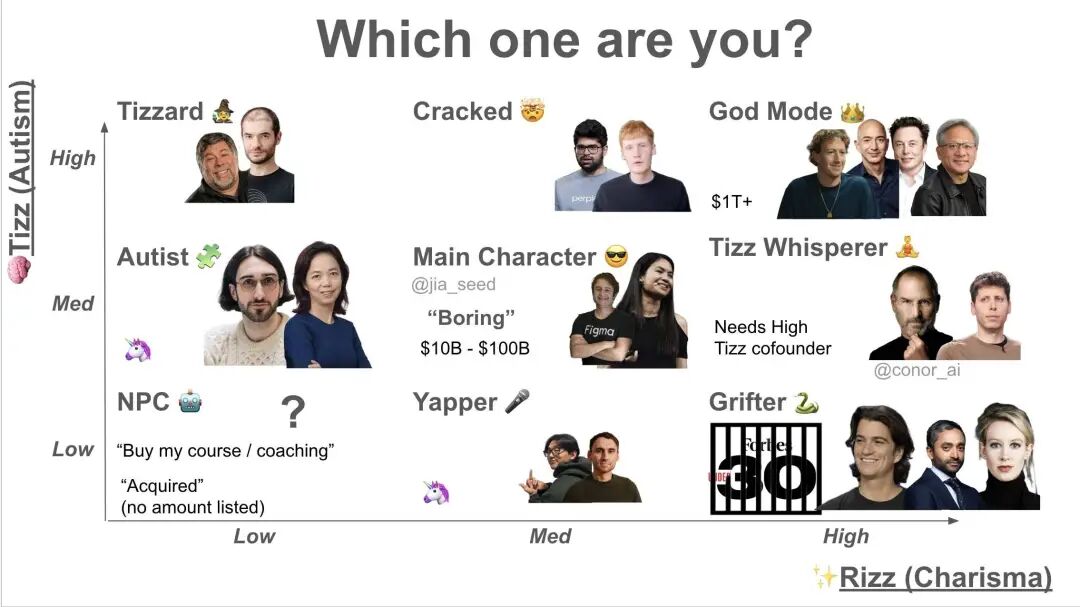
AI 圈疯传的新「MBTI 测试」:乔布斯和奥特曼同一档,马斯克小扎直接封神,你是什么段位
3 6 Ke· 2025-09-01 09:09
Core Insights - The article discusses the emergence of a new social metric called "Tizz/Rizz matrix" that categorizes individuals based on their social charm (Rizz) and technical expertise (Tizz) [1][3][23] - It highlights the importance of balancing both attributes for success in the tech industry, showcasing various tech leaders and their positions within the matrix [21][22][23] Summary by Categories Rizz (Social Charm) - Rizz is defined as a measure of social prowess, indicating one's ability to persuade and engage others effectively [4] - Individuals with high Rizz can excel in marketing and fundraising, often overshadowing their technical skills [4][7] Tizz (Technical Expertise) - Tizz represents a person's technical inclination or "tech nerd" status, with higher values indicating better communication with machines but difficulty in social interactions [5] - Those with high Tizz are often seen as the creators of technology, while those with low Tizz may struggle to engage in technical discussions [5][19] Matrix Quadrants - The matrix categorizes individuals into various quadrants based on their Rizz and Tizz scores: - **Tizzard (Technical Wizards)**: High Tizz, low Rizz; exemplified by figures like Steve Wozniak and Ilya Sutskever, who are known for their technical contributions but are not prominent public speakers [7][26] - **Grifter (Con Artists)**: High Rizz, low Tizz; represented by individuals like Elizabeth Holmes, who excel in persuasion but lack genuine technical skills [9][26] - **Yapper (Talkative Individuals)**: Low Tizz, high Rizz; characterized by those who are more talkative than productive [11][26] - **Autist (Technical Experts)**: High Tizz, low Rizz; these individuals are often brilliant in their fields but may struggle with social interactions [13][26] - **Main Character (Balanced Individuals)**: Those who have a good balance of both Rizz and Tizz, like Melanie Perkins and Dylan Field, are seen as successful and well-rounded [14][16][26] - **God Mode (Top Performers)**: Individuals like Elon Musk and Jeff Bezos, who excel in both Rizz and Tizz, are positioned as the ultimate achievers in the tech world [21][22][26] Conclusion - The article emphasizes that in today's competitive landscape, both technical skills and social charm are crucial for success, and individuals must navigate their positions within this matrix to maximize their potential [23]


服贸会走进东北亚博览会“招商引客”
Zhong Guo Jing Ji Wang· 2025-08-29 06:29
Group 1 - The 2025 China International Service Trade Fair (CIFT) promotional event in Changchun is part of efforts to connect Northeast Asia's regional cooperation resources [1] - The event highlighted the latest preparations for the 2025 CIFT, inviting representatives from various sectors to participate in the fair scheduled from September 10 to 14 in Beijing [1] Group 2 - The 2025 CIFT will continue with the permanent theme "Global Services, Mutual Benefits" and the annual theme "Digital Intelligence Leading, Service Trade Renewed," emphasizing international participation and technological empowerment [2] - Over 70 countries and international organizations have confirmed participation, with Australia as the guest country organizing the largest delegation in the fair's history, including major firms like ANZ Bank and Canva [2] - Nearly 2,000 enterprises, including around 500 Fortune Global 500 companies, are expected to exhibit, showcasing cutting-edge technologies such as AI-guided catheter shaping robots and advanced ophthalmic frequency scanning technology [2] Group 3 - Representatives from Beijing Fengshou International Trade Co. and Beijing Enamel Factory shared their experiences of leveraging the CIFT platform for growth and modernization of traditional industries [3] - The Changchun promotional event is part of a series of initiatives to connect regional enterprises and empower local economies, following other promotional events in various cities [3] - Attendees expressed their understanding of the CIFT's preparations, exhibition features, exclusive policies, and cooperation opportunities, planning to engage further at the fair for mutual benefits [3]
10 Mistakes Every Entrepreneur Should Make | Raul Handa | TEDxMSRIT
TEDx Talks· 2025-08-25 15:43
Entrepreneurship & Business Strategy - The speaker shares personal experiences of bankruptcy and building the Fortuna Group to $15 million in annual recurring revenue, emphasizing the importance of learning from mistakes [1] - The speaker advocates for making mistakes early in entrepreneurship to learn and avoid repeating them, viewing mistakes as fundamental to growth [1] - The speaker suggests launching businesses quickly, within three months of having an idea, and learning on the go, rather than waiting for perfect conditions [2] - The speaker highlights the importance of trusting people, including angel investors, VCs, and employees, despite the risk of betrayal [9] - The speaker advises against solely chasing trends like AI and D2C, and instead focusing on solving real problems [10] - The speaker emphasizes that money made from consumers should be used to grow the business, rather than relying on outside funding [15] - The speaker suggests entrepreneurs should initially do everything themselves (HR, finance, marketing, etc) to gain practical knowledge [16][17] - The speaker warns against comparing oneself to others and feeling the "fear of missing out" (FOMO), which can lead to raising money unnecessarily [23][24] - The speaker advises against falling in love with one's own idea, as it can blind entrepreneurs to flaws, and instead encourages focusing on customers [27][28] - The speaker illustrates the learning process with an example of receiving $1,000 repeatedly, showing how mistakes lead to better financial management over time [29][30]