
大疆

Search documents
中国汽车“带货”中国芯片
Di Yi Cai Jing· 2025-09-18 01:27
Core Insights - Chinese brands are demonstrating resilience in the face of a "weak peak season" threat in the fourth quarter of the year, with exports growing by 6.9% in the first eight months and 4.8% in August [2][5] - The shift towards non-American exports and the growth of private enterprises are key factors behind this performance [2][4] - The trend of "exporting" not just products but also brands, technology, and capital is becoming a new growth point for Chinese companies [4][8] Export Performance - In August, China's exports to the EU and Japan increased by 10.4% and 6.7% respectively, with ASEAN exports growing by 22.5% [5] - The Trade Desk's insights indicate that the upcoming holiday shopping season will see consumers making more rational purchasing decisions, with many planning to complete their shopping before Black Friday [3][6] Brand Strategy and Market Diversification - Chinese brands are increasingly diversifying their market strategies to mitigate risks associated with U.S. tariffs, focusing on Europe, Japan, and the Asia-Pacific region [6][7] - The trend of simultaneous market expansion is becoming more common, with companies leveraging successful experiences in one market to explore opportunities in others [7][8] Technological Innovation and Product Quality - Chinese brands are showcasing significant craftsmanship and technological innovation, particularly in AI and robotics, enhancing their competitiveness in the global market [4][8] - The shift from low-end manufacturing to high-end products is driving the internationalization of Chinese brands, although challenges remain in brand recognition compared to established international brands [9] Consumer Perception and Brand Value - There is a growing recognition of the importance of brand value and consumer trust in overseas markets, with Chinese brands moving towards establishing a local presence and identity [8][9] - The challenge lies in balancing the perception of value for money with the need to convey brand philosophy and values to international consumers [8][9]


中国汽车“带货”中国芯片
第一财经· 2025-09-18 01:16
Core Viewpoint - The resilience of Chinese brands is highlighted in the face of the "not-so-busy" fourth quarter in the European and American markets, with a notable increase in exports and a shift towards diversified market strategies [3][4][9]. Export Growth and Market Dynamics - In the first eight months of the year, China's goods exports grew by 6.9%, with August's export growth reaching 4.8%, driven by non-American exports and private enterprises [3][4]. - The Trade Desk's insights indicate that despite demand contraction, Chinese companies are increasing investments in marketing and brand building, showcasing strong craftsmanship and technological innovation [3][6]. - The U.S. holiday retail sales are projected to grow by only 1.2% in 2025, marking the lowest growth since 2009, with a significant decline compared to the previous year [5]. Competitive Edge of Chinese Electronics - At the 2025 Berlin International Consumer Electronics Show, around 764 Chinese companies participated, representing nearly 40% of exhibitors, indicating strong competitiveness in the electronics sector [6]. - Chinese brands are not only relying on manufacturing and logistics advantages but are also gaining premium capabilities in high-end markets, becoming significant choices for global consumers during the shopping season [6][12]. Diversification Strategies - Chinese brands have initiated diversification strategies in response to increased tariffs from the U.S., with exports to the EU and Japan growing by 10.4% and 6.7% respectively in August [9][10]. - The shift towards non-American markets is evident, with companies increasingly focusing on Europe and Asia-Pacific to mitigate trade war risks [10][11]. Brand Value and Consumer Trust - Chinese brands are transitioning from merely exporting products to establishing brand value and recognition in overseas markets, moving towards a model where they are seen as local international brands [12][13]. - The challenge remains for Chinese brands to balance value-for-money propositions with the need to convey brand values and ideologies to gain trust from overseas consumers [13][14].

独家丨前安克 UV 打印机产品负责人付瀚龙计划创业,多家头部机构火速跟进
雷峰网· 2025-09-18 00:24
Core Viewpoint - The article discusses the entrepreneurial plans of Fu Hanlong, a former product head at Anker, who is currently seeking investment for his new project after leaving the company [3][4]. Group 1: Background of Fu Hanlong - Fu Hanlong has previously worked at DJI and Yuanrong Qixing before joining Anker in September 2023 as the UV printer product head [4]. - He played a significant role in defining the product for Anker's UV printer, contributing to its development [4]. Group 2: Current Entrepreneurial Endeavors - Fu Hanlong is actively seeking direction for his new venture while simultaneously building a team [5]. - He has explored the 3D imaging industry but has not yet confirmed whether he will pursue this field, as it is considered a less favorable entrepreneurial direction due to the current state of the VR industry [5]. Group 3: Market Interest - Fu Hanlong's project is reportedly attracting significant interest in the primary market, with multiple leading institutions looking to invest [4]. - There is potential for the project to complete multiple rounds of financing quickly, indicating strong market confidence [4].

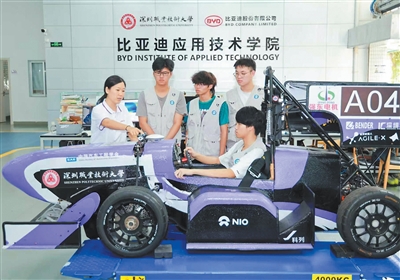
深职大与龙头企业协同育人(民生一线·职业教育观察)
Ren Min Ri Bao· 2025-09-17 22:22
Core Points - Shenzhen Polytechnic University has established a collaborative education model with industry associations and Fortune 500 companies, creating 16 specialized industry colleges to enhance vocational education's appeal and recognition [2][4][7]. Group 1: Enrollment and Academic Performance - This year, 100% of the admitted students in physics and history at Shenzhen Polytechnic University exceeded the provincial control line, with 10 students scoring above 600 in physics [4]. - The university's successful enrollment reflects the increasing attractiveness and recognition of vocational undergraduate education [4]. Group 2: Industry-Education Integration - The university emphasizes integrating professional courses with the industrial chain, extending classrooms to industrial parks, and embedding talent cultivation into production lines [5][6]. - The collaborative model has led to significant achievements, such as a graduate applying for 14 patents within three years, with 8 already authorized for use [5]. Group 3: Collaborative Projects and Achievements - Shenzhen Polytechnic University has established a "nine common" model for school-enterprise cooperation, including joint curriculum development and addressing key technological challenges [6][8]. - The university has initiated over 1,400 technology development and consulting projects for enterprises in the past three years, establishing 43 joint research centers with leading companies like DJI [8]. Group 4: Internationalization and Global Competence - The university has launched international training programs to meet the talent needs of companies like BYD in overseas markets, creating pathways for students to work abroad [9][10]. - It has established partnerships with 205 institutions across 45 countries and regions, promoting the internationalization of vocational education and the export of "Chinese standards" [11].
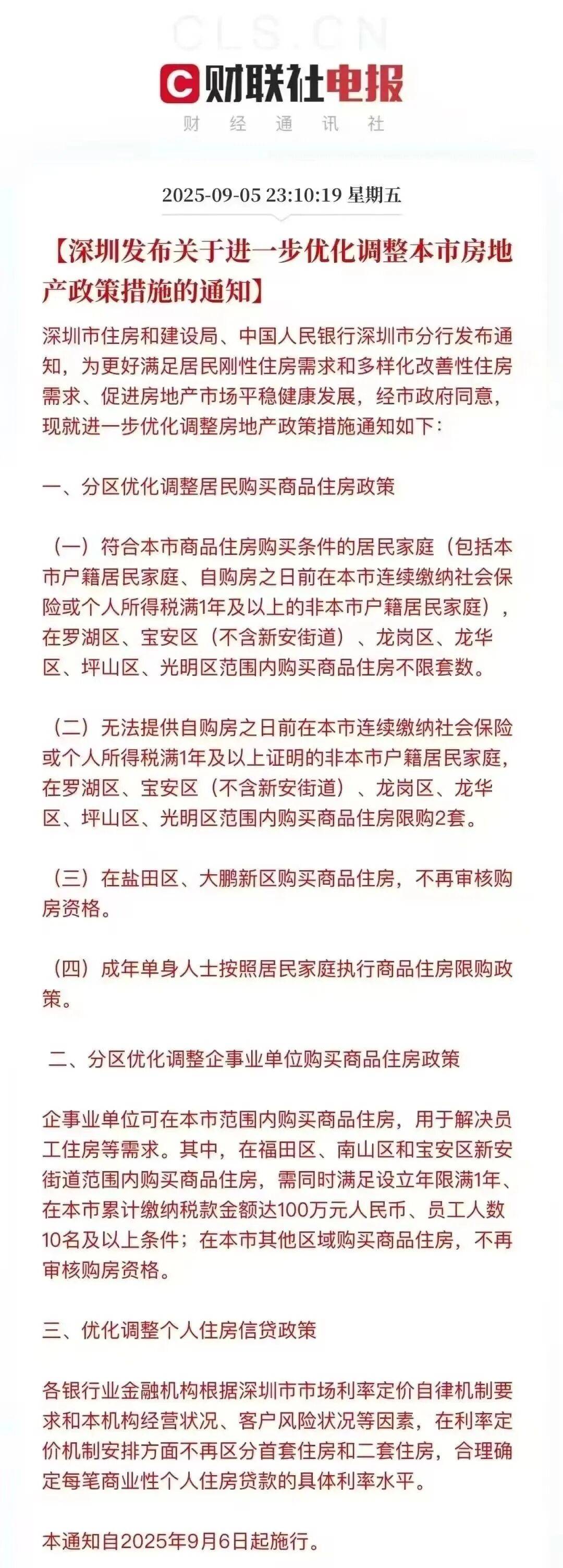
罗湖被深圳踢出核心区了????
Sou Hu Cai Jing· 2025-09-17 18:14
Core Insights - Shenzhen's real estate market has undergone significant policy adjustments, particularly in the core area zoning, which has attracted considerable attention [1][7]. Policy Changes - The new policy allows individuals to purchase up to two residential properties in specific districts, including Luohu, Bao'an (excluding Xin'an Street), Longgang, Longhua, Pingshan, and Guangming [3]. - In Yantian District and Dapeng New District, there will be no qualification review for purchasing residential properties [3]. - Single adults will be subject to the same purchasing limits as resident families [3]. Corporate Housing Policy Adjustments - Enterprises can purchase residential properties within the city to address employee housing needs, with specific conditions in districts like Futian, Nanshan, and Bao'an [4]. Personal Housing Credit Policy Optimization - Financial institutions will no longer differentiate between first and second home loans in terms of interest rate pricing, allowing for a more flexible approach based on market conditions and client risk profiles [5]. Market Dynamics - The adjustment of purchase limits has significantly reduced the restricted areas from multiple zones to just three, with Luohu being removed from the restricted list, contrasting with Bao'an's inclusion [7]. - Luohu, historically a central area for Shenzhen, has seen its status change due to slower industrial upgrades and urban renewal compared to other districts like Futian and Nanshan [8][9][10]. Future Outlook - Despite being removed from the core restricted zone, Luohu retains its historical significance and existing infrastructure, which may still attract buyers [12][13]. - The policy shift may stimulate the real estate market in Luohu, encouraging more purchasing activity and balancing development across Shenzhen's districts [15][16][17]. - Luohu's future positioning in Shenzhen's urban landscape remains a point of interest, as it seeks to redefine its role and capitalize on new opportunities [18].
中国品牌不惧“旺季不旺” 中国汽车还能“带货”芯片
Di Yi Cai Jing· 2025-09-17 14:08
Group 1 - The core viewpoint is that despite the challenges in the US and European markets, Chinese brands are demonstrating resilience and adaptability in their export strategies [1][5] - China's goods exports increased by 6.9% in the first eight months of the year, with August's export growth reaching 4.8%, driven by non-US exports and private enterprise exports [1][4] - The Trade Desk's insights indicate that Chinese companies are increasing investments in marketing and brand building, showcasing strong craftsmanship and technological innovation in AI and robotics [1][3] Group 2 - The automotive sector is enhancing the global recognition of Chinese chips, with companies like Naxin Micro seeing over 10% of their revenue coming from overseas by 2024 [3][5] - Chinese brands are diversifying their export markets, with significant growth in exports to the EU and ASEAN, indicating a shift away from reliance on the US market [4][5] - The trend of early preparation for the holiday shopping season reflects a more rational consumer mindset, with half of US consumers planning to complete their purchases before Black Friday [2][5] Group 3 - Chinese brands are transitioning from merely exporting products to establishing themselves as international brands, focusing on brand value and consumer trust [7][8] - The global expansion of Chinese manufacturing is evolving from low-end to high-end products, enhancing brand internationalization [8] - There is a notable difference in consumer perceptions between Chinese fast-moving consumer goods and international brands, highlighting the need for greater cultural understanding and marketing efforts [8]
中国品牌不惧“旺季不旺”,中国汽车还能“带货”芯片
Di Yi Cai Jing· 2025-09-17 14:01
Group 1: Market Trends and Performance - China's exports grew by 6.9% in the first eight months of the year, with August's export growth reaching 4.8%, driven by non-U.S. exports and private enterprises [1] - The global economic pressure is expected to lead to a gradual decline in export growth in the fourth quarter, with a focus on the impact of external demand on production [2] - Despite challenges, Chinese electronic consumer goods maintain strong competitiveness, with approximately 764 Chinese companies participating in the 2025 IFA, accounting for nearly 40% of exhibitors [2][3] Group 2: Brand Strategy and Innovation - Chinese brands are increasingly integrating AI technology and showcasing craftsmanship and technological innovation, enhancing their competitiveness in high-end markets [3] - The shift from product export to brand export is evident, with companies leveraging long-term R&D and industry cluster advantages to expand globally [3] - Chinese brands are transitioning from relying solely on supply chain advantages to establishing brand value and recognition in overseas markets [7] Group 3: Diversification and Market Expansion - Chinese brands have initiated diversification strategies in response to increased tariffs from the U.S., with exports to the EU and Japan growing by 10.4% and 6.7% respectively in August [4] - The trade transfer effect is strengthening, allowing for continued growth in non-U.S. exports, which is crucial for mitigating external economic fluctuations [5] - Companies are now more confident in exploring multiple markets simultaneously, moving away from a single-market focus [6] Group 4: Consumer Behavior and Brand Perception - There is a noticeable shift in consumer behavior towards more rational purchasing decisions, with many planning to complete their holiday shopping earlier [2] - Chinese brands are increasingly recognized for their value and ideology, which is essential for gaining trust and acceptance in overseas markets [7][8] - The perception of Chinese fast-moving consumer goods and cultural brands still lags behind international brands, indicating a need for greater efforts in brand recognition and cultural understanding [8]
润欣科技(300493):业绩稳健增长,技术创新与客户协作驱动未来发展
Tianfeng Securities· 2025-09-17 12:16
Investment Rating - The report maintains a "Buy" rating for the company, indicating an expected relative return of over 20% within the next six months [5]. Core Insights - The company achieved a revenue of 1.358 billion yuan in the first half of 2025, representing a year-on-year growth of 16.42%. The net profit attributable to the parent company was 29.93 million yuan, up 18.23% year-on-year [1]. - The company is positioned to leverage opportunities in the recovering global semiconductor industry, driven by demand for AI computing, storage chips, and automotive electronics [2]. - The company has established a competitive advantage in AI edge computing, automotive electronics, and sensor fields, supported by a stable and efficient business model [2]. - The company has strengthened its core technological capabilities through collaboration with the National Intelligent Sensor Innovation Center and has initiated the construction of an integrated sensing and computing ecosystem [3]. - The company has a solid core competitiveness, supported by high-quality IC supplier resources and a well-known domestic customer base, which enhances its market expansion capabilities [4]. Financial Performance and Forecast - The company expects revenues of 2.817 billion yuan, 3.155 billion yuan, and 3.572 billion yuan for the years 2025, 2026, and 2027, respectively [4]. - The forecasted net profit attributable to the parent company has been adjusted downwards to 0.755 billion yuan, 1.143 billion yuan, and 1.682 billion yuan for the years 2025, 2026, and 2027, respectively [4]. - The report provides detailed financial projections, including revenue growth rates of 8.52%, 12.00%, and 13.20% for the years 2025, 2026, and 2027 [9].

“飞”出农事新力量:低空经济赋能乡村振兴
Nan Fang Nong Cun Bao· 2025-09-17 11:32
Core Viewpoint - The article discusses the integration of low-altitude economy into agricultural practices in Guangdong, highlighting the potential of drones as essential agricultural tools to empower rural revitalization and enhance agricultural productivity [5][70]. Group 1: Event Overview - The Guangdong Second Agricultural Sports Meeting featured a skills competition for crop protection personnel, aimed at enhancing vocational training and skills through competitive events [2][4]. - The event was organized by the Guangdong Provincial Department of Agriculture and Rural Affairs, in collaboration with local educational and agricultural institutions [3]. Group 2: Competition Details - The competition combined training, competition, and demonstration to improve the overall skill level of crop protection personnel across the province [8]. - Participants faced various assessments, including theoretical knowledge on pest identification and practical tasks involving drone operation for pesticide application [10][14]. Group 3: Technological Integration - Drones were showcased in practical applications such as field monitoring, material transport, and precise pesticide spraying, demonstrating the deep integration of low-altitude economy into agricultural production [20][21]. - The event highlighted the capabilities of drones, which not only fly but also utilize AI for real-time monitoring and data analysis to optimize agricultural practices [39][41]. Group 4: Future Directions - The Guangdong Provincial Department of Agriculture plans to further develop training and certification systems for new types of agricultural professionals, focusing on knowledge-based and skilled talent to support the low-altitude economy [63][66]. - The article emphasizes the importance of integrating advanced technology and skilled labor to drive agricultural modernization and rural revitalization efforts [62][70].

中海达:公司与大疆在航空测量业务方面有一定的合作
Mei Ri Jing Ji Xin Wen· 2025-09-17 08:54
Core Viewpoint - Company Zhonghaidah (300177.SZ) has established a collaboration with DJI in the field of aerial surveying, utilizing its L10 airborne laser measurement system to enhance data collection in debris flow disaster areas [1] Group 1 - The L10 airborne laser measurement system is compatible with DJI's drone systems, allowing for efficient data collection in disaster-affected regions [1] - The collaboration aims to provide precise and reliable data support for the investigation of geomorphological features, surface deformation, vegetation coverage, and hydrological characteristics in debris flow disaster areas [1]
