
浦发银行

Search documents
股份制银行板块11月18日跌0.06%,民生银行领跌,主力资金净流出3.94亿元
Zheng Xing Xing Ye Ri Bao· 2025-11-18 08:11
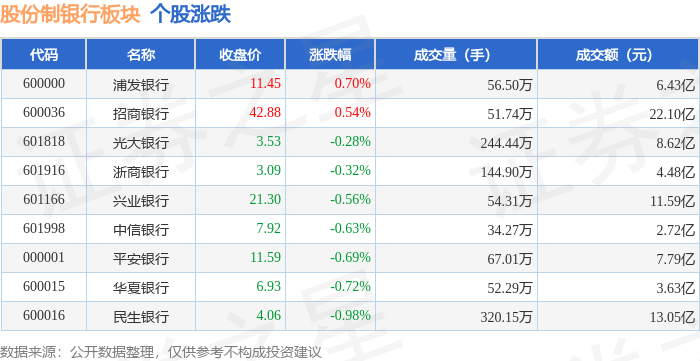
从资金流向上来看,当日股份制银行板块主力资金净流出3.94亿元,游资资金净流入8260.65万元,散户 资金净流入3.12亿元。股份制银行板块个股资金流向见下表: 证券之星消息,11月18日股份制银行板块较上一交易日下跌0.06%,民生银行领跌。当日上证指数报收 于3939.81,下跌0.81%。深证成指报收于13080.49,下跌0.92%。股份制银行板块个股涨跌见下表: | 代码 | 名称 | 收盘价 | 涨跌幅 | 成交量(手) | 成交额(元) | | --- | --- | --- | --- | --- | --- | | 600000 | 浦发银行 | 11.45 | 0.70% | 56.50万 | 6.43 Z | | 600036 | 招商银行 | 42.88 | 0.54% | 51.74万 | 22.10亿 | | 601818 | 光大银行 | 3.53 | -0.28% | 244.44万 | 8.62亿 | | 601916 | 浙商银行 | 3.09 | -0.32% | 144.90万 | 4.48亿 | | 601166 | 兴业银行 | 21.30 | -0.56% | ...


今日35只个股突破年线
Zheng Quan Shi Bao Wang· 2025-11-18 07:59
Market Overview - The Shanghai Composite Index closed at 3939.81 points, with a decline of 0.81%, and the total trading volume of A-shares reached 1,945.96 billion yuan [1] Stocks Breaking the Annual Line - A total of 35 A-shares have surpassed the annual line, with notable stocks showing significant deviation rates including: - Guangyun Technology with a deviation rate of 19.13% - Longxun Co., Ltd. at 15.24% - Central Plaza at 7.88% [1] Top Performers - The top three stocks with the highest deviation rates are: 1. Guangyun Technology: Today's price increase of 19.99%, turnover rate of 9.16%, annual line price of 13.81 yuan, latest price at 16.45 yuan [1] 2. Longxun Co., Ltd.: Price increase of 20.00%, turnover rate of 19.74%, annual line price of 69.30 yuan, latest price at 79.86 yuan [1] 3. Central Plaza: Price increase of 10.11%, turnover rate of 9.48%, annual line price of 3.63 yuan, latest price at 3.92 yuan [1] Additional Notable Stocks - Other stocks that have recently crossed the annual line with lower deviation rates include: - Tianlong Group, Jinyu Medical, and Meili Cloud, which have just crossed the annual line [1]






浦发天津分行深耕供应链金融,为实体经济注入“金融活水”
Zhong Guo Jin Rong Xin Xi Wang· 2025-11-18 07:41
Core Insights - The core viewpoint emphasizes the importance of supply chain finance in supporting the real economy, with浦发银行天津分行 innovating financial products to enhance capital flow within industrial chains [1][3]. Group 1: Supply Chain Financial Products - 浦发银行 has launched a digital supply chain finance product called "浦链通," which facilitates online financing based on core enterprise credit and supplier receivables, characterized by easy access, short processes, and minimal paperwork [1]. - Since the launch of "浦链通," 浦发银行天津分行 has serviced 60 core enterprise chains, disbursing over 8 billion yuan in financing and serving nearly 500 suppliers, indicating a continuous enhancement of its digital supply chain service capabilities [1]. Group 2: Market Opportunities and Innovations - 浦发银行天津分行 has identified market opportunities by providing differentiated services through "浦链通," including system integration with core enterprises and third-party platforms, as well as rapid financing processes that can complete transactions in as little as one hour [2]. - The bank has expanded its "浦链通" services to 15 core enterprises in the construction industry, providing over 2 billion yuan in financing to small and micro suppliers, showcasing its commitment to supporting this sector [2]. Group 3: Future Directions - 浦发银行天津分行 aims to continue focusing on the needs of the real economy by deepening the integration of supply chain finance products and technology, offering more precise services, flexible solutions, and efficient responses to empower the industrial chain [3].
我国城商行资产规模突破60万亿元;广东首次出台养老金融专属政策 | 金融早参
Mei Ri Jing Ji Xin Wen· 2025-11-18 02:29
Group 1: Foreign Exchange Market - The foreign exchange market in China has maintained a stable operation despite increased volatility in international financial markets and a rising US dollar index [1] - In October, the bank's foreign exchange settlement and sales surplus was $17.7 billion, indicating a more balanced foreign exchange market [1] - Cross-border capital flows remained stable, with a monthly average surplus of $24 billion over the two months of September and October [1] Group 2: Pension Finance Policy - Guangdong Province has introduced its first dedicated pension finance policy aimed at high-quality development [2] - The implementation plan sets two-stage goals for pension finance development, aiming for a well-established supply system by 2028 [2] - The policy is expected to enhance the efficiency of pension fund utilization and promote the development of the pension industry in Guangdong [2] Group 3: Urban Commercial Banks - The total asset scale of urban commercial banks in China has surpassed 60 trillion yuan, reflecting rapid growth in the financial sector [3] - This asset growth represents a 134-fold increase since 1995, with urban commercial banks now holding a 13.53% market share [3] - The non-performing loan ratio stands at 1.76%, with a provision coverage ratio of 188.08% and a capital adequacy ratio of 12.97% [3] Group 4: Gold Consumption Trends - International gold prices remain high, with domestic jewelry prices exceeding 1300 yuan per gram [4] - New consumption trends are emerging, with consumers favoring lightweight gold products and gold bars [4] - The strong performance of gold prices is attributed to global geopolitical uncertainties and fluctuations in the US dollar index [4] Group 5: Retail Banking Trends - Retail banking is experiencing a shift, with the growth of high-net-worth clients outpacing that of basic retail clients [5][6] - Six banks reported varying growth rates for ordinary retail clients, while private banking client growth rates were significantly higher [5] - This trend indicates a deeper competition in retail banking, necessitating a focus on existing customer segments [6]
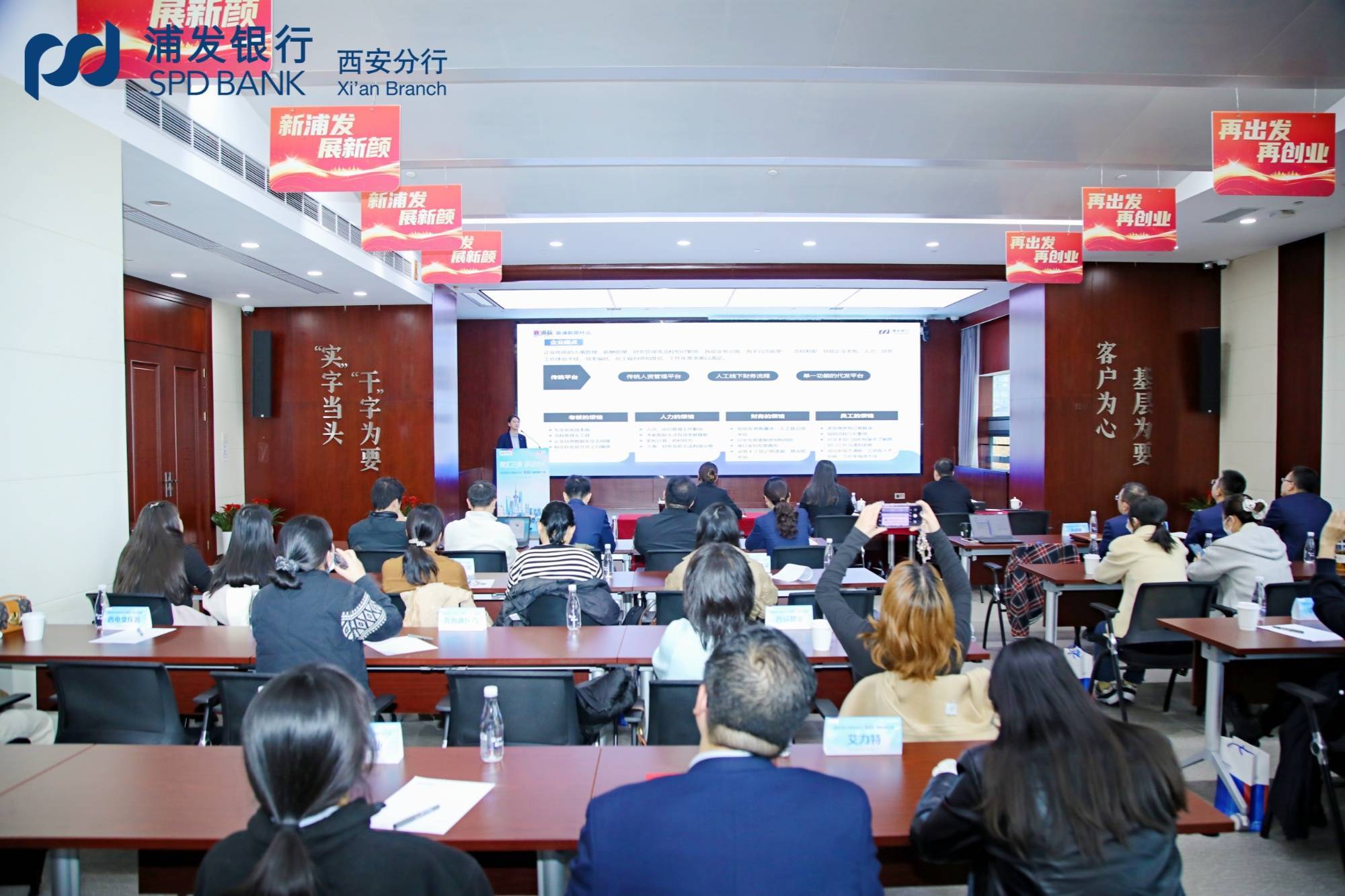
浦发银行西安分行举办“智汇三秦·薪动未来”靠浦薪代发超级系统焕新推介会
Sou Hu Cai Jing· 2025-11-18 00:12
Core Insights - The event "Intelligent Gathering in Sanqin: Future of Salary Distribution" was held by SPD Bank Xi'an Branch, focusing on the new paths for digital transformation in enterprises through bank-enterprise collaboration [1][4] - SPD Bank launched a comprehensive one-stop human resources salary service platform called "KaoPuXin," marking a significant shift in its customer service model and establishing itself as a strategic benchmark for digital transformation in banking [1][4] Summary by Sections Product Features - "KaoPuXin" addresses complex payroll processes and information security concerns by focusing on customer needs, offering modules for salary distribution, human resource management, financial cost control, and comprehensive financial support for employees [4][5] - The system streamlines the entire employee lifecycle management, including onboarding, electronic contracts, position changes, and salary calculations, enhancing efficiency and reducing manual errors [5][6] Strategic Value - The intelligent salary distribution feature of "KaoPuXin" not only simplifies processes but also provides management value through data-driven insights, improving payroll efficiency and security [6][7] - The system integrates various functions such as salary calculation, payment, and card issuance, allowing for a seamless payroll experience and reducing preparation time for managers [6][7] User Experience and Ecosystem - "KaoPuXin" emphasizes user experience by creating a collaborative financial ecosystem that addresses the needs of personnel, finance, and operations, enhancing overall efficiency [7] - SPD Bank is focusing on building a "super platform, super products, and super systems" as part of its digital strategy, aiming to enhance market competitiveness and brand influence in the Sanqin region [7]
安徽建工集团股份有限公司2025年第三次临时股东大会决议公告
Shang Hai Zheng Quan Bao· 2025-11-17 19:53
Group 1 - The third extraordinary general meeting of shareholders was held on November 17, 2025, at the company's conference room in Hefei [2][3] - All resolutions presented at the meeting were approved without any objections [2][5] - The meeting was chaired by the company's chairman, Yang Shanbin, and all directors and supervisors were present [3][4] Group 2 - The meeting approved the cancellation of the supervisory board, changes to the business scope, and amendments to the company's articles of association [5][6] - The meeting also approved the revision of the rules for shareholder meetings and board meetings, the appointment of the auditing firm for the 2025 financial report, and an increase in the investment plan for 2025 [6][5] - The meeting was legally valid, as confirmed by the witnessing lawyers from Anhui Tianhe Law Firm [6][8] Group 3 - The company announced that its subsidiary, Anhui Construction Sanjian Group Co., Ltd., received approval to issue debt financing instruments totaling up to RMB 5 billion in short-term financing bonds and RMB 10 billion in medium-term notes [7][8] - The registration for these instruments is valid for two years and will be underwritten by several banks [7][8] - The subsidiary will comply with relevant disclosure obligations as per regulatory requirements [8] Group 4 - The company's 14th board meeting was held on November 17, 2025, with all directors present [11] - The board approved the establishment of Anhui Low Altitude Technology Industry Co., Ltd., with an investment of RMB 70 million from the company [12][13] - The new company will focus on low-altitude industry investments, logistics, infrastructure construction, and technology development [12]

8.75亿元资金今日流出银行股
Zheng Quan Shi Bao Wang· 2025-11-17 14:30
Market Overview - The Shanghai Composite Index fell by 0.46% on November 17, with 17 industries experiencing gains, led by the computer and defense industries, which rose by 1.67% and 1.59% respectively [1] - The pharmaceutical and banking sectors had the largest declines, with drops of 1.73% and 1.31% respectively [1] Capital Flow - The net outflow of capital from the two markets was 31.953 billion yuan, with six industries seeing net inflows [1] - The computer industry had the highest net inflow of capital at 7.211 billion yuan, followed by the defense industry with 2.892 billion yuan [1] - A total of 25 industries experienced net capital outflows, with the pharmaceutical industry leading at 8.789 billion yuan, followed by the power equipment sector with 7.644 billion yuan [1] Banking Sector Performance - The banking sector declined by 1.31% with a net outflow of 875 million yuan, out of 42 listed banks, only 2 saw gains while 40 experienced losses [2] - Among the banks, Minsheng Bank had the highest net inflow of 141 million yuan, followed by China Merchants Bank and Qilu Bank with inflows of 99.896 million yuan and 73.512 million yuan respectively [2] - The banks with the largest net outflows included Agricultural Bank of China, Postal Savings Bank, and Shanghai Pudong Development Bank, with outflows of 428 million yuan, 279 million yuan, and 134 million yuan respectively [2] Individual Bank Performance - The table of bank performance shows various banks' daily changes, turnover rates, and main capital flows, highlighting significant outflows from major banks [3] - Agricultural Bank of China saw a decline of 2.12% with a net outflow of 427.5 million yuan, while Minsheng Bank was the only bank to gain, increasing by 0.99% with a net inflow of 1.414 billion yuan [3]



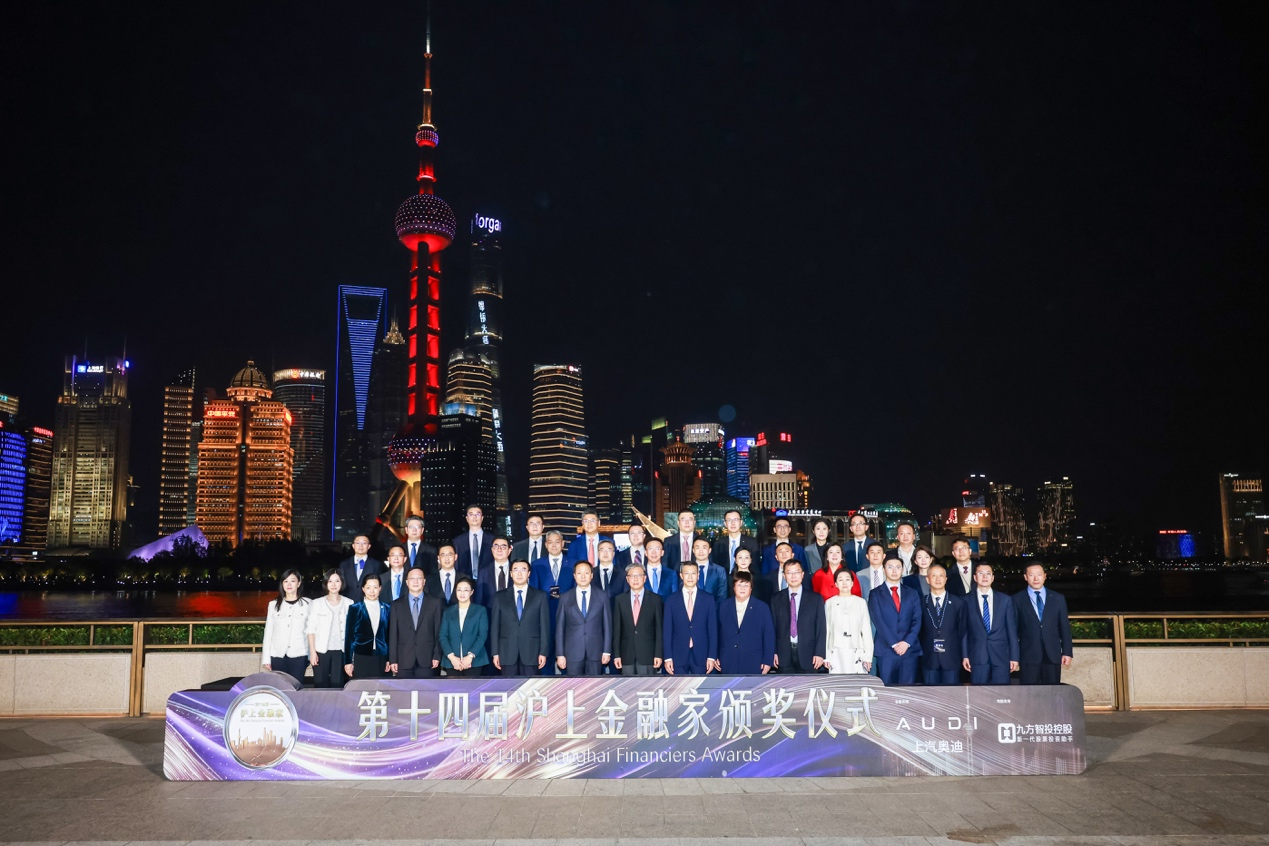
第十四届“沪上金融家”评选结果揭晓,21位金融英才分获三大奖项
Guo Ji Jin Rong Bao· 2025-11-17 13:58
Core Insights - The 14th "Shanghai Financial Talents" awards recognized 21 financial professionals for their contributions to the Shanghai International Financial Center [1][2] - Significant policies and initiatives have been implemented this year to enhance Shanghai's status as an international financial center, leading to a continuous improvement in its capabilities [1] - Shanghai's financial market saw a total trading volume of 2967.83 trillion yuan in the first nine months of the year, marking a 12.7% year-on-year increase [1] Group 1: Awards and Recognition - Three individuals were awarded "Annual Figures in the Construction of Shanghai International Financial Center," eight as "Leaders in Shanghai's Financial Industry," and ten as "Innovators in Shanghai's Financial Industry" [2] - Notable awardees include executives from major banks and financial institutions, highlighting the recognition of leadership in the financial sector [4][5] Group 2: Financial Market Performance - Shanghai's stock market capitalization and interbank bond market scale rank among the top globally, reflecting the city's financial strength [1] - The successful launch of the digital yuan international operation center and offshore bond issuance in the Shanghai Free Trade Zone are key developments [1] Group 3: Financial Innovation and Talent Development - The event featured the release of the first "Green Finance Development Index Report," emphasizing the connection between the securities industry and green finance [5] - The importance of a strong financial talent pool was highlighted as a critical resource for building a financial powerhouse and enhancing the international financial center [5][6] Group 4: Ongoing Initiatives and Discussions - A roundtable discussion included experts from financial infrastructure, banking, and fintech sectors, focusing on how technology can support the development of Shanghai as an international financial center [6] - The "Shanghai Financial Talents" awards have been held for 14 consecutive years, contributing to the soft power and cultural atmosphere of Shanghai's financial sector [7]
百万级项目频现!银行业密集启动科技招标,数字化转型驶入深水区
Xin Lang Cai Jing· 2025-11-17 12:24
Core Insights - Recent trends show multiple banks accelerating their technology procurement efforts, with significant budgets allocated for projects in areas such as large model development, computing infrastructure, and intelligent risk control [1][3][6] - The banking industry's IT investment is projected to reach 169.315 billion yuan in 2024, marking a 3.6% increase from 2023, and is expected to exceed 266.227 billion yuan by 2028 [7] Group 1: Technology Procurement Trends - Major banks are shifting from fragmented IT equipment purchases to systematic and ecological strategic layouts, with policy banks leading through large-scale tenders and framework agreements [3][4] - State-owned banks and national joint-stock banks dominate the technology procurement market, focusing on high-budget, long-cycle projects [3][4] - Smaller banks are adopting a more targeted approach, focusing on regional needs and core requirements with flexible budget scales [4] Group 2: Drivers of Technology Investment - The narrowing net interest margin and pressure on traditional lending businesses are pushing banks to leverage technology for competitive differentiation and cost control [6] - Regulatory policies are also driving technology projects, with over 30 "one-table" related projects initiated or completed across the industry since October [6][9] - External competition from fintech companies and internet platforms is compelling banks to accelerate their transformation efforts [6][9] Group 3: Challenges and Risks - The rapid pace of technology procurement presents challenges such as unclear risk responsibilities in outsourcing partnerships and compliance with regulatory requirements [9][10] - A notable case involving Guizhou Bank highlights issues with contract clarity and risk assessment in technology procurement [9] - The fast iteration of technology poses adaptation risks, as banks may face additional costs for upgrades if algorithms become outdated [10] Group 4: Future Considerations - The banking industry needs to establish a more systematic technology governance framework, including lifecycle management of suppliers and risk assessment mechanisms [10] - Balancing technological innovation with risk management will be crucial for banks to transform technology investments into core competitive advantages [10]



基金市场与ESG产品周报20251117:医药主题基金表现占优,TMT、科创主题ETF受被动资金加仓-20251117
EBSCN· 2025-11-17 12:22
Quantitative Models and Construction Methods 1. Model Name: Active Equity Fund Position Estimation Model - **Model Construction Idea**: The model aims to estimate the high-frequency positions of active equity funds using quantitative methods based on daily disclosed net value sequences[64] - **Model Construction Process**: - Utilize constrained multivariate regression models to find the optimal estimation results of fund positions among the constructed asset sequences[64] - Construct simulated portfolios for each fund to improve the accuracy of position estimation[64] - Measure the overall position change trend of active equity funds and further estimate their latest industry preferences[64] - **Model Evaluation**: The model provides a high-frequency estimation of fund positions, which is crucial for understanding the investment behavior of active equity funds[64] 2. Model Name: REITs Series Index Construction Model - **Model Construction Idea**: The model provides a new perspective for asset allocation using REITs indices based on index investment philosophy[48] - **Model Construction Process**: - Construct a complete series of REITs indices to reflect the market performance comprehensively[48] - Provide detailed sub-indices for different underlying assets and project types, considering the high dividend characteristics of REITs[48] - Use a tiered rounding method to ensure the stability of the index calculation[48] - Apply the divisor adjustment method to maintain the continuity of the index when non-trading factors (e.g., new issuance, expansion) occur[48] - **Model Evaluation**: The model effectively captures the performance of various REITs assets and provides valuable tools for investors to measure the risk-return profile of REITs[48] Model Backtesting Results Active Equity Fund Position Estimation Model - **Weekly Position Change**: The estimated positions of active equity funds decreased by 0.19 percentage points compared to the previous week[64] - **Industry Allocation Trends**: Increased allocation in electronics, home appliances, and automobiles; decreased allocation in computers, non-bank finance, and banking sectors[64] REITs Series Index Construction Model - **Weekly Performance**: The comprehensive REITs index increased by 0.87%[50] - **Sub-Indices Performance**: - Property REITs Index: +0.81%[50] - Franchise REITs Index: +1.00%[50] - Affordable Rental Housing REITs Index: +1.51%[50] Quantitative Factors and Construction Methods 1. Factor Name: ESG Fund Performance Tracking - **Factor Construction Idea**: Track the performance of ESG funds by considering environmental, social, and governance factors in investment strategies[79] - **Factor Construction Process**: - Classify ESG funds into thematic ESG funds and general ESG funds based on their investment strategies[79] - Thematic ESG funds include "ESG," "sustainable," and "responsible investment" themes[79] - General ESG funds cover themes like "low carbon," "carbon neutral," "green," "environment," "climate," "ecology," "Yangtze River protection," etc.[79] - Social themes include "social responsibility," "poverty alleviation," "rural revitalization," "Belt and Road," "Silk Road," "regional development," etc.[79] - Governance themes include "corporate governance" and "governance"[79] - **Factor Evaluation**: The factor provides a comprehensive classification and tracking of ESG funds, helping investors understand the performance and impact of ESG investments[79] Factor Backtesting Results ESG Fund Performance Tracking - **Number of ESG Funds**: 213 funds with a total scale of 1520.28 billion yuan[80] - **Thematic Distribution**: - ESG Theme: 172.07 billion yuan[80] - Environmental Theme: 1185.57 billion yuan[80] - Social Theme: 137.23 billion yuan[80] - Governance Theme: 25.41 billion yuan[80] - **Type Distribution**: - Active Equity Funds: 804.90 billion yuan[80] - Stock Passive Index Funds: 202.64 billion yuan[80] - Pure Bond Funds: 221.67 billion yuan[80] - Bond Passive Index Funds: 278.98 billion yuan[80] - QDII Funds: 12.08 billion yuan[80] - **Weekly Performance**: - Active Equity ESG Funds: Median net value change of -1.67%[84] - Stock Passive Index ESG Funds: Median net value change of -1.13%[84] - Bond ESG Funds: Median net value change of +0.04%[84]