广发证券

Search documents
政策定调催生新主线 A股跨年行情蓄势待发
2 1 Shi Ji Jing Ji Bao Dao· 2025-12-15 15:53
Market Overview - A-share market sentiment has improved following a significant meeting, with average daily trading volume increasing to 19,530.44 billion yuan, up by 2,568.66 billion yuan from the previous week [1][3] - The market has shown a mixed performance, with the ChiNext Index and Shenzhen Component Index rising by 2.74% and 0.84% respectively, while the Shanghai Composite Index fell by 0.34% [2] Fund Flows - Institutional and retail investors have shown synchronized net inflows into the consumer sector, while there are divergences in other sectors, with institutions reducing exposure to technology and cyclical manufacturing [5] - Northbound capital's average daily trading volume increased to 2,324.71 billion yuan, up by 397.27 billion yuan from the previous week [4] Investment Opportunities - Analysts suggest that A-shares may experience a year-end rally, driven by structural market dynamics and capital market reforms [8] - Key sectors expected to perform well in 2026 include AI industry trends, advantageous manufacturing, "anti-involution," and structural recovery in domestic demand, with predicted net profit growth exceeding 30% [11] ETF Trends - There is a notable divergence in ETF fund flows, with broad-based ETFs gaining significant attention, particularly the A500 ETFs, which saw net inflows of 40.33 billion yuan, 37.64 billion yuan, and 20.58 billion yuan from major fund houses [6][7] Future Outlook - The market is anticipated to benefit from continued economic policy support, with expectations of a reasonable growth rate and a favorable liquidity environment for capital markets [9][10] - The focus for 2026 will likely shift towards AI applications, with a significant emphasis on commercial viability and cross-industry investment opportunities [11]
逆势大涨,资金加速布局
Ge Long Hui· 2025-12-15 12:07
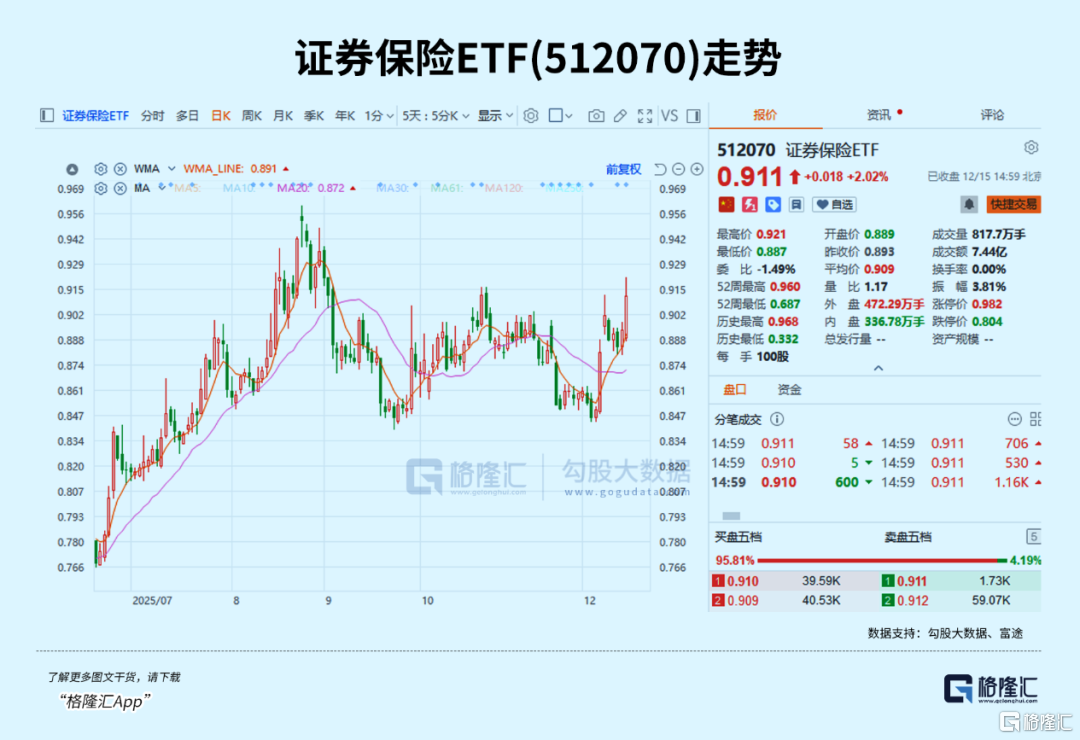
Core Viewpoint - The A-share market experienced a decline influenced by the significant drop in the US AI technology sector, but certain sectors like consumer goods and insurance showed resilience and growth amidst the downturn [1][5]. Group 1: Market Performance - The three major indices in the A-share market closed down by 0.55%, 1.1%, and 1.77%, with a total market turnover of 1.79 trillion yuan, a decrease of 324.6 billion yuan from the previous trading day, and over 2900 stocks fell [1]. - Despite the overall market decline, the insurance sector saw a notable increase, with the Securities Insurance ETF (512070) rising by 2.02% on the day and 7.18% over the past week [1]. Group 2: Non-Banking Financial Sector - The non-banking financial sector has become a focal point for investors due to recent favorable policy signals, particularly for brokerages, which are traditionally seen as a barometer of market performance [3][4]. - The China Securities Regulatory Commission (CSRC) has indicated a willingness to expand capital space and leverage limits for quality brokerages, which is expected to enhance capital efficiency and support the growth of margin financing and proprietary trading [6][7]. Group 3: Insurance Sector Developments - The recent reduction in risk factors for insurance companies' investments, particularly in stocks, is expected to release significant capital, potentially adding 108.6 billion yuan to the market if fully allocated to the CSI 300 index [9][11]. - The insurance sector's strong performance is also attributed to a government push to encourage insurance capital to enter the market, which is expected to enhance market valuations [12][15]. Group 4: Investment Trends and Opportunities - The insurance and brokerage sectors are experiencing a valuation recovery, with the insurance industry showing an average PEV of 0.60-0.95 times and PB of 1.15-2.06 times, indicating a significant discount compared to historical averages [26]. - The total investment assets of listed insurance companies reached 21.85 trillion yuan, with an increase in stock allocation from 7.98% at the end of 2024 [21]. - The recent influx of capital into the non-banking financial sector, including a net inflow of 7.202 billion yuan into the Securities Insurance ETF (512070), reflects growing market interest [29]. Group 5: Long-term Investment Outlook - The outlook for the non-banking financial sector remains positive, driven by supportive government policies and the potential for long-term capital inflows into high-dividend assets like banks and insurance [33][35]. - The insurance sector's increased allocation to high-growth technology stocks and other sectors is expected to enhance future investment returns [38].

绩效新规|易方达近十年分121亿分红率47%,广发证券获28亿,实行股权激励后分红率上升,员工持股累计获9.7亿
Xin Lang Cai Jing· 2025-12-15 09:44
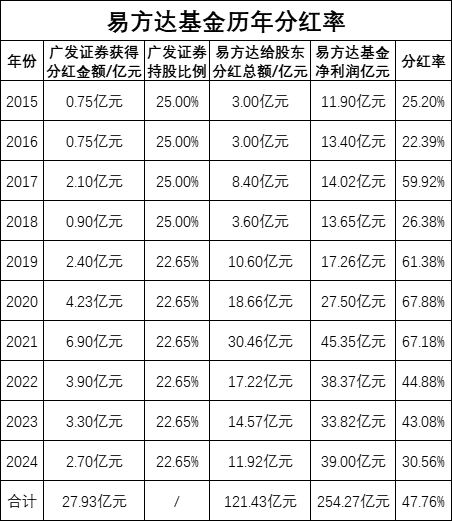
Core Viewpoint - The recent draft of the "Guidelines for Performance Assessment of Fund Management Companies" has sparked discussions in the industry, particularly regarding the constraints on dividend distributions to shareholders based on fund performance and investor losses [1] Group 1: Dividend Distribution - The guidelines require fund companies to prudently determine the frequency and proportion of dividends based on the long-term performance of fund products and the profit and loss situation of investors [1] - In the past decade, E Fund has distributed a total of 12.143 billion yuan in dividends to shareholders, with a dividend rate of 30.56% for 2024 [2][3] - E Fund's average dividend rate over the past ten years is 47.76%, ranking it fourth among leading funds, lower than some competitors but higher than others [4] Group 2: Employee Stock Ownership and Incentives - Following the approval of employee stock incentives in December 2019, E Fund's dividend rate has generally increased, with the employee stock platform receiving a total of 970 million yuan in dividends from 2019 to 2024 [5][6] - The implementation of stock incentives led to a significant increase in the dividend rate, with an average of 51% from 2019 to 2024, compared to an average of 34% from 2015 to 2018 [6] Group 3: Fund Performance - From 2022 to 2024, 52.75% of E Fund's 273 fund products experienced losses, with 47.99% underperforming their benchmarks, resulting in a total loss of 48.8 billion yuan for investors [7][8] - In a more recent analysis from December 2022 to November 2025, only 6% of 307 products reported losses, indicating a significant improvement in performance [8]

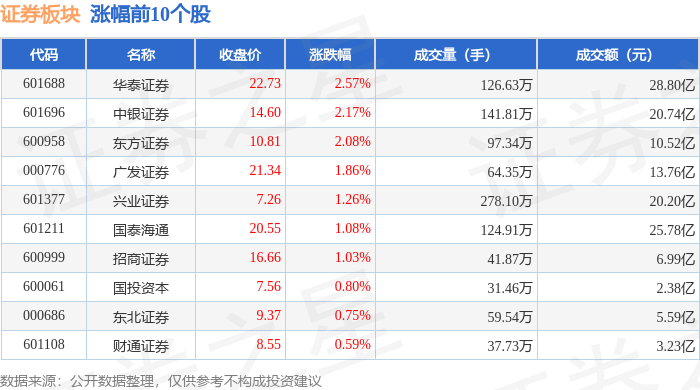
证券板块12月15日涨0.37%,华泰证券领涨,主力资金净流出3.75亿元
Zheng Xing Xing Ye Ri Bao· 2025-12-15 09:08
证券之星消息,12月15日证券板块较上一交易日上涨0.37%,华泰证券领涨。当日上证指数报收于 3867.92,下跌0.55%。深证成指报收于13112.09,下跌1.1%。证券板块个股涨跌见下表: | 代码 | 名称 | 收盘价 | 涨跌幅 | 成交量(手) | 成交额(元) | | --- | --- | --- | --- | --- | --- | | 601688 | 华泰证券 | 22.73 | 2.57% | 126.63万 | 28.80亿 | | 601696 | 中银证券 | 14.60 | 2.17% | 141.81万 | 20.74亿 | | 600958 | 东方证券 | 10.81 | 2.08% | 97.34万 | 10.52亿 | | 000776 | 广发证券 | 21.34 | 1.86% | 64.35万 | 13.76亿 | | 601377 | 兴业证券 | 7.26 | 1.26% | 278.10万 | 20.20亿 | | 601211 | 週夢遊間 | 20.55 | 1.08% | 124.91万 | 25.78亿 | | 666009 | 招商证券 | ...




上市券商分红密集落地,35家年内分红两次以上,近90亿红利待兑现
Sou Hu Cai Jing· 2025-12-15 08:15
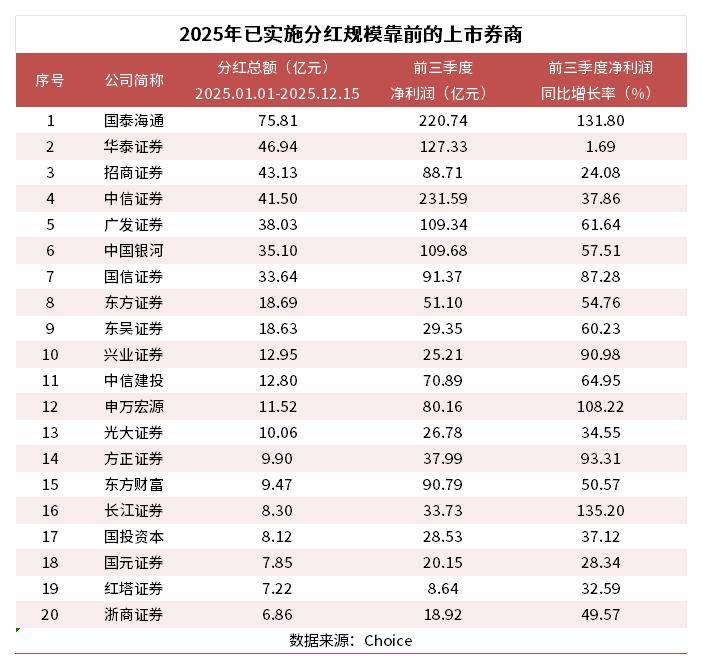
Core Viewpoint - The new "National Nine Articles" released in 2024 emphasizes strengthening the regulation of listed companies' dividends, enhancing the stability, continuity, and predictability of dividends, and promoting multiple dividends within a year, pre-dividends, and dividends before the Spring Festival [1] Group 1: Dividend Distribution - Several listed securities firms have announced profit distribution plans, marking the implementation phase of a new round of dividend payouts [1] - Changcheng Securities announced a cash dividend of 0.76 yuan per 10 shares, totaling 307 million yuan, with the payment date set for December 19 [1] - Industrial Securities plans to distribute a cash dividend of 0.05 yuan per share, totaling 432 million yuan, with the payment date on December 18 [1] - 35 out of 44 listed securities firms have distributed dividends two times or more within the year, with Xibu Securities having implemented three dividends totaling 446 million yuan [1] Group 2: Dividend Scale - Leading securities firms dominate the dividend scale, with Guotai Junan leading at 7.581 billion yuan in total cash dividends for the year [2] - Huatai Securities, China Merchants Securities, and CITIC Securities follow with 4.694 billion yuan, 4.313 billion yuan, and 4.150 billion yuan respectively [2] - Notable performances from smaller firms include Dongfang Securities and Dongwu Securities, with dividends of 1.869 billion yuan and 1.863 billion yuan respectively, placing them in the top ten of the industry [2] Group 3: Profitability and Future Dividends - Significant improvements in profitability support larger dividend distributions, with Guotai Junan, Shenwan Hongyuan, and Changjiang Securities reporting net profit growth rates exceeding 100% in the first three quarters of 2025 [4] - Approximately 9 billion yuan in dividends are still pending distribution, with Guoxin Securities planning to distribute 1 yuan per 10 shares, totaling 1.024 billion yuan, pending shareholder approval [4] - Other firms, including CITIC Securities and CITIC Jiantou, have mid-term profit distribution plans that have yet to be finalized [4]
破发股清越科技实控人撤回回购提议 广发证券保荐上市
Zhong Guo Jing Ji Wang· 2025-12-15 08:01
2、承担时点:前述人民法院生效民事判决确定的履行期限之内,即高裕弟将在上市公司收到生效 民事判决确定的公司履行期限之内,将对应金额支付至上市公司指定账户或经上市公司确认的其他账 户。 中国经济网北京12月15日讯 清越科技(688496.SH)日前披露关于实际控制人撤回股份回购提议及自 愿承担未来上市公司一定范围民事赔偿额的公告称,近期,公司收到中国证监会出具的《立案告知书》 (编号:证监立案字0382025011号)。因公司涉嫌定期报告等财务数据虚假记载,根据《中华人民共和 国证券法》《中华人民共和国行政处罚法》等法律法规,中国证监会决定对公司立案。结合《中华人民 共和国证券法》《最高人民法院关于审理证券市场虚假陈述侵权民事赔偿案件的若干规定》等法律法规 及司法解释,公司存在因定期报告等财务数据虚假记载而被投资者提起民事诉讼、进而产生民事赔偿责 任的风险。 2025年12月12日,公司董事会收到实际控制人高裕弟出具的《关于撤回股份回购提议并自愿承担未 来上市公司一定范围民事赔偿额的承诺》。因公司目前正处于立案调查期间,为主动维护投资者合法权 益,公司实际控制人高裕弟决定撤回股份回购提议(回购提议的详细情况请 ...

广发证券郭磊:2026年政策的“跨周期”特征将更明显 降息降准仍是政策工具选项
Zhong Guo Ji Jin Bao· 2025-12-15 06:38
Core Viewpoint - The Central Economic Work Conference emphasizes the need for a balanced approach to economic policy, focusing on both short-term support and long-term structural reforms to stimulate economic potential and address external challenges [1][2]. Group 1: Economic Policy Framework - The conference introduced five new "musts" for economic policy, including the need to fully tap economic potential to address insufficient effective demand and release domestic demand space [2] - It highlighted the importance of combining policy support with reform and innovation to stimulate factor vitality [2] - The need to balance market vitality with regulatory frameworks was emphasized, aiming for both flexibility and effective governance [2] Group 2: Investment Focus - The conference stressed the importance of combining investments in physical assets with human capital, advocating for increased investment in areas such as population, education, healthcare, social security, and skills [2] - It called for a focus on internal demand expansion, technological self-reliance, industrial chain security, and green transformation to enhance economic resilience against external uncertainties [2] Group 3: Monetary Policy - The conference reiterated the implementation of a moderately loose monetary policy, with a focus on stabilizing economic growth and ensuring reasonable price recovery [3] - It emphasized the flexible and efficient use of various policy tools, including interest rate cuts and reserve requirement ratio reductions, to maintain ample liquidity and support key areas such as domestic demand, technological innovation, and small and medium enterprises [3] - The importance of maintaining the RMB exchange rate at a reasonable and balanced level was also highlighted [3]
广发证券郭磊:2026年政策的“跨周期”特征将更明显,降息降准仍是政策工具选项
Zhong Guo Ji Jin Bao· 2025-12-15 06:34
Core Viewpoint - The Central Economic Work Conference emphasizes the need for a balanced approach to economic policy, focusing on both short-term support and long-term structural reforms to stimulate economic potential and address external challenges [1][2]. Group 1: Economic Policy Framework - The 2026 policy will exhibit more pronounced "cross-cycle" characteristics, with interest rate cuts and reserve requirement ratio reductions remaining viable policy tools [2]. - The conference introduced five new "musts" for economic policy, including the need to fully tap economic potential and to combine policy support with reform innovation [2][3]. - The focus on balancing total supply and demand, as well as enhancing quality while expanding total volume, will significantly influence the macro policy framework for 2025 [2]. Group 2: Monetary Policy - The implementation of a moderately loose monetary policy is to continue, with a focus on stabilizing economic growth and ensuring reasonable price recovery [3]. - The use of various policy tools, including interest rate cuts and reserve requirement reductions, is expected to be flexible and efficient, indicating that these remain options for policy action [3]. - Financial institutions are encouraged to support key areas such as expanding domestic demand, technological innovation, and small and medium-sized enterprises, reflecting the priority of domestic demand in financial policy [3].
港股春躁不会缺席!机构:关注“独有资产”互联网,年线附近强支撑,港股互联网ETF(513770)再现溢价抢筹
Xin Lang Cai Jing· 2025-12-15 05:26
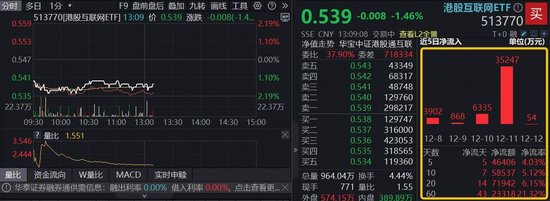
Market Overview - The Hong Kong stock market is experiencing overall fluctuations, with major tech stocks like Alibaba, Xiaomi, Tencent, and Meituan showing declines of nearly 3%, over 2%, and over 1% respectively [1][8] - The Hong Kong Internet ETF (513770) saw a price drop of 1.46%, despite a previous decline of 2%, indicating active buying interest as the premium rate exceeded 0.5% [8] Fund Inflows - The Hong Kong Internet ETF (513770) has recorded a net inflow of 585 million yuan over the past seven days, reflecting strong buying momentum [8] Market Sentiment and Future Outlook - Huatai Securities notes that the current market sentiment remains pessimistic, suggesting limited downside but uncertain upside potential. Future catalysts may include RMB appreciation, overseas expansion of companies, and breakthroughs in domestic technology [3][10] - GF Securities anticipates that the spring market rally in Hong Kong stocks will not be absent this year, potentially driven by liquidity easing and unexpected inflows, with a focus on developments in DeepSeek's model and domestic internet companies' consumer applications [3][10] Valuation Metrics - The Hong Kong Internet ETF (513770) tracks the CSI Hong Kong Internet Index, which has a current P/E ratio (TTM) of 25.5, placing it at a historical low compared to the past five years and significantly lower than the P/E ratios of the ChiNext Index (40.74) and Nasdaq 100 (35.75) [4][11] ETF Composition and Strategy - The Hong Kong Internet ETF (513770) heavily invests in leading internet companies, with over 73% of its top ten holdings focused on AI cloud computing and various AI applications. The fund's total size exceeds 10 billion yuan, with an average daily trading volume of over 600 million yuan [4][11] - For investors seeking to reduce volatility while still investing in technology, the Hong Kong Large Cap 30 ETF (520560) is recommended, combining high-growth tech stocks with stable dividend-paying companies [4][11]
大金融盘中发力,券商ETF基金(515010)逆市上涨超1%
Sou Hu Cai Jing· 2025-12-15 03:56
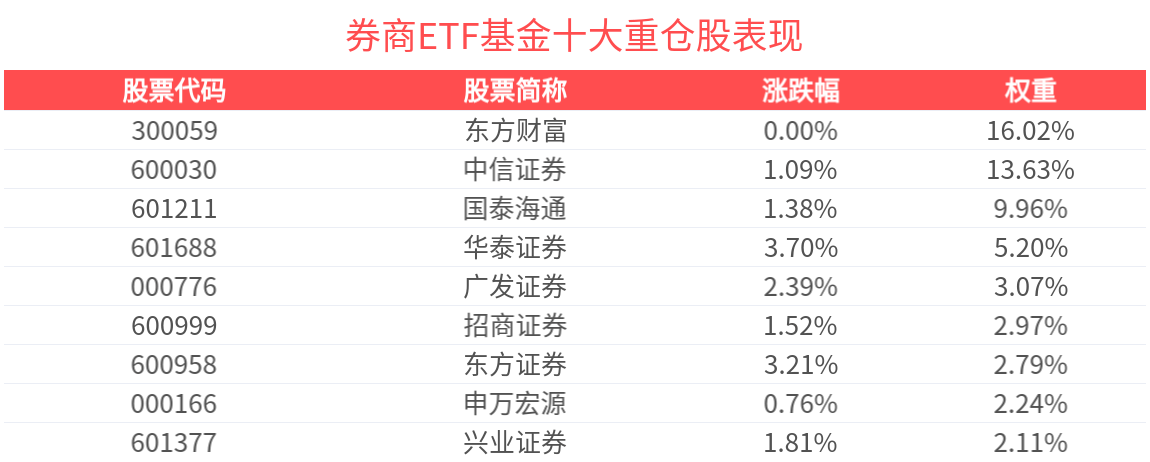
Core Viewpoint - The A-share market showed a collective strength on December 15, with significant performance from the financial sector, particularly insurance and brokerage stocks, indicating a potential investment opportunity in this area [1]. Financial Sector Performance - The brokerage ETF fund (515010) rose by 1.09%, with notable increases in its constituent stocks such as Huatai Securities (up 3.70%), Dongfang Securities, GF Securities, and Bank of China Securities [1]. - The financial technology ETF (Hua Xia, 516100) increased by 0.15%, with Star Ring Technology surging over 19% [1]. Valuation Insights - The latest price-to-earnings ratio (PE-TTM) for the index tracked by the brokerage ETF is 17.13, which is in the 5.26% percentile over the past year, indicating that the valuation is lower than 94.74% of the time in the last year, suggesting historical low valuations [1]. ETF Composition and Management Fees - The top ten weighted stocks in the brokerage ETF, as of November 28, 2025, include Dongfang Wealth, CITIC Securities, Guotai Junan, Huatai Securities, GF Securities, and others, collectively accounting for 60.23% of the index [1]. - The management and custody fee rate for the brokerage ETF (515010) is 0.2%, making it one of the lowest fee investment options in the market, which may attract investors looking for cost-effective exposure to the brokerage sector [1].