
工商银行

Search documents
新浪财经资讯AI速递:昨夜今晨财经热点一览 丨2026年1月27日
Xin Lang Cai Jing· 2026-01-26 23:42
Group 1: Precious Metals Market - Gold prices have historically surpassed $5,100 per ounce, with silver also reaching new highs, driven by monetary credit reconstruction, geopolitical risks, and liquidity expectations [1][10] - Major institutions, including Goldman Sachs, have raised their price targets for gold to above $5,400, indicating a bullish outlook for the precious metals market [1][10] - The surge in precious metals prices is accompanied by significant inflows into gold ETFs and other related assets, while regulatory bodies have increased risk controls and trading limits [1][10] Group 2: Banking Sector Adjustments - Industrial and Agricultural Banks have raised the risk assessment requirements for their gold accumulation business, with Agricultural Bank requiring a cautious risk level starting January 30 [2][12] - The adjustments aim to increase investment thresholds and enhance risk awareness among clients, while existing accounts remain unaffected by the new rules [2][12] Group 3: M&A Activity - Huayi Brothers is set to acquire core film assets from Noon Sunshine and others for approximately 4.577 billion yuan, marking a "snake swallowing elephant" acquisition that is 12 times the market value of Huayi Brothers [3][13] - The transaction aims to create a large integrated film platform, with existing shareholders like Alibaba and Tencent participating in the integration process [3][13] Group 4: Economic Indicators - Guangdong province is nearing a significant milestone with its foreign currency deposit balance expected to reach 40 trillion yuan by the end of 2025, showcasing its economic strength [4][14] - Despite a GDP growth slowdown to 3.9%, Guangdong maintains a leading position in various economic metrics, including population size and foreign trade [4][14] Group 5: Insurance Sector Trends - Nearly 38 trillion yuan of residents' fixed deposits are set to mature in the first quarter of 2026, creating pressure for reallocation of funds amid declining bank deposit rates [6][16] - Insurance companies are experiencing rapid premium growth during the "opening red" period, with dividend insurance becoming a key product due to its guaranteed and floating characteristics [6][16] Group 6: Market Dynamics in Alcohol Industry - The recall of a misprinted version of Moutai's zodiac wine has led to a tightening supply in the market, causing prices to rise despite the initial issue [5][15] - Some merchants believe the scarcity of the misprinted product may enhance its collectible value, although there are concerns about potential price corrections once new stock arrives [5][15] Group 7: Diamond Market Analysis - Over the past decade, gold prices have increased nearly fourfold, while diamond prices have dropped over 45%, indicating a significant divergence in market trends [7][17] - The decline in diamond prices is attributed to reduced demand in weddings and the impact of lab-grown diamonds, while gold benefits from monetary easing and its safe-haven status [7][17] Group 8: Corporate Governance Issues - The founder of Miaokelando has been removed from key positions due to failure to fulfill compensation commitments related to significant asset losses, leading to arbitration proceedings [8][18] - The company has appointed a new general manager while the founder remains on the board [8][18]
买金门槛再提升!又一国有大行发布积存金交易新规
券商中国· 2026-01-26 23:26
Core Viewpoint - Agricultural Bank of China (ABC) is increasing the risk tolerance assessment requirements for personal customers participating in gold accumulation transactions to enhance consumer protection and comply with regulatory demands [1][2]. Group 1: Changes in Risk Assessment Requirements - Starting from January 30, 2026, ABC will require personal customers to complete a risk tolerance assessment questionnaire and achieve at least a cautious rating to engage in gold accumulation services [1]. - This adjustment follows a similar move by Industrial and Commercial Bank of China (ICBC), which raised the risk assessment level from C1 (conservative) to C3 (balanced) for its gold accumulation business [2]. Group 2: Market Context and Implications - The adjustments in risk assessment are attributed to the high volatility of gold prices, which recently surpassed $5,100 per ounce, indicating a shift in the nature of gold accumulation from a stable savings alternative to a high-risk asset [2]. - Experts suggest that the ongoing rise in gold prices, supported by monetary easing and central bank purchases, will continue to bolster the demand for gold, despite the increased investment thresholds [3]. Group 3: Investor Behavior and Risks - There are concerns about investors potentially misrepresenting their risk tolerance during assessments, which could lead to mismatched risk profiles and expose them to products beyond their comfort zone [4]. - Such behavior undermines the investor protection framework and may result in difficulties for investors seeking to claim losses due to initial misrepresentations [4].



个别机构看多黄金到6600美元,多方提示超买风险
Di Yi Cai Jing· 2026-01-26 23:20
Core Viewpoint - The surge in gold and silver prices is driven by a combination of factors including monetary credit reconstruction, escalating geopolitical risks, and liquidity expectations, with gold prices potentially reaching $6,000 per ounce by 2026 [1][3]. Group 1: Gold and Silver Price Movements - On January 26, London spot gold broke through the $5,000 and $5,100 per ounce thresholds, reaching a historical high of $5,111 per ounce, while silver also hit a new record, surpassing $110 per ounce before settling at $108 [1]. - In the domestic futures market, the main contract for gold rose by 3.67%, reaching a new high of 1,151 yuan per gram, while silver surged nearly 13%, peaking at 28,226 yuan per kilogram [1]. Group 2: Institutional and Investor Sentiment - Various institutions maintain bullish outlooks on gold, with UBS setting a target price of $5,000 per ounce, while Goldman Sachs raised its year-end target from $4,900 to $5,400, citing increased demand from private investors and central banks [3]. - Bank of America has set a target of $6,000 per ounce for gold, predicting a significant price increase based on historical trends [3]. Group 3: Investment Trends and Demand - There is a notable increase in investor interest in gold, with many seeking to diversify their portfolios through various investment vehicles such as gold ETFs and stocks [5]. - The largest gold ETF in China surpassed 100 billion yuan in assets for the first time, reflecting a significant inflow of capital into gold investments [6]. Group 4: Central Bank Activities - Central banks globally continue to increase their gold reserves, with China's central bank reporting a rise in gold holdings, and emerging market central banks actively converting foreign reserves into gold [7]. - The World Gold Council reported that global official gold reserves reached approximately $3.69 trillion, with central banks purchasing gold at a rate significantly higher than in previous years [7]. Group 5: Market Risks and Regulatory Actions - Regulatory bodies have begun to implement measures to cool down the overheated gold market, including adjusting trading limits and increasing risk assessment requirements for gold investment products [8]. - Analysts caution that the current market is driven by emotional factors, and while the long-term outlook for gold remains positive, short-term corrections may be necessary due to overbought conditions [9].
智通ADR统计 | 1月27日
智通财经网· 2026-01-26 22:46
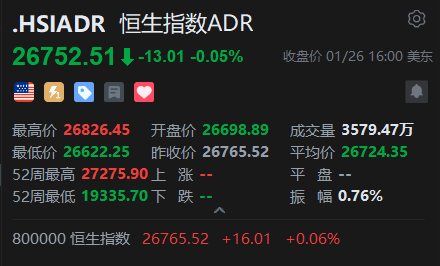
Market Overview - The Hang Seng Index (HSI) closed at 26,752.51, down by 13.01 points or 0.05% as of January 26, 16:00 Eastern Time [1] - The index reached a high of 26,826.45 and a low of 26,622.25 during the trading session, with a trading volume of 35.7947 million [1] - The 52-week high for the index is 27,275.90, while the 52-week low is 19,335.70, indicating a trading range of 0.76% [1] Blue-Chip Stocks Performance - HSBC Holdings closed at HKD 132.695, up by 1.29% compared to the Hong Kong market close [2] - Tencent Holdings closed at HKD 600.708, reflecting a slight increase of 0.2% from the Hong Kong market close [2] - Alibaba Group (BABA) saw a decline of 1.96%, closing at HKD 165.200 [3] - Xiaomi Group (01810) decreased by 2.81%, closing at HKD 35.220 [3] - AIA Group (01299) remained unchanged at HKD 83.050 [3] Notable Stock Movements - New World Development (00016) experienced a significant increase of 3.93%, closing at HKD 119.000 [3] - Kuaishou Technology (01024) fell by 3.26%, closing at HKD 78.600 [3] - JD.com (09618) rose by 1.05%, closing at HKD 116.000 [3] - Ctrip Group (09961) increased by 1.40%, closing at HKD 492.200 [3]




中国工商银行股份有限公司深圳市分行与中国信达资产管理股份有限公司深圳市分公司债权转让暨债务催收联合补正公告
Jing Ji Ri Bao· 2026-01-26 22:30
Core Viewpoint - The announcement details a debt transfer arrangement between Industrial and Commercial Bank of China Shenzhen Branch and China Cinda Asset Management Co., Ltd. Shenzhen Branch, correcting specific debt information from a previous notice [1] Group 1: Debt Transfer Arrangement - The debt transfer arrangement was published on January 16, 2026, in the Economic Daily [1] - The announcement includes a correction of the debt situation for specific borrowers listed in the original notice [1] Group 2: Borrower and Guarantor Information - The first borrower, Shenzhen Linzhuyuan Landscaping Co., Ltd., has a principal amount of 1,189,495,430.07 yuan and interest of 116,609,956.04 yuan, with multiple guarantors [1] - The second borrower, Shenzhen United Paper Co., Ltd., has a principal amount of 363,099,993.6 yuan and interest of 37,560,662.08 yuan, also with multiple guarantors [1] - The fifth borrower, Shenzhen Shengfeng Jewelry Co., Ltd., has a principal amount of 111,264,825.73 yuan and interest of 5,249,163.59 yuan, with various guarantors listed [1]

村镇银行改革重组有序推进
Jing Ji Ri Bao· 2026-01-26 22:04
Group 1 - The core viewpoint of the news is the approval of the acquisition of Zhejiang Anji Jiaoyin Village Bank by Bank of Communications, which aims to enhance financial services in rural areas through the establishment of new branches [1] - Village banks are independent legal entities established to provide financial services primarily for local agriculture and small enterprises, addressing the low coverage and supply issues in rural financial institutions [1] - Recent challenges faced by village banks include limited economic scale, a narrow customer base, and weak technology and risk control capabilities, leading to difficulties in profitability and sustainability [1] Group 2 - Rural commercial banks and other small financial institutions are also accelerating the "village-to-branch" transformation, exemplified by the recent opening of four new branches by Shunde Rural Commercial Bank [2] - The transformation allows for direct sharing of systems, funds, and risk control resources from the main initiating bank, significantly enhancing survival capabilities and optimizing regional financial layouts [2] - Small rural banks play an irreplaceable role in serving county economies, with initiatives like "Grain Farmer Loans" to alleviate financing difficulties for grain producers [2] Group 3 - The central government's policy emphasizes the need for orderly reform and restructuring of village banks to enhance risk resistance and operational capabilities, as outlined in the 2025 Central No. 1 Document [3] - The recent Central Economic Work Conference highlighted the importance of reducing the number of independent legal entities while improving quality through concentrated management to mitigate operational risks [3] - The focus is on balancing reduction and quality improvement, ensuring that financial service coverage is not diminished while enhancing the efficiency of financial services [3]
经营贷利率“贴地飞行” 中小银行有点吃不消
Zhong Guo Zheng Quan Bao· 2026-01-26 21:52
Core Viewpoint - The continuous decline in operating loan interest rates is driven by multiple factors, including policy guidance, market competition, and reduced funding costs, leading banks to focus on lending to quality small and micro enterprises [1][4]. Group 1: Loan Interest Rates - Several banks have reduced their operating loan interest rates, with some as low as 2.31%, a decrease of nearly 20 basis points from the previous month [1][2]. - The lowest rates for collateralized operating loans are reported between 2.31% and 2.55%, with some products potentially offering effective rates in the "1s" due to interest subsidies [2][4]. - The interest rate for first-time borrowers among small and micro enterprises can be reduced to the "1s" range due to a fiscal interest subsidy of 1% for the first year [2][3]. Group 2: Policy and Market Environment - The fiscal interest subsidy policy has been extended to the end of 2026, increasing the loan cap for eligible enterprises from 1 million to 10 million yuan [3]. - The subsidy now covers 11 sectors, including newly added digital, green, and retail consumption areas, alongside traditional sectors like hospitality and entertainment [3]. Group 3: Competition Among Banks - The competition for quality clients has intensified, with banks requiring higher standards for collateral, such as property location and age [5][7]. - Smaller banks are focusing on differentiating their client base and may offer lower rates or higher loan amounts to attract clients that do not meet the criteria of larger banks [7][8]. - The pressure to lower rates may lead to a compromise in risk management, with some banks potentially relaxing their standards to maintain competitiveness [7][8]. Group 4: Strategic Recommendations - Banks are encouraged to adopt differentiated pricing based on client creditworthiness and operational status, leveraging digital technology for risk control [8]. - There is a need for banks to diversify their business structure, focusing on wealth management and payment services to reduce reliance on net interest margins [8]. - Strengthening self-regulation and avoiding irrational price competition are essential for maintaining a balance between supporting the real economy and ensuring sustainable operations [8].

凌晨点外卖致银行卡被风控?多些精准研判避免“误伤”
Xin Lang Cai Jing· 2026-01-26 21:05
Core Viewpoint - The recent incident of bank card restrictions due to excessive late-night food delivery orders has highlighted the balance between customer rights and risk control in banking, raising concerns about the effectiveness and execution of risk management measures [1][2]. Group 1: Risk Control Measures - Many banks have implemented strict risk control measures to prevent telecom fraud and protect customer funds, but these measures have led to inconveniences for consumers, such as account restrictions due to normal behaviors like late-night food orders [1][2]. - The "one-size-fits-all" approach to risk control has resulted in misclassifying legitimate transactions as suspicious, causing unnecessary disruptions to customer banking activities [1][2]. Group 2: Impact on Consumers and Banks - Consumers face significant challenges when their accounts are restricted, including the need to visit bank branches and submit various proofs, which can lead to additional financial losses due to delayed payments and emergency expenses [2]. - Frequent misclassifications by banks can erode customer trust and potentially harm the bank's reputation and competitive position in the market [2]. Group 3: Recommendations for Improvement - To achieve a balance between security and convenience, regulatory bodies should provide clearer guidelines on risk control boundaries, preventing banks from falling into extreme control measures due to accountability pressures [2]. - Banks should enhance their risk control models by incorporating multi-dimensional data, such as consumer behavior and transaction contexts, to better differentiate between normal and suspicious activities [2]. - It is recommended that banks implement tiered restrictions for suspected accounts rather than outright halting all non-counter transactions, and simplify the unblocking process through online verification and remote audits [2].

经营贷利率“贴地飞行”中小银行有点吃不消
Zhong Guo Zheng Quan Bao· 2026-01-26 20:54
Core Insights - The continuous decline in operating loan interest rates is driven by multiple factors including policy guidance, market competition, and reduced funding costs [1][3][6] - Banks are focusing on operating loans as a key area for credit allocation, especially in light of weak mortgage demand and the need to optimize credit structures [1][3] Group 1: Interest Rate Trends - Several banks have lowered their operating loan interest rates, with some rates dropping to as low as 2.31% [1] - The minimum interest rate for secured operating loans is currently around 2.35%, while unsecured loans start at 2.55% [2] - With government subsidies, first-time borrowers from small and micro enterprises can enjoy interest rates as low as the "1s" [2] Group 2: Policy and Market Dynamics - The government has extended the fiscal subsidy policy for service industry enterprises until the end of 2026, increasing the loan cap for subsidies from 1 million to 10 million yuan [2] - The competition among banks is intensifying as they seek to attract high-quality small and micro enterprise clients, leading to a price war [3][5] Group 3: Risk and Sustainability - The ongoing decline in interest rates is putting pressure on banks' net interest margins, potentially leading to a focus on higher-risk clients [6] - Banks are encouraged to adopt differentiated pricing based on client creditworthiness and to enhance risk control through digital technologies [6] - The balance between price competition and sustainable operations is identified as a critical challenge for banks [6]

通鼎互联信息股份有限公司关于为子公司提供担保的进展公告
Shang Hai Zheng Quan Bao· 2026-01-26 20:46
登录新浪财经APP 搜索【信披】查看更多考评等级 证券代码:002491 证券简称:通鼎互联 公告编号:2026-005 通鼎互联信息股份有限公司 关于为子公司提供担保的进展公告 近期,公司全资子公司江苏通鼎光电科技有限公司(以下简称"光电科技")因业务发展需要,拟向中国 工商银行股份有限公司苏州长三角一体化示范区分行(以下简称"工行苏州示范区分行")申请总额不超 过人民币5,000万元的银行授信额度。公司与工行苏州示范区分行签署了相关的《最高额保证合同》, 为上述综合授信额度提供连带责任保证担保。 根据公司2024年年度股东大会审议通过的《关于为子公司提供担保的议案》,公司在股东大会授权期限 内可为光电科技提供的担保额度合计为20,000万元。公司股东大会授权公司管理层根据实际情况,在担 保额度范围内实施具体担保事项并签署相关担保文件。具体内容详见公司于2025年4月26日披露于《证 券时报》和巨潮资讯网的《关于为子公司提供担保的公告》(公告编号:2025-019)。 上述担保事项在公司董事会和股东大会审议通过的担保额度范围内,已经公司董事长审批,无需再次提 交董事会和股东大会审议。 二、被担保人基本情况 ...
