
中国人民银行

Search documents
人民银行党委表示:加快建设科技赋能监测监管设施
Zhong Guo Zheng Quan Bao· 2025-09-23 00:09
Group 1 - The People's Bank of China (PBOC) is actively implementing long-term rectification tasks while focusing on concentrated rectification efforts, aiming to address deep-seated and common issues within the financial system [1][2] - The PBOC is accelerating the construction of financial infrastructure, including enhancing cybersecurity measures, improving treasury management, and strengthening regulatory oversight of financial market infrastructure [1] - The PBOC is advancing information technology reforms by developing project management guidelines, integrating information systems, and increasing the usage of data lakes and cloud services [1] Group 2 - The PBOC has made significant progress in financial legislation, including the implementation of the Anti-Money Laundering Law and revisions to the PBOC Law, while also working on the Financial Stability Law and other banking regulations [2] - The PBOC plans to integrate rectification efforts into the implementation of the Central Committee's decisions, maintaining a stable yet progressive approach to foster a favorable monetary and financial environment for economic recovery [2] - The PBOC is committed to enhancing the construction of a self-controlled, secure, and efficient financial infrastructure system to mitigate financial risks [2]
什么信号?3000亿元,央行首次出手
Zhong Guo Ji Jin Bao· 2025-09-22 23:05
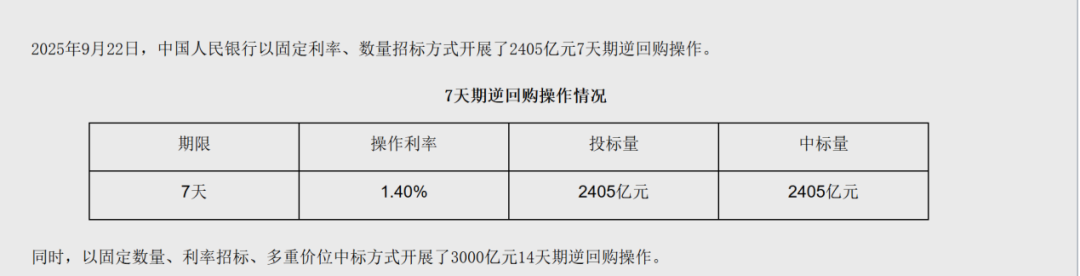
Core Viewpoint - The People's Bank of China (PBOC) has conducted a significant reverse repurchase operation, indicating a proactive approach to manage liquidity in the banking system, particularly ahead of the quarter-end and holiday periods [1][12]. Group 1: Reverse Repo Operations - On September 22, the PBOC conducted a 7-day reverse repo operation amounting to 240.5 billion yuan at a fixed rate of 1.40% [1][3]. - The PBOC also initiated a 14-day reverse repo operation for the first time in eight months, amounting to 300 billion yuan, using a multi-price bidding method [1][3]. - The adjustment in the bidding method for the 14-day reverse repo aims to enhance market pricing capabilities and better match differentiated funding needs [3][12]. Group 2: Market Reactions - On the same day, the treasury reverse repo rates surged, with 1-day, 2-day, and 3-day rates increasing by over 20% [4]. - Market liquidity has improved due to the PBOC's continuous net injection through open market operations, although cross-quarter factors may still cause disturbances [11]. Group 3: Future Implications - The PBOC's adjustment to the 14-day reverse repo operation is expected to provide more regular liquidity support, particularly during tax periods and month-end [12][13]. - The move is seen as a way to strengthen the 7-day reverse repo rate's position as a key policy rate, aiding in macro-prudential management of the bond market [12][13]. - The PBOC aims to create a more stable and transparent liquidity environment, showcasing a forward-looking and flexible monetary policy approach [13].

中国大规模减持美债,单月抛售超1800亿,央行连买黄金稳美元风险
Sou Hu Cai Jing· 2025-09-22 20:59
Core Insights - A global asset reshaping is occurring, with a notable decline in the allocation of dollar assets despite the emphasis on stable foreign exchange reserves [2] - Concerns regarding the sustainability of U.S. fiscal health and the long-term credibility of the dollar are growing due to potential tax reforms and trade tariffs under the Trump administration [2] - The U.S. federal debt is nearing dangerous levels, raising alarms about future interest burdens and policy constraints [2] Group 1: Market Reactions - Traders are engaging in discussions about the selling of European long-term bonds and the contrasting behavior of Japan and the UK, which increased their holdings in U.S. Treasuries [4][5] - The divergence in asset allocation strategies among countries indicates a lack of uniformity in foreign investment behavior, with China actively adjusting its asset structure for long-term resilience [5] Group 2: Gold as an Alternative - China has been increasing its gold reserves for ten consecutive months, reaching 74.02 million ounces by the end of August, reflecting a strategic shift towards diversifying foreign exchange reserves [5][7] - The global central banks collectively increased their gold reserves by 166 tons in Q2, marking a historical high, indicating a broader trend towards gold accumulation as a hedge against potential crises [7] Group 3: Strategic Asset Allocation - The shift from U.S. dollar assets to gold is seen as a gradual rebalancing rather than a complete decoupling, aimed at enhancing reserve flexibility [11][14] - The adjustments in asset allocation are influenced by both strategic policy intentions and market-driven risk aversion, highlighting a complex interplay of factors shaping current asset flows [14][16] Group 4: Future Implications - The ongoing adjustments in asset allocation are not revolutionary but represent an evolution towards a more resilient foreign exchange reserve structure [16][18] - The effectiveness of this strategy in mitigating risks associated with dollar volatility and geopolitical tensions remains uncertain, with market sentiment often diverging from rational decision-making [18]

人民银行党委表示 加快建设科技赋能监测监管设施
Zhong Guo Zheng Quan Bao· 2025-09-22 20:23
Core Insights - The People's Bank of China (PBOC) is actively implementing long-term rectification measures following the third round of inspections by the Communist Party, focusing on addressing deep-rooted and common issues in the financial sector [1][2] Group 1: Financial Infrastructure Development - The PBOC is accelerating the construction of technology-enabled monitoring and regulatory facilities, including the development of cybersecurity management systems and expanding the monitoring scope of the financial cybersecurity situation awareness platform [1] - There is a strong emphasis on enhancing treasury construction and management, ensuring the safe and stable operation of the treasury system, and advancing the national treasury project [1] - The PBOC is also focusing on strengthening the regulation and interconnectivity of financial market infrastructure, promoting the implementation of interbank and exchange market connectivity projects [1] Group 2: Information Technology Reform - The PBOC is advancing information technology reforms by establishing project management guidelines and actively promoting the integration of information systems across the organization [1] - There is a plan to enhance centralized management of data centers and to increase the usage rate of data lakes and central bank cloud services [1] Group 3: Financial Legislation Progress - The Anti-Money Laundering Law has been officially implemented, and significant progress has been made in revising the PBOC Law [2] - The PBOC is collaborating with the National People's Congress to advance the review of the Financial Stability Law draft and has achieved milestones in the revision of the Commercial Bank Law, Bill Law, and Foreign Exchange Management Regulations [2] Group 4: Future Work Plans - The PBOC plans to integrate inspection rectification into the implementation of the Central Committee's decisions, maintaining a stable and progressive work approach to foster a favorable monetary and financial environment for economic recovery [2] - There is a commitment to further solidify responsibilities for mitigating financial risks and to continue building a self-controlled, safe, and efficient financial infrastructure system [2]
加快建设科技赋能监测监管设施
Zhong Guo Zheng Quan Bao· 2025-09-22 20:15
Group 1 - The People's Bank of China (PBOC) is actively implementing long-term rectification tasks as part of the third round of inspections, focusing on addressing deep-rooted and common issues in the financial sector [1][2] - The PBOC is accelerating the construction of financial infrastructure, including enhancing cybersecurity measures, improving treasury management, and regulating financial market infrastructure [1] - The PBOC is advancing information technology reforms, including the development of project management guidelines and increasing the usage of data lakes and cloud services [1] Group 2 - The PBOC has made significant progress in financial legislation, including the implementation of the Anti-Money Laundering Law and revisions to the PBOC Law, while also working on the Financial Stability Law and other banking regulations [2] - The PBOC aims to integrate inspection rectification into the broader implementation of the Central Committee's decisions, focusing on creating a favorable monetary and financial environment for economic recovery [2] - The PBOC is committed to strengthening the responsibility for financial risk management and building a self-controlled, safe, and efficient financial infrastructure system [2]
没有降息!刚刚,央行官宣最新LPR!已连续4个月不变
Sou Hu Cai Jing· 2025-09-22 17:08
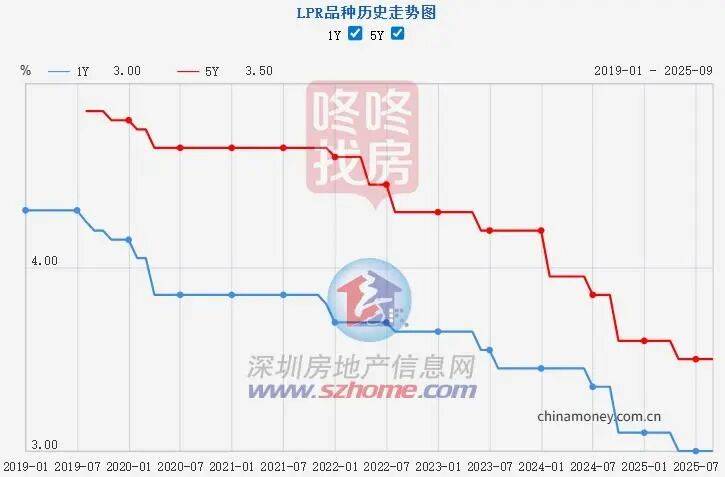
Core Points - The People's Bank of China announced that the Loan Prime Rate (LPR) for one year is set at 3.0% and for five years or more at 3.5%, remaining unchanged for four consecutive months [1] - In Shenzhen, the new policy effective from September 5 states that there will be no distinction between first and second home loan interest rates, both set at 3.05% [3][4] - Several banks in Shenzhen have begun to optimize and adjust the pricing mechanism for commercial personal housing loans following the new policy [5] Group 1 - The LPR remains stable, indicating a consistent monetary policy environment [1] - Shenzhen's new policy simplifies the mortgage landscape by unifying interest rates for first and second homes [3][4] - Banks are actively responding to the new policy by adjusting their loan pricing mechanisms [5] Group 2 - Existing borrowers of second home loans may now apply for interest rate adjustments if their original loan rates exceed the national average by 30 basis points [8] - The adjustment process for existing loans is facilitated through online channels, allowing borrowers to check eligibility and submit applications without fees [6][7] - The criteria for rate reduction are based on the comparison of original loan rates to the current national average, creating a clear threshold for borrowers [8]




中国人民银行行长潘功胜:我国金融治理体系和治理能力现代化迈上新台阶
Zheng Quan Ri Bao· 2025-09-22 16:11
Core Achievements of China's Financial Sector During the 14th Five-Year Plan - The financial system reform has deepened significantly, with the establishment of the Central Financial Committee and the Central Financial Work Committee to enhance centralized leadership over financial work [2] - The quality and efficiency of financial services to the real economy have improved markedly, with a supportive monetary policy framework aiding in the achievement of major economic and social development goals [3] - The financial sector has seen continuous reform and opening-up, with structural reforms in financial supply and a focus on high-level bilateral openness [3] - Important progress has been made in preventing and resolving financial risks, with effective measures taken to address prominent risk points in the financial sector [4] Monetary Policy and Financial Stability - The People's Bank of China has focused on establishing a dual-pillar framework for monetary and macro-prudential policy, aiming for both currency stability and financial stability [5] - A scientific and robust monetary policy system has been constructed, optimizing the monetary policy framework and enhancing the effectiveness of monetary policy tools [5] - The macro-prudential policy framework has been improved, with enhanced monitoring and management of systemic financial risks [5] Development of Financial Markets - The financial market infrastructure has been strengthened, with the introduction of a "Technology Board" in the bond market and a multi-tiered bond market framework being established [6] - The financial market has seen a steady expansion in product offerings, scale, and activity, with comprehensive strengthening of regulations and oversight [6] - Efforts are ongoing to build a higher-level open financial system, promoting the internationalization of the Renminbi and enhancing cross-border payment systems [6]
货币市场日报:9月22日
Xin Hua Cai Jing· 2025-09-22 14:17
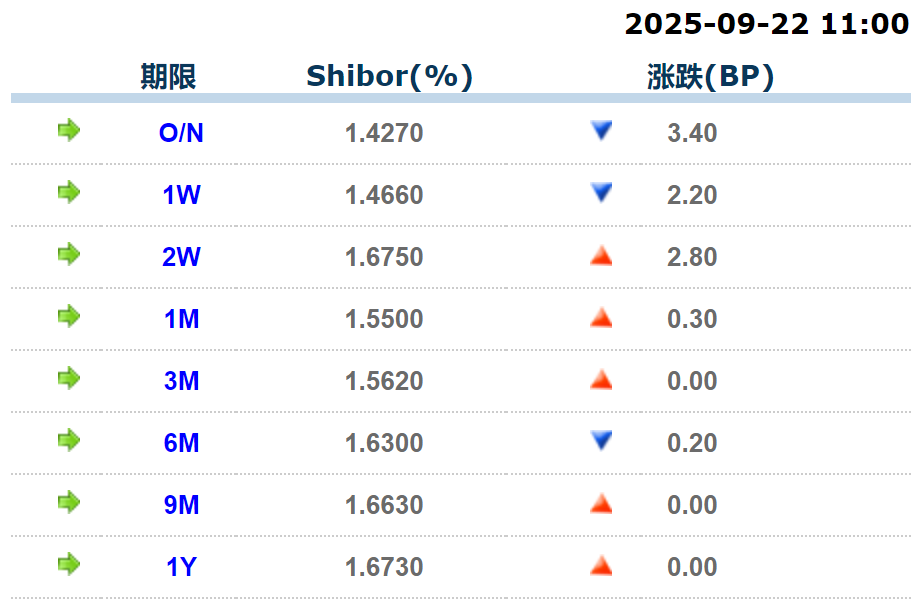
Group 1 - The People's Bank of China conducted a 240.5 billion yuan 7-day reverse repurchase operation at an interest rate of 1.40% and a 300 billion yuan 14-day reverse repurchase operation, resulting in a net injection of 260.5 billion yuan into the market [1] - The overnight and 7-day Shanghai Interbank Offered Rate (Shibor) continued to decline, while the 14-day Shibor increased. Specifically, the overnight Shibor fell by 3.40 basis points to 1.4270%, and the 7-day Shibor decreased by 2.20 basis points to 1.4660% [1][3] - In the interbank pledged repo market, the overnight rates decreased while the 14-day rates increased, with the R014 rate surpassing 1.7%. The weighted average rates for DR001 and R001 fell by 3.7 basis points and 2.4 basis points, respectively [5] Group 2 - The overall funding situation on September 22 was balanced and slightly loose, with overnight transactions primarily occurring in the range of 1.53%-1.55% and 7-day rates around 1.52% [7] - A total of 111 interbank certificates of deposit were issued on September 22, with an actual issuance amount of 231.87 billion yuan [7] - The financial regulatory authority reported that since the beginning of the "14th Five-Year Plan," insurance funds have invested over 5.4 trillion yuan in stocks and equity funds, marking an 85% increase compared to the end of the "13th Five-Year Plan" [11]
“以我为主”兼顾内外均衡,美联储降息不改中国货币政策节奏
Sou Hu Cai Jing· 2025-09-22 14:13
Core Insights - The financial industry in China has achieved significant milestones during the "14th Five-Year Plan" period, with the banking sector's total assets reaching nearly 470 trillion yuan, ranking first globally [3][4] - China maintains the world's largest foreign exchange reserves for 20 consecutive years and ranks second in stock and bond market sizes [3][4] - The People's Bank of China (PBOC) emphasizes a supportive monetary policy stance, focusing on balancing internal and external factors while enhancing financial support for the real economy [5][6] Financial Achievements - As of June 2025, China's banking assets are approximately 470 trillion yuan, leading globally [3] - The stock and bond markets are the second largest in the world, showcasing robust financial market development [3] - China is at the forefront of green finance, inclusive finance, and digital finance, with a well-established cross-border payment network [3][4] Monetary Policy - The PBOC's monetary policy is characterized by a focus on domestic priorities while considering global economic conditions [5][6] - The current loan market interest rates (LPR) remain stable, with the one-year LPR at 3% and the five-year LPR at 3.5% [5] - The PBOC aims to ensure liquidity and support economic recovery through various monetary policy tools [6] Risk Management - The PBOC highlights the importance of preventing and mitigating financial risks, particularly in local government financing and real estate sectors [7][8] - There has been a significant reduction in the number of financing platforms and overall financial debt levels, indicating improved risk management [7] - The PBOC is committed to maintaining financial stability and preventing systemic financial risks through macro-prudential measures [8]
央行:为推动经济持续回升向好,营造良好的货币金融环境
Zhong Guo Zheng Quan Bao· 2025-09-22 13:14
Core Viewpoint - The People's Bank of China (PBOC) is committed to integrating the rectification of issues identified in the recent inspection into the implementation of the Central Committee's decisions, aiming to create a favorable monetary and financial environment for sustained economic recovery [1][18]. Group 1: Rectification Measures - The PBOC has established a leadership group to oversee the rectification work, ensuring comprehensive coordination and supervision [4]. - A mechanism for regular progress reporting and accountability has been implemented, including weekly updates and a three-step verification process for rectification measures [4][5]. - The PBOC is focusing on both comprehensive and specialized rectification efforts, with a clear plan and ongoing adjustments based on feedback [5]. Group 2: Financial Infrastructure and Risk Management - The PBOC is advancing the construction of a secure and efficient financial infrastructure, including the development of cybersecurity management systems and the establishment of a financial stability guarantee fund [2][15]. - There is a strong emphasis on monitoring and preventing financial risks, with the establishment of a macro-prudential and financial stability committee to assess systemic risks [11]. - The PBOC is enhancing its legal framework, including the revision of key financial laws and the introduction of new regulations to improve financial stability [16]. Group 3: Political and Organizational Responsibility - The PBOC is reinforcing its political responsibility by ensuring that all levels of the organization align with the Central Committee's directives and maintain a high standard of governance [7][12]. - Continuous training and evaluation of leadership are being conducted to strengthen the political awareness and accountability of PBOC officials [13]. - The PBOC is committed to a long-term rectification strategy, focusing on deep-rooted issues and ensuring that improvements are sustainable [14].