
中航沈飞

Search documents
全球首张“载人类”低空OC证落地,高端装备ETF(159638)连续5天净流入
Sou Hu Cai Jing· 2025-03-31 03:15
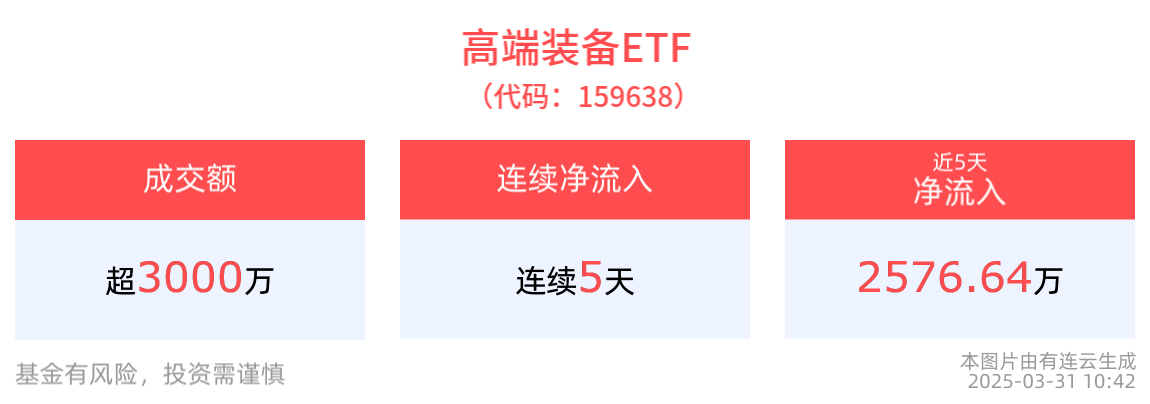
截至2025年3月31日 10:42,中证高端装备细分50指数下跌2.34%。成分股方面,中航重机领跌,中航机载、航发控制、振华风光、天奥电子跟跌。高端装备 ETF(159638)回调整固,盘中成交额已达3045.37万元。 消息面方面,中国民航局28日向广东和安徽的两家公司同时颁发了载人类民用无人驾驶航空器运营合格证,这是全国首批载人类民用无人驾驶航空器运营合 格证,标志着中国低空经济"载人时代"序章正式开启。 华泰证券表示,合肥合翼航空有限公司收到了由中国民航局颁发的全球首张"载人类"民用无人驾驶航空器运营合格证(OC证);亿航智能旗下全资子公司 亿航通航获得OC证。该载人类OC证落地代表着低空经济载人空中交通运营场景的从"0"到"1"突破,行业发展初期的"有没有运营场景"问题得到落地,建议 从飞行器侧和低空基建侧两大方向关注低空经济板块的投资机遇。 场外投资者可通过中证高端装备细分50ETF联接基金(018028)布局行业轮动机会。 拉长时间看,截至2025年3月28日,高端装备ETF近半年累计上涨12.17%。规模方面,高端装备ETF最新规模达11.40亿元。从资金净流入方面来看,高端装 备ETF近5 ...

2025年将是低空经济规模化落地元年,高端装备ETF(159638)有望受益
Jie Mian Xin Wen· 2025-03-26 03:26
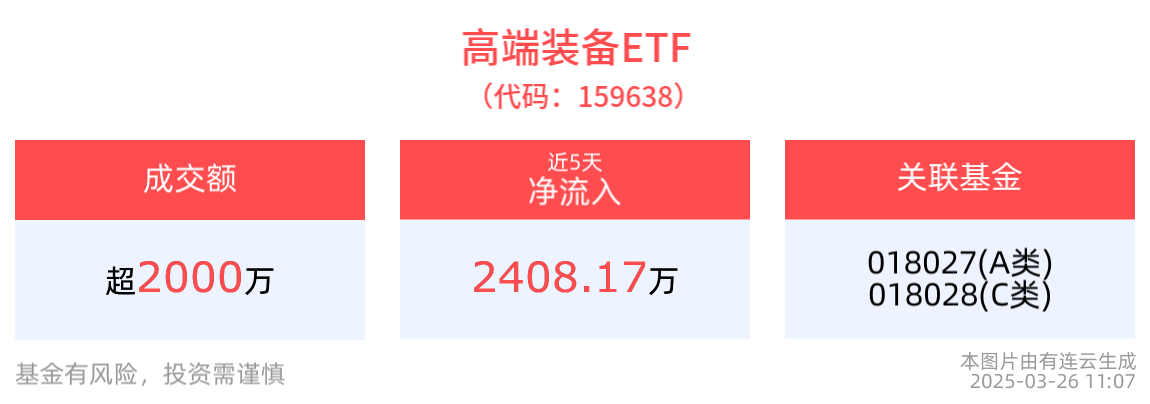
Core Viewpoint - The year 2025 is projected to be the year of large-scale implementation of the low-altitude economy, with high-end equipment ETFs (159638) expected to benefit significantly from this trend [1][4]. Group 1: Market Performance - As of March 26, 2025, the CSI High-end Equipment Sub-index has risen by 0.42%, with notable increases in constituent stocks such as Zhenhua Technology (up 4.82%) and Hangjin Technology (up 3.96%) [1]. - The high-end equipment ETF (159638) has seen a rise of 0.38%, with a trading volume reaching 24.64 million yuan [1]. Group 2: Fund Flow and Investment - The latest scale of the high-end equipment ETF has reached 1.139 billion yuan, with a net inflow of 3.171 million yuan [3]. - Over the past five trading days, there have been net inflows on four days, totaling 24.08 million yuan [3]. - Leveraged funds are actively investing, with the latest margin buying amounting to 2.321 million yuan and a margin balance of 31.896 million yuan [3]. Group 3: Industry Outlook - The high-end equipment ETF closely tracks the CSI High-end Equipment Sub-index, focusing on leading companies in aerospace, military equipment, and satellite navigation, which are expected to benefit from the low-altitude economy boom [3]. - According to Zhejiang Securities, various provincial low-altitude economic development plans and support measures are being rolled out in 2024, with 2025 anticipated to be a pivotal year for large-scale application of new technologies and products in this sector [4]. - The low-altitude economy is expected to play a significant role in macroeconomic recovery and has strategic importance in the competition between emerging industries in China and abroad [4].
前海开源新经济混合C连续3个交易日下跌,区间累计跌幅4.09%
Sou Hu Cai Jing· 2025-03-25 16:38
公开信息显示,现任基金经理崔宸龙先生:中国国籍,研究生、博士,曾任深圳市前海安康投资发展有限公 司研究部研究员,2017年8月加盟前海开源基金管理有限公司,曾任权益投资本部研究员,现任权益投资本 部基金经理。2020年7月20日起担任前海开源公用事业行业股票型证券投资基金基金经理。2020年7月20 日起担任前海开源沪港深非周期性行业股票型证券投资基金基金经理。2020年10月27日起担任前海开源 新经济灵活配置混合型证券投资基金基金经理。2021年6月24日起担任前海开源沪港深智慧生活优选灵 活配置混合型证券投资基金基金经理。2021年11月18日担任前海开源新兴产业混合型证券投资基金基金 经理。2023年01月13日担任前海开源沪港深新机遇灵活配置混合型证券投资基金基金经理。 截止2024年12月31日,前海开源新经济混合C前十持仓占比合计60.81%,分别为:航发动力 (9.60%)、中航沈飞(9.60%)、法拉电子(9.10%)、中航西飞(8.59%)、紫光国微(5.37%)、中 航重机(4.75%)、山东黄金(3.59%)、国轩高科(3.56%)、道通科技(3.40%)、微光股份 (3.25%)。 ...
中航沈飞(600760)3月24日主力资金净流出1068.72万元
Sou Hu Cai Jing· 2025-03-24 08:55
中航沈飞最新一期业绩显示,截至2024三季报,公司营业总收入252.98亿元、同比减少26.95%,归属净 利润18.18亿元,同比减少23.12%,扣非净利润17.86亿元,同比减少22.31%,流动比率1.354、速动比率 0.997、资产负债率67.25%。 中航沈飞(600760)3月24日主力资金净流出 1068.72万元 金融界消息 截至2025年3月24日收盘,中航沈飞(600760)报收于43.85元,下跌0.27%,换手率 0.46%,成交量12.63万手,成交金额5.52亿元。 资金流向方面,今日主力资金净流出1068.72万元,占比成交额1.94%。其中,超大单净流入276.99万 元、占成交额0.5%,大单净流出1345.71万元、占成交额2.44%,中单净流出流入3745.27万元、占成交 额6.79%,小单净流出2676.55万元、占成交额4.85%。 天眼查商业履历信息显示,中航沈飞股份有限公司,成立于1996年,位于威海市,是一家以从事汽车制 造业为主的企业。企业注册资本275569.9513万人民币,实缴资本140192.83万人民币。公司法定代表人 为纪瑞东。 通过天眼查大 ...

“深海科技”首次写入政府工作报告,水下装备产业迎来重要发展机遇
China Post Securities· 2025-03-17 05:20
Investment Rating - The industry investment rating is "Outperform the Market" [1] Core Insights - The concept of "Deep Sea Technology" has been included in the government work report for the first time, indicating significant growth opportunities for the underwater equipment industry [4][10] - The government aims to promote the large-scale application of new technologies and products in emerging industries, including deep sea technology, commercial aerospace, and low-altitude economy [4][10] - The underwater combat capabilities are considered an important component of new domain combat power, with technologies such as underwater acoustic detection and communication, and UUV technology expected to play a crucial role [11] Summary by Sections Industry Overview - The closing index for the defense and military industry is 1555.26, with a 52-week high of 1712.48 and a low of 1113.62 [1] Investment Recommendations - Two main investment themes are suggested: 1) Aerospace and "gap-filling" new focuses, including companies like Feilihua, Fenghuo Electronics, and AVIC Shenyang Aircraft [12][13] 2) New technologies, products, and markets with greater elasticity, including companies like Aerospace Zhizao, Guorui Technology, and Guangdong Hongda [12][13] Market Performance - The military industry index increased by 2.57% this week, ranking 9th among 31 first-level industries [14] - The top ten performing stocks in the military sector this week include Zhongke Haixun (+62.42%) and Hongyuan Electronics (+23.80%) [16] Valuation Levels - As of March 14, 2025, the military industry index stands at 11204.55, with a PE-TTM valuation of 78.84 and a PB valuation of 3.55, both at historical mid-levels [19] Key Data Tracking - The report tracks various aspects, including private placements and stock incentive data for military companies [22][25] - The report highlights significant growth in the low-altitude economy and military trade markets, with the U.S. maintaining a dominant position in global arms exports [28][30]
军工行业本周观点:继续乐观
Huafu Securities· 2025-03-16 09:36
Investment Rating - The report maintains an "Outperform" rating for the defense and military industry [5]. Core Viewpoints - The report expresses continued optimism for the military industry, highlighting a 2.57% increase in the Shenwan Military Index (801740) compared to a 1.59% increase in the CSI 300 Index, resulting in an excess return of 0.98 percentage points [2][43]. - The 2025 government work report emphasizes "deep-sea technology" as a new emerging industry, which has positively impacted related stocks [3][43]. - The macro-level focus on completing the "14th Five-Year Plan" is expected to accelerate improvements in the industry's fundamentals [3][44]. - The report notes a slight decrease in financing buy-in amounts, but an increase in military ETF fund sizes and shares, indicating stable confidence from passive funds in the military sector [3][44]. Summary by Sections Market Performance - The Shenwan Military Index increased by 2.57% during the week of March 10-14, outperforming the CSI 300 Index by 0.98 percentage points [10][17]. - Since May 2024, the Shenwan Military Index has risen by 22.96%, while the CSI 300 Index has increased by 11.16%, resulting in an excess return of 11.8 percentage points [19][10]. - The engine sector performed the best this week, with significant gains from stocks like Baotai Co., which rose by 21.07% due to the "deep-sea technology" theme [24][10]. Investment Opportunities - The report suggests focusing on traditional main battle equipment and high-elasticity sectors that will cross the "15th Five-Year Plan" cycle [45][47]. - Key companies to watch include: - Traditional Equipment: AVIC Shenyang Aircraft, AVIC Xi'an Aircraft, and others [47]. - High Elasticity Directions: Commercial engines, materials, information technology, low-cost drones, and controlled nuclear fusion [47]. Valuation and Funding - As of March 15, the TTM price-to-earnings ratio for the Shenwan Military Index is 63.72, with a percentile rank of 86.27%, indicating a high configuration value despite some valuation increases [4][45]. - The report notes that passive funds have shown a net inflow of 949 million yuan into military ETFs, reflecting strong confidence in the sector [30][44].
2025年国防支出预算点评:国防支出预算增长7.2%,国防建设有望稳步推进
Guotai Junan Securities· 2025-03-14 11:34
Investment Rating - The report assigns an "Overweight" rating for the defense industry, consistent with the previous rating [8]. Core Insights - The national defense budget for 2025 is set at 1,784.7 billion yuan, reflecting a year-on-year increase of 7.2%, which is higher than the expected GDP growth target of 5% [3][8]. - The defense budget growth rate has remained stable over the past nine years, with the proportion of defense spending to GDP still having room for improvement compared to countries like the US and Japan [3][8]. - The report emphasizes the importance of the defense budget as a foundation for modernization and equipment development, with a consistent growth trend observed from 2016 to 2024 [3][8]. Summary by Sections National Defense Budget Overview - The 2025 defense budget is 1,784.7 billion yuan, marking a 7.2% increase, which aligns with the stable growth trend observed in previous years [3][8]. - The defense budget growth has been consistent, with annual increases of 7.6%, 7%, 8.1%, 7.5%, 6.6%, 6.8%, 7.1%, and 7.2% from 2016 to 2024 [8]. Comparison with Other Countries - Japan's defense budget for 2025 is projected at 8.7 trillion yen, a 9.4% increase, while the US defense budget for the fiscal year 2024 is approximately 886 billion USD, accounting for 3% of its GDP [8]. - China's defense spending as a percentage of GDP has remained below 1.5%, indicating significant potential for growth compared to global averages and specific countries [8]. Strategic Implications - The report highlights the ongoing modernization of the military and defense capabilities as a priority, with a focus on implementing Xi Jinping's military strategies and enhancing combat readiness [8]. - The year 2025 is seen as a pivotal year for transitioning from the 14th Five-Year Plan to the 15th, with expectations for steady growth in defense spending to support modernization goals [8]. Recommended Investment Targets - The report suggests focusing on companies within the aerospace and aviation supply chain, recommending specific stocks such as AVIC Optoelectronics, Aerospace Electric, AVIC Shenyang Aircraft, and others [8].
国防军工行业周报:习近平出席解放军和武警部队代表团全体会议,SpaceX试飞遇挫-2025-03-14
Guotai Junan Securities· 2025-03-14 11:28
Investment Rating - The report maintains an "Overweight" rating for the defense and military industry [1] Core Insights - The defense sector has shown an upward trend, with significant increases in indices, particularly a 7.44% rise in the national defense and military index, outperforming the broader market by 5.88 percentage points [4][9] - The report emphasizes that the intensification of great power competition is a long-term trend, leading to increased defense spending and a positive long-term outlook for the military industry [10][11] Summary by Sections Market Review - The national defense and military index rose by 7.44% from March 3 to March 7, outperforming the Shanghai Composite Index, which increased by 1.56% [15][16] - The CSI National Defense Index performed the best among military indices, with an 8.98% increase [17][18] - The report highlights strong performances in the national defense information technology and materials processing sectors [19][21] Major News in the Military Industry - President Xi Jinping emphasized the importance of completing the military's "14th Five-Year Plan" during a meeting with military representatives, which is crucial for achieving the centenary goals of the military [26] - SpaceX's eighth test flight of the "Starship" faced setbacks, and Russia conducted strikes on Ukrainian energy facilities, indicating ongoing geopolitical tensions [28] Investment Focus - Key investment areas identified include: 1. Assembly: AVIC Shenyang Aircraft Corporation 2. Components: AVIC Optoelectronics, Aerospace Electrical Equipment 3. Subsystems: AVIC Onboard, North Navigation 4. Materials and Processing: Fushun Special Steel, AVIC Heavy Machinery, Philit, Tunan Co., Huayin Technology, and Plit [11][12]


2025年国防军工行业春季投资策略:军工订单落地促发大反转,军用AI/机器人拓展大空间
申万宏源· 2025-03-11 09:20
Investment Rating - The report provides a positive investment outlook for the defense and military industry, highlighting a dual logic driving significant market opportunities in 2025 [4]. Core Insights - The report emphasizes that the improvement in military orders and thematic catalysts, such as military AI and robotics, will significantly expand the investment space and elasticity within the military sector [4][40]. - It identifies four main investment themes: order elasticity in missiles and underwater systems, thematic space in military AI/robotics, military-civilian integration in commercial aerospace and low-altitude economy, and value investment in aircraft and engines [4][50]. Summary by Sections 1. Dual Logic Driving the 2025 Military Market - The report outlines that the military construction cycle in China is currently in a new phase, with increasing demand for various military products and a shift from sporadic orders to more consistent and widespread orders across the industry [4][10]. - It notes that the demand for military supplies is expected to grow due to increased training frequency and global conflicts, which will drive ammunition consumption [16][23]. 2. Order Elasticity Main Line: Missiles/Underwater - The missile sector is projected to enter a growth phase in 2025, with significant potential for order elasticity, particularly in guided missiles [4][50]. - The underwater sector is also highlighted, with a focus on the development of underwater combat systems and the integration of various platforms [78][82]. 3. Thematic Catalysts: Military AI/Robotics - The report discusses the acceleration of military AI and robotics, which are expected to become core components of new combat capabilities, enhancing the overall investment landscape [40][44]. - It emphasizes that global military powers are increasingly prioritizing the development of intelligent weaponry and new combat strategies [44][45]. 4. Military-Civilian Integration: Commercial Aerospace/Low-altitude Economy - The report indicates that policies supporting commercial aerospace and low-altitude economies are gaining traction, presenting new investment opportunities [4][50]. - It highlights specific companies that are well-positioned to benefit from these trends, such as Zhenray Technology and Shanghai Hanhua [4]. 5. Value Investment Main Line: Aircraft/Engines - The aircraft and engine sectors are expected to maintain stable growth, with resilience against market fluctuations [4][50]. - The report suggests focusing on companies like AVIC Shenyang Aircraft and Aero Engine Corporation of China for potential investments [4].
注重AI+机器人带来的行业投资机遇:IDEX2025盛大开幕,我国军工企业组团亮相
Jianghai Securities· 2025-02-25 02:00
Investment Rating - The industry investment rating is maintained at "Overweight" [4] Core Insights - The report highlights the recent launch of the revised "Military Equipment Research Regulations," indicating a new wave of investment opportunities in the defense and military industry [3][4] - The IDEX 2025 exhibition showcased China's defense capabilities, with a focus on AI and robotics, emphasizing the potential for investment in these areas [4][5] - The report identifies the growing importance of AI technology in enhancing military capabilities and the emergence of quadruped robots as key assets in future combat scenarios [5] Summary by Sections Industry Performance - Over the past 12 months, the industry has shown an absolute return of 23.78%, while the relative return compared to the CSI 300 index is 8.02% [2] Investment Highlights - The IDEX 2025 exhibition featured 1,565 companies from 65 countries, with China's defense sector prominently displaying advanced technologies such as new air defense missiles, high-performance drones, and cutting-edge radar systems [4] - The report emphasizes the significance of quadruped robots in military reconnaissance, disaster rescue, and logistics, showcasing their adaptability and advanced capabilities [5] Investment Recommendations - The report suggests that national policies and advancements in AI technology will accelerate the military industry's shift towards intelligence and informationization, creating new opportunities for companies in the defense supply chain [5]