
宁波银行

Search documents
机构深挖科技股机会 银行股调研热度提升
Zheng Quan Shi Bao· 2025-10-17 18:52
Group 1: Market Trends and Performance - A total of 173 listed companies received institutional research during the week of October 13 to 17, with approximately 20% of the researched stocks achieving positive returns, led by Huicheng Environmental with a 20.08% increase [1] - The technology sector remained a focus for research despite experiencing adjustments, with companies like Dike Co., Nengke Technology, and Aipeng Medical attracting around 100 institutional inquiries [1] Group 2: Semiconductor Industry Insights - The storage industry is witnessing a continuous price increase, prompting institutions to explore investment opportunities [2] - Dike Co. indicated a positive outlook for the storage sector, expecting revenue growth in its storage business, and is planning to acquire Jiangsu Jingkai to enhance its integrated capabilities in DRAM chip application development and testing [2] - Deep Technology stated that its semiconductor packaging and testing business is progressing steadily, with capacity utilization meeting order demands [2] - Demingli projected a favorable trend for the storage industry cycle, driven by advancements in NAND technology and increasing demand for high-speed storage due to AI applications [2] Group 3: Policy Impact on Companies - The recent issuance of guidelines for AI model deployment in government sectors is expected to enhance the intelligent service upgrade in the public sector, as noted by Nanwei Software [3] - Zhongjin Irradiation plans to strengthen communication with cobalt suppliers to mitigate costs following the implementation of cobalt export quotas in the Democratic Republic of the Congo [3] - Zhongji United has prepared sufficient inventory to manage potential tariff changes, ensuring minimal short-term impact on operations while maintaining communication with clients to adjust pricing strategies as needed [3] Group 4: Banking Sector Developments - Bank stocks have become a safe haven during market adjustments, leading to increased research interest [4] - Shanghai Bank reported a more than 6% increase in stock price and plans to maintain a stable dividend policy, with a cash dividend ratio of no less than 30% over the next three years [4] - Ningbo Bank's stock rose by 4%, with the bank emphasizing its commitment to expanding financial services to meet the financing needs of the real economy while ensuring steady growth in credit [4]


银行积存金“门槛”频上调
Zhong Guo Jing Ying Bao· 2025-10-17 18:51
Core Viewpoint - The rising gold prices, driven by multiple factors including expectations of interest rate cuts by the Federal Reserve and increasing geopolitical risks, have led to a surge in investor interest in gold-related investments, particularly gold ETFs and accumulation gold products offered by commercial banks [1][2]. Group 1: Market Trends - The scale of gold ETFs has rapidly expanded, with 14 commodity gold ETFs collectively nearing 200 billion yuan, and a net inflow of 73.8 billion yuan from January to mid-October 2025 [2]. - The international gold price has recently surpassed 4,000 USD per ounce, reaching an opening price of 4,208.757 USD per ounce on October 16, 2025, marking a year-to-date increase of 61% [2]. - Accumulation gold products are gaining popularity due to their flexible investment thresholds and features like dollar-cost averaging, which help mitigate risks in a volatile market [3]. Group 2: Institutional Responses - Several major banks, including Bank of China, Industrial and Commercial Bank of China, and China Construction Bank, have raised the minimum purchase amounts for accumulation gold products to enhance risk management and investor suitability [1][2]. - The minimum purchase amount for Bank of China’s accumulation gold products will increase from 850 yuan to 950 yuan starting October 15, 2025, while ICBC has raised its minimum investment from 850 yuan to 1,000 yuan [1][2]. Group 3: Risk Management - Analysts suggest that the rapid increase in gold prices and heightened volatility necessitate stronger risk controls from financial institutions, which is reflected in the recent adjustments to investment thresholds [2][4]. - The year-to-date increase in gold prices exceeding 50% and the rising volatility have raised concerns about potential risks, prompting banks to respond to regulatory guidance by increasing minimum purchase amounts and margin requirements [4].




多家银行官宣调整!积存金起购金额升高,有银行门槛已达1000元
Mei Ri Jing Ji Xin Wen· 2025-10-17 16:06
Group 1 - The international gold price has recently surged, breaking through $4,300 per ounce, while domestic gold prices have also risen, with the Shanghai gold futures surpassing 1,000 yuan [1] - Several domestic banks have increased the minimum investment threshold for gold accumulation products, with the minimum amount exceeding 1,000 yuan [2][3] - The adjustments in investment thresholds by banks are attributed to significant fluctuations in domestic gold prices, indicating a trend of increasing thresholds among banks [4] Group 2 - The international gold price has seen a cumulative increase of over 66% this year, with the World Gold Council stating that this year could witness the largest price increase since 1979 [5] - Factors contributing to the recent surge in gold prices include renewed risks in the U.S. regional banking sector, which have heightened market concerns about the stability of the credit system and increased demand for safe-haven assets [5][6] - The ongoing external uncertainties continue to support high demand for gold, suggesting that investors should approach gold investments with caution and consider long-term strategies rather than short-term gains [6]
年内多家银行上调部分代销公募基金风险评级
Zheng Quan Ri Bao Zhi Sheng· 2025-10-17 15:38
Core Viewpoint - Multiple banks in China, including CITIC Bank, are adjusting the risk ratings of their asset management products, primarily to comply with regulatory requirements and enhance investor protection [1][4]. Group 1: Risk Rating Adjustments - CITIC Bank announced an adjustment of risk ratings for 17 asset management products, with 15 products seeing an increase in their risk ratings and 2 experiencing a decrease [2]. - The adjustment covers a wide range of product types, including passive index bond funds, mixed equity funds, and flexible allocation funds, indicating a comprehensive approach to risk assessment [2]. - This marks the fourth adjustment by CITIC Bank in 2023, reflecting ongoing regulatory compliance and the need for consistent risk rating practices [2]. Group 2: Regulatory and Market Influences - The adjustments are driven by the dual factors of deepening regulatory requirements and changes in market conditions, necessitating a more accurate reflection of risk levels [4]. - The regulatory framework established by the National Financial Supervision Administration in March 2023 mandates banks to independently assess the risk of asset management products and align them with appropriate customer profiles [4]. - As market volatility increases, the underlying risk-return characteristics of certain funds have changed, prompting banks to adjust ratings accordingly [4]. Group 3: Implications for the Banking and Asset Management Industry - In the short term, banks may experience fluctuations in sales revenue from high-risk products due to these adjustments, but long-term benefits include reduced legal disputes and enhanced reputation through improved compliance [5]. - The dynamic rating system is expected to encourage asset management companies to optimize product design and risk control, shifting the industry focus from "scale expansion" to "high-quality development" [5]. - Banks are advised to enhance their due diligence capabilities to better manage risks associated with asset management product sales [5].

走出“V”形曲线,国际金价波动加剧
Sou Hu Cai Jing· 2025-10-17 10:31
Core Viewpoint - The recent fluctuations in gold prices are driven by increased market uncertainty and rising demand for safe-haven assets due to concerns over the stability of the credit system and geopolitical tensions [4][7]. Group 1: Gold Price Movements - On October 17, gold prices experienced significant volatility, with spot gold and COMEX gold reaching highs of $4380.79 and $4392 per ounce, respectively, before declining and then rebounding [1]. - As of the report, spot gold and COMEX gold were trading around $4335 and $4359 per ounce [1]. Group 2: Factors Driving Gold Prices - The recent surge in gold prices is attributed to concerns over loan fraud at two U.S. regional banks, which heightened fears regarding the stability of the credit system and increased safe-haven demand [4]. - Ongoing geopolitical uncertainties, including the U.S. government shutdown and unresolved U.S.-China trade tensions, have further supported high levels of market risk aversion [4]. Group 3: Investment Trends - Domestic banks have raised the investment thresholds for gold accumulation products multiple times this year, with some banks increasing the minimum purchase price to 1000 yuan per gram [5]. - Despite price volatility, global gold demand reached 1249 tons in Q2 2025, a 3% year-on-year increase, driven primarily by strong investment demand [5]. Group 4: Market Outlook - Analysts suggest that the current environment, characterized by rising credit risks and geopolitical tensions, will continue to support gold prices in the medium term [7]. - Long-term factors such as the restructuring of the global monetary credit system, de-dollarization trends, and ongoing central bank purchases of gold are expected to sustain the bullish trend in gold prices over the next 2-3 years [7].
金融行业双周报(2025/10/3-2025/10/16):关税扰动再起,银行红利价值凸显-20251017
Dongguan Securities· 2025-10-17 10:00
Investment Ratings - Banking: Overweight (Maintain) [1] - Securities: Market Weight (Maintain) [1] - Insurance: Overweight (Maintain) [1] Core Insights - The banking sector is seen as a safe haven amid rising market uncertainties, with high dividend yield assets becoming increasingly attractive [1][41] - The securities sector is benefiting from a surge in trading volumes and increased stamp duty revenues, indicating strong performance in upcoming quarterly reports [1][43] - The insurance sector is experiencing significant growth in investment income and new business value, driven by increased equity market exposure and favorable policy support [1][45] Summary by Sections Market Review - As of October 16, 2025, the banking index increased by 5.53%, the securities index decreased by 0.57%, and the insurance index rose by 6.27%, while the CSI 300 index fell by 0.48% [11] - Among the sub-sectors, Chongqing Bank (+15.90%), GF Securities (+8.98%), and New China Life Insurance (+12.21%) showed the best performance [11] Valuation Situation - As of October 16, 2025, the banking sector's price-to-book (PB) ratio is 0.73, with state-owned banks at 0.79, joint-stock banks at 0.62, city commercial banks at 0.73, and rural commercial banks at 0.65 [22] - The securities sector's PB ratio is 1.59, indicating potential for valuation recovery [24] - Insurance companies' price-to-earnings value (PEV) ratios are as follows: New China Life (0.74), China Pacific Insurance (0.59), Ping An (0.69), and China Life (0.72) [25] Recent Market Indicators - As of October 16, 2025, the one-year Medium-term Lending Facility (MLF) rate is 2.0%, and the one-year and five-year Loan Prime Rates (LPR) are 3.0% and 3.50%, respectively [29] - The average daily trading volume in the A-share market is 22,359.31 billion, showing a decrease of 13.57% [33] - The total social financing scale reached 437.08 trillion yuan, with a year-on-year growth of 8.7% [41] Company Announcements - New China Life Insurance expects a net profit of 29.986 billion to 34.122 billion yuan for the first three quarters of 2025, representing a year-on-year increase of 45% to 65% [45] - Shanghai Bank announced a cash dividend of 0.30 yuan per share, totaling 4.263 billion yuan [41]




城商行板块10月17日跌0.17%,上海银行领跌,主力资金净流出4.03亿元
Zheng Xing Xing Ye Ri Bao· 2025-10-17 08:35
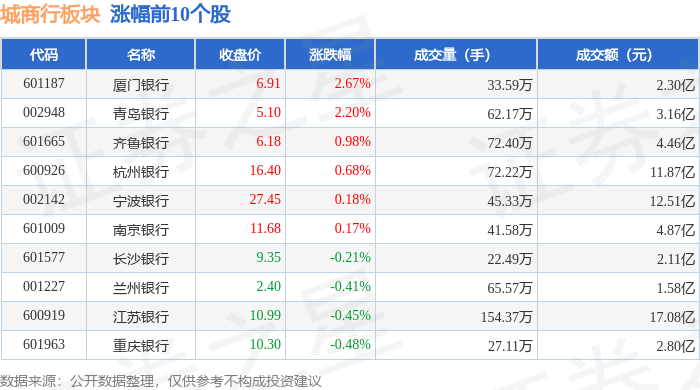
Market Overview - The city commercial bank sector experienced a decline of 0.17% on October 17, with Shanghai Bank leading the drop [1] - The Shanghai Composite Index closed at 3839.76, down 1.95%, while the Shenzhen Component Index closed at 12688.94, down 3.04% [1] Individual Bank Performance - Xiamen Bank saw a closing price of 6.91, with an increase of 2.67% and a trading volume of 335,900 shares, amounting to a transaction value of 230 million [1] - Qingdao Bank closed at 5.10, up 2.20%, with a trading volume of 621,700 shares and a transaction value of 316 million [1] - In contrast, Shanghai Bank closed at 9.49, down 1.04%, with a trading volume of 768,900 shares and a transaction value of 734 million [2] Capital Flow Analysis - The city commercial bank sector saw a net outflow of 403 million from institutional investors, while retail investors contributed a net inflow of 308 million [2] - The table indicates that Suzhou Bank had a net inflow of 24.27 million from institutional investors, while it faced a net outflow of 14.17 million from speculative funds [3] - Jiangsu Bank experienced a net outflow of 24.10 million from institutional investors but had a net inflow of 1.78 million from retail investors [3]



多家银行上调代销基金风险评级
Zhong Guo Jing Ying Bao· 2025-10-17 07:13
Core Viewpoint - Recent adjustments in risk ratings for fund distribution by banks are closely related to market changes, with increased asset risk and a shift from static to dynamic risk management practices [1][2][3] Group 1: Risk Rating Adjustments - Multiple banks, including CITIC Bank, have raised the risk ratings of 15 out of 17 asset management products, indicating a trend towards higher risk assessments in response to market conditions [2][5] - The adjustments are part of a broader regulatory requirement for banks to independently conduct risk ratings and ensure consistency with fund managers' ratings [3][4] - The adjustments reflect a need to align risk ratings with the actual risk profiles of funds, particularly for equity and pension-themed funds, which have shown structural changes in risk characteristics [6][7] Group 2: Regulatory and Market Influences - The implementation of the "Commercial Bank Agency Sales Business Management Measures" starting October 1, 2025, mandates banks to independently assess risk ratings, influencing recent adjustments [3][4] - Data analysis revealed a mismatch between clients' risk profiles and the actual risk levels of funds they held, prompting banks to raise ratings to mitigate overexposure to risk [3][6] - Market volatility, particularly in the A-share market, has led to increased risk for equity funds, necessitating adjustments in their risk ratings [6][7] Group 3: Investor Risk Assessment Changes - Some banks, like Jiangnan Rural Commercial Bank, have revised their investor risk assessment rules to enhance consumer protection and ensure appropriate risk evaluations [4] - The new rules limit the frequency of risk assessments and establish a one-year validity period for assessment results, emphasizing the importance of timely evaluations in light of changing financial circumstances [4] - The overall trend indicates that banks are striving to improve their suitability management practices to better protect investors' interests [4][5]
金价再创新高!有投资者欲贷款炒金,银行密集提示市场风险
Sou Hu Cai Jing· 2025-10-17 06:43
Core Insights - Gold prices have reached new highs, touching $4,380 per ounce on October 17, with an increase of over 40% year-to-date [2] - The rising gold prices have sparked interest among investors, with many considering investing in gold, including some planning to use loans for funding [2] Investment Behavior - Some investors are utilizing consumer loans with interest rates around 3% to invest in gold, while others are leveraging credit card interest-free periods of 20 to 56 days to fund their investments [2] - Additionally, some investors are using online lending platforms like Huabei to finance their gold investments [2] Risk Warnings from Banks - Major banks such as ICBC and CCB have issued warnings regarding the risks associated with precious metal investments due to increased market volatility [3] - ICBC advised investors to be aware of market changes and to enhance their risk awareness, suggesting a diversified approach to gold investments [3] - CCB highlighted the need for clients to manage their positions and margin balances carefully in light of heightened market risks [3] Market Cooling Measures - Several banks have raised the minimum purchase amounts for gold accumulation products to cool down the market [4] - Bank of China announced an increase in the minimum purchase amount for gold accumulation products from 850 yuan to 950 yuan [4] - ICBC raised the minimum investment for its "Ruyi Jin" accumulation product from 850 yuan to 1,000 yuan, while maintaining a minimum of 1 gram for weight-based accumulation [4] - Ningbo Bank also adjusted its minimum purchase amount for gold accumulation from 900 yuan to 1,000 yuan due to significant price fluctuations [4]

多只基金密集调升风险等级,“翻倍基”也在列,你买的基金受影响不?
Xin Lang Cai Jing· 2025-10-17 06:28
Core Insights - Recent adjustments in risk ratings for multiple funds indicate increased market volatility and a need for better investor protection [1][2][3] Group 1: Fund Risk Rating Adjustments - A total of 17 asset management products will have their risk ratings adjusted by Citic Bank, with 15 funds seeing an increase and 2 a decrease [2] - The risk rating for the Huatai-PineBridge North Exchange Innovation Selected Two-Year Open Fund was raised from PR4 to PR5, reflecting its high one-year return of 126.13% [2][3] - Increased volatility in the bond market has led to several bond funds also experiencing risk rating upgrades, with 28 out of 31 products adjusted by Fuguo Fund seeing an increase [3] Group 2: Impact on Investors - The adjustments do not change the core attributes of already purchased products, but may affect ongoing investment strategies, particularly for systematic investment plans [4] - If the new risk rating exceeds an investor's risk tolerance, it could result in failed investment deductions, potentially leading to the automatic termination of investment agreements after three consecutive failures [4] - Investors are advised to regularly reassess their risk tolerance and the risk-return characteristics of their funds in light of market changes [4]