迈瑞医疗

Search documents
双创50ETF(588380)开盘跌1.10%,重仓股宁德时代涨0.77%,中芯国际跌1.27%
Xin Lang Cai Jing· 2025-09-24 01:40
Group 1 - The core point of the article highlights the performance of the 双创50ETF (588380), which opened down by 1.10% at 0.902 yuan on September 24 [1] - The major holdings of the 双创50ETF include companies like 宁德时代, 中芯国际, and 迈瑞医疗, with varying performance; 宁德时代 increased by 0.77%, while 中际旭创 decreased by 4.21% [1] - The 双创50ETF's performance benchmark is the 中证科创创业50指数, managed by 富国基金管理有限公司, with a return of -9.01% since its inception on June 29, 2021, and a recent one-month return of 21.02% [1]





科创主线不变,节前风格或倾向于低估值标的
Xinda Securities· 2025-09-23 13:04
Investment Rating - The investment rating for the pharmaceutical and biotechnology industry is "Positive" [2] Core Viewpoints - The report indicates that the innovation-driven market trend in China is still ongoing, with a focus on innovative drugs, medical devices, and AI healthcare as key areas for medium to long-term investment. Short-term strategies may favor stable and undervalued stocks due to cautious capital allocation ahead of the holiday [3][12] - The report suggests a focus on undervalued stocks for pre-holiday allocation, recommending companies such as Xinhua Medical (2025 expected PE of approximately 13 times), Liuyuan Group (2025 expected PE of approximately 9 times), and Baiyunshan (2025 expected PE of approximately 13 times) [3][12] - The report highlights various sectors within the industry, including high-end medical devices, AI healthcare, CXO, and life sciences, suggesting specific companies to watch in each category [13][14][12] Summary by Sections 1. Industry Overview - The pharmaceutical and biotechnology sector experienced a weekly return of -2.07%, ranking 23rd among 31 first-level sub-indices. The medical services sub-sector had the best performance with a weekly return of -0.47% [10][27] - Over the past month, the sector's return was -1.19%, ranking 26th among first-level sub-indices, with medical services again leading with a return of 6.43% [10][25] 2. Market Performance and Valuation - The current PE (TTM) for the pharmaceutical and biotechnology industry is 31.19 times, slightly above the 5-year average of 29.46 times. The industry is trading at a premium of 137% compared to the CSI 300 index [20][22][24] - The report notes that the medical services sub-sector has shown the highest growth over the past year, with a return of 87.05% [29] 3. Sector Dynamics - High-end medical devices are expected to see growth driven by hospital procurement recovery, with companies like KAILI Medical and Mindray Medical recommended for attention [13] - In AI healthcare, companies such as JD Health and Alibaba Health are highlighted for their performance in AI-driven e-commerce and marketing [13] - The CXO and life sciences sectors are also emphasized, with leading companies like WuXi AppTec and Tigermed suggested for investment [14] 4. Recent Industry Developments - The report outlines recent policy changes, including the launch of the 11th batch of national drug centralized procurement, which aims to balance clinical needs and rational competition among enterprises [11][44] - Key announcements from companies in the sector include new drug registrations and clinical trial approvals, indicating ongoing innovation and regulatory progress [45]
【IPO前哨】获华为入股,半导体领域独角兽赛美特冲刺港股
Sou Hu Cai Jing· 2025-09-23 08:37
Core Viewpoint - The semiconductor sector in Hong Kong is experiencing significant growth, with companies like Saimate Information Group (赛美特) entering the market and aiming for an IPO to enhance R&D and strategic investments [1][2][3]. Company Overview - Saimate is not a traditional chip manufacturer but a provider of intelligent manufacturing software solutions for the semiconductor industry, having developed the first and only full-stack smart manufacturing and management software solution in the industry [2][5]. - The company has successfully integrated the entire semiconductor manufacturing process and is the first domestic supplier to have a fully automated Computer Integrated Manufacturing (CIM) solution validated and put into mass production by several 12-inch wafer fabs [2][5]. Market Context - The semiconductor sector is heating up due to the domestic substitution trend, with multiple companies in the semiconductor supply chain pursuing listings on the Hong Kong Stock Exchange [1][3]. - Saimate is positioned as the largest provider of advanced industrial intelligent manufacturing software in China, with its revenue primarily derived from the semiconductor sector [5]. Financial Performance - Saimate's revenue is projected to grow from 181 million RMB in 2022 to 499 million RMB in 2024, with a net profit of 73.83 million RMB expected in 2024 [10][11]. - The company has seen a rapid increase in its customer base, growing from 223 clients at the end of 2022 to an expected 758 by mid-2025, with a compound annual growth rate of 38.1% for its intelligent manufacturing software solutions [8][10]. Investment and Valuation - Since 2021, Saimate has raised nearly 1 billion RMB across five funding rounds, with notable investors including Huawei and BYD [6][7]. - Following its C+ round financing at the end of 2023, Saimate's implied valuation reached 6.383 billion RMB [7]. Challenges and Future Outlook - Despite the overall growth in the semiconductor industry, Saimate's revenue growth has slowed, with a 9.7% increase in the first half of 2025 compared to a 74.2% increase the previous year [10][12]. - The company faces intense competition from both international giants and domestic peers, which may pressure project bidding prices and impact revenue growth [12]. - Saimate has increased its R&D investment by 32% to nearly 38.17 million RMB, indicating a commitment to technological innovation and the development of a self-developed ERP system for domestic substitution [12][13].


成交34亿领跑同类!创业板50ETF(159949)资金悄然回流5.1亿 机构扎堆看好储能
Xin Lang Ji Jin· 2025-09-23 08:32
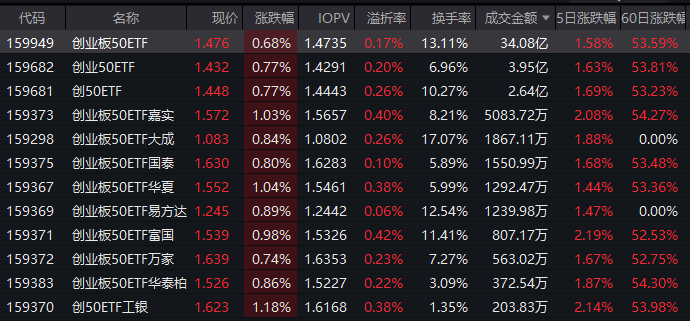
Group 1 - The Huazhong Entrepreneur Board 50 ETF has seen a net inflow of 510 million yuan over the past five trading days, while experiencing a net outflow of 3.73 billion yuan over the past 20 trading days, indicating fluctuating investor sentiment [1] - As of September 22, 2025, the circulating scale of the ETF is 25.97 billion yuan, with a total trading volume of 68.105 billion yuan over the last 20 trading days, averaging 3.405 billion yuan per day, showcasing strong liquidity compared to peers [1] - The top ten holdings of the ETF include leading companies such as CATL, Dongfang Wealth, and Mindray Medical, with varying performance in stock prices [1] Group 2 - The Huazhong Entrepreneur Board 50 ETF was established in June 2016 and tracks the Entrepreneur Board 50 Index, focusing on high liquidity stocks in sectors like information technology, new energy, and financial technology [2] - The fund manager highlighted that the index constituents are primarily growth stocks with good long-term investment value, positioning the ETF as a key tool for investing in China's technology growth sector [2] - The ETF closed at 1.476 yuan with a daily turnover rate of 13.11%, leading in trading volume among similar ETFs [2] Group 3 - Multiple institutions have expressed positive views on sectors covered by the Entrepreneur Board 50 Index, particularly in energy storage and technology, anticipating strong demand driven by policy support and overseas market growth from 2025 to 2030 [1] - Long-term investment strategies are recommended, such as dollar-cost averaging, while keeping an eye on the fundamentals of constituent stocks and industry policy changes [3]



医疗器械 ETF(562600)持续回调,机构称25Q3有望迎来器械板块阶段性拐点
Sou Hu Cai Jing· 2025-09-23 06:48
Core Viewpoint - The medical device ETF (562600) has experienced a decline, with a drop of 2.33% as of September 23, following four consecutive trading days of losses and over 5% decline in the past five days [1] Fund Flow - The medical device ETF (562600) has shown a net outflow of 3.85 million yuan over the last ten trading days, while there has been a net inflow of 139 million yuan over the past sixty trading days [1] Industry Outlook - According to Zhongtai Securities, the domestic medical device industry remains in a rapid development phase. Short-term medical insurance cost control may negatively impact the medical device sector, but the outlook remains positive due to innovation-driven import substitution and globalization. A potential turning point for the device sector is anticipated in Q3 2025 as multiple negative impacts are expected to be fully released [1] ETF Overview - The medical device ETF (562600) serves as a convenient tool for investors to capture growth opportunities in the medical device industry. It tracks the CSI All Share Medical Device Index, which carefully selects 100 representative listed companies covering core medical fields such as medical devices, medical services, and medical information technology. The medical device sector accounts for 89.34% of the index, indicating a high concentration that can accurately capture the development dividends in the medical device field [1] Top Holdings - As of September 19, the top ten holdings of the medical device ETF (562600) include Mindray Medical and United Imaging Healthcare, which together account for 22.9% of the ETF [1]
创业50ETF(159682)跌1.48%,半日成交额2.69亿元
Xin Lang Cai Jing· 2025-09-23 03:42
Core Viewpoint - The article discusses the performance of the ChiNext 50 ETF (159682) as of September 23, highlighting a decline in its value and the performance of its major holdings [1] Group 1: ETF Performance - As of the midday close, the ChiNext 50 ETF (159682) fell by 1.48%, priced at 1.400 yuan, with a trading volume of 269 million yuan [1] - Since its inception on December 23, 2022, the fund has achieved a return of 42.17%, with a one-month return of 19.14% [1] Group 2: Major Holdings Performance - Key stocks within the ChiNext 50 ETF include: - CATL: down 2.17% - East Money: down 3.76% - Huichuan Technology: down 0.89% - Zhongji Xuchuang: up 0.96% - Mindray: down 2.66% - Xinyisheng: down 0.90% - Sungrow Power: up 2.48% - Shenghong Technology: down 2.50% - Yiwei Lithium Energy: up 1.42% - Tonghuashun: down 4.17% [1]
迈瑞生物- APT 医疗_核心增长驱动力
2025-09-23 02:34
Summary of Mindray Bio-Medical Electronics Conference Call Company Overview - **Company**: Shenzhen Mindray Bio-Medical Electronics - **Ticker**: 300760.SZ - **Industry**: Medical Devices - **Market Cap**: Rmb288 billion (approximately US$40.6 billion) as of September 18, 2025 [6][18] Key Points APT Medical Growth Potential - **Initiation of Coverage**: APT Medical, a subsidiary of Mindray, has been initiated with a Buy rating and a price target (PT) of Rmb428 [1] - **Market Position**: APT is a leading manufacturer of electrophysiology (EP) and vascular interventional (VI) products in China [1] - **Growth Forecast**: Expected CAGRs of 14% for EP and 10% for VI from 2024 to 2030, driven by new product sales and market share gains [1] Acquisition and Synergies - **Acquisition Details**: Mindray acquired a controlling stake (21.12%) in APT for Rmb6.65 billion, valuing APT at Rmb30.2 billion, a 25% premium [2] - **Post-Acquisition Integration**: Mindray has established an EP business unit and launched PFA products, enhancing APT's operational efficiency and governance [2] Market Sentiment and Investor Caution - **Improved Sentiment**: Positive sentiment among long-only and hedge fund investors, with expectations of limited downside in stock price [3] - **Revenue Growth Concerns**: Investors remain cautious due to uncertainties in revenue growth, particularly from domestic equipment and IVD businesses [3] Financial Projections and Valuation - **Revenue Estimates**: Mindray's revenue is projected to decline by 1.2% in 2025, followed by a recovery with 12.2% growth in 2026 [9][15] - **Earnings Per Share (EPS)**: EPS estimates for 2025 have been adjusted to Rmb8.31, reflecting a 13.8% decline from the previous year [7][15] - **Price Target Adjustment**: The price target for Mindray has been raised from Rmb330 to Rmb341, implying a P/E ratio of 36.2x for 2026 [4][6] Financial Metrics - **Revenue Growth**: Projected revenues for 2025 are Rmb36.277 billion, with a gradual increase to Rmb55.732 billion by 2029 [5][15] - **Profitability**: EBIT margin is expected to be 31.3% in 2025, with a gradual improvement to 34.1% by 2029 [15][16] - **Debt Management**: Net debt is projected to decrease from Rmb22.55 billion in 2025 to Rmb46.239 billion by 2029 [5][15] Risks and Challenges - **Mindray Risks**: Include weak domestic demand, slower-than-expected market share gains in IVD, and geopolitical risks affecting overseas growth [19] - **APT Medical Risks**: Include potential price cuts in VBP programs, slower sales ramp-up of PFA products, and intensified competition [20] Conclusion - **Investment Outlook**: Despite some challenges, the overall outlook for Mindray and its subsidiary APT Medical remains positive, with significant growth potential in the medical device sector, particularly in electrophysiology and vascular intervention markets [1][2][3][19]
医药近期投资策略
2025-10-13 01:00
Summary of Key Points from the Conference Call Industry Overview - The pharmaceutical industry in China is experiencing enhanced innovation capabilities, with leading companies showing growth rates surpassing the global average, indicating an increase in global competitiveness [1][2] - Despite recent market fluctuations, the fundamentals of the pharmaceutical industry remain robust, with reasonable valuations and no signs of bubbles [1][3][4] Core Insights and Arguments - The overall valuation of the pharmaceutical sector is deemed reasonable, with potential growth for innovative drug companies projected at 50-100% over the next three years [1][4] - The medical device, CRO (Contract Research Organization), consumer healthcare, and traditional Chinese medicine sectors also show relatively low valuations, indicating manageable risks [1][4] - The current allocation in the pharmaceutical sector is at a historical low, suggesting room for improvement in future investments [5] - The innovative drug sector's logic remains unchanged, with active business development (BD) activities expected, particularly in areas like PD-L1 Plus, ADC, and dual antibodies [1][7] Market Performance and Trends - The pharmaceutical sector has shown significant performance this year, with the Hong Kong stock index rising nearly 100% and the A-share market increasing by approximately 40-50% [3][5] - The recovery of the innovative drug sector is expected to lead to nonlinear growth, with many companies in the sector having a PEG ratio of less than 1, indicating accelerated earnings growth [6][7] - The medical device sector is in a mild recovery phase, with procurement pressures easing and opportunities for domestic companies to gain market share through competitive pricing [3][24][25] Investment Opportunities - Innovative drugs are highlighted as the primary investment focus due to their potential for significant earnings growth and market interest following recent interest rate cuts [6][7] - The medical device sector is also seen as a stable investment opportunity, with leading companies showing signs of recovery in their financial performance [6][7] - Consumer healthcare and traditional Chinese medicine are currently more focused on individual stock selection, with potential for recovery in the latter half of the year [6][35] Company-Specific Insights - Key companies with strong growth potential include Heng Rui, BeiGene, and Innovent Biologics, with expectations of exceeding profit forecasts [7][10] - The performance of companies like WuXi AppTec and WuXi Biologics is also noted, with a focus on their recovery and growth potential in the coming years [19][20] Policy and Regulatory Environment - Recent policy changes, such as the optimization of centralized procurement, are expected to positively impact the pharmaceutical sector, providing better financial and profit margins for innovative drug companies [9][24] - The adjustment of the essential drug list is anticipated to have significant implications for the traditional Chinese medicine sector, with expectations for clearer guidelines in the near future [45] Risks and Challenges - While there are no significant risks currently identified in the industry, geopolitical factors, particularly U.S.-China relations, could introduce uncertainties [23] - The medical device sector faces ongoing pricing pressures, particularly in the context of centralized procurement, which could impact profitability [25][29] Conclusion - The pharmaceutical industry in China is positioned for growth, with innovative drugs and medical devices leading the way. The current market environment presents numerous investment opportunities, particularly for companies demonstrating strong fundamentals and growth potential.




创业50ETF(159682)开盘涨1.34%,重仓股宁德时代跌0.55%,东方财富跌1.19%
Xin Lang Cai Jing· 2025-09-23 01:41
Core Insights - The Chuangye 50 ETF (159682) opened with a gain of 1.34%, priced at 1.440 yuan [1] - The ETF's performance is benchmarked against the ChiNext 50 Index, managed by Invesco Great Wall Fund Management Co., with a return of 42.17% since its inception on December 23, 2022, and a return of 19.14% over the past month [1] Stock Performance - Major holdings in the ETF include: - CATL: down 0.55% - Dongfang Wealth: down 1.19% - Huichuan Technology: up 0.01% - Zhongji Xuchuang: up 6.94% - Mindray: down 0.37% - Xinyisheng: up 5.28% - Sunshine Power: down 0.02% - Shenghong Technology: up 5.59% - Yiwei Lithium Energy: unchanged - Tonghuashun: down 1.34% [1]

朱雀基金总经理梁跃军卸任1只产品
Xi Niu Cai Jing· 2025-09-23 01:35
Core Viewpoint - Recent changes in fund management at Zhuque Fund have attracted market attention, particularly the resignation of fund manager Liang Yuejun and the appointment of Chen Fei and Wang Yihai as new fund managers [2][3] Group 1: Fund Manager Changes - Liang Yuejun has resigned from the Zhuque Enterprise Preferred Fund, effective September 11, 2025, due to work arrangements, and will take on other roles within the company [3] - Chen Fei has been appointed as the new fund manager for the Zhuque Enterprise Preferred Fund, while Wang Yihai has been added as a co-manager for the Zhuque Hengxin One-Year Holding Fund [2][3] Group 2: Liang Yuejun's Background and Current Role - Liang Yuejun is the general manager of Zhuque Fund and has managed several funds, with a peak management scale exceeding 100 billion [3] - Liang has a background in investment banking, having worked at various securities firms before co-founding Zhuque Investment in 2007 and joining Zhuque Fund in January 2019 [4] Group 3: Company Leadership Changes - The current chairman of Zhuque Fund is Shi Yaru, who has recently returned to the position after a series of leadership changes, including a switch with former chairman Wu Jinming [5] - Zhuque Fund has experienced frequent changes in its chairmanship, with notable transitions occurring in 2020 and 2021 [5] Group 4: Fund Performance and Holdings - The Zhuque Hengxin One-Year Holding Fund has reported a return of -14.39% as of September 15, with a net asset value of approximately 3.17 billion [6] - The fund's portfolio is heavily weighted in equities, with a 75.19% allocation to stocks and no bonds held, featuring top holdings in companies like SMIC, Li Auto, and Tencent [6] Group 5: Regulatory Issues - The fund's holding, Xiangyuan Cultural Tourism, faced regulatory penalties for failing to fulfill disclosure obligations, resulting in fines totaling 2 million for the company and additional fines for its executives [6][7] - Despite these issues, Zhuque Fund believes that the violations will not have a significant impact on normal operations or investment decisions [7]