OPPO

Search documents
2025年Q3全球智能手机出货量同比增长4%,三星、苹果领跑,亚太地区拉动增长
Counterpoint Research· 2025-10-16 02:02
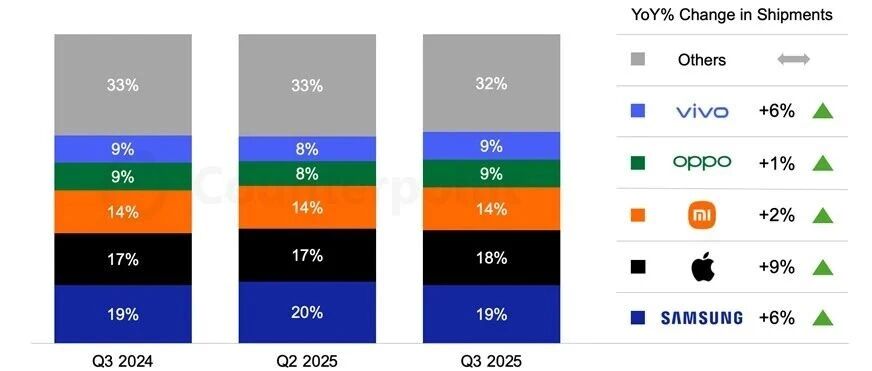
Core Insights - The global smartphone market experienced a 4% year-on-year growth in Q3 2025, driven by strong performances in the APAC and MEA regions despite declines in mature markets like North America and Europe [4][5]. Market Performance - Strong demand for high-end models persists in developed markets, while affordable 5G devices are gaining traction in growth markets such as India, APAC, and MEA. However, inventory reduction strategies have slowed down the Chinese market, and consumer confidence remains weak in Latin America [7]. - Japan's smartphone market saw a 15% year-on-year growth, fueled by the continued popularity of the iPhone 16 and iPhone 16e, alongside strong performance from Samsung's high-end Galaxy S25 series [7]. - The MEA region's smartphone shipments grew by 14% year-on-year, primarily driven by strong performances from Samsung and Xiaomi, with Apple leading the high-end segment [7]. - India's smartphone shipments increased by 9% year-on-year, benefiting from early festive season demand and government relief measures that improved consumer sentiment [7]. Brand Performance - Samsung led the global market with a 19% shipment share and a 6% year-on-year growth, driven by the strong performance of the Galaxy A series and the newly launched Galaxy Z Fold7 [11]. - Apple recorded a 9% year-on-year growth in global shipments, making it the fastest-growing brand among the top five, with significant growth in Japan, China, Western Europe, and APAC [11]. - Xiaomi maintained a 14% shipment share with a 2% year-on-year growth, particularly strong in Southeast Asia, MEA, and Latin America [12]. - Google saw an 18% year-on-year growth in shipments, driven by the popularity of the Pixel 9 series and the integration of AI features [12]. - OPPO and vivo ranked fourth and fifth in the global market, with OPPO achieving growth through affordable 5G models and vivo maintaining steady growth in India and Southeast Asia [12].


Omdia:2025年第三季度,中国智能手机市场回调3%,vivo重返第一,竞争态势趋紧
Canalys· 2025-10-16 01:46
Core Insights - The Chinese smartphone market is experiencing a 3% year-on-year decline in Q3 2025, indicating an ongoing adjustment phase with increasing competition among leading manufacturers [2][4] - Vivo regained the top position with 11.8 million units shipped, capturing 18% market share, followed closely by Huawei with 10.5 million units (16% market share) and Apple with 10.1 million units (15% market share) [2][6] - The overall smartphone shipments in China for Q3 2025 totaled 67.2 million units, reflecting a 3% decrease from 69.1 million units in Q3 2024 [6] Market Dynamics - The market's contraction over two consecutive quarters is showing signs of easing, suggesting that the fluctuations caused by the national subsidy program are subsiding, allowing for a return to normal market rhythms [4] - Manufacturers are strategically managing their inventory levels, preparing for the upcoming launch of flagship products and the Double 11 shopping festival [4] Product Strategy - Major manufacturers are updating their mid-range product lines, focusing on practical upgrades in response to rising component costs, with new models featuring large batteries (over 7000mAh) and enhanced durability [4] - The emphasis on battery technology and durability reflects manufacturers' responses to consumer demands for reliability and longevity in devices [4] Future Outlook - Despite the current market decline, Omdia forecasts a moderate growth in smartphone shipments for the entire year of 2025, supported by local subsidies [6] - Domestic brands are differentiating their products through design, battery life, and camera capabilities, while also enhancing AI functionalities to attract local consumers, who are notably inclined towards AI technologies [6]


小米杀入短剧赛道;官方通报升龙烟花秀;苹果发布M5芯片;传特斯拉中国拟推减配版新车型;村长李锐回应在迪拜拿下超12亿订单丨邦早报
创业邦· 2025-10-16 00:08
Group 1 - The article discusses the investigation and findings related to the "Ascendant Dragon" fireworks show in Tibet, highlighting environmental impacts and damage caused by the event [3] - Tesla is reportedly working on new, lower-priced versions of its Model Y and Model 3, with potential price reductions of around 30,000 yuan [4] - Apple has announced the launch of its M5 chip, which boasts over four times the GPU performance compared to the M4 chip, and will be featured in new MacBook Pro and iPad Pro models [4] Group 2 - The founder of Pang Donglai revealed that the company has 4.1 billion yuan in cash and no loans, emphasizing the importance of employee happiness over blind expansion [6] - Xiaomi has launched a new short drama app called "Weiguan Short Drama," which is currently available only for Xiaomi phone users [6] - JD.com is reportedly planning to release a new car priced between 100,000 to 120,000 yuan during the Double 11 shopping festival, although it does not directly involve manufacturing [9][10] Group 3 - Alibaba Cloud has opened its second data center in Dubai to meet the growing demand for cloud and AI services in the region, expanding its global presence to 29 regions and 92 availability zones [10] - The article mentions that the WeChat public relations director responded to claims about the decline of Moments, stating that user engagement remains stable with 780 million daily users accessing the feature [10] - Li Xiang, CEO of Li Auto, expressed optimism that fully autonomous driving cars could be realized within 3 to 5 years, potentially leading to a new wave of AI-driven automotive companies [10] Group 4 - Google announced a significant investment of nearly $15 billion to establish an AI center in India, marking its largest investment in the country to date [19] - The health tech company Oura has successfully raised $900 million in funding, doubling its valuation to $11 billion compared to the previous round [19] - The article highlights that the demand for AI products is expected to drive a 4% increase in global PC panel shipments by 2025, with OLED and MiniLED technologies projected to see significant growth [23][24]

教授被AI换声带货商家被判赔12万;OPPO发布AI全新战略丨AIGC日报
创业邦· 2025-10-16 00:08
Group 1 - A university professor's likeness and AI-generated voice were used without consent for commercial purposes, leading to a court ruling that the act constituted an infringement of portrait and voice rights, resulting in a compensation of 120,000 yuan [2] - OPPO announced a new AI strategy focusing on "new computing, new perception, and new ecology," leveraging technologies such as On-Device Compute, PersonaX memory cohabitation engine, and Agent Matrix intelligent ecosystem framework to create a personalized AI operating system [2] - Goldman Sachs informed employees about potential layoffs by year-end as part of its strategy to enhance productivity through AI, termed "OneGS 3.0," which prioritizes AI applications in sales, customer guidance, loan processes, regulatory reporting, and vendor management [2] Group 2 - Beijing's market regulatory authority dealt with the first case of AI-generated false advertising, where a company misrepresented a product as a treatment for various diseases using an AI-generated likeness of a well-known host, leading to an investigation that revealed the product did not meet medical standards [2]

财信证券晨会纪要-20251016
Caixin Securities· 2025-10-15 23:30
Group 1: Market Overview - The Shanghai Composite Index closed at 3912.21, up 1.22%, while the Shenzhen Component Index rose 1.73% to 13118.75, and the ChiNext Index increased by 2.36% to 3025.87, indicating a positive market trend [1][7] - The overall market saw a reduction in trading volume, with a total turnover of 20903.87 billion, down by 5061.99 billion from the previous trading day, reflecting a cautious sentiment among investors [7][10] Group 2: Economic Indicators - In the first three quarters, RMB loans increased by 14.75 trillion, with M2 growing by 8.4% year-on-year as of the end of September [15][16] - The Consumer Price Index (CPI) fell by 0.3% year-on-year in September, while the Producer Price Index (PPI) decreased by 2.3%, indicating deflationary pressures in the economy [19][21] Group 3: Industry Dynamics - ASML reported a net sales of 7.5 billion euros in Q3 2025, with a gross margin of 51.6%, driven by strong demand for extreme ultraviolet (EUV) lithography equipment [27][28] - IDC reported that global smartphone shipments reached 322.7 million units in Q3 2025, a year-on-year increase of 2.6%, driven by high-end market demand [29][30] Group 4: Company Updates - Mindray Medical (300760.SZ) plans to issue H shares and list on the Hong Kong Stock Exchange to enhance its international strategy and capital strength [31] - Haiguang Information (688041.SH) reported a revenue of 9.49 billion for the first three quarters of 2025, a year-on-year increase of 54.65% [33] - Tailin Microelectronics (688591.SH) expects a revenue of 766 million for the first three quarters of 2025, representing a 30% year-on-year growth [36]
AI场景新入口之争: 手机AI智能体正在撬动智能经济“新蓝海”
Zheng Quan Ri Bao· 2025-10-15 22:39
Core Insights - The article highlights a significant transformation in the mobile industry, driven by the emergence of AI agents, which are evolving from simple voice assistants to sophisticated, self-evolving AI systems that enhance user experience and decision-making [1][2][3]. Group 1: AI Agent Development - The introduction of the YOYO AI agent by Honor showcases the shift towards self-evolving AI native smartphones, capable of understanding user intent and automating tasks like coupon collection [1][2]. - Major smartphone manufacturers, including Honor, Huawei, Vivo, and OPPO, are competing to develop AI agents that can create new business models in various sectors such as shopping, travel, and home automation [1][2][3]. Group 2: Market Impact and Consumer Behavior - The upcoming "Double 11" shopping festival is expected to significantly change shopping behaviors, with AI agents replacing traditional search and comparison processes, thus becoming a new entry point for e-commerce [2]. - AI agents are transforming from passive tools to proactive partners, enhancing personalized services and reshaping user interactions with platforms [2][3]. Group 3: Industry Collaboration and Ecosystem Development - The shift towards AI agents is prompting a reconfiguration of relationships among hardware, software, and services, leading to a new ecosystem that integrates e-commerce platforms, developers, and hardware manufacturers [3][4]. - Companies are forming collaborative initiatives, such as the establishment of the IIFAA intelligent agent trust interconnection working group, to address challenges related to data privacy and standardization [6][7]. Group 4: Future Prospects and Economic Potential - The market for AI agents is projected to reach hundreds of billions, with self-evolving AI native smartphones becoming key entry points for the smart economy [5][6]. - Honor's upcoming global developer conference aims to further explore AI self-evolution technology and its implications for expanding the smart economy [7].
影响市场重大事件:新凯来“惊喜”公布!旗下万里眼发布超高速示波器;工信部李乐成会见美国苹果公司首席执行官蒂姆·库克
Mei Ri Jing Ji Xin Wen· 2025-10-15 22:18
Group 1: New Product Launches - New Kai Lai's subsidiary Wanliyan announced the release of a new generation ultra-high-speed real-time oscilloscope with a bandwidth exceeding 90GHz, making it the second highest globally [1] - The oscilloscope is the world's first ultra-high-speed intelligent oscilloscope featuring intelligent parameter optimization and noise suppression capabilities [1] - It is also the first fully-screen oscilloscope, designed for an intuitive user experience with smart terminal-style interaction [1] Group 2: Corporate Developments - China's Ministry of Industry and Information Technology met with Apple's CEO Tim Cook to discuss Apple's business development in China and collaboration in the electronic information sector [2] - Cook expressed gratitude for the support from the Ministry and indicated plans to increase investment in China, aiming for mutually beneficial growth [2] Group 3: Industry Trends - China Mobile announced plans to develop eSIM and operating system localization technology, focusing on creating more secure eSIM terminals to promote the domestic eSIM industry [3] - The private equity sector has seen significant dividend distributions, with over 140 billion yuan distributed in 2023, indicating strong performance and a strategy to manage fund sizes [4] Group 4: Market Insights - ASML expects strong demand for extreme ultraviolet (EUV) and deep ultraviolet (DUV) lithography equipment, projecting revenue growth to reach 440-600 billion euros by 2030, with a potential annual growth rate of 10% from 2025 to 2030 [5] - Goldman Sachs reported that U.S. consumers may bear 55% of tariff costs by the end of the year, highlighting the impact of tariffs on consumer prices [6] Group 5: Technological Advancements - The eSIM technology is gaining traction, with major telecom operators in China beginning commercial trials for eSIM services, supported by devices from Apple, Huawei, and OPPO [9] - Baidu Search has upgraded its AI capabilities, enabling the creation of various content types and launching the industry's first open real-time interactive digital human agent [11]

腾讯研究院AI速递 20251016
腾讯研究院· 2025-10-15 17:47
Group 1: New Product Releases - New Kai launched a 90GHz ultra-high-speed real-time oscilloscope, ranking second globally with a sampling rate of 200GSa/s and a storage depth of 4Gpts, enhancing domestic oscilloscope performance by 500% [1] - Apple released the M5 chip featuring a 10-core CPU and GPU, with AI performance 3.5 times that of the M4 version, and a memory bandwidth of 153GB/s, marking a nearly 30% improvement [2] - Google’s Gemini 3.0 Pro demonstrated the ability to replicate operating systems like macOS and Windows in just 2 minutes using a few prompts, showcasing advanced capabilities in generating complete HTML versions [3] Group 2: AI and Machine Learning Developments - Alibaba's Qwen3-VL model series, available in 4B and 8B versions, surpassed competitors in various benchmark tests, achieving state-of-the-art results in both text and vision tasks [4] - iFlytek upgraded its simultaneous translation model, achieving a user experience score of 4.6 out of 5, with a professional vocabulary expanded to over 100,000 terms [5][6] - OPPO introduced ColorOS 16, featuring advanced AI capabilities and a unique chip-level dynamic tracking technology, enhancing performance stability under high temperatures [7] Group 3: Research and Theoretical Insights - Hong Kong University of Science and Technology and NVIDIA proposed the NewtonBench benchmark to evaluate scientific discoveries, revealing that GPT-5 had a low accuracy of 29.9% in difficult scenarios [8] - Anthropic co-founder Jack Clark expressed a dual sentiment of optimism and fear regarding AI's evolution, noting that larger and more complex AI systems exhibit signs of self-awareness [9] - Philippe Aghion discussed the economic implications of AI, suggesting that even with full automation, economic growth rates will still be constrained by physical laws and the limitations of less efficient sectors [12]




AI场景新入口之争:手机AI智能体正在撬动智能经济“新蓝海”
Zheng Quan Ri Bao· 2025-10-15 16:15
Core Insights - The article discusses the transformation of mobile phones from traditional smart devices to "self-evolving AI native phones," driven by the emergence of AI agents that enhance user interaction and decision-making [1][2][3]. Group 1: AI Agent Development - The YOYO AI agent, showcased by Honor, can automatically identify screen content and understand user intent, marking a significant advancement in mobile AI capabilities [1][2]. - AI agents are set to replace traditional shopping processes during events like "Double 11," becoming new entry points for e-commerce platforms [2][3]. - The shift from passive tools to proactive partners in user decision-making is highlighted, with AI agents now playing a central role in reshaping user interactions with platforms [2][3]. Group 2: Market Dynamics and Opportunities - The integration of AI agents into mobile devices is expected to create new business models in various sectors, including shopping, travel, and home automation [1][4]. - The overall market size driven by AI agents is projected to reach hundreds of billions, indicating a significant economic opportunity [5]. - The competition among major smartphone manufacturers, such as Honor, Vivo, and Huawei, is intensifying as they evolve from traditional voice assistants to advanced AI agents [2][3]. Group 3: Industry Collaboration and Challenges - The establishment of the IIFAA intelligent agent trust interconnection working group aims to address challenges related to data privacy, application execution, and ecosystem standards [6]. - Companies are increasingly focusing on collaborative innovation to overcome technical and commercial challenges in the AI landscape [6][7]. - Honor's upcoming global developer conference will further explore the AI self-evolution technology, emphasizing the importance of open standards and collaborative platforms in the industry [7].
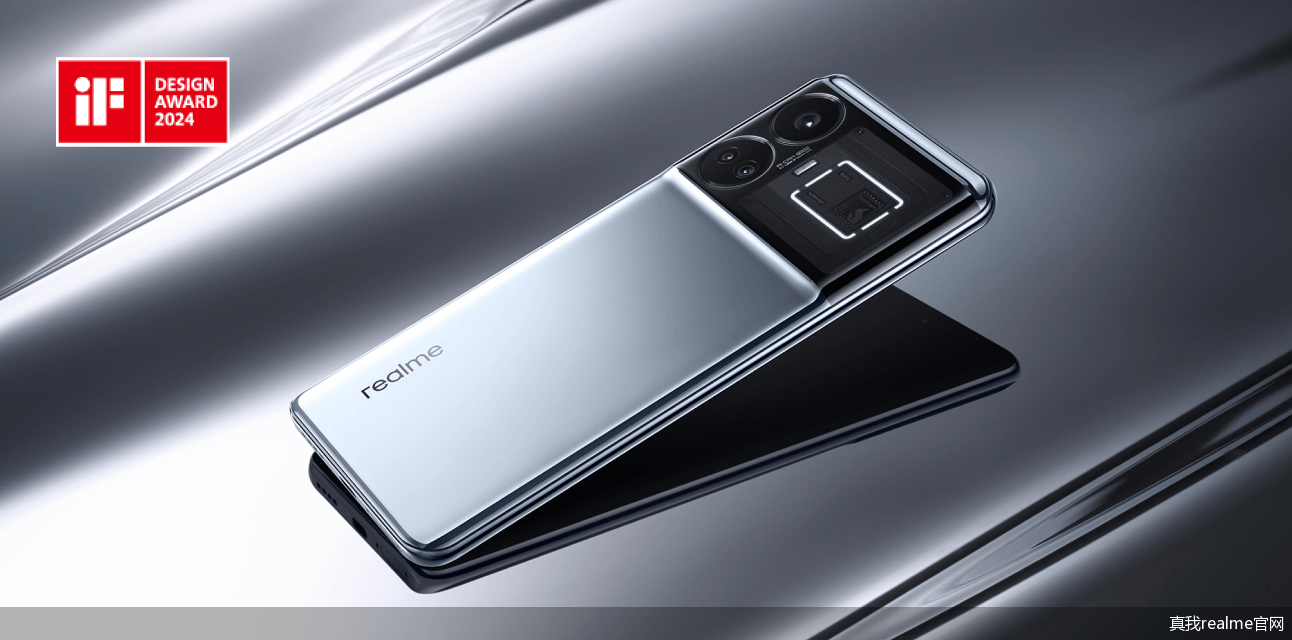
真我搭上手机影像“末班车”
Bei Jing Shang Bao· 2025-10-15 14:17
Core Viewpoint - The collaboration between realme and Ricoh marks a significant step in the smartphone imaging landscape, as realme aims to enhance its market presence through this partnership, which is seen as a late entry into the competitive imaging collaboration space dominated by established brands like Huawei, vivo, and OPPO [1][2]. Group 1: Collaboration Details - realme announced a strategic imaging partnership with Ricoh, set to debut on the upcoming realme GT8 Pro on October 21 [1]. - This collaboration is a culmination of four years of joint development between realme and the Ricoh GR team, indicating a deeper technical enhancement in their imaging capabilities [2]. Group 2: Market Context - The smartphone market is heavily influenced by imaging capabilities, with major brands like Huawei, vivo, OPPO, and Xiaomi already having established partnerships with renowned camera brands [5]. - realme's market share stands at only 1.3%, significantly lower than leading competitors, highlighting the challenges it faces in gaining a foothold in the saturated smartphone market [8][9]. Group 3: Consumer Insights - Consumers are increasingly valuing high-quality imaging in smartphones, with many willing to pay a premium for devices that offer superior photography capabilities [4][5]. - The presence of branding elements like special filters and watermarks from camera collaborations enhances the perceived value of the images taken, influencing consumer purchasing decisions [4]. Group 4: Competitive Landscape - The smartphone imaging sector is becoming increasingly competitive, with brands like vivo and OPPO launching new imaging accessories alongside their devices, while realme must navigate its strategy between collaboration and in-house development [12][13]. - The trend of leveraging partnerships with established camera brands is seen as a shortcut for realme to enhance its brand and technical capabilities, although it faces stiff competition from other brands that have already secured such collaborations [12].