亿帆医药

Search documents
流感检验新药成色,原研药、创新药、仿制药竞分市场 | 海斌访谈
Di Yi Cai Jing· 2025-12-04 14:00
Core Insights - The demand for influenza medications has surged, with the Chinese influenza drug market fluctuating around 100 billion RMB. Oseltamivir dominates the market, with East Sunshine Pharmaceutical as the leader, while Roche's Xofluza leads in new drug offerings [1][3]. Market Dynamics - In 2023, the Chinese antiviral drug market is estimated at 110 billion RMB, expected to decline to 80 billion RMB in 2024 due to a decrease in influenza cases, with oseltamivir accounting for approximately 80% of the market [4]. - East Sunshine Pharmaceutical's oseltamivir product, Kewai, generated 5.54 billion RMB in revenue in 2023, representing nearly 90% of its total revenue, capturing about 60% of the oseltamivir market share [3][4]. Competitive Landscape - The introduction of national centralized procurement policies has significantly impacted the market dynamics for oseltamivir, leading to a sharp price drop and increased competition from other generic manufacturers, resulting in East Sunshine's sales plummeting to 2.58 billion RMB in 2024 [3][4]. - As of August 2025, there are 118 approved oseltamivir products from 69 companies, indicating a highly competitive environment [5]. Emerging Trends - The market for traditional Chinese medicine is also growing, with sales of cold and flu medications increasing significantly, indicating a shift in consumer preferences [6]. - New antiviral drugs, particularly PA proteinase inhibitors like Marbofloxacin, are gaining traction, with a reported 600% increase in purchases during a recent two-week period [8][9]. Future Outlook - Roche's Xofluza is expected to maintain its leading position in the innovative drug market, with a threefold increase in supply anticipated for the current year [10]. - The entry of domestic new drugs is expected to challenge the market share of oseltamivir, particularly affecting generic versions [12][13].

利好创新药 中国药品价格登记系统上线
2 1 Shi Ji Jing Ji Bao Dao· 2025-12-03 23:05
Core Viewpoint - The launch of the China Drug Price Registration System marks a significant step towards a globalized pricing framework for innovative drugs, enhancing market-oriented pricing capabilities for pharmaceutical companies and supporting the development of a new pricing ecosystem that aligns drug prices with innovation value and market demand [1][2][6]. Group 1: Drug Price Registration System - The new system allows domestic and international pharmaceutical companies to independently register drug prices, ensuring accountability for price authenticity [1][3]. - The system operates under the principle of "one location acceptance, nationwide sharing, global openness," and is managed by a state-owned enterprise in Beijing [1][3]. - The first batch of companies to register prices includes major players such as China National Pharmaceutical Group, Beijing Tongrentang, and Roche, indicating strong industry participation [3]. Group 2: Impact on Pharmaceutical Industry - The system is expected to enhance the pricing strategies of pharmaceutical companies, allowing them to adjust prices based on clinical value, supply-demand dynamics, and competitive landscape [3][4]. - The dual mechanism of registration and query will promote transparency in drug pricing, moving away from previous opaque practices [4]. - The establishment of this system is anticipated to create a comprehensive pricing structure that encompasses innovative drugs, insurance payment prices, and generic drug prices, benefiting the innovative drug sector [5]. Group 3: Global Market Development - The China Drug Price Registration System is designed to facilitate the international expansion of Chinese innovative drugs and attract high-quality foreign drugs into the Chinese market [2][5]. - Data indicates that the total amount of overseas licensing transactions by Chinese pharmaceutical companies exceeded $92 billion in the first three quarters of 2025, highlighting the growing global presence of Chinese innovative drugs [2]. - The system aims to address significant price discrepancies between domestic and international markets, influenced by factors such as currency exchange rates and pricing mechanisms [5]. Group 4: Long-term Industry Implications - The implementation of the drug price registration system is expected to enhance the global competitiveness of China's biopharmaceutical industry and drive high-quality innovation within the sector [6].



鼓励创新药出海,中国药品价格登记系统上线:我国药企授权出海交易超920亿美元
Mei Ri Jing Ji Xin Wen· 2025-12-03 13:24
Core Insights - The launch of the Chinese Drug Price Registration System on December 2 is seen as a significant positive development for the innovative drug sector, facilitating the international expansion of domestic innovative drugs [1][4]. Group 1: Drug Price Registration System - The Chinese Drug Price Registration System was launched on December 2, with nine pharmaceutical companies participating in the initial registration, including both multinational and traditional Chinese medicine firms [2]. - The system currently includes limited information, with only 10 drug entries available, indicating a nascent stage of development [2]. - The system allows for independent pricing by companies outside of the National Medical Insurance (NMI) framework, which is a notable shift in policy [1][5]. Group 2: Innovative Drugs Highlighted - Four drugs showcased on the system are recognized as either the first of their kind in China or globally, including innovative treatments like Toripalimab and Icaritin [3]. - For instance, Toripalimab is the first Chinese PD-1 monoclonal antibody approved in both Europe and the U.S., while Icaritin is the first CAR-T therapy targeting BCMA approved in China [3]. Group 3: Market Implications - The establishment of the registration system is expected to enhance the global pricing framework for Chinese innovative drugs and attract high-quality foreign drugs to the Chinese market [4][5]. - Data indicates that in the first three quarters of 2025, Chinese pharmaceutical companies completed 103 license-out transactions totaling $92.03 billion, highlighting the growing importance of the Chinese market in the global pharmaceutical industry [4]. - The NMI's non-interference in pricing for the non-NMI market is seen as a positive step towards respecting market dynamics and enhancing the pricing power of domestic companies in international markets [5].

我国药企授权出海交易超920亿美元
Mei Ri Jing Ji Xin Wen· 2025-12-03 12:49
Core Insights - The launch of the Chinese Drug Price Registration System on December 2 is seen as a significant positive development for the innovative drug sector, facilitating the international expansion of domestic innovative drugs [1][4] - The system allows for independent pricing by companies outside of the National Medical Insurance (NMI) market, which is expected to foster a more competitive environment [1][5] Group 1: Drug Price Registration System - The Chinese Drug Price Registration System was launched on December 2, with nine pharmaceutical companies participating in the initial registration, including both multinational and domestic firms [2] - The system currently includes limited data, with only 10 drug entries available, indicating a nascent stage of development [2] - The system is designed to respect the pricing autonomy of companies in the non-NMI market, which is a shift from previous perceptions that equated the NMI market with the entire Chinese pharmaceutical market [5] Group 2: Innovative Drugs Highlighted - Four drugs showcased on the system's homepage hold either domestic or global "first" status, including innovative treatments like the first Chinese PD-1 monoclonal antibody approved in Europe and the U.S. [3] - Specific pricing examples illustrate the disparity between NMI reimbursement prices and companies' self-reported prices, such as the self-reported price of 10,688 yuan for a PD-1 monoclonal antibody compared to the NMI price of 1,253.53 yuan [3] Group 3: Market Implications - The establishment of the drug price registration system is expected to enhance the global pricing framework for Chinese innovative drugs and attract high-quality foreign drugs to the Chinese market [4] - Data indicates that Chinese pharmaceutical companies completed 103 license-out transactions worth 9.203 billion USD in the first three quarters of 2025, highlighting the growing importance of the Chinese market in the global pharmaceutical industry [4] - The NMI's non-interference in pricing for the non-NMI market is viewed as a positive step towards empowering companies to set prices that reflect market conditions, potentially increasing their influence in international markets [5]
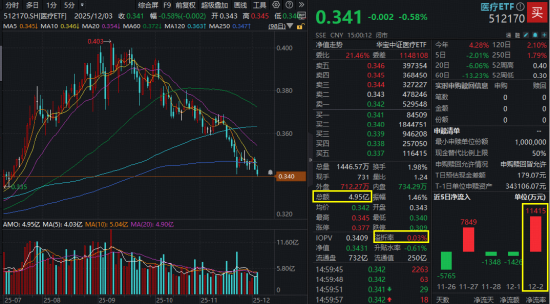
医药跌势未止,抄底资金再出动!医疗ETF再创4个月新低,单日逾亿元增仓,港股创新药四连跌,520880放量溢价
Xin Lang Cai Jing· 2025-12-03 12:03
Core Viewpoint - The A+H pharmaceutical sector continues to adjust, with significant fluctuations in the market, particularly in innovative drugs, indicating potential investment opportunities as bottom-fishing capital emerges [1][5][16]. Group 1: Market Performance - The largest medical ETF in the market (512170) and the only drug ETF (562050) fell by 0.58% and 0.19% respectively, while the Hong Kong innovative drug ETF (520880) dropped by 1.43% [1][5]. - A-share medical leaders mostly declined, with WuXi AppTec down 2.01%, and both Aier Eye Hospital and Tigermed down over 1%, while some stocks like Yingke Medical and New Industry saw gains [1][12]. - The medical ETF (512170) hit a four-month low during intraday trading, closing below all moving averages, but saw over 1.14 billion yuan in net subscriptions as investors sought to buy the dip [1][16]. Group 2: Sector Analysis - The pharmaceutical sector in A-shares showed relative resilience, with the drug ETF (562050) outperforming the market, primarily due to gains from traditional Chinese medicine leaders like Pian Zai Huang and Yunnan Baiyao [3][12]. - The innovative drug sector displayed divergence, with Yifan Pharmaceutical surging by 6.11%, while major stocks like BeiGene fell by 1.59% [3][12]. - The drug ETF (562050) has about 25% weight in traditional Chinese medicine, which helps mitigate the high volatility of innovative drugs, thus reducing the overall volatility and drawdown of the pharmaceutical index [3][12]. Group 3: Future Outlook - The innovative drug sector is expected to be a major upward trend heading into 2026, as the industry continues to experience strong demand and unmet needs, with increased R&D investments from pharmaceutical companies [7][16]. - Analysts suggest that the current adjustment phase may present a favorable long-term investment opportunity in pharmaceutical assets, particularly as the sector shows signs of recovery [16]. - The Hong Kong innovative drug ETF (520880) is recommended for balanced internal allocation strategies, with a focus on improving fundamentals in the innovative drug supply chain [7][16].
12月3日生物经济(970038)指数跌0.32%,成份股迪安诊断(300244)领跌
Sou Hu Cai Jing· 2025-12-03 10:24
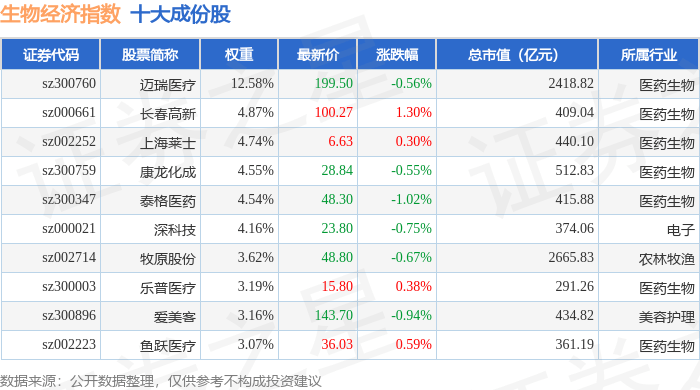
Core Points - The Biotech Economy Index (970038) closed at 2121.91 points, down 0.32%, with a trading volume of 11.12 billion yuan and a turnover rate of 0.9% [1] - Among the index constituents, 17 stocks rose while 32 fell, with Yifan Pharmaceutical leading the gainers at 6.11% and Dean Diagnostics leading the decliners at 2.62% [1] Index Constituents Summary - The top ten constituents of the Biotech Economy Index include: - Mindray Medical (sz300760) with a weight of 12.58% and a market cap of 241.88 billion yuan, down 0.56% [1] - Changchun High-tech (sz000661) with a weight of 4.87% and a market cap of 40.90 billion yuan, up 1.30% [1] - Yishao Dianyi (sz002252) with a weight of 4.74% and a market cap of 44.01 billion yuan, up 0.30% [1] - Kanglong Chemical (sz300759) with a weight of 4.55% and a market cap of 51.28 billion yuan, down 0.55% [1] - Tigermed (sz300347) with a weight of 4.54% and a market cap of 41.59 billion yuan, down 1.02% [1] - Deep Technology (sz000021) with a weight of 4.16% and a market cap of 37.41 billion yuan, down 0.75% [1] - Muyuan Food (sz002714) with a weight of 3.62% and a market cap of 266.58 billion yuan, down 0.67% [1] - Lepu Medical (sz300003) with a weight of 3.19% and a market cap of 29.13 billion yuan, up 0.38% [1] - Aesthetic Care (sz300896) with a weight of 3.16% and a market cap of 43.48 billion yuan, down 0.94% [1] - Yuyue Medical (sz002223) with a weight of 3.07% and a market cap of 36.12 billion yuan, up 0.59% [1] Capital Flow Analysis - The Biotech Economy Index constituents experienced a net outflow of 359 million yuan from institutional investors, while retail investors saw a net inflow of 241 million yuan [3] - Notable capital flows include: - Yifan Pharmaceutical (002019) with a net inflow of 75.07 million yuan from institutional investors [3] - Hualan Biological (002007) with a net inflow of 9.99 million yuan from retail investors [3] - Muyuan Food (002714) with a significant net inflow of 766.06 million yuan from retail investors despite a net outflow of 81.87 million yuan from institutional investors [3] Index Adjustment Summary - Recent adjustments to the Biotech Economy Index included the addition of 9 stocks and the removal of 9 stocks [4] - Newly added stocks include: - Chaoyan Co. (301602) with a market cap of 9.78 billion yuan [4] - Kanghua Biotechnology (300841) with a market cap of 10.63 billion yuan [4] - Yingke Medical (300677) with a market cap of 28.22 billion yuan [4] - Stocks removed from the index include: - Wens Foodstuff Group (300498) with a market cap of 120.30 billion yuan [4] - Hongri Pharmaceutical (300026) with a market cap of 11.08 billion yuan [4]

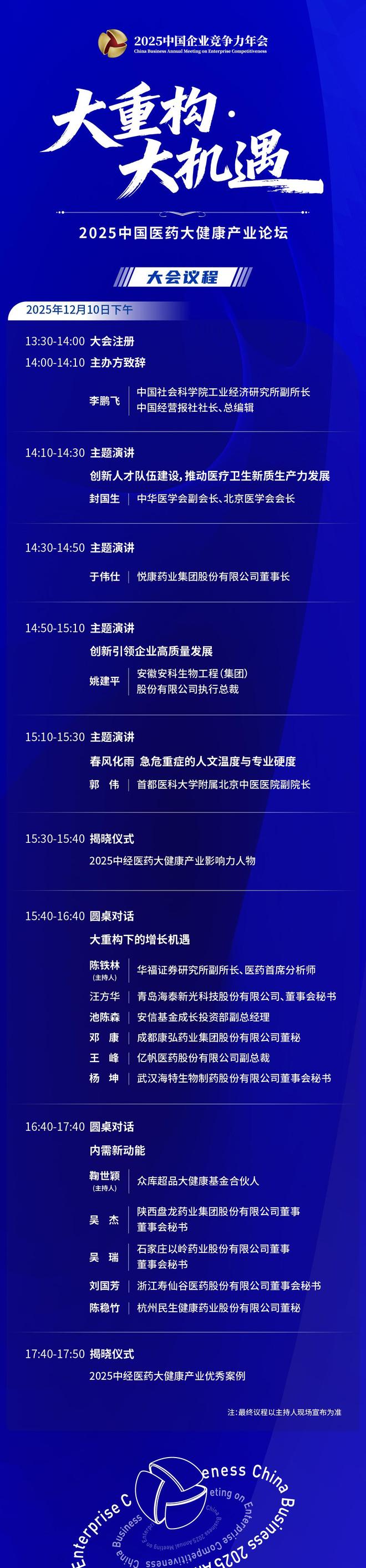
寻找2026中国医药大健康产业风起之源
Zhong Guo Jing Ying Bao· 2025-12-03 07:11
Core Viewpoint - The 2025 China Pharmaceutical Health Industry Summit Forum aims to address the significant restructuring of the industry, focusing on innovation, strategic capital integration, and responding to new consumer demands in the healthcare sector [9][10][11]. Group 1: Forum Agenda - The forum will take place on December 10, 2025, featuring a series of keynote speeches and roundtable discussions from industry leaders and experts [4][5][14]. - Keynote speakers include prominent figures such as Feng Guosheng from the Chinese Medical Association and Yao Jianping from Anhui Anke Bioengineering [4][5]. - The agenda includes discussions on high-quality development, humanistic care in critical conditions, and growth opportunities under industry reconstruction [5][6]. Group 2: Industry Challenges and Opportunities - The era of relying on generic drug advantages and channel strategies is over, leading to a complete restructuring of industry value [9]. - The core competitiveness of the pharmaceutical health industry is being redefined around three key questions: global product value, strategic capital integration, and responsiveness to demand shifts [10]. - The forum is positioned as a critical alignment event for industry executives, investors, and analysts to identify clear and executable growth paths for the next 3-5 years [11][13]. Group 3: Value Propositions of the Forum - The forum emphasizes the transition from "borrowing boats to go to sea" to "building ships for long voyages," addressing the real challenges of global clinical and commercial innovation [12]. - It aims to provide insights from a buy-side perspective on how to select and invest in future industry leaders amid a new valuation norm [13]. - The forum seeks to uncover new growth areas within the changing landscape of healthcare insurance and consumer markets, focusing on a model that integrates products and services [13].

全国共享全球公开 中国药登系统上线
Bei Jing Shang Bao· 2025-12-02 15:53
Core Viewpoint - The establishment of the China Drug Price Registration System (China Drug Registration) aims to create a global drug pricing system, support the high-quality development of innovative drugs, and enhance the integration of China's pharmaceutical industry into international competition [1][4]. Group 1: Announcement and Implementation - The National Healthcare Security Administration (NHSA) and the Beijing Municipal Government jointly launched the China Drug Registration, providing a platform for drug price registration and inquiry services [3]. - The registration will initially focus on innovative drugs and gradually expand to other drugs, allowing pharmaceutical companies to self-declare prices while ensuring the authenticity of the information [3][5]. Group 2: Independence and Pricing Mechanism - China Drug Registration operates independently from provincial medical procurement platforms, ensuring that registered prices do not alter the pricing levels for insured and uninsured patients [5][6]. - The registration system allows for the disclosure of market prices, which can be used for international price comparisons, enhancing the competitiveness of Chinese pharmaceutical companies in the global market [6][7]. Group 3: Global Market Integration - The establishment of China Drug Registration facilitates the "going out" strategy for Chinese innovative drugs and attracts high-quality foreign drugs into the Chinese market [7][8]. - The system supports Chinese companies in gaining global market recognition and establishing international brand influence, which is crucial for their valuation and future research and development [7]. Group 4: Participation of Foreign Companies - The first batch of registered companies includes both domestic and foreign pharmaceutical firms, indicating a collaborative approach to enhance the availability of innovative drugs in China [8]. - The independent pricing mechanism of China Drug Registration is expected to attract multinational pharmaceutical companies to participate in national healthcare negotiations, thereby increasing the availability of innovative drugs in the Chinese market [8].

中国药品价格登记系统上线!创新药出海传来利好
Guo Ji Jin Rong Bao· 2025-12-02 13:41
Core Viewpoint - The launch of the drug price registration system in China is a significant step towards establishing a global pricing framework for innovative drugs, enhancing the international competitiveness of Chinese pharmaceutical companies [1][3][6]. Group 1: Drug Price Registration System - The drug price registration system, initiated by the National Healthcare Security Administration, allows domestic and foreign pharmaceutical companies to independently declare drug prices, creating a comprehensive pricing archive [1][3]. - The system operates independently from provincial procurement platforms and follows principles of "one location acceptance, nationwide sharing, and global openness," which aids in building a globalized drug pricing system [1][3]. - The registration of prices does not alter the medication costs for insured and uninsured individuals [1]. Group 2: Support for Chinese Pharmaceutical Companies - The new system addresses the shortcomings in the pricing mechanism for innovative drugs, facilitating their entry into international markets and allowing for pricing that aligns with local payment systems [3][4]. - Companies like Yifan Pharmaceutical highlight that the system will provide substantial support for overseas expansion, allowing for a more accurate reflection of the true value of innovative drugs [4]. - The system enables companies to register prices according to international practices, providing verifiable pricing information to regulatory bodies and partners [4]. Group 3: Attracting Foreign Innovative Drugs - The establishment of the drug price registration system is expected to attract more high-quality foreign innovative drugs into the Chinese market, as multinational companies will be encouraged to participate in national healthcare negotiations [6][7]. - The system allows multinational companies to register prices independently in China, creating a clear distinction between market supply prices and negotiated healthcare prices, which enhances the certainty of market entry for innovative drugs [7].

利好创新药!中国药品价格登记系统上线
2 1 Shi Ji Jing Ji Bao Dao· 2025-12-02 13:33
(原标题:利好创新药!中国药品价格登记系统上线) 21世纪经济报道记者 闫硕 北京报道 创新药全链条发展已进入全面推进阶段,国家医保局聚焦价格登记查询环节,推出全新支持政策。 12月2日,中国药品价格登记系统上线。国内外医药企业可根据发展需要,自主申报登记药品价格,并为价格真实性负责。药品价格登记按照"一地 受理、全国共享、全球公开"原则,采取社会化运营模式,由北京市西城区国资企业负责运营,对外提供登记、查询等服务。 近年来,我国医药产业创新动能持续释放,创新能力显著增强。一批具备自主特色、达到国际先进水平的创新药相继问世,既为国内患者带来全 新治疗选择与康复希望,也为中国医药企业拓展全球市场奠定了坚实基础。 市场数据直观印证了中国创新药的全球化发展势头。据统计,2025年前三季度,我国医药企业海外授权交易总金额突破920亿美元。随着中国创新 药在全球市场的参与度不断提升,其终端价格的国际参考作用日益凸显。 这一趋势既彰显了中国超大市场规模在全球医药领域的重要地位,也对我国医药价格体系的完善提出了更高要求。在此背景下,国家医保局借鉴 国际通行做法,牵头建设中国药品价格登记系统。 该系统主要包含两大服务,即药品 ...