水晶光电

Search documents
私募超44000次调研,去了哪些行业?
中国基金报· 2025-11-30 15:06
Core Insights - The article highlights that private equity firms have conducted over 44,000 research activities on A-share listed companies in China this year, with a strong focus on hard technology sectors such as electronics, biomedicine, and machinery [2][4]. Group 1: Research Activities - A total of 2,579 private equity firms participated in A-share research activities, covering 2,184 stocks across 30 primary industries, with 44,702 total research instances [4]. - The top three industries by research frequency are electronics (8,732 times), biomedicine (6,341 times), and machinery (5,437 times) [4]. - Notable stocks in the electronics sector include Luxshare Precision, which was researched 335 times, and other prominent companies in the biomedicine sector such as United Imaging Healthcare and Mindray Medical [4][5]. Group 2: Investment Focus - Private equity firms are increasingly interested in sectors like artificial intelligence, innovative pharmaceuticals, and new consumption trends, as well as structural opportunities arising from "anti-involution" policies [2][9]. - The electronics industry is leading due to accelerated domestic semiconductor replacement and the initiation of a consumer electronics innovation cycle [7]. - The biomedicine sector is favored for its diverse stock options and the rapid approval of innovative drugs, while the power equipment sector benefits from the continuous growth of new energy installations [7]. Group 3: Market Outlook - The article suggests that the market is transitioning from valuation-driven to performance-driven, with a focus on high-growth sectors such as AI, innovative pharmaceuticals, and machinery [9]. - There is an expectation that individual stock performance will become more significant than sector performance in the future, with a focus on areas that show structural growth potential [9]. - Investment strategies are being adjusted to account for market corrections and style rebalancing, with an emphasis on sectors that can maintain profitability without relying on overall economic recovery [9].


14万人围观资产大戏!八年缠斗,徐翔背后的三个女人藏不住了
商业洞察· 2025-11-28 09:26
Core Viewpoint - The article discusses the recent auction of shares in Ningbo Zhongbai, highlighting the involvement of various stakeholders, including the family of Xu Xiang, and the implications of these transactions for the market and the individuals involved [2][3][5][6]. Group 1: Auction Details - The auction for 35.4053 million shares of Ningbo Zhongbai concluded with Hangzhou Jindi Commercial Management Co., Ltd. winning the bid at 527 million yuan, with an average price of 14.88 yuan per share, slightly below the closing price of 15.12 yuan prior to the auction [3]. - The shares auctioned were entirely held by Tibet Zetian Investment Development Co., Ltd., which is controlled by Xu Xiang's father, Xu Bai Liang, representing 15.78% of Ningbo Zhongbai's total shares [5]. Group 2: Xu Xiang Family's Market Influence - The article notes that the Xu family, particularly Xu Xiang's mother, Zheng Su Zhen, has been a significant player in the stock market, with her past investments yielding substantial returns before the family's legal troubles began [19][20][24]. - Zheng Su Zhen's investments included significant stakes in multiple companies, with her total investment amounting to 79.57 billion yuan, which appreciated to a market value of 247.74 billion yuan, netting nearly 150 billion yuan in profits [24]. Group 3: Emerging Stakeholders - A mysterious figure, Li Rongrong, emerged as a significant buyer in the auction, acquiring 27.46 million shares of Daheng Technology for 362 million yuan, becoming the largest single shareholder [11][12]. - Li Rongrong's funding sources were revealed to be primarily from family and friends, indicating a network of support for her investment decisions, which were seen as optimistic given the high-interest rates on borrowed funds [14]. Group 4: Ongoing Legal and Financial Developments - The article mentions ongoing legal proceedings regarding the Xu family's assets, with various companies, including Daheng Technology and Wenfeng Shares, having their shares auctioned off as part of the asset liquidation process [8][27]. - The complexities surrounding the divorce proceedings of Xu Xiang's wife, Ying Ying, are highlighted, indicating that the financial entanglements and asset divisions remain contentious and unresolved [36][41].



谷歌进军AI眼镜!长盈精密大涨超13%,消费电子50ETF(159779)V型翻红
2 1 Shi Ji Jing Ji Bao Dao· 2025-11-28 03:16
Group 1 - The technology sector is experiencing a significant rebound, with the Consumer Electronics 50 ETF (159779) showing a V-shaped recovery, and key stocks like Changying Precision rising over 13% [1] - Major tech companies are entering the AI smart glasses market, with Quark launching its first AI glasses powered by the Qianwen model on November 27 [1] - Meta has launched the AI smart glasses Meta Ray-Ban Display, which have reportedly sold out in physical retail stores [1] - Google has initiated two AI glasses projects, currently in the POC (proof of concept) stage, with a potential launch as early as Q4 2026 [1] Group 2 - The Beijing Municipal Bureau of Radio and Television and other departments have issued an action plan for the high-quality development of the "AI + audiovisual" industry from 2025 to 2029, focusing on AI-enabled devices [2] - Tianfeng Securities highlights the vast existing user base for glasses and the low penetration rate of AI, indicating a promising market for AI glasses [2] - The integration of AI and AR technologies is expected to drive rapid industry growth, with global sales of AI + AR smart glasses projected to reach 1.4 billion units and a penetration rate of 70% at maturity [2] - The Consumer Electronics 50 ETF (159779) has outperformed the CSI 300 Index and the CSI TMT Index over the past year, with a 48.25% increase [2]

中港IPO全球占比显著提升,工业科技先进制造领跑,500质量成长ETF(560500)盘中涨0.27%
Xin Lang Cai Jing· 2025-11-28 02:42
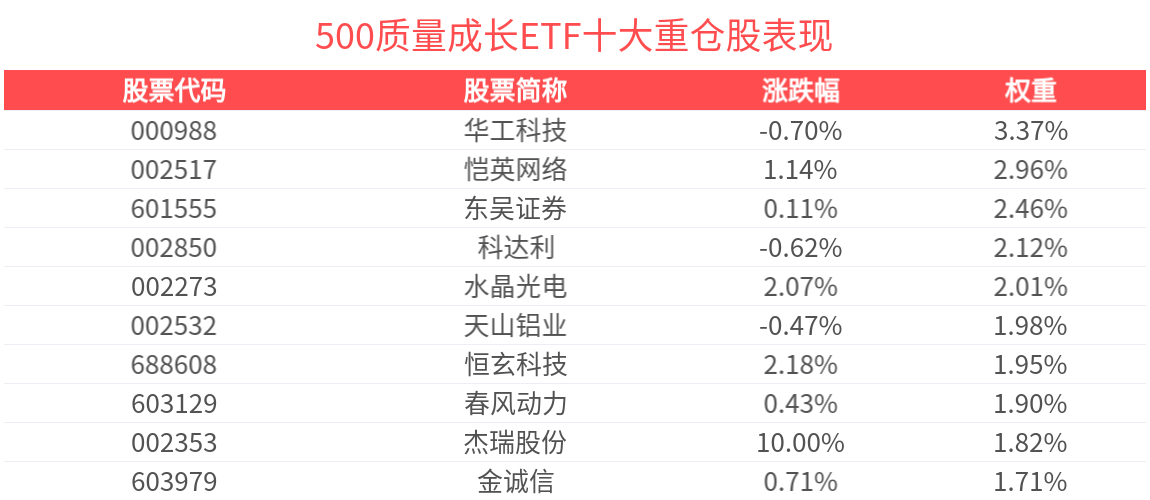
Core Insights - The report by Ernst & Young highlights a growth trend in IPO activities in mainland China and Hong Kong, with A-shares and Hong Kong markets accounting for 16% and 33% of global IPO numbers and fundraising amounts respectively [1] - Chinese companies secured five positions in the global top ten IPOs, with an increase in numbers compared to 2024, primarily in the automotive, mining, energy, and advanced manufacturing sectors [1] - The industrial, technology, and materials sectors are the top three in terms of IPO quantity [1] Market Performance - The A-share market has shown signs of recovery amidst fluctuations, with overall market confidence improving and a strong technical outlook [2] - The "14th Five-Year Plan" policies, capital market developments, and declining interest rates are positively influencing the market, indicating a phase of recovery [2] - Third-quarter reports indicate moderate improvements in fundamentals, which may drive further market recovery [2] Index and ETF Information - The CSI 500 Quality Growth Index selects 100 companies with high profitability, sustainable earnings, and strong cash flow from the CSI 500 Index, providing diverse investment options [2] - As of October 31, 2025, the top ten weighted stocks in the CSI 500 Quality Growth Index accounted for 21.64% of the index [2] - The top ten stocks include Huagong Technology, Kaiying Network, Dongwu Securities, Tianshan Aluminum, Keda Li, Crystal Optoelectronics, Shunluo Electronics, Chuangfeng Power, Changjiang Securities, and Shanghai Electric [2][4]


谷歌重启AI眼镜项目,消费电子ETF(561600)冲击4连涨
Xin Lang Cai Jing· 2025-11-28 02:35
Core Insights - The consumer electronics sector is experiencing positive momentum, with the Zhongzheng Consumer Electronics Theme Index rising by 0.25% and several key stocks showing significant gains, such as Changying Precision up 4.22% and Shunluo Electronics up 3.33% [1][2] - Google has initiated two AI glasses projects, currently in the POC (Proof of Concept) stage, with a potential launch as early as Q4 2026, indicating a growing interest in AI-integrated consumer products [1] - Recent policy support in China aims to enhance the adaptability of supply and demand in consumer goods, focusing on new consumption areas like smart home and AI terminals, which could stimulate consumption potential and upgrade the consumer experience [1][2] Industry Developments - The joint consumption promotion plan released by six departments signals a strong policy direction, particularly in the home appliance sector, encouraging technological innovation and the development of interactive products like household service robots and smart appliances [2] - The consumer electronics ETF closely tracks the Zhongzheng Consumer Electronics Theme Index, which includes 50 companies involved in component production and brand design, reflecting the overall performance of the consumer electronics sector [2] - As of October 31, 2025, the top ten weighted stocks in the Zhongzheng Consumer Electronics Theme Index account for 56.3% of the index, highlighting the concentration of investment in key players like Luxshare Precision and Cambricon [2]
万和财富早班车-20251128
Vanho Securities· 2025-11-28 01:49
Core Insights - The report highlights the importance of identifying investment opportunities in emerging technologies such as AI, quantum technology, and renewable energy, which are expected to drive market growth in the coming years [7] - It emphasizes the potential for structural recovery in manufacturing and resource sectors due to policy support and demand-supply optimization [7] - The report suggests that the A-share market is currently in a relatively reasonable valuation range, with earnings expected to take over from valuation as a key driver by 2026 [7] Domestic Financial Market - The Shanghai Composite Index closed at 3875.26, up by 0.29%, while the Shenzhen Component Index fell by 0.25% to 12875.19 [2] - The ChiNext Index decreased by 0.44%, indicating a mixed performance across major indices [2] Macro News Summary - The National Development and Reform Commission held a meeting to address issues related to price competition and cost recognition [4] - The Ministry of Industry and Information Technology is promoting supply-side adjustments to maximize consumer potential [4] - The National Bureau of Statistics is focused on expanding domestic demand and optimizing structure to enhance industrial economic quality and new momentum [4] Industry Developments - Huawei launched its first conversational robot, indicating potential growth in the AI toy market, with related stocks such as Tom Cat and Guanghe Tong [5] - OpenAI anticipates reaching 220 million paid users within five years, suggesting significant growth in AI applications, with related stocks including Hongsoft Technology and Focus Technology [5] - Hesai Technology has delivered over 2 million laser radars, marking a golden period for the industry with both volume and price increases, related stocks include Guangpu Co. and Crystal Optoelectronics [5] Company Focus - Longping High-Tech is collaborating with Beijing Academy of Agriculture and Forestry Sciences on the cultivation and industrialization of dwarf resistant corn varieties [6] - Aikang Co. is strategically acquiring Dongguan Silicon Xiang to strengthen its new energy supply chain [6] - Kaishan Co. plans to establish a joint venture to advance geothermal power project construction and operation in Hungary [6] - Yinxin Technology offers a variety of 3D printing materials, including consumer-grade PLA and modified PETG [6] Market Review and Outlook - On November 27, the market experienced a pullback after an initial rise, with the A-share market benefiting from upward liquidity trends [7] - The report notes that over 2700 stocks rose, with significant gains in lithium battery concepts and consumer sectors [7] - The report recommends focusing on two main lines: emerging technologies and the recovery of manufacturing and resource sectors, alongside two auxiliary lines related to consumer sector opportunities and international expansion [7]
智能眼镜更新
2025-11-28 01:42
Summary of Quark Smart Glasses Conference Call Company and Industry Overview - The conference call discusses **Quark Smart Glasses**, a product in the **smart eyewear industry**. Key Points and Arguments 1. **Comfort and Design**: Quark Smart Glasses outperform competitors in comfort due to flexible hinges, optimized weight distribution, and a nose pad design tailored for Asian facial structures, significantly enhancing user experience and addressing discomfort issues common in traditional smart glasses [2][4][5] 2. **Optical Performance**: The glasses utilize **ZhiGe optical waveguide modules** with a light transmittance of **97%-98%**, surpassing the industry average of around **90%**. This improvement effectively addresses issues like rainbow effects, light leakage, and image blurriness, enhancing visual experience despite higher manufacturing costs [2][11] 3. **Battery Design**: The glasses feature a **pluggable battery design** that allows users to replace batteries in seconds without interrupting usage, providing a practical solution to battery anxiety compared to competitors that require the device to be removed for charging [2][4] 4. **Ecosystem Integration**: The integration with the **Alibaba ecosystem** (including apps like Gaode Navigation, Alipay, and Taobao) provides Quark Smart Glasses with a unique competitive advantage, creating software and hardware barriers that are difficult for competitors to replicate [2][6][7] 5. **Sales Forecast**: Quark Smart Glasses are projected to achieve sales of over **200,000 units** within a year, positioning them as a leader in the industry, although there are concerns regarding supply chain disruptions and whether production capacity can meet demand [2][9] 6. **Pricing Strategy**: The current pricing of **3,699 RMB** is deemed reasonable based on market research, with consumers showing a willingness to pay a premium for the Alibaba brand [2][10] 7. **Manufacturing Costs**: The estimated manufacturing cost of the glasses ranges from **2,000 to 2,500 RMB**, with key components including optical modules and waveguides being significant cost drivers [3][14] 8. **Local Processing Power**: Local processing capabilities are essential for ensuring functionality during network instability, countering the notion that cloud computing can replace the need for robust on-device processing [16] 9. **Supply Chain Dynamics**: The ODM supplier for the glasses is **Luxshare**, while the screen supplier is **JBD**, indicating a solid supply chain structure [17] 10. **Market Trends**: The global AR glasses market is expected to grow significantly, with projections indicating that companies like Rokid could achieve **500,000 units** in shipments by **2026**, driven by advancements in hardware technology and ecosystem development [19] Additional Important Insights - **Technical Barriers**: Quark's choice of more expensive technologies creates a barrier to entry for competitors, as they may take time to catch up with Quark's innovations [6] - **Consumer Acceptance**: The glasses weigh **51 grams**, allowing for all-day wear without discomfort, which is a significant improvement over competitors like Meta [12] - **Future Product Development**: Future iterations of smart glasses may explore new technologies beyond current offerings, as companies like Huawei and Alibaba are moving away from existing AR solutions [12] - **Competitive Landscape**: The competitive landscape in the AR/VR market is evolving, with major players like Meta facing skepticism regarding their sales forecasts, while Chinese brands are expected to launch promising products [25][26] This summary encapsulates the essential insights from the conference call regarding Quark Smart Glasses and the broader smart eyewear industry.
7000亿分红险:三季度末双位数增长!都投了什么?有什么特点?
13个精算师· 2025-11-27 15:30
Core Viewpoint - The article highlights the significant growth of dividend insurance premiums, which have surpassed 10% year-on-year as of the end of Q3 2025, driven by a combination of lower guaranteed interest rates and the potential for floating returns from capital market investments [1][2]. Group 1: Dividend Insurance Premium Growth - As of September 2025, the premium for dividend insurance has exceeded 700 billion, showing a year-on-year growth of over 10% [1]. - The new policy premium growth for dividend insurance has outpaced that of traditional insurance products [2]. Group 2: Investment Strategies in Dividend Accounts - By the end of Q3 2025, the market value of investments in dividend accounts reached 57.6 billion, reflecting a 5% increase since the beginning of the year [3][6]. - The investment strategy for dividend accounts is relatively diversified, balancing fixed and floating returns [7][9]. Group 3: Asset Allocation Characteristics - Dividend accounts must consider both guaranteed and floating returns, leading to a unique asset allocation strategy that includes high-dividend sectors, although these only account for 30% of the total investments [9][10]. - The insurance companies have increased their investments in sectors such as hardware, transportation, and non-ferrous metals compared to ten years ago [11]. Group 4: Trading Frequency and Revenue Generation - Insurance companies tend to trade more frequently in dividend accounts to capture floating returns, with quarterly investments exceeding 50 billion and new investments over 70 billion [16]. - The trading strategy aims to leverage market opportunities, with companies like Ping An and China Life achieving an estimated annualized return of 20% from their trading activities in Q3 2025 [19][21].
水晶光电(002273) - 2025年11月26日投资者关系活动记录表
2025-11-27 07:20
Group 1: Project Progress and Business Development - The "No. 1 Project" of the reflective waveguide golden line is currently in a critical phase, with key process optimization underway, exceeding initial expectations [2][3] - The coating filter business has entered stable mass production, with market share targets for 2025 expected to be met, and a growth phase starting in 2026 [2][4] - The company is accelerating infrastructure construction for the second phase of its factory in Taiwan to ensure capacity meets customer demand [2][4] Group 2: Technology Pathways in AR Glasses - Reflective and diffractive waveguide technologies are both essential for the AR glasses industry, with no absolute replacement relationship, but rather a collaborative advancement [3] - The company focuses on large-scale production breakthroughs in reflective waveguide technology while also developing diffractive waveguide holographic solutions [3] Group 3: Product Supply and Market Position - The company has completed a diverse product layout in the AR glasses sector, with various optical components in different stages of mass production [4] - The reflective waveguide golden line is currently in a critical construction phase, while other products have achieved batch supply to downstream manufacturers [4] Group 4: Future Business Growth Guidance - Key growth drivers include stable performance in the North American market for optical film panels and the transition of production lines to Vietnam [5][6] - The company aims to maintain its position as a primary supplier for micro-prism business and increase market share in coating filter products [5][6] - Engagement with multiple end customers in the AR optical field is ongoing, with positive market feedback on reflective waveguide solutions [6]

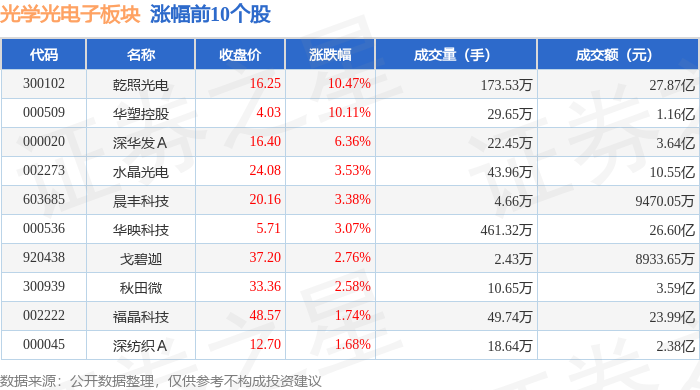
光学光电子板块11月26日涨0.19%,乾照光电领涨,主力资金净流出3.02亿元
Zheng Xing Xing Ye Ri Bao· 2025-11-26 09:05
Core Insights - The optical and optoelectronic sector saw a slight increase of 0.19% on November 26, with Qianzhao Optoelectronics leading the gains [1] - The Shanghai Composite Index closed at 3864.18, down 0.15%, while the Shenzhen Component Index closed at 12907.83, up 1.02% [1] Stock Performance - Qianzhao Optoelectronics (300102) closed at 16.25, up 10.47% with a trading volume of 1.7353 million shares and a transaction value of 2.787 billion [1] - Hu塑控股 (000509) closed at 4.03, up 10.11% with a trading volume of 296,500 shares and a transaction value of 116 million [1] - Other notable performers include 深华发A (000020) up 6.36%, 水晶光电 (002273) up 3.53%, and 华映科技 (000536) up 3.07% [1] Capital Flow - The optical and optoelectronic sector experienced a net outflow of 302 million from institutional investors, while retail investors saw a net inflow of 300 million [2] - The sector's overall capital flow indicates a mixed sentiment, with institutional investors withdrawing funds while retail investors are actively buying [2][3] Individual Stock Capital Flow - Qianzhao Optoelectronics had a net inflow of 97.1797 million from institutional investors, but a net outflow of 79.7584 million from speculative funds [3] - 华映科技 (000536) saw a net inflow of 70.1528 million from institutional investors, with retail investors contributing a net inflow of 51.7918 million [3] - 华塑控股 (000509) had a significant net inflow of 50.6239 million from speculative funds, but a net outflow from retail investors [3]