海信视像

Search documents
黑色家电板块2月2日跌3.1%,*ST高斯领跌,主力资金净流出3.07亿元
Zheng Xing Xing Ye Ri Bao· 2026-02-02 09:15
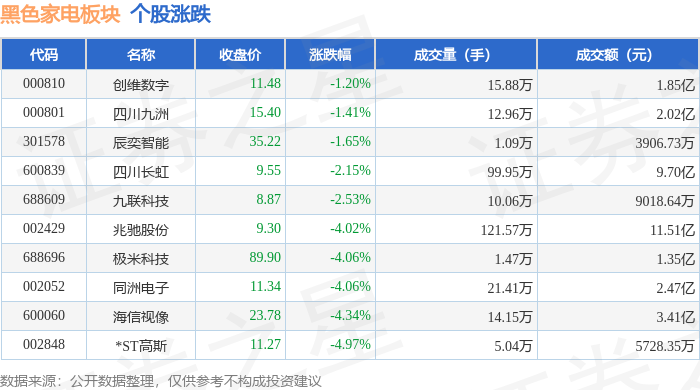
Market Overview - The black home appliance sector experienced a decline of 3.1% on February 2, with *ST Gauss leading the drop [1] - The Shanghai Composite Index closed at 4015.75, down 2.48%, while the Shenzhen Component Index closed at 13824.35, down 2.69% [1] Stock Performance - Notable declines in individual stocks include: - *ST Gauss: -4.97% closing at 11.27 with a trading volume of 5.04 million shares and a turnover of 57.28 million yuan [1] - Sichuan Changhong: -2.15% closing at 9.55 with a trading volume of 199.95 million shares and a turnover of 970 million yuan [1] - Zhaochi Co.: -4.02% closing at 9.30 with a trading volume of 121.57 million shares and a turnover of 1.15 billion yuan [1] Capital Flow - The black home appliance sector saw a net outflow of 307 million yuan from main funds, while retail funds had a net inflow of 210 million yuan [1] - Specific stock capital flows indicate: - *ST Gauss had a main fund net outflow of 13.84 million yuan, with retail inflow of 6.37 million yuan [2] - Hisense Visual had a main fund net inflow of 4.71 million yuan, but a retail outflow of 29.63 million yuan [2] - Sichuan Jiuzhou experienced a main fund net outflow of 5.95 million yuan, with a retail outflow of 2.34 million yuan [2]


构建消费新格局:山东以供需双侧变革激活内需强引擎
Feng Huang Wang Cai Jing· 2026-02-02 08:16
正如2026年山东省政府工作报告所明确部署的,"奋力推进全方位扩大内需"置于全年工作首位,正是紧 扣发展之"纲"的战略抉择。报告同时提出"全力释放消费潜能"等具体举措,为应对外部环境不确定性、 推动经济持续回升向好提出了清晰路径。 而这一战略部署,是基于对2025年成功实践的深化与延续。从实施提振消费"五大工程",到出台以旧换 新实施方案细则,从"山东交旅1号工程"撬动"票根经济",到各地特色消费季激活市场潜力,山东以前 所未有的力度与精度,为消费市场注入动能。 立足"十五五"开局之年,如何进一步释放内需潜力、拓展增长空间?成为两会期间代表委员们讨论的热 点话题。 筑牢内需根基:从"有钱有闲"到"敢消费愿消费" 去年,在一系列政策举措的推动下,山东省社会消费品零售总额突破4.2万亿元,规模稳居全国第3位。 这一亮眼数据,不仅直观表明山东消费市场有着巨大韧性与潜力,更充分验证了将扩内需、促消费作为 工作"置顶项"的战略前瞻性与实践有效性。 消费,作为连通经济发展与民生福祉的纽带,既是拉动经济增长的主引擎,也在扩大内需中居于重要地 位。然而,引擎的持续运转与内需的深度释放,其根本前提在于切实增强老百姓"能消费、敢 ...
为什么2026年值得买的电视是RGB-MiniLed?
Sou Hu Wang· 2026-02-02 07:19
Core Viewpoint - The television industry in China is undergoing a significant transformation, with the introduction of the Hisense E8S Pro marking a milestone in the commercialization of RGB-MiniLED technology, which addresses the limitations of traditional QD-MiniLED displays [1] Group 1: Technological Advancements - The Hisense E8S Pro features a "dual-chip" logic, incorporating RGB light-emitting chips and an AI picture quality chip (H7) that controls up to 9,360 zones, enabling "light and color co-control" [2] - The E8S Pro achieves a light and color control precision of 108 bits, offering 100% coverage of the BT.2020 color gamut, which allows for the accurate reproduction of all colors found in nature [4] Group 2: Environmental Adaptability - The E8S Pro is designed to perform well in various lighting conditions, with a black crystal screen that reduces reflectivity to 1.28%, significantly lower than that of standard televisions, enhancing viewing experience in bright environments [7] - The television's RGB-MiniLED technology provides a peak brightness of 6,200 nits, ensuring that images remain clear and vibrant even in challenging lighting conditions [7] Group 3: Energy Efficiency - The E8S Pro is marketed as a "new energy television," achieving a 40% improvement in energy efficiency compared to QD-OLED displays, while also reducing harmful blue light by 42% [8] - This approach balances high-quality visual performance with health and environmental considerations, reflecting a mature commercial responsibility [9]


抛弃电视机的年轻人,开始抛弃投影仪了
Xin Lang Cai Jing· 2026-02-02 05:38
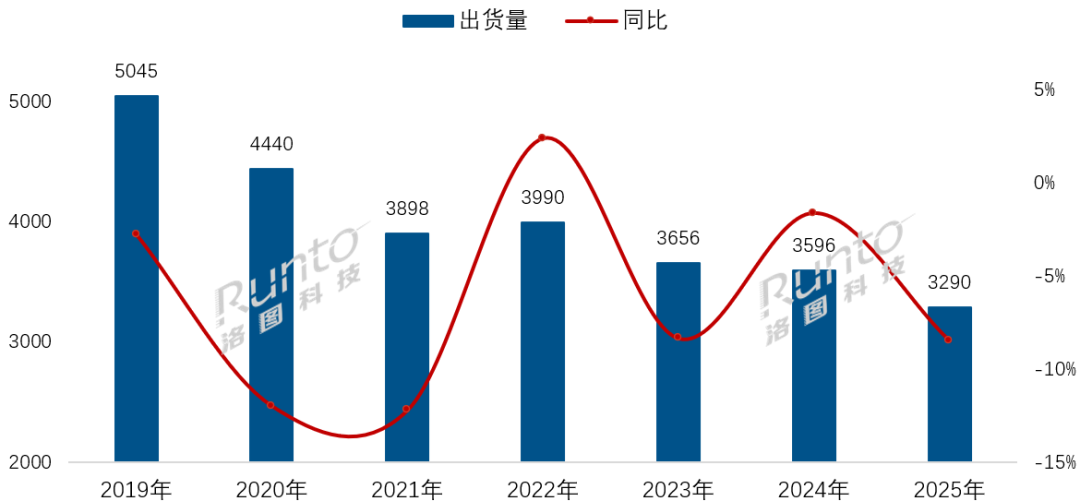
Group 1 - The core viewpoint of the article highlights a significant decline in the sales of traditional large-screen televisions and projectors in China, indicating a shift in consumer preferences towards smaller screens and alternative entertainment formats [1][2][3][4][6][12] - In 2025, the domestic color TV market is projected to see a shipment volume of 32.895 million units, a year-on-year decline of 8.5%, marking the lowest level in nearly 16 years [1][3] - The projector market is also facing challenges, with an expected total sales volume of 5.203 million units in 2025, down 13.9% year-on-year, and a sales revenue of 8.36 billion yuan, a decrease of 16.5% [2][6] Group 2 - Domestic brands such as Hisense, TCL, Xiaomi, and Skyworth dominate the TV market, accounting for 77.8% of the market share, despite a 9.2% year-on-year decline in their combined shipment volume [3][4] - Foreign brands like Samsung, Sony, Philips, and Sharp have seen their combined shipment volume drop below 1 million units in 2025, leading to strategic shifts such as Panasonic's plan to sell its TV business [4][5] - The market concentration remains high, with the top 10 manufacturers accounting for 66.5% of total sales revenue, indicating that smaller brands may struggle to survive in the shrinking market [7] Group 3 - The rise of micro-short dramas and short videos has shifted consumer entertainment preferences, with the micro-short drama market expected to reach a value of 100 billion yuan in 2025, nearly double that of the national film box office [8][9][10] - The "girlfriend machine," a new category of mobile smart screens, has shown significant growth, with a 45.4% year-on-year increase in sales volume in the first half of 2025, suggesting a potential threat to traditional TVs and projectors [11][12] Group 4 - Predictions for 2026 indicate continued declines in both the TV and projector markets, with TV shipments expected to drop to 30.12 million units, a decrease of 8.4% year-on-year [13][14] - The upcoming 2026 World Cup may provide a temporary boost to large-screen usage, as past events have shown significant marketing success for Chinese brands [14][15] - Chinese TV brands are gaining ground in international markets, with a combined global market share of 31.3% for TCL, Hisense, and Xiaomi, surpassing South Korean competitors [16]





AI生活管家获“年度家电智能体创新案例” 海信冰箱引领行业智慧场景突破
Zhong Guo Jin Rong Xin Xi Wang· 2026-02-02 05:20
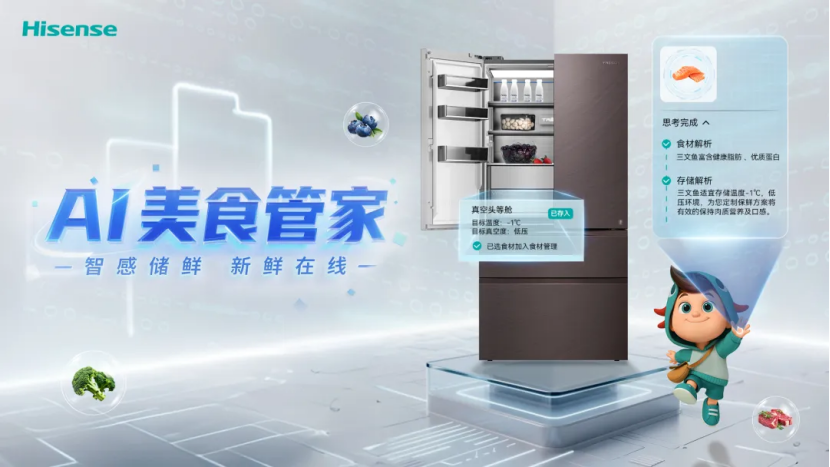
Core Insights - Hisense AI Life Butler, which includes the AI Food Butler, AI Cleaning Butler, and AI Air Butler, won the "Annual Smart Appliance Innovation Case" award at the "2025 Smart Life Annual List Award Ceremony" for its innovative smart technology and proactive service scenarios [1] Group 1 - Hisense AI Food Butler enhances the Hisense refrigerator by providing a full-chain smart service from ingredient storage management to cooking and meal planning [2] - The AI Food Butler utilizes advanced image recognition and natural language interaction technology to intelligently identify over 800 common ingredients, offering personalized preservation solutions through simple voice or interface commands [2] - The AI Food Butler records the storage time and condition of ingredients, proactively reminding users before expiration to effectively reduce food waste [2] Group 2 - The AI Food Butler features over 200,000 recipes and can recommend seasonal healthy recipes and shopping suggestions based on existing ingredients, seasonal availability, and regional taste preferences, shifting from "people seeking services" to "services serving people" [2] - This award reflects Hisense's long-term commitment to a "technology-driven enterprise" strategy, promoting the deep integration of AIoT technology with the home appliance industry [2] - Innovations like the AI Food Butler provide consumers with a more convenient, healthy, and personalized smart kitchen experience, aiding in the quality upgrade of family dining and serving as a transformation model for the home appliance industry from single product intelligence to scenario and ecological intelligence [2]
“生活经济”正当时:在美好生活“种草”中看见新需求
Zhong Guo Jing Ji Wang· 2026-02-02 05:15
Core Insights - The emergence of "life economy" signifies a shift in consumer demand, emphasizing personalized needs and diverse aspirations rather than uniformity and large-scale narratives [1][2][5] Group 1: Market Trends - The "life economy" is defined as an economic form where individual life needs are expressed, connected, and stimulated through digital technology, leading to positive supply-demand interactions and growth [1] - Specific consumer demands, such as "silent shoes" for urban workers and "dedicated laundry care for infants," are becoming the new driving forces for consumption and domestic demand [2] - Digital platforms like Xiaohongshu are crucial in identifying and amplifying these nuanced consumer demands, with over 200 million users expressing shopping needs monthly [2][3] Group 2: Business Adaptation - Companies are transitioning from being "product definers" to "demand responders," as they leverage consumer insights to innovate and create products that meet specific needs [4][5] - Successful case studies include Vatti's development of a "dry dishwasher" based on user feedback and Hisense's adaptation to the growing "TV + esports" market [4] - Over 50% of active merchants on Xiaohongshu are first-time entrepreneurs, indicating a rise in opportunities for small businesses to cater to niche demands [4] Group 3: Economic Implications - The life economy is reshaping supply logic from "selling what is produced" to "creating what is needed," enabling precise identification of potential demands and efficient market matching [5] - The core mechanism of the life economy involves a complete chain of "discovering needs - matching supply - co-creating supply," fostering a positive cycle of demand-driven supply [6] - The rise of Citywalk culture illustrates how online content can stimulate offline exploration and consumption, promoting a blend of virtual and physical experiences [6] Group 4: Policy Recommendations - Encouragement of innovative business models that integrate virtual and physical experiences is essential, with a focus on using algorithms and marketing activities to meet diverse consumer needs [7] - The establishment of a platform-driven innovation incubation system is recommended to enhance the development of the life economy through AI empowerment [7] - The life economy's growth reflects the resilience and vitality of the Chinese economy, rooted in the public's pursuit of a better life, which is crucial for high-quality development [7]
家电行业 2026W04 周报:关注地产链复苏机会,重点家电公司披露年报预告
GUOTAI HAITONG SECURITIES· 2026-02-02 02:40
Investment Rating - The industry investment rating is "Increase Holding" [6][13]. Core Insights - The real estate market is expected to stabilize, creating opportunities for recovery in the real estate supply chain, with a focus on key home appliance companies' annual report forecasts [2][6]. - Key home appliance companies are showing significant profit growth, with notable increases in net profits for companies like Ecovacs and Ninebot, while others like Roborock are experiencing declines [3][4][6]. Summary by Relevant Sections Key Home Appliance Company Forecasts - Ecovacs is projected to achieve a net profit of 1.7-1.8 billion yuan in 2025, representing a year-on-year increase of 111%-123% [3]. - Ninebot expects a net profit of 1.67-1.85 billion yuan in 2025, a year-on-year increase of 54%-71% [3]. - Roborock anticipates a net profit of no less than 1.34 billion yuan in 2025, a year-on-year decrease of 31% [3]. - Anfu Technology forecasts a net profit of 220-250 million yuan in 2025, a year-on-year increase of 29%-51% [3]. - TCL Electronics expects an adjusted net profit of 2.33-2.57 billion HKD in 2025, a year-on-year increase of 45%-60% [4]. - Beiding Co. anticipates a revenue of 950 million yuan in 2025, a year-on-year increase of 26% [4]. Investment Recommendations - The report recommends increasing holdings in companies such as Midea Group, Haier Smart Home, TCL Electronics, and Hisense Visual, which are expected to perform well due to stable operations and high dividends [6][7]. - The report highlights the potential for smart home appliances to drive growth, particularly for leading robotic vacuum companies like Roborock and Ecovacs [6]. - Companies like Ninebot and Anfu Technology are noted for their stable performance and upward potential, making them attractive investment options [6].


大消费行业周报:春节旺季临近,期待后续表现-20260202
Ping An Securities· 2026-02-02 02:32
Investment Rating - The industry investment rating is "stronger than the market," indicating that the industry index is expected to outperform the market by more than 5% within the next six months [32]. Core Insights - The consumer sector is showing mixed performance as the Spring Festival approaches, with certain sub-sectors like food and beverage, agriculture, and media performing well, while others like light manufacturing and retail are declining [3][7]. - In the food and beverage sector, high-end liquor brands are expected to maintain market share due to strong demand, while the casual dining market is recovering as supply chain conditions stabilize [3]. - The tourism sector is anticipated to benefit from a release of pent-up demand, with leading companies adapting quickly to consumer changes [3]. - The jewelry sector, particularly gold and accessories, presents investment opportunities, focusing on brands with potential market share growth [3]. Summary by Relevant Sections Food and Beverage - Alcohol - Major liquor companies are experiencing deeper profit adjustments, but leading brands are expected to gain market share [3]. - Focus on three main lines: high-end liquor, mid-range liquor with national expansion, and local market strongholds [3]. Food and Beverage - Consumer Goods - The at-home dining market is expanding, with companies like Guoquan showing strong growth potential [3]. - The restaurant supply chain is stabilizing, with sectors like condiments and frozen foods recovering from previous lows [3]. Social Services - The tourism sector is evolving, with leading companies responding effectively to consumer demand [3]. - The beauty industry is growing steadily, with a focus on companies that adapt quickly to market changes [3]. Apparel and Jewelry - Investment opportunities are seen in the gold and jewelry sector, particularly for brands with room for market share growth [3]. Home Appliances - The air conditioning market is undergoing a transformation, with a focus on value creation rather than just scale [20]. - The electric compressor market is growing rapidly, driven by the expansion of the new energy vehicle sector [20]. Key Company Announcements - Companies like Huaxi Biological and Ruoyu Chen are projecting significant profit increases for 2025, driven by operational efficiency and market expansion [26][28]. - Anta Sports is acquiring a significant stake in PUMA, enhancing its global market position [29].
家电行业周报20260131:错期扰动致2月排产承压,白电出口韧性优于内销-20260201
SINOLINK SECURITIES· 2026-02-01 09:17
Investment Rating - The report suggests a positive outlook for leading brands in the home appliance sector, indicating a potential for steady growth due to integrated advantages and strong pricing power [5]. Core Insights - The home appliance industry is currently facing short-term adjustments in both domestic and export sales due to high base effects and the timing of the Spring Festival, with air conditioning production experiencing significant declines [1][12]. - Domestic air conditioning production in February 2026 was 4.555 million units, down 38.1% year-on-year, while export production was 6.93 million units, down 26.5% year-on-year [1][12]. - Refrigerator production also saw a decline, with domestic production at 2.6 million units (down 17.1%) and exports at 3.4 million units (down 8%) [1][15]. - Washing machine production showed a slight increase in exports (up 1.5%), while domestic production fell to 3.1 million units (down 5.9%) [1][16]. - The report highlights that the real estate market's downturn continues to suppress demand for home appliances, although there are signs of a potential recovery in production post-holiday [3][5]. Summary by Sections Air Conditioning Production - February 2026 air conditioning production was impacted by the Spring Festival timing and high base effects, leading to a significant drop in both domestic and export figures [1][12]. - Domestic production was 4.555 million units, a year-on-year decrease of 38.1%, while exports were 6.93 million units, down 26.5% [1][12]. Refrigerator Production - Domestic refrigerator production in February 2026 was 2.6 million units, down 17.1%, with exports at 3.4 million units, down 8% [1][15]. - The decline in domestic sales was attributed to the Spring Festival holiday and weak macro demand, but a recovery is expected in March [1][15]. Washing Machine Production - Domestic washing machine production was 3.1 million units, down 5.9%, while exports increased slightly to 3.2 million units, up 1.5% [1][16]. - The domestic decline is linked to previous policy impacts and a sluggish real estate market, while exports benefited from stable overseas demand [1][16]. Market and Sector Performance - The report notes that the Shanghai and Shenzhen 300 Index increased by 0.08%, while the home appliance index decreased by 2.88% [2][19]. - Key companies showed varied performance, with Samsung New Materials up 23.72% and Tianyin Electromechanical down 18.66% [2][19]. Raw Material Prices - Recent trends show fluctuations in raw material prices, with copper prices up 1.32% and aluminum prices down 2.57% in the last week [2][23]. - Year-to-date, copper prices have increased by 6.35%, while aluminum has risen by 4.15% [2][23]. Real Estate Data - Real estate metrics indicate a continued decline, with new housing starts down 19.9% year-on-year, impacting long-term demand for home appliances [3][31]. Investment Recommendations - The report recommends leading brands such as TCL Electronics, Hisense Visual, Midea Group, and Haier Smart Home for their strong market positions and growth potential in both domestic and international markets [5][42].
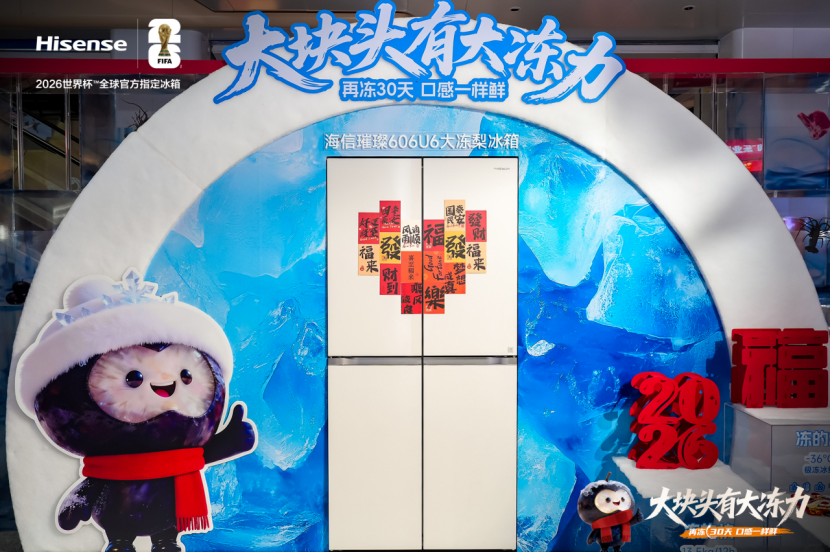
海信发布璀璨大冻梨冰箱 以“大冻力”开辟行业新增长点
Zhong Guo Jin Rong Xin Xi Wang· 2026-02-01 02:24
1月31日,海信正式推出全新产品——海信璀璨大冻梨冰箱。新款冰箱旨在系统性解决中国家庭在食材冷冻存储中长 期面临的容积不足、冷冻效果差等核心痛点,将行业竞争从"容积参数"引向"用户体验"。 转自:新华财经 长期以来,冰箱冷冻空间小、食材堆积杂乱、大块肉类冻不透、化冻后口感劣化等问题,困扰着无数中国家庭。尽管 用户需求清晰,但受限于传统设计定式、对"总容积"这一市场显性指标的盲目追逐以及技术突破难度,行业整体解决 方案进展缓慢。 在整机606升容积内,海信璀璨大冻梨冰箱"腾挪"出267升的超大冷冻空间,相当于"一台冰箱加一台冷柜"的复合能 力,满足家庭大批量、长周期存储需求。为提升使用便利性,其还采用98厘米高腰线设计,并将冷冻空间科学划分 为"3+3+1"精储分区,配备可平放整条羊腿或整扇排骨MAX超大抽屉。 (海信璀璨大冻梨冰箱,海信冰箱供图) 海信璀璨大冻梨冰箱在细节上也有创新考量。该产品采用特种玻璃与创新SMI磁性复合工艺,实现了玻璃质感与磁吸 功能的结合,在满足家居美学质感需求的同时,也能稳固吸附各类冰箱贴,承载家庭生活美好记忆。 业内观察人士指出,海信璀璨大冻梨冰箱的推出,说明头部企业主动跳出同质化 ...