SHEIN

Search documents
金融助力中国企业“走出去”报告
第一财经研究院· 2025-11-21 05:51
Investment Rating - The report indicates a positive investment outlook for Chinese enterprises going global, with a projected increase in foreign direct investment (FDI) to 1.16 trillion RMB in 2024, reflecting an 11.30% year-on-year growth [8]. Core Insights - Chinese enterprises are actively exploring new pathways for international expansion, adapting strategies in response to geopolitical challenges and evolving market conditions [4][8]. - The ASEAN region has emerged as a key destination for Chinese investment, with its share of China's outbound investment rising from 6.34% in 2014 to 17.88% in 2024 [8]. - The structure of China's outbound investment is shifting, with significant increases in the wholesale, retail, and manufacturing sectors, indicating a deeper integration into global value chains [8][52]. Summary by Sections Part A: Challenges and Pathways for Chinese Enterprises Going Global - The Chinese government is committed to high-quality outbound investment, emphasizing the importance of maintaining a stable international economic environment despite rising geopolitical tensions [18][19]. - The share of China's exports in global trade is projected to reach 14.64% in 2024, maintaining its position as the world's largest exporter [19][23]. - Chinese enterprises are increasingly focusing on the ASEAN region for investment, with a notable rise in direct investment since the implementation of the RCEP [44][52]. Part B: Financial Support for Outbound Expansion - Chinese financial institutions are enhancing their overseas presence, with major banks establishing branches in numerous countries to support outbound enterprises [9]. - There is a strong emphasis on integrating domestic and international resources, with banks providing cross-border credit and financing solutions for projects under the Belt and Road Initiative [9][11]. - Innovative financial products and services are being developed to support overseas investments, including specialized loans for infrastructure projects and comprehensive solutions for cross-border e-commerce [9][11]. Part C: Future Outlook and Recommendations - Recommendations include optimizing overseas network construction, enhancing multi-tiered financial service systems, and expanding the use of cross-border RMB [12][13]. - A comprehensive risk management system is suggested to help enterprises navigate geopolitical uncertainties and market volatility [12][13]. - Strengthening collaboration between financial institutions and industries is crucial for supporting enterprises in their global expansion efforts [12][13].




共建全球良性产业生态,海内外品牌加速入驻SHEIN平台
Huan Qiu Wang· 2025-11-21 03:00
Core Viewpoint - Guangzhou's foreign trade import and export value reached 1.02 trillion yuan in the first ten months of this year, marking a historical high and a year-on-year increase of 12.1%, with exports growing by 20.5%, leading among major foreign trade cities in China and Guangdong province [1] Group 1: Cross-Border E-Commerce Growth - Cross-border e-commerce has become a significant engine for China's foreign trade transformation and upgrading, with Guangzhou promoting itself as a "cross-border e-commerce city" through collaborations with companies like SHEIN, Amazon, and AliExpress [1] - The city has maintained double-digit growth in cross-border e-commerce imports and exports, driven by various industry activities [1] Group 2: SHEIN's Role and Initiatives - SHEIN is enhancing industry and international cooperation while empowering domestic supply chains and leading industrial upgrades, exemplified by its "SHEIN Xcelerator" brand incubation program and a service open platform for global developers [1][10] - The company has invested over 15 billion yuan in building a smart supply chain system centered in Guangzhou, covering surrounding cities [4] Group 3: Supplier Empowerment and Training - SHEIN's "Five-Year 500 Million Yuan" supplier empowerment plan has led to significant upgrades in factory environments and extensive training programs, with nearly 1,400 training sessions conducted [3] - The company has invested approximately 300 million yuan in technological innovation and lean construction in the first half of 2023 [3] Group 4: Global Brand Collaborations - Numerous global brands, including Funko and The Children's Place, have joined the SHEIN platform, attracted by its extensive reach and influence among young consumers [7] - French fashion brand Pimkie and British footwear brand Clarks are among those collaborating with SHEIN to enhance their market presence and sales through tailored services [8] Group 5: SHEIN's Open Platform and Ecosystem - SHEIN's service open platform aims to provide digital value-added services to sellers, with over 3,000 independent software partners in discussions for collaboration [10] - The platform supports sellers and brands in achieving high-quality, sustainable development in global markets, fostering a harmonious global industrial chain ecosystem [10]


赛文思陈勇:解码中国品牌全球化增长的“DTC+”方程式
Sou Hu Cai Jing· 2025-11-20 13:40
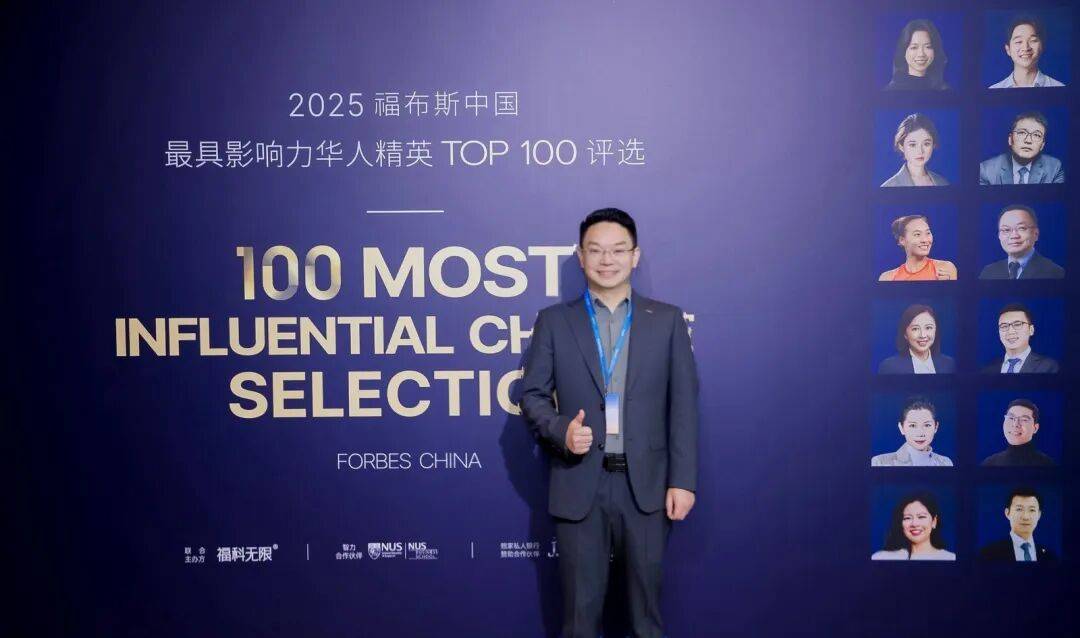
来源:福布斯中文网 过去十年,是中国品牌从"引领"国内到"远征"海外的黄金十年。从"供应链出海"的货通天下,到"产品出海"的微创新试水,再到如今"品牌出海"的价值远 征,一代代中国企业家与行业专家在全球化的大洋中搏击风浪。在这波澜壮阔的图景中,陈勇(Chris Chen)与他创立的赛文思营销咨询,以其独特 的"DTC+整合增长模型",成为众多顶尖品牌幕后不可或缺的"导航仪"与"加速器"。 陈勇的职业生涯,几乎与中国品牌出海的发展路径同频。他不仅是时代的亲历者,更是规则的参与制定者与模式的创新开拓者。日前,这位"DTC全球化 增长模型开创者"入选"2025福布斯中国最具影响力华人精英TOP 100评选"。此番和陈勇的对话,意在探寻赛文思如何用一套科学、系统、可复制的方法 论,助力数百个中国品牌在海外市场实现从0到1的破局与从1到10的跃升。 锚定中国品牌出海的三次转型 陈勇的职业生涯轨迹,清晰地勾勒出一条与中国出海大势深度咬合的逻辑主线。他将中国出海历程概括为三个主要阶段:早期的"供应链出海"阶段,特征 是"货通天下",将中国工厂的公模产品搬上电商平台,核心是价格与供应链效率;随之而来的"产品出海"阶段,商家开 ...
瑞幸「上岸」背后:IDG的「赌局」与新面孔
3 6 Ke· 2025-11-20 12:08
Core Insights - Luckin Coffee reported Q3 2025 total revenue of 15.3 billion RMB (2.14 billion USD), a year-on-year increase of 50.2%, and a net profit of 1.28 billion RMB, marking a turnaround from losses [3][4] - The company's stock price reached 40.00 USD per share, a staggering increase of 2497.4% from its 2020 price of 1.54 USD [3] - CEO Guo Jinyi announced efforts to return to the US main board listing, although no specific timeline was provided [3][4] Company Recovery - Luckin Coffee has transformed from a company that faced severe penalties and was nearly declared dead in 2020 to becoming China's largest coffee chain with over 29,000 stores [4][8] - The company has expanded internationally, opening stores in Singapore, the US, and Malaysia, with projected annual revenue exceeding 50 billion RMB by 2025 [4][8] Role of Major Investors - Dazhong Capital played a crucial role in Luckin's recovery, leading debt restructuring and governance changes after becoming the controlling shareholder in January 2022 [4][6] - IDG Capital joined Dazhong Capital's buyer group during a critical acquisition of shares from Luckin's original founders, acquiring over 383 million shares [4][6] Investment Strategy - IDG Capital's investment in Luckin was seen as a significant gamble, as the firm is typically viewed as conservative [5][9] - The decision to invest was based on thorough due diligence, revealing that Luckin's sales remained stable despite the scandal, indicating genuine market demand [7][8] Market Potential - IDG Capital estimated that Luckin could expand to at least 20,000 stores, with a potential for 30,000, highlighting the scalability of its business model [8][9] - The investment reflects IDG's shift towards recognizing the long-term potential of consumer brands in China, moving beyond traditional financial metrics [14][18] Evolution of Investment Approach - IDG Capital's investment history shows a transition from focusing on global brand localization to embracing innovative consumer products and long-term investments [16][17] - The firm is now pursuing a strategy that includes acquisitions, aiming to take a more active role in managing consumer brands globally [17][18]

瑞幸「上岸」背后:IDG的「赌局」与新面孔
36氪· 2025-11-20 10:43
Core Insights - Luckin Coffee reported Q3 2025 total revenue of 15.3 billion RMB (2.14 billion USD), a year-on-year increase of 50.2%, and a net profit of 1.28 billion RMB, marking a turnaround from losses [5] - The company aims to return to the US main board listing, although no specific timeline has been set [5][6] - Luckin Coffee has expanded to over 29,000 stores, becoming the largest coffee chain in China, with expectations of exceeding 50 billion RMB in annual revenue by 2025 [6][16] Investment Dynamics - IDG Capital played a crucial role in Luckin's debt restructuring and governance after becoming the controlling shareholder in January 2022 [6][8] - The investment opportunity arose from a judicial auction where IDG acquired shares from Luckin's original shareholders during a time when the company was viewed negatively by the market [11][12] - IDG's due diligence revealed that Luckin's sales were not significantly impacted by the previous scandal, and the company was able to adjust pricing strategies without losing customers [13][14] Strategic Insights - IDG's investment decision was based on the belief that Luckin's business model had significant growth potential, with a target of at least 20,000 stores [15][16] - The investment was seen as a gamble on Luckin's ability to leverage its digital capabilities and standardized management to capture a larger market share in China's coffee sector [15][16] - IDG's approach reflects a shift from being perceived as conservative to actively engaging in high-risk investments during market downturns [18][19] Evolution of Investment Strategy - IDG's investment history shows a progression from localizing global brands to focusing on innovative consumer products and now emphasizing technology and dual globalization [29][30] - The firm is transitioning towards a more active role in managing consumer companies, moving from minority stakes to controlling interests [31][32] - IDG's recent investments indicate a willingness to embrace longer-term, asset-heavy projects, as seen in their commitment to the Yixing Yaohu Lake project [24][30] Conclusion - The narrative surrounding Luckin Coffee illustrates IDG's evolving investment philosophy, highlighting a blend of patience, thorough due diligence, and a willingness to take calculated risks in uncertain markets [26][34]

第一省会,提前“破万”
Mei Ri Jing Ji Xin Wen· 2025-11-20 05:32
Core Insights - Guangzhou's foreign trade import and export value reached 1.02 trillion yuan in the first ten months of this year, marking a historical high with a year-on-year growth of 12.1% [1][2] - Exports from Guangzhou totaled 682.36 billion yuan, with a year-on-year increase of 20.5%, leading among major foreign trade cities in China and within Guangdong province [1][2] Trade Performance - In the first ten months, Guangzhou's trade with other RCEP member countries amounted to 292.5 billion yuan, a year-on-year increase of 11.6% [1] - Trade with the EU and ASEAN reached 182.54 billion yuan and 169.63 billion yuan, growing by 23.9% and 31.1% respectively [1] - Trade with Belt and Road countries was 479.61 billion yuan, up 24.1% year-on-year, while trade with other BRICS nations and partners reached 255.96 billion yuan, increasing by 22.5% [1] Role of Private Enterprises - Over 27,000 enterprises in Guangzhou engaged in import and export activities, a 12.5% increase year-on-year, with private enterprises accounting for over 24,000, representing 87.3% of the total [1] - Private enterprises' import and export value reached 620.75 billion yuan, a year-on-year growth of 20.3%, making up 60.6% of Guangzhou's total foreign trade [1] Export Growth Drivers - Guangzhou's exports have consistently maintained over 20% growth this year, driven by emerging industries and traditional sectors like apparel [5] - Cross-border e-commerce in Guangzhou saw a two-digit growth, reaching 169.12 billion yuan, significantly contributing to the city's foreign trade growth [5] Infrastructure and Economic Development - The new T3 terminal and fifth runway at Guangzhou Baiyun International Airport have been inaugurated, with plans to enhance the airport's multifunctionality to support cross-border e-commerce and boost regional economic development [5]
“第一省会”,提前“破万”
3 6 Ke· 2025-11-20 02:15
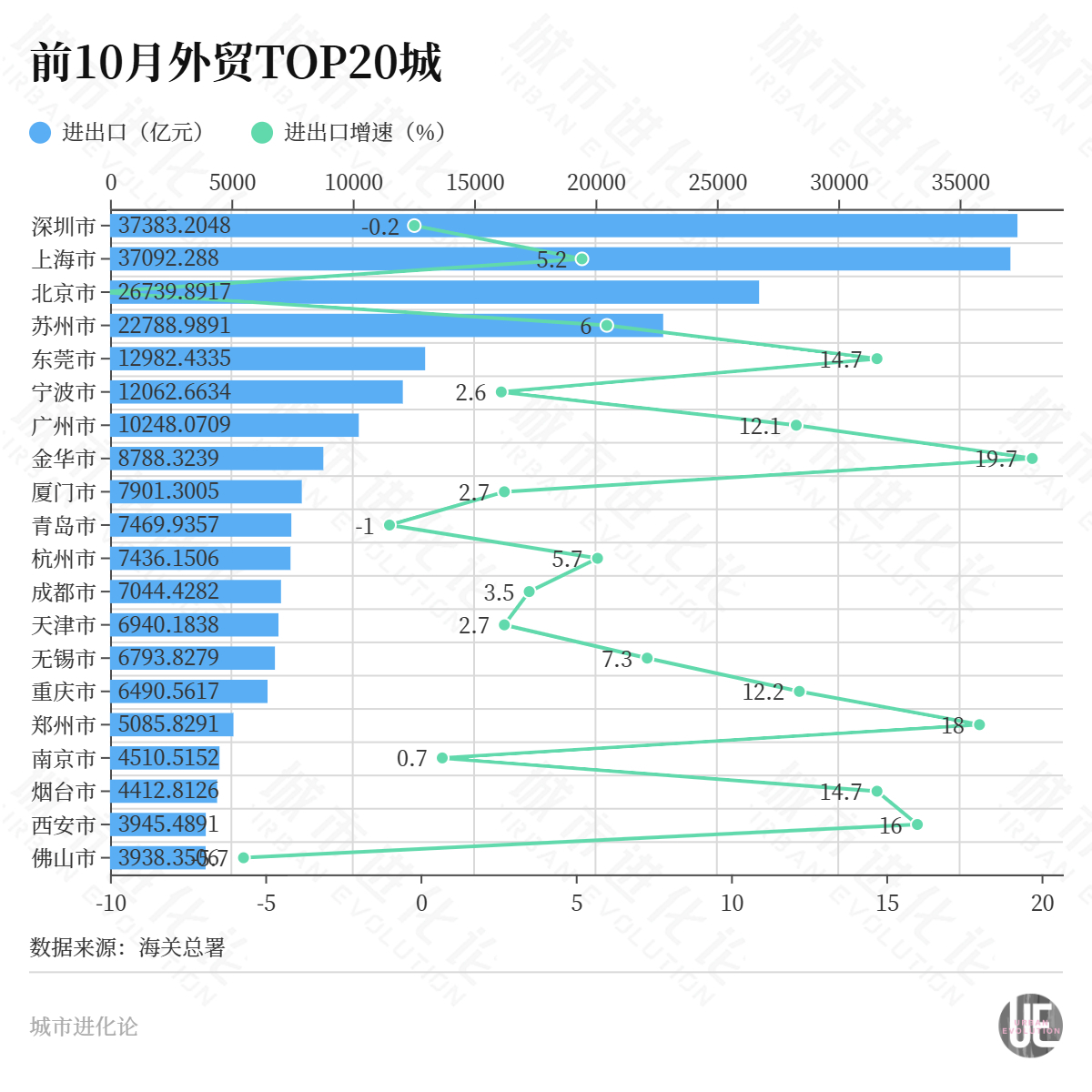
出口是广州外贸增长的核心优势。前10月广州出口规模达6823.6亿元,同比增长20.5%,增速居全国前十外贸城市首位、广东省21个地市首位。 海关数据显示,广州重点商品出口增长明显,"新三样"产品出口199.4亿元,同比增长52.8%;同期,高新技术产品出口753.6亿元,同比增长15.3%。 据广州海关统计,今年前10月,广州市外贸进出口总值达1.02万亿元,创下历史同期新高,同比增长12.1%。其中,出口6823.6亿元,同比增长20.5%,增 速居全国主要(前十)外贸城市首位、广东省21个地市首位。 具体来看,今年前10月,广州市对其他RCEP成员国进出口2925亿元,同比增长11.6%。同期,广州市对欧盟、东盟的进出口值分别为1825.4亿元、1696.3 亿元,同比分别增长23.9%、31.1%;对共建"一带一路"国家进出口4796.1亿元,同比增长24.1%;对其他金砖成员国和伙伴国进出口2559.6亿元,同比增 长22.5%。 民营企业是广州外贸"主力军"。今年前10月,广州市有进出口实绩的企业超过2.7万家,同比增长12.5%。其中,民营企业数量超过2.4万家,在有进出口实 绩企业总数中占比达 ...
城市24小时 | 第一省会,提前“破万”
Mei Ri Jing Ji Xin Wen· 2025-11-19 16:02
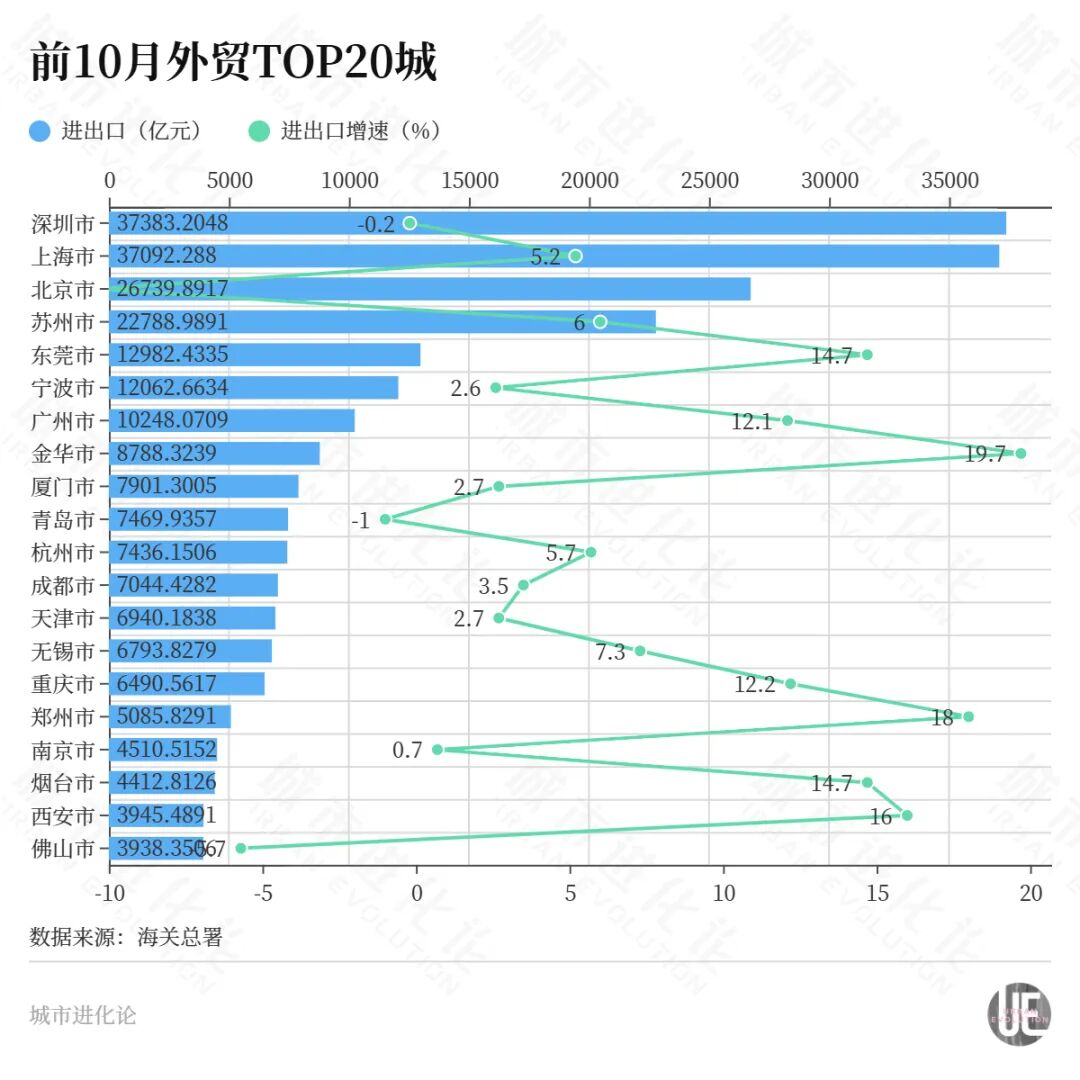
Core Insights - Guangzhou's foreign trade import and export value reached 1.02 trillion yuan in the first ten months of this year, marking a historical high for the same period, with a year-on-year growth of 12.1% [1][2] - Exports from Guangzhou amounted to 682.36 billion yuan, with a year-on-year increase of 20.5%, leading among major foreign trade cities in China and within Guangdong province [1][2] - Private enterprises are the main contributors to Guangzhou's foreign trade, accounting for 87.3% of the total number of enterprises engaged in import and export activities [1] Trade Performance - In the first ten months, Guangzhou's trade with other RCEP member countries reached 292.5 billion yuan, a year-on-year increase of 11.6% [1] - Trade with the EU and ASEAN saw significant growth, with values of 182.54 billion yuan and 169.63 billion yuan, respectively, reflecting year-on-year increases of 23.9% and 31.1% [1] - Trade with Belt and Road countries reached 479.61 billion yuan, growing by 24.1% year-on-year, while trade with other BRICS countries and partners was 255.96 billion yuan, up 22.5% [1] Export Dynamics - Key export products from Guangzhou showed notable growth, with "new three samples" products exporting 19.94 billion yuan, a year-on-year increase of 52.8%, and high-tech products exporting 75.36 billion yuan, up 15.3% [3] - The cross-border e-commerce sector in Guangzhou maintained double-digit growth, reaching 169.12 billion yuan in the first nine months, significantly contributing to the overall foreign trade growth [7] Economic Development Initiatives - The Guangdong provincial government aims to enhance the airport economy by expanding the functions of the airport and attracting cross-border e-commerce industries to stimulate regional economic growth [7]

亚马逊反攻Temu
3 6 Ke· 2025-11-19 10:20
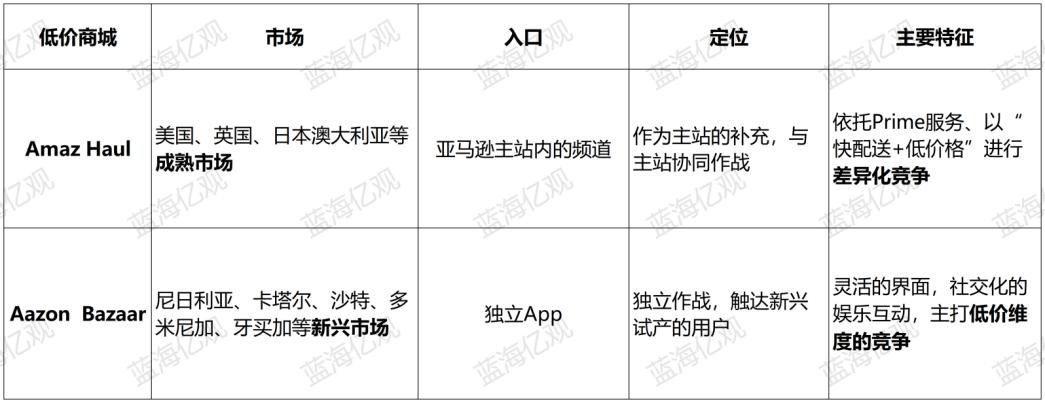
Core Insights - Amazon has launched a standalone low-price shopping app named Amazon Bazaar, marking a significant move into emerging markets and a shift from a defensive to an offensive strategy in the low-price segment [1][7]. Group 1: Amazon's Strategy - Amazon is leveraging two low-price e-commerce platforms: Amazon Haul for developed markets and Amazon Bazaar for emerging markets, emphasizing the importance of positioning and differentiation [2][3]. - Amazon Haul operates as a channel within the main site, focusing on fast delivery and low prices to retain low-price shoppers, while Amazon Bazaar operates independently, focusing solely on low prices [2][3]. - The Bazaar app features a simple interface with interactive entertainment functions, with most products priced below $10, some as low as $2 [3][5]. Group 2: Competitive Landscape - Amazon faces strong competition from Temu and SHEIN in both developed and emerging markets, which have captured significant market share and consumer attention [7][10]. - Temu has rapidly gained traction in emerging markets, including Nigeria, where it topped download charts shortly after launch [10]. - Amazon's Haul is currently struggling in the U.S. market, with low traffic and sales, despite the removal of tax exemptions for Temu [11][12]. Group 3: Future Prospects - Amazon Bazaar will compete with Temu's centralized pricing model and supply chain responsiveness, with the potential challenge of maintaining low prices due to seller autonomy in pricing [14][15]. - The effectiveness of Bazaar in emerging markets remains to be seen, but it may provide new opportunities for factory-type and private label sellers already familiar with platforms like Temu and SHEIN [17].

亚马逊卖家之困:电商税风暴与价格体系的崩塌
雷峰网· 2025-11-19 06:38
Core Viewpoint - The cross-border e-commerce industry is facing significant challenges due to strict enforcement of e-commerce taxes and changing platform rules, particularly on Amazon, which is leading to a survival crisis for small and medium-sized sellers [2][4][9]. Group 1: Challenges Faced by Sellers - The strict enforcement of e-commerce taxes is forcing many sellers to explain discrepancies in reported income, which could lead to losses if they are required to pay back taxes [2][4]. - Amazon's new pricing rules are causing historical prices to be recalibrated, leading to reduced sales volumes for many sellers [6][9]. - Increased advertising costs and platform fees are squeezing profit margins, with some sellers reporting advertising costs exceeding 10% of sales [7][9]. Group 2: Seller Strategies and Adaptations - Many sellers are exploring alternative platforms like TikTok and Temu, seeking better profit margins and less competitive environments, although these platforms also present their own challenges [10][11][12]. - A shift towards brand building is emerging among sellers, as reliance on low-price strategies is becoming unsustainable in the face of intense competition [15][16][18]. - Sellers are balancing their resources between maintaining a presence on Amazon and exploring new channels, with a common strategy being to allocate 70% of resources to Amazon and 30% to emerging platforms like TikTok [21]. Group 3: Market Dynamics - The competitive landscape is evolving, with platforms like TikTok offering lower commission rates (5%-8%) compared to Amazon's rates (15% or more), making them attractive alternatives for sellers [11]. - Amazon is adjusting its algorithms to favor brand-oriented sellers, indicating a shift in platform strategy towards higher-value sellers [16][18]. - The overall sentiment among sellers is one of cautious adaptation, recognizing that while Amazon's environment is tightening, it remains the most viable platform for sustainable profit [21].