
赛力斯

Search documents
赛力斯张正萍:正全力推进“人工智能+”产业化落地
Nan Fang Du Shi Bao· 2025-11-28 10:00
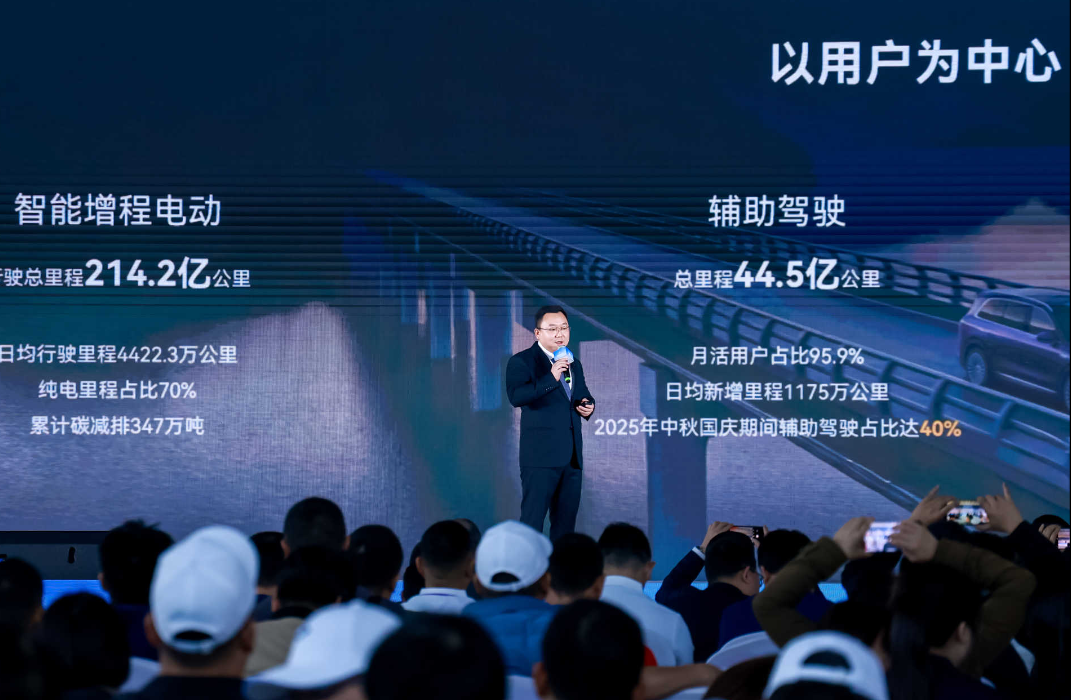
Group 1 - The core viewpoint of the articles highlights the strategic initiatives of the company in building a world-class high-end industrial chain for new energy vehicles, emphasizing deep collaboration with industry partners and efficient synergy mechanisms [1][3] - The company is focusing on product integration, intelligent manufacturing, and industrial clustering to enhance the overall competitiveness of China's automotive industry in the global market [1] - The company has reported significant growth in its new energy vehicle sales, with October sales reaching 51,500 units, a year-on-year increase of 42.89%, and cumulative sales for the first ten months totaling 356,000 units [3] Group 2 - The company has positioned "intelligence" as a key brand label, with its assisted driving feature having safeguarded over 4.45 billion kilometers for users, particularly during peak travel periods [3] - The company is committed to advancing the industrialization of "Artificial Intelligence +" technologies, aiming to transform its products into emotional, intelligent, and reliable "mobile intelligent entities" [3] - For the first three quarters of the year, the company reported revenue of 110.5 billion yuan, a year-on-year increase of 3.67%, and a net profit attributable to shareholders of 5.312 billion yuan, reflecting a growth of 31.56% [3]


赛力斯张正萍:深化产业链协同 积极推进“人工智能+”产业化落地
Yang Guang Wang· 2025-11-28 09:31
Core Viewpoint - The company, Seres, is focused on building a world-class high-end electric vehicle industry chain through deep collaboration with industry partners and efficient synergy mechanisms [1] Group 1: Strategic Initiatives - Seres is actively promoting product integration, intelligent manufacturing clustering, and industrial agglomeration to enhance the overall competitiveness of China's automotive industry in the global market [1] - The company aims to anchor its strategy in the high-end smart electric vehicle sector and deepen strategic cooperation with industry partners to drive high-quality development in the new energy vehicle industry [1] Group 2: Technological Advancements - "Intelligentization" has become a key brand label for the company, with the assisted driving feature deeply integrated into users' daily travel scenarios [1] - As of now, the assisted driving feature has safeguarded users for over 4.45 billion kilometers, with a significant 40% of the driving distance during the recent Mid-Autumn and National Day holidays attributed to this feature [1] Group 3: AI Integration - The company is fully committed to advancing the industrialization of "Artificial Intelligence+" to transform products into emotional, intelligent, and trustworthy "mobile intelligent entities," accelerating the transition of the automotive industry from electrification to intelligentization [1]
乘用车板块11月28日涨1.57%,广汽集团领涨,主力资金净流入11.25亿元
Zheng Xing Xing Ye Ri Bao· 2025-11-28 09:08
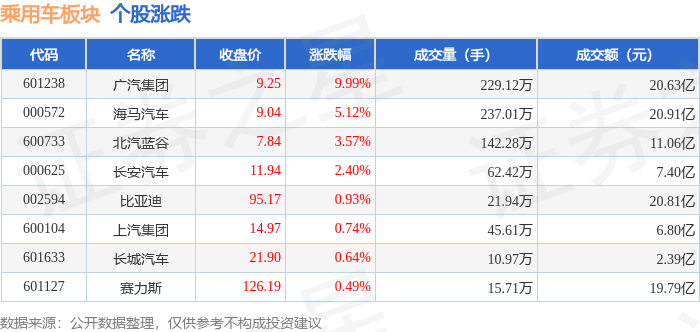
Core Points - The passenger car sector experienced a rise of 1.57% on November 28, with GAC Group leading the gains [1] - The Shanghai Composite Index closed at 3888.6, up 0.34%, while the Shenzhen Component Index closed at 12984.08, up 0.85% [1] Passenger Car Sector Summary - GAC Group's stock closed at 9.25, with a significant increase of 9.99%, and a trading volume of 2.29 million shares, amounting to a transaction value of 2.063 billion yuan [1] - Other notable performers included: - BAW Blue Valley, which rose by 3.57% to close at 7.84, with a transaction value of 1.106 billion yuan [1] - Changan Automobile, which increased by 2.40% to close at 11.94, with a transaction value of 740 million yuan [1] - BYD, which saw a modest increase of 0.93% to close at 95.17, with a transaction value of 2.081 billion yuan [1] Fund Flow Analysis - The passenger car sector saw a net inflow of 1.125 billion yuan from main funds, while retail investors experienced a net outflow of 643 million yuan [1] - The overall fund flow indicates a mixed sentiment, with institutional investors showing confidence while retail investors withdrew [1]




港股机器人概念股大涨
Di Yi Cai Jing Zi Xun· 2025-11-28 08:52
机器人概念股集体走强,广汽集团涨超16%,越疆涨超9%,优必选涨超3%。 11月28日,香港恒生指数收跌0.34%,恒生科技指数涨0.02%。 | 代码 | 名称 | 现价 | 涨跌 | 涨跌幅 | 成交额 | | --- | --- | --- | --- | --- | --- | | ISH | 恒生指数 | 25858.89c | -87.04 | -0.34% | 1462亿 | | HSTECH | 恒生科技 | 5599.11c | 1.06 | 0.02% | 431亿 | | HSBIO | 恒生生物科技 | 15663.98c | -144.54 | -0.91% | 81亿 | | HSCEI | 恒生中国企业指数 | 9130.18c | -34.69 | -0.38% | 565亿 | | HSCI | 恒生综合指数 | 3957.64c | -7.04 | -0.18% | 1046亿 | 编辑 | 钉钉 | 广汽集团 | 4.140 | 16.62% | | --- | --- | --- | | HK 2238 | | | | 越疆 | 40.080 | 9.75% | | H ...


【快讯】每日快讯(2025年11月28日)
乘联分会· 2025-11-28 08:42
Domestic News - The Ministry of Commerce will promote automotive circulation consumption reform trials to expand automotive consumption across the entire chain, including used car circulation and automotive aftermarket services such as modifications and rentals [7] - As of the end of October this year, the total number of electric vehicle charging infrastructure (guns) in China reached 18.645 million, a year-on-year increase of 54.0% [8] - Chongqing aims to integrate "AI + intelligent driving" as a key component of its automotive industry development, enhancing policy support and resource integration for advanced autonomous driving technology [9] - Hefei has launched a new round of consumption vouchers, offering a maximum subsidy of 10,000 yuan for individuals purchasing new vehicles that meet the National VI emission standards [10] - Seres has successfully completed the industry's first "vehicle-police-medical" linkage technology verification, enhancing emergency rescue efficiency through real-time accident information sharing [12] - Avita Technology has submitted a listing application to the Hong Kong Stock Exchange, reporting a revenue of 12.208 billion yuan for the first half of 2025, a year-on-year increase of 98.5% [13] - Changan Automobile's indirect controlling shareholder has completed a business change registration, with no impact on the company's operations [14] - Leap Motor announced a sales target of 1 million units for 2026, becoming the first new force car company in China to set such an ambitious annual sales goal [15] International News - In October, UK automotive production fell by 23.8% year-on-year, largely due to a cyberattack on Jaguar Land Rover [16] - South Korea plans to commercialize fully autonomous vehicles by 2027, establishing a demonstration city for over 100 autonomous vehicles and easing regulatory restrictions [18] - Environmental organizations are urging the EU to reject car manufacturers' requests to allow the use of biofuels post-2035, citing supply shortages and inadequate carbon neutrality [19] - Russia's largest car manufacturer, Avtovaz, plans to return to a five-day workweek starting January 1, 2026, as production prospects improve [20] Commercial Vehicles - GAC's Lingcheng won the "Annual New Energy Tractor" award, highlighting its strong performance and energy efficiency in the new energy commercial vehicle market [21] - Beijing Heavy Truck has celebrated the production of its 20,000th vehicle, marking a significant milestone and indicating strong market recognition [22] - Shanxi Province has adjusted its subsidy policy for the scrapping and updating of old operating trucks, implementing a new registration and lottery system for subsidies [23] - ZF's new hybrid transmission has completed real vehicle testing, showing significant emissions reduction and lower total cost of ownership while meeting modern fleet operational needs [24]


港股机器人概念股大涨
第一财经· 2025-11-28 08:42
Market Overview - The Hang Seng Index (HSI) closed at 25,858.89, down by 87.04 points or 0.34%, with a trading volume of 146.2 billion [1] - The Hang Seng Technology Index (HSTECH) slightly increased by 1.06 points or 0.02%, closing at 5,599.11, with a trading volume of 43.1 billion [1] - The Hang Seng China Enterprises Index (HSCEI) decreased by 34.69 points or 0.38%, closing at 9,130.18, with a trading volume of 56.5 billion [1] - The Hang Seng Composite Index (HSCI) fell by 7.04 points or 0.18%, closing at 3,957.64, with a trading volume of 104.6 billion [1] Sector Performance - Robot concept stocks showed strong performance, with GAC Group rising over 16%, Yuejiang up over 9%, and UBTECH increasing by over 3% [2] - Gold stocks also saw gains, with Zhenfeng Gold rising over 12%, China Gold International up over 5%, and Lingbao Gold increasing by over 4% [3] - Other individual stocks experienced declines, with Seres down over 8% and WuXi AppTec falling over 3% [3]

香港恒生指数收跌0.34% 恒生科技指数涨0.02%
Xin Lang Cai Jing· 2025-11-28 08:13
香港恒生指数收跌0.34%,恒生科技指数涨0.02%。机器人概念股走高,广汽集团涨超16%,越疆涨超 9%,优必选涨超3%;黄金股上涨,珠峰黄金涨超12%,中国黄金国际涨超5%,灵宝黄金涨超4%。赛 力斯跌超8%,药明康德跌超3%。 ...
驰援香港大埔火灾救援 汽车相关企业在行动
Cai Jing Wang· 2025-11-28 07:53
Core Points - A fire incident occurred in Hong Kong's Tai Po district, resulting in 94 fatalities, including one firefighter, as of November 28 [1] - Various companies and organizations have made significant donations to support disaster relief efforts, totaling millions of Hong Kong dollars [3][6][7][8] Group 1: Donations and Support - Chery Automobile donated 10 million HKD to assist in emergency rescue and post-disaster recovery efforts [1] - Geely Holding Group and the Li Shufu Public Welfare Foundation also donated 10 million HKD for medical aid, emergency housing, and disaster reconstruction [3] - BYD (Hong Kong) contributed 10 million HKD for medical assistance and temporary housing for affected residents [3] - GAC Group donated 6 million HKD for emergency medical aid and temporary housing [3] - Seres Group provided 5 million HKD for medical assistance and disaster recovery [3] - Xiaomi Foundation donated 10 million HKD for medical aid and emergency housing for affected residents [7] - Didi donated 10 million HKD for emergency rescue and humanitarian aid, and will continue to provide support as needed [8] Group 2: Logistics and Material Support - JD Group's Hong Kong subsidiary was the first to deliver emergency supplies, including water and food, to the disaster area [7] - JD Logistics activated its emergency plan to ensure timely delivery of essential supplies, leveraging its extensive warehouse network [7] - Zeekr brand from Geely will deploy vehicles for emergency logistics during the disaster response [3]

首家央企新势力要IPO了
Hua Er Jie Jian Wen· 2025-11-28 07:32
Core Viewpoint - Avita, a high-end electric vehicle brand under Changan Automobile, has submitted its IPO application to the Hong Kong Stock Exchange, aiming to become the first central enterprise new energy stock in Hong Kong [2] Group 1: Company Growth and Market Position - Avita has achieved a "three years, four cars" layout, with four main models and two limited edition models, covering the mainstream high-end market priced between 200,000 to 700,000 RMB [2] - The company has seen consistent monthly sales exceeding 10,000 units in recent months, with total sales surpassing 100,000 units from January to October [2][4] - Avita's revenue is projected to grow significantly, with expected revenues of 5.645 billion RMB and 15.195 billion RMB for 2023 and 2024 respectively, marking a year-on-year increase of 169.16% [4] Group 2: Strategic Goals and Future Plans - Avita aims to achieve global sales of 400,000 units by 2027 and 800,000 units by 2030, with a long-term goal of 1.5 million units by 2035 [5] - The company plans to focus on enhancing product supply and strengthening its foundational capabilities to achieve scale effects [5] - Avita has completed four rounds of financing, raising over 19 billion RMB, with the IPO funds intended for product development, brand building, and operational support [5][8] Group 3: Partnership with Huawei - Avita has established a strategic partnership with Huawei, with plans for Huawei's products and technologies to be first launched on Avita vehicles [6] - The two companies plan to jointly launch 17 models by 2030, including five upgraded models in 2026 [7] Group 4: Global Expansion - Avita is expanding its presence internationally, having entered over 34 countries and regions since September 2024, with plans to establish over 160 sales channels by 2030 [8] - The brand maintains a high-end positioning in overseas markets, exemplified by the Avita 11's starting price of 1.56 million RMB in Singapore [8]
问界M9交付破26万持续领跑高端新能源市场 多家券商看好成长潜力
Zhong Zheng Wang· 2025-11-28 07:09
Group 1 - The luxury car market is becoming increasingly competitive, with the Wanjie M9 setting a new delivery record for vehicles priced at 500,000 yuan, highlighting its leadership in the high-end market and attracting significant attention from the capital market [1] - The Wanjie M9, a flagship product co-developed by Seres and Huawei, has surpassed cumulative deliveries of 260,000 units, maintaining its position as the sales champion in the 500,000 yuan luxury car segment [1] - Multiple securities firms, including CITIC Securities, Huachuang Securities, and Guohai Securities, have released reports expressing optimism about Wanjie's product strength and brand power [1] Group 2 - The successful listing of Seres on the Hong Kong Stock Exchange has established an "A+H" dual capital platform, with 30% of the funds raised earmarked for new model development, enhancing the high-end product matrix [2] - The Wanjie M9 has begun its overseas expansion, with the Hong Kong listing providing strong momentum for internationalization, focusing on core markets such as ASEAN and the Middle East [2] - Wanjie aims to consolidate its leading position in the high-end new energy vehicle market through a combination of product strength, brand power, and support from the capital market [2]