智谱

Search documents
智谱(02513)回应与出行平台合作不涉内幕消息 业务推进属日常范畴
智通财经网· 2026-01-12 12:18
Core Viewpoint - The company, Zhiyu (02513), confirmed a strategic partnership with a ride-hailing platform, stating that this partnership is part of its normal business operations and does not involve any undisclosed information that could mislead the market [1] Group 1 - The partnership with the ride-hailing platform is established during the company's routine business processes [1] - The company collaborates with various firms across different industries to advance its business objectives in daily operations [1] - The company is not aware of any information that needs to be disclosed to prevent misleading the market regarding its securities [1]
智谱(02513) - 根据上市规则第13.10条作出之公告
2026-01-12 12:10
香港交易及結算所有限公司及香港聯合交易所有限公司對本公告的內容概不負責,對其準確性或完整性亦不發表 任何聲明,並明確表示概不就因本公告全部或任何部分內容而產生或因倚賴該等內容而引致的任何損失承擔任何 責任。 Knowledge Atlas Technology Joint Stock Company Limited 北京智譜華章科技股份有限公司 (於中華人民共和國成立之股份有限公司) 就近期有報導指本集團與一家出行平台建立戰略合作夥伴關係,經作出在相關情況下屬 合理的有關本公司的查詢後,本公司確認,該合作夥伴關係乃於本集團之一般及日常業 務過程中進行。本集團與不同行業的多家公司合作,以在日常營運中推進其業務目標。 本公司並不知悉任何須予公佈以避免本公司證券出現虛假市場之資料,或根據上市規則 第13.09(2)條及證券及期貨條例(香港法例第571章)第XIVA部須予披露之任何內幕消息。 本公告乃承本公司之命而作出。本公司董事會(「董事會」)共同及個別就本公告之準確 性承擔責任。 本公司股東及有意投資者於買賣本公司證券時務請審慎行事。 承董事會命 北京智譜華章科技股份有限公司 執行董事兼董事長 劉德兵博士 香港, ...
全球科技(计算机)行业周报:英伟达VeraRubin平台量产,驱动AI应用规模化普及-20260112
Huaan Securities· 2026-01-12 12:02
Investment Rating - Industry rating: Overweight [1] Core Insights - On January 6, 2026, NVIDIA CEO Jensen Huang officially launched the latest NVIDIA Rubin platform at CES 2026, stating that it has entered full-scale production. The Rubin platform consists of six new chips: Vera CPU, Rubin GPU, NVLink 6 switch, ConnectX-9 SuperNIC, BlueField-4 DPU, and Spectrum-6 Ethernet switch, designed to form an AI supercomputer that significantly reduces AI training time and lowers inference token generation costs. The training performance of the Rubin platform is 3.5 times that of the previous Blackwell generation, with software performance improved by 5 times, and the cost per token for inference reduced by 10 times compared to the Blackwell platform. Additionally, the number of GPUs required for training MoE models is reduced to one-fourth of the previous requirement [3][13][15]. - The Rubin platform integrates five key technologies to achieve breakthroughs in performance enhancement and cost reduction: 1) New NVLink interconnect technology ensures low latency and high bandwidth during multi-chip collaboration; 2) The third-generation Transformer engine optimizes for AI tasks, greatly improving model training and inference efficiency; 3) Confidential computing technology provides end-to-end security for sensitive AI data, meeting compliance needs in finance and healthcare; 4) RAS engine ensures stable performance under 24/7 high-load operation; 5) Vera CPU is specifically designed for agent inference [4][13]. - Major cloud providers, including Amazon AWS, Google Cloud, Microsoft Azure, and Oracle Cloud, have confirmed plans to deploy instances based on Vera Rubin in 2026, allowing global users to access top-tier AI computing power through cloud services. This will enable AI startups and SMEs, previously limited by high computing costs, to easily utilize the Rubin platform's powerful capabilities without significant hardware investment. Efficient computing power will accelerate breakthroughs in basic scientific research and technology, promoting deep applications of AI in healthcare, education, and environmental protection [5][14]. - The Rubin platform's dual breakthroughs in performance and cost reduction will significantly lower hardware procurement and operational costs for AI companies, facilitating the widespread adoption of AI applications such as intelligent customer service, autonomous driving, drug development, industrial quality inspection, and scientific research. It is recommended to pay attention to domestic and international AI computing infrastructure and related companies, including Cambrian, Zhongke Shuguang, Yonyou Network, Dingjie Zhizhi, Kingsoft Office, Tonghuashun, Jiao Dian Technology, Saiyi Information, and Fubo Group [6][15]. Market Overview - As of the week, the Shanghai Composite Index rose by 3.82%, the ChiNext Index increased by 3.89%, and the CSI 300 Index went up by 2.79%. The computer industry index surged by 8.49%, outperforming the Shanghai Composite Index by 4.67 percentage points, the ChiNext Index by 4.60 percentage points, and the CSI 300 Index by 5.70 percentage points. Year-to-date, the computer industry index has also increased by 8.49% [17][20]. - The computer industry index ranked 5th among 31 industry indices this week and 2nd among the four major TMT industries (electronics, communications, computers, media) [17]. Company Dynamics - The report highlights significant movements in the software and information technology sectors, with companies like Huijin Technology, Ersan Siwu, and Zhuoyi Information showing notable performance. Future investment opportunities are suggested in the financial IT, industrial software, and trusted innovation sectors, which are expected to see upward trends [22].

【IPO追踪】港股开年新股全线飘红,热潮背后亦有隐忧
Sou Hu Cai Jing· 2026-01-12 11:52
Core Insights - The Hong Kong stock market has seen a strong start in 2026, with eight companies completing their IPOs within just six trading days, including notable firms in the GPU, surgical robotics, and biotechnology sectors [2][3][5] - The initial public offerings (IPOs) have been well-received, with first-day price increases ranging from 8.44% to 109.09%, indicating strong market enthusiasm for sectors like large models, domestic chip alternatives, and surgical robotics [2][3][5] IPO Performance - MiniMax, a key player in the large model sector, achieved a remarkable first-day closing price increase of 109.09%, with a market capitalization reaching HKD 106.7 billion, and was oversubscribed by 1,836.17 times in public offerings [3][5] - Wallen Technology, the first GPU stock in Hong Kong, also performed impressively with a first-day increase of 75.82% [4] - The average first-day increase for the new batch of IPOs was 40.16%, with a cumulative average increase of nearly 62% since listing, reflecting strong market recognition of high-quality hard tech assets [5][6] Market Dynamics - The current IPO market in Hong Kong is characterized by a large backlog of over 300 companies waiting to list, indicating a robust supply pipeline [6] - In December 2025, 32 companies submitted IPO applications, and 26 companies have done so in January 2026 alone, showcasing sustained enthusiasm for new listings [6] Sector Trends - The successful performance of new IPOs has broken the previous trend of "hot IPOs followed by cold market performance," suggesting that the sectors these companies operate in are gaining market confidence [5][6] - Companies like MiniMax and Zhizhu have shown significant cumulative price increases since their IPOs, with MiniMax achieving a total increase of 141.21% and Zhizhu 79.35% [5][6] Regulatory Environment - The Hong Kong Securities and Futures Commission has emphasized the need for high-quality IPO submissions, responding to concerns about the quality of some recent applications [8] - This regulatory focus aims to shift the IPO market from quantity-driven to quality-driven, which may temporarily slow down the listing process for some companies [8]

MiniMax和智谱,千亿IPO的两条路
3 6 Ke· 2026-01-12 11:42
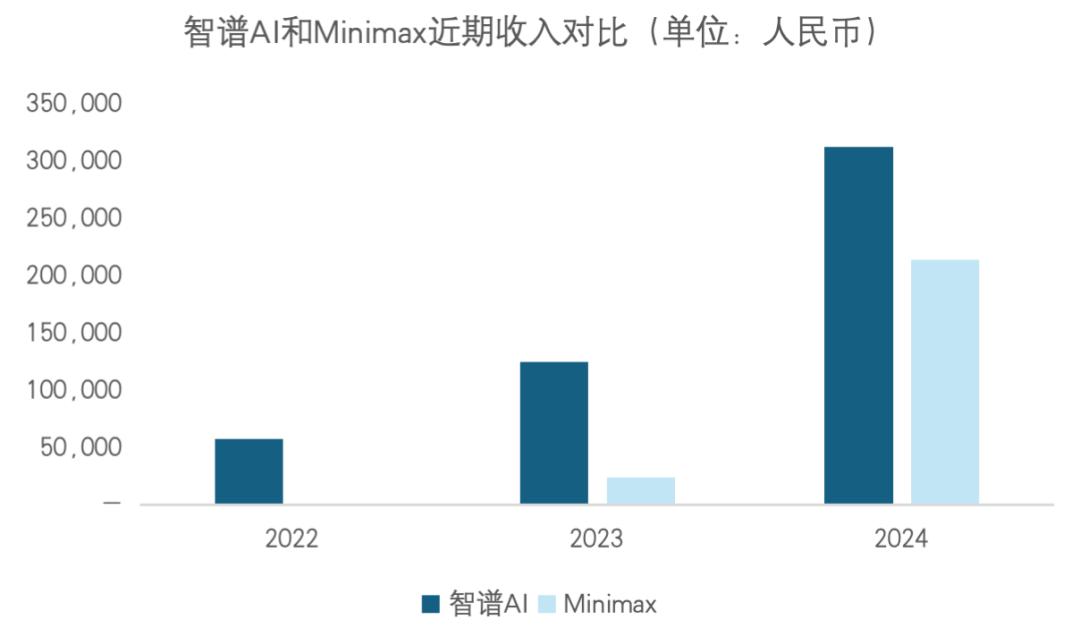
Core Insights - The article discusses the contrasting paths taken by MiniMax and Zhipu AI, two emerging players in the AI sector, amidst the intense competition and capital expenditure by larger AI firms [1] Group 1: MiniMax - MiniMax is characterized as an aggressive player focusing on consumer-driven products and multiple models, starting with its AI virtual social application Glow, which emphasizes emotional interaction [2] - The company has expanded its product offerings to include Talkie and Xingye, which together accounted for 63.7% of MiniMax's revenue in 2024 [2] - By 2025, MiniMax aims to diversify its technology with independent models for text, video, and voice, leading to a decrease in revenue contribution from Talkie/Xingye to 35.1% [3] - Over 70% of MiniMax's revenue comes from overseas, primarily from consumer membership fees, indicating a promising revenue model [4] - Despite its growth, MiniMax holds only a 0.3% market share in the global AI market as of Q3 2025, ranking tenth [4] - The company faces challenges in competing with larger firms that have more resources for model training and data acquisition, which are critical for AI development [4][5] Group 2: Zhipu AI - Zhipu AI, founded in 2019 and rooted in academic research, has a more traditional B2B approach, generating over 80% of its revenue from local enterprises through project-based AI model implementations [6][7] - The company has a higher revenue and consistent gross margins above 50%, but its growth potential may be limited compared to MiniMax [8] - Zhipu AI has attracted significant investment, completing 18 funding rounds before its IPO, which has positioned it well in the competitive landscape [6][7] - The company focuses on developing a unified multimodal model, which is seen as a trend in enhancing AI capabilities [6] Group 3: Market Context - Both companies represent different growth strategies in the AI sector, with MiniMax focusing on consumer products and Zhipu AI on enterprise solutions [12] - The article highlights the ongoing competition in the AI market, with significant investments from major players like OpenAI, which is reportedly preparing for an IPO with a valuation of $1 trillion [12] - The future of AI profitability is anticipated to hinge on companies that effectively integrate AI into various industries to enhance efficiency and meet demand [14]
智谱CEO张鹏:焦虑AI大浪潮之后,市场一片狼藉
Sou Hu Cai Jing· 2026-01-12 11:13
张鹏解释,他不是在担心自己团队是否能留下,而是担心市场在过度繁荣之后走向另一极端,即"烈火 烹油"后整个市场都塌掉。"如果市场都没了,你做的再好也没有用。" 近日,智谱科技CEO张鹏在一档访谈节目中表示,AI爆火后,除了特别兴奋的感觉,他也有些担心害 怕。 ...
Token售卖已无溢价、大模型公司转型“系统商”?记忆张量 CTO 李志宇:智能体能力会拉开差距,长期记忆与状态管理成竞争核心
AI前线· 2026-01-12 11:04
Core Insights - The article discusses the evolution of AI companies and technologies, emphasizing the shift from merely scaling models to developing sustainable systems that incorporate memory and state management capabilities [2][4][17]. Group 1: Industry Trends - In 2025, notable companies like MiniMax and Zhipu have emerged, aiming for IPOs, but face challenges such as severe losses and production ratios [4]. - The pressure on tech companies has intensified, with a focus on system efficiency and sustainable technology accumulation rather than just chasing model parameters [5]. - The competition landscape is shifting from a focus on individual model capabilities to a broader emphasis on system-level capabilities, including memory management and reasoning [17]. Group 2: Technological Developments - The trend of using large-scale synthetic data is growing, but it is not expected to completely replace human-annotated data; high-quality synthetic data must be carefully constructed [9]. - Significant advancements in model capabilities have been observed, particularly in complex instruction understanding and multi-step reasoning stability [10]. - The introduction of Mixture of Experts (MoE) architecture has become mainstream due to its cost-effectiveness, balancing parameter efficiency and inference costs [12]. Group 3: Future Directions - The next major leap in AI models is anticipated to come from advancements in memory management, transitioning from static parameter storage to dynamic memory systems that support long-term tasks [18]. - The competition in AI is expected to focus on the development of intelligent agents, with a need for models to enhance reasoning, state understanding, and collaboration with tools [15]. - Companies are likely to explore value-added services beyond just selling model tokens to maintain profitability amid increasing price competition [16].

A股成交额创新高!三大指数均涨超1%
Jin Rong Shi Bao· 2026-01-12 10:47
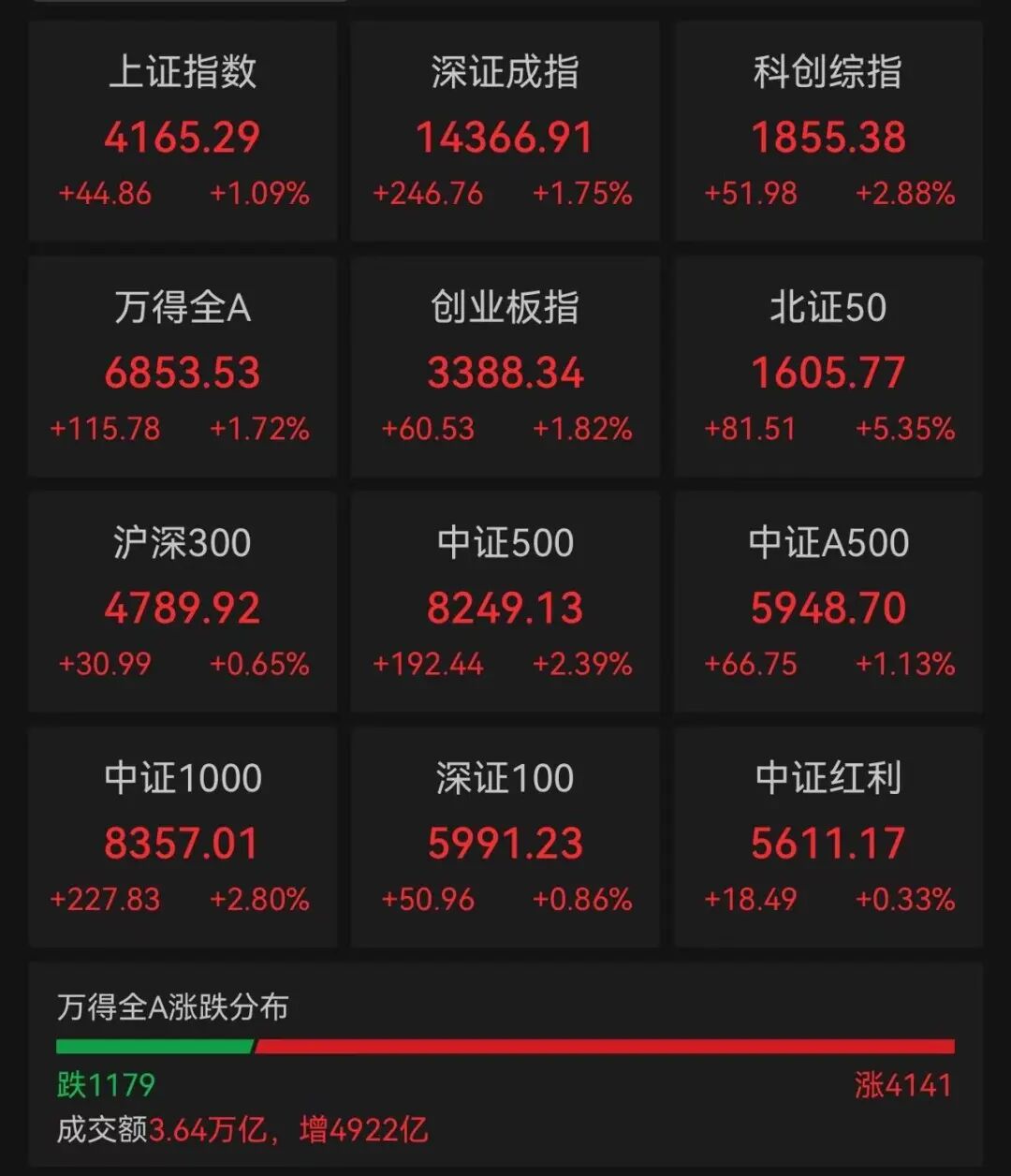
Market Performance - The A-share market continued its upward trend on January 12, with the Shanghai Composite Index, Shenzhen Component Index, and ChiNext Index rising by 1.09%, 1.75%, and 1.82% respectively [1] - The total market turnover reached 3.64 trillion yuan, marking the second consecutive trading day above 3 trillion yuan, setting a new historical record [1][2] Sector Performance - The AI application sector experienced significant growth, with the Wande Internet Index and Software Index increasing by 9.81% and 7.75% respectively, and over 20 stocks, including Tianrun Technology and Zhongcheng Technology, hitting the daily limit [2][5] - The commercial aerospace sector also showed strong performance, with stocks like Guobo Electronics and Ligong Navigation seeing daily limit increases [6] AI Industry Developments - Domestic and international AI dynamics are intensifying, with major financing activities reported, including xAI's completion of a Series E funding round raising $20 billion (approximately 140 billion yuan) [5] - Domestic large model companies, such as Zhipu and MiniMax, have recently listed on the Hong Kong Stock Exchange, with stock price increases of 80% and 141% respectively [5] - The AI application is in an accelerated penetration phase, supported by government policies aimed at enhancing digital infrastructure and increasing the penetration rate of intelligent agents to 70% by 2027 [6] Technological Advancements - Recent breakthroughs in domestic large models are expected to enhance programming capabilities and support longer context windows, facilitating the deployment of intelligent agents in complex scenarios [6] - Upcoming AI platforms, such as NVIDIA's "Rubin platform" and AMD's "Helios" platform, are set to advance AI computing capabilities [5]
放量,大涨!
Zhong Guo Ji Jin Bao· 2026-01-12 10:38
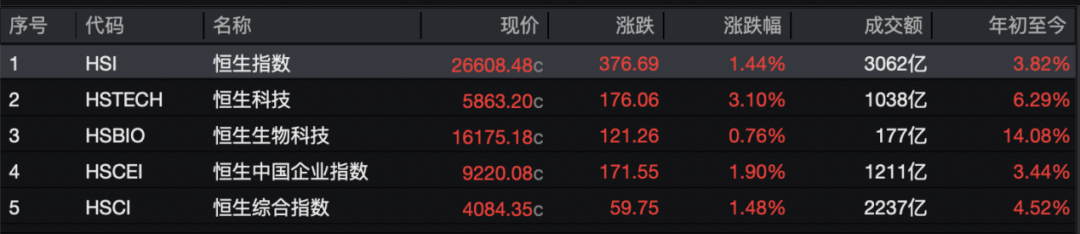
Market Performance - On January 12, Hong Kong stocks saw a significant increase in trading volume, with total turnover exceeding 300 billion HKD, reaching 306.22 billion HKD, a substantial rise from the previous trading day [2] - The Hang Seng Index closed up 1.44% at 26,608.48 points, while the Hang Seng Technology Index surged 3.10% to 5,863.20 points [1][2] Sector Highlights - The technology sector experienced a collective surge, with 23 out of 28 constituents of the Hang Seng Technology Index rising, including Kingdee International, which increased by 12.16%, and SenseTime, which rose by 6.88% [3] - Alibaba-W saw a notable increase of 5.87%, with a trading volume of 25 billion HKD [7] AI and Strategic Developments - The Chinese government has initiated a "Special Action Implementation Opinion" for "Artificial Intelligence + Manufacturing," aiming for significant advancements in AI technology by 2027, including the application of 3 to 5 general large models in manufacturing [5] - Global model leader, Zhiyuan, experienced a dramatic rise of 31.40%, with its market capitalization briefly surpassing 100 billion HKD [6] Strategic Partnerships - Zhiyuan announced a strategic partnership with Didi to explore the implementation of AI in travel scenarios, focusing on enhancing AI capabilities in complex business environments [9] Short Selling Activity - On January 12, a total of 701 Hong Kong stocks were short-sold, with a total short-selling amount of 36.24 billion HKD, including significant amounts for Xiaomi Group-W and Alibaba-W [12][13]
放量,大涨!
中国基金报· 2026-01-12 10:31
Core Viewpoint - The Hong Kong stock market experienced significant gains on January 12, with a trading volume exceeding 300 billion HKD, driven by a surge in technology stocks and positive sentiment surrounding AI applications [2][3]. Market Performance - The Hang Seng Index rose by 1.44% to close at 26,608.48 points, while the Hang Seng Technology Index increased by 3.10% to 5,863.20 points. The total market turnover reached 306.22 billion HKD, a substantial increase from the previous trading day [2][3]. - Notable stocks included Alibaba, which surged by 5.87% with a trading volume of 25 billion HKD, and the global leader in large models, Zhiyuan, which saw a dramatic increase of 31.40% [7][9]. Sector Highlights - The technology sector saw widespread gains, with 23 out of 28 constituents of the Hang Seng Technology Index rising. Kingdee International led the gains with a 12.16% increase, while SenseTime rose by 6.88%. However, Horizon Robotics experienced a decline of 4.19% [4][12]. - The AI sector is expected to be a key driver of market performance, with the Chinese government outlining plans to enhance AI applications in manufacturing by 2027, including the development of general large models and high-quality data sets [7]. Strategic Developments - Zhiyuan announced a strategic partnership with Didi to explore AI applications in transportation, which is expected to enhance their capabilities in complex business scenarios [11]. - The market is reacting positively to the anticipated release of new AI technologies, including Elon Musk's announcement regarding the open-sourcing of the latest content recommendation algorithm on the X platform [11]. Short Selling Activity - On January 12, a total of 701 Hong Kong stocks were short-sold, with a total short-selling amount of 36.24 billion HKD. Notable stocks with significant short-selling included Xiaomi, Alibaba, and Tencent [15][16].