
OPPO

Search documents
一周新消费NO.330|孙颖莎成为 OPPO 全球合作伙伴;郑钦文成为霸王茶姬首位全球品牌代言人
新消费智库· 2025-10-12 13:04
New Product Launches - Luckin Coffee collaborates with "Tom and Jerry" to launch "Milk Skin Latte," inspired by traditional Inner Mongolian dairy products, featuring a rich milk flavor and a pudding-like texture [6][4] - Heytea introduces "Sauce-flavored White Tofu Crushed Silver," combining Yunnan sweet soy sauce with butter for a unique taste experience [6][4] - Qiaqia partners with Dairy Dragon to launch "Growth Nuts," featuring cartoon packaging and added lutein and probiotics [6][4] - Yanjinpuzi collaborates with Nongshim to create "Spicy Kimchi Chips," utilizing a non-fried baking process and optimized for reduced fat, salt, and sugar [7][4] - Dongpeng Special Drink teams up with Wrigley's to launch a sugar-free gum flavored like Dongpeng Special Drink [6][4] - Let Tea launches "Guava Oil Kumquat Jasmine Tea," a new product emphasizing health with no sugar and added probiotics [11][8] - Yuanqi Forest releases a new 1.8L iced tea, priced around 8 yuan, expanding its product sizes [11][8] Industry Events - Sun Yingsha becomes a global partner for OPPO, unveiling the special edition "Chasing Light Red" for the Find X9 series [15][13] - General Mills announces the closure of factories and a restructuring plan costing approximately $82 million, aimed at enhancing supply chain competitiveness [16][12] - Pang Donglai reports sales of 681 million yuan over the National Day holiday, with the Times Square store leading at 188 million yuan [16][12] - UNDEFEATED SPORT launches a themed event in Anaya, promoting its fall/winter collection through interactive sports challenges [16][12] - RIMOWA introduces a new seasonal limited edition in ballet pink, enhancing its Essential series [19][17] - LG Life Health appoints a new CEO, Lee Sun-joo, who has extensive experience in the beauty industry [20][18] - Mengniu Dairy continues its stock buyback strategy, repurchasing shares on multiple occasions in October [20][18] - Zheng Qinwen becomes the first global brand ambassador for Bawang Tea [20][18] - Three Squirrels receives approval for its H-share listing, aiming to issue up to 81.5 million shares [23][21] Investment and Acquisitions - M Stand acquires RAC BAR, marking its entry into multi-brand development [25][24] - Mixue Ice Cream invests 285.6 million yuan in Fulu Beer, gaining a 51% stake to enter the fresh beer market [25][24] - Zhou Dasheng acquires German high-end audio brand MBL, preserving jobs and production facilities [25][24] - Froneri, the parent company of Häagen-Dazs in the U.S., secures 36 billion yuan in new funding to strengthen its asset holding [25][24] - Pernod Ricard invests over 50 million yuan in a Canadian distillery, reaffirming its commitment to the region [28][26] - Jianming Industrial acquires enzyme producer HJ Youtel, enhancing its capabilities in various sectors [30][29] Food Industry Developments - Central Park Coffee Co. announces the opening of a Friends-themed café in New York, offering immersive experiences for fans [31][30] - Meituan's Happy Monkey brand opens its first northern store in Yanjiao, Hebei [33][32] - Asahi Foods launches a new nursing food brand, focusing on enjoyable eating experiences for the elderly [33][32] - a2 Milk becomes the first official milk partner of the Australian Open [33][32] - Wangwang introduces "Wangzai Vegetable and Fruit Milk," made with 100% imported milk and various fruit and vegetable juices [35][34] - JD.com kicks off its 11.11 fresh food sales event, offering significant discounts [35][34] - Xiangpiaopiao announces Sun Yingsha as its brand ambassador, promoting its health-focused product line [35][34] - Baili Foods plans to list on the Beijing Stock Exchange, aiming to issue up to 54 million shares [38][36] - Vitasoy is launching new flavors to adapt to emerging tea drink trends and competitive pricing [38][36] - Shuanghui's premium light food brand Jian Song releases new products, emphasizing health and nutrition [38][36]




vivo起诉某MCN诋毁索赔近千万
Guan Cha Zhe Wang· 2025-10-12 06:47
Group 1 - Vivo has filed a lawsuit against a certain MCN organization for spreading false information and maliciously defaming its products and business reputation, with a compensation claim of nearly 10 million [1] - Vivo's legal department emphasizes that the company respects social supervision but will take all necessary legal actions against any illegal activities involving false information and defamation [1] - OPPO has also issued a statement regarding similar malicious activities against its brand, highlighting that these actions violate national laws and may constitute civil infringement and unfair competition [1][2] Group 2 - OPPO's legal department has adopted a zero-tolerance stance and will pursue all legal avenues, including civil liability, administrative reporting, and criminal prosecution, to protect its legal rights and corporate reputation [2] - The Central Cyberspace Administration of China has launched a special action called "Qinglang" to address issues such as malicious defamation and extortion against enterprises, focusing on maintaining the legal rights of companies and supporting high-quality economic development [2]

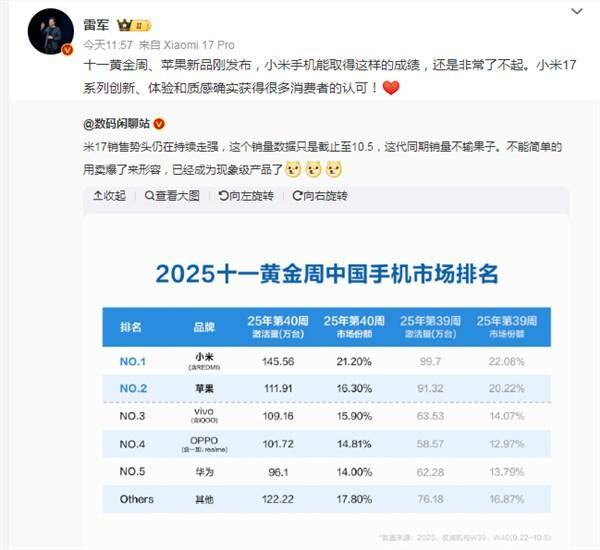
雷军回应小米手机登顶黄金周销量第一:非常了不起
Sou Hu Cai Jing· 2025-10-11 19:55
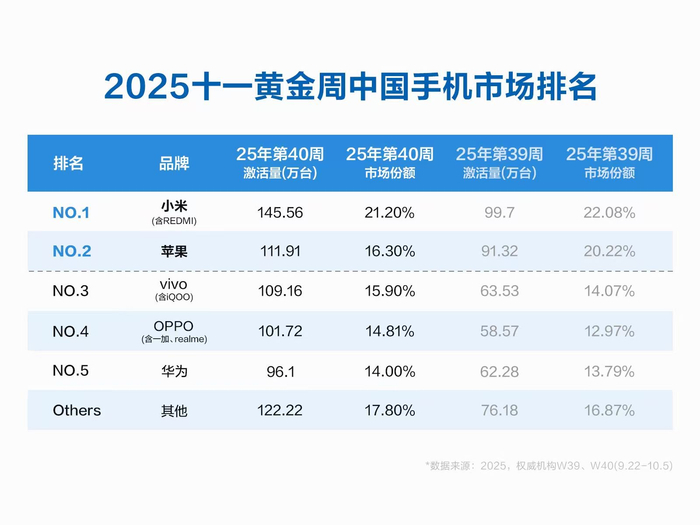
Core Insights - Xiaomi's performance during the Golden Week, despite competition from Apple's new products, is highlighted as impressive by its founder Lei Jun [1][3] - Xiaomi achieved a market share of 21.2% during the Golden Week, surpassing Apple to become the top-selling smartphone brand in China [1][2] - The Xiaomi 17 series has shown strong sales momentum, with over 1 million units sold and a 20% increase in sales compared to the previous generation [2][3] Market Performance - During the Golden Week (September 29 to October 5), Xiaomi sold 145.56 million units, capturing 21.2% of the market share [2] - Apple followed in second place with 111.91 million units sold, holding a 16.3% market share [2] - Other brands in the top five included Vivo, OPPO, and Huawei, with market shares of 15.9%, 14.8%, and 14.0% respectively [2][3] Product Recognition - The Xiaomi 17 series is recognized for its innovation, user experience, and quality, gaining significant consumer approval [2][3] - The sales data indicates that the Xiaomi 17 series is not only competitive but is also considered a phenomenon in the market [2]

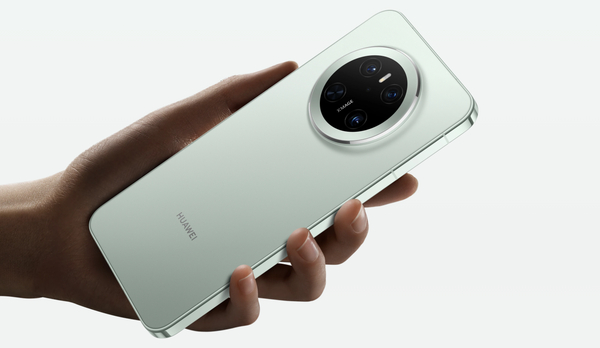
曝华为新款旗舰手机将采用LOFIC技术 苹果OV也在布局
Xin Lang Cai Jing· 2025-10-11 12:23
Core Insights - LOFIC (Linear-Logarithmic Fused Imaging Chip) technology is recognized as the next-generation high dynamic range imaging solution, being rapidly adopted by major domestic smartphone manufacturers for their flagship product lines [1][3]. Group 1: Industry Adoption - All top five domestic smartphone manufacturers have incorporated LOFIC technology into their flagship product plans, with Huawei set to launch a new flagship phone utilizing this technology [3]. - Vivo and OPPO have not yet implemented LOFIC in their current flagship models but are actively planning to integrate it into their products by 2026 [3]. - Internationally, Apple is also planning to use LOFIC technology in its self-developed CMOS sensors, but commercial application in iPhones is not expected until 2028 due to development and product iteration timelines [3]. Group 2: Technical Advantages - LOFIC technology effectively addresses common issues in traditional multi-frame HDR imaging, such as ghosting and motion blur, while providing superior dynamic range performance compared to current second-generation DCG (Dual Conversion Gain) or DXG technologies [4]. - The technology allows smartphones equipped with LOFIC to achieve more natural transitions between light and dark, retain richer details, and deliver more accurate color reproduction, significantly enhancing the photography experience [4]. Group 3: Cost and Production - The production costs of LOFIC technology are gradually decreasing as CMOS sensor manufacturers accelerate technological iterations, paving the way for broader application [3].

大疆降价风暴背后,藏着一场生死攻防战
商业洞察· 2025-10-11 09:39
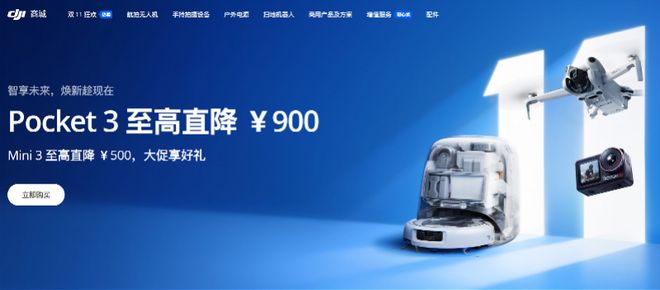
Core Viewpoint - DJI's recent price cuts on its products, including the Pocket 3 series, are seen as a necessary move in response to competitive pressures in the consumer imaging device market, rather than a simple promotional strategy [5][24]. Group 1: Price Cut Events - DJI launched a promotional campaign in October 2025, offering discounts of up to 900 yuan on various products, including the Pocket 3 series and action cameras [3][16]. - Consumers reported feeling deceived after purchasing products just before the price drop, leading to widespread complaints and calls for price protection [9][15]. - The price of the Pocket 3 kit dropped from 3519 yuan to 2859 yuan, representing an 8.1% discount, causing frustration among recent buyers [9][16]. Group 2: Consumer Reactions - Many consumers expressed their dissatisfaction on social media, coining the term "大冤种" (big fool) to describe their feelings of being misled by the price drop [3][15]. - The experiences of consumers like Meng Tao and Wang Yan highlight the confusion and frustration regarding the lack of consistent price protection policies across different sales channels [10][12][21]. Group 3: Competitive Landscape - DJI's market share in the global smart imaging device market has declined from 19.1% in 2023 to 13.2% in 2024, while competitors like Insta360 have increased their share from 28.4% to 35.6% during the same period [27][25]. - The entry of smartphone manufacturers like OPPO and Vivo into the imaging device market poses a significant threat to DJI, as these companies leverage their existing technology and supply chains [32][24]. Group 4: Strategic Implications - The price cuts are part of DJI's strategy to create a "price moat" against new entrants, making it difficult for them to compete on price without incurring losses [36][37]. - DJI aims to slow down competitors' market penetration while preparing for the launch of the new Pocket 4 model, expected in early 2026 [33][37]. - The current pricing strategy reflects a broader shift in the consumer imaging market, indicating an intensifying competition as more players enter the field [38][24].

大疆降价风波背后:多重竞对夹击下的“焦虑”
Nan Fang Du Shi Bao· 2025-10-11 08:21
Core Viewpoint - DJI has announced significant price reductions on several of its products, including the Osmo Pocket 3, Action 4, and Mini 4K drone, with discounts reaching up to 1,478 yuan, as part of a regular promotional strategy for the upcoming "Double Eleven" shopping festival [1][3][5]. Group 1: Price Reduction Details - The price cuts include the Osmo Pocket 3 standard version dropping by 700 yuan and the all-around kit by 900 yuan, while the Mini 3 drone sees a reduction of 900 yuan and the Mini 4 PRO by 1,478 yuan [5][8]. - The promotional period for these discounts is from October 9 to October 14 [5]. Group 2: Market Competition and Strategy - The price reduction is seen as a response to intense competition in the consumer electronics market, where DJI faces challenges from both traditional smartphone manufacturers and emerging competitors like Insta360 [3][11]. - Experts suggest that the price cuts may be a strategy to maintain market share and buy time for research and development efforts, reinforcing DJI's technological leadership [3][16]. Group 3: Consumer Reactions - The price drop has led to a surge in demand, with the Osmo Pocket 3 quickly selling out in stores and online [8]. - Some consumers who purchased products shortly before the price drop expressed dissatisfaction, feeling "betrayed" by the sudden price changes [8][9]. Group 4: Product Lifecycle and Future Outlook - The Osmo Pocket series typically sees new releases every 2-3 years, with speculation that the Pocket 4 may be launched in Q1 2026 [10][11]. - DJI's market share in the consumer drone sector remains strong at over 70%, but growth is slowing, with projections indicating a decrease in the growth rate of the Chinese civilian drone market from 32% in 2023 to 20% by 2025 [11][12]. Group 5: Challenges from Competitors - DJI is facing increasing competition from companies like Insta360 and traditional brands like GoPro, which are encroaching on its market share in the handheld imaging device sector [11][12]. - The entry of smartphone manufacturers into the imaging device market poses additional challenges, as they leverage their software ecosystems to offer seamless user experiences [13][16].
硬刚“背刺”争议,大疆为何主动降价?
Guan Cha Zhe Wang· 2025-10-11 07:51
Core Viewpoint - DJI's recent price cuts have sparked significant consumer backlash, leading to discussions about potential refunds and customer rights [1][3][5] Price Reduction Details - DJI announced substantial price reductions from October 9 to October 14, with the Osmo Pocket 3 standard version dropping from 3499 yuan to 2799 yuan (a reduction of 700 yuan), Action 4 dropping up to 1129 yuan, and Mini 4 PRO decreasing by 1478 yuan [3][6] - The price cuts affected products released within the last three months, including a recently launched vacuum cleaner and a panoramic camera [3] Consumer Reactions - Many consumers expressed frustration after being assured by sales staff that prices would not drop shortly before the significant reductions [5][7] - Some customers have successfully returned products for refunds, while others faced challenges due to activation status [8][5] Strategic Implications - The price cuts are seen as a strategic move by DJI to expand market share amid increasing competition and market pressures [6][12] - DJI's historical pricing stability has been disrupted, indicating a shift in strategy to counteract competitive threats and market dynamics [11][6] Market Challenges - DJI faces significant challenges in the North American market, where regulatory pressures and competition have intensified [12][13] - The consumer drone market is experiencing slower growth, transitioning from expansion to a more competitive landscape [14][15] Competitive Landscape - DJI's market share in the handheld imaging device sector is declining, with competitors like Insta360 gaining ground [16][21] - New entrants, including major smartphone manufacturers, are expected to increase competition in DJI's core markets [23][25] Long-term Strategy - DJI's price cuts may be part of a broader strategy to build a user base for future ecosystem development, similar to trends seen in the smartphone industry [26][28] - The company aims to leverage its supply chain advantages to maintain competitive pricing while expanding its ecosystem [25][28]

小米连续两周排名中国手机市场销量第一
Ge Long Hui A P P· 2025-10-11 02:22
Core Insights - Xiaomi achieved a market share of 21.2% during the Golden Week from September 29 to October 5, surpassing Apple to become the top smartphone seller in China [1] - The sales momentum for the Xiaomi 17 series remains strong, with cumulative sales exceeding 1 million units, representing a 20% increase compared to the previous generation [1] Market Performance - Xiaomi (including REDMI) ranked first with 1,455,600 units activated and a market share of 21.20% in the 40th week of 2025, showing a slight decrease from 22.08% in the previous week [2] - Apple ranked second with 1,119,100 units activated and a market share of 16.30%, down from 20.22% [2] - Vivo (including SIQOO) secured the third position with 1,091,600 units activated and a market share of 15.90%, up from 14.07% [2] - OPPO (including OnePlus and realme) came in fourth with 1,017,200 units activated and a market share of 14.81%, increasing from 12.97% [2] - Huawei ranked fifth with 961,000 units activated and a market share of 14.00%, up from 13.79% [2]
宗馥莉辞职原因曝光!商标使用不合规,将独立经营娃小宗;曹德旺回应做慈善慷慨但对员工苛刻:用的个人的钱;微软新一轮裁员补偿N+4
雷峰网· 2025-10-11 00:27
Group 1 - Cao Dewang responded to criticism about being generous in charity but strict with employees, stating that his charitable donations come from personal funds, not company funds. He emphasized that the average monthly salary for employees is around 10,000 yuan, which is slightly above the industry average, to maintain competitiveness and risk resilience [3][5]. - The resignation of Zong Fuli from Wahaha Group was attributed to trademark usage non-compliance, leading her to independently operate her brand "Wawa Xiaozong" [8][9]. - ByteDance announced a new employee support scheme for those laid off due to organizational adjustments, offering up to 7.2 million yuan in transitional subsidies over six months [9][10]. Group 2 - Qualcomm is under investigation by China's market regulator for allegedly failing to report its acquisition of Autotalks, which may violate antitrust laws [10]. - Longxin Technology has completed its IPO counseling, with a valuation exceeding 140 billion yuan, positioning itself as a leading player in the DRAM market [27]. - BYD's 14 millionth new energy vehicle was rolled off the production line in Brazil, with the Brazilian president becoming the owner of this vehicle [25].




vivo将与小鹏汽车开展合作 手机品牌“生态战”升级
Zheng Quan Ri Bao Zhi Sheng· 2025-10-10 16:10
Core Insights - Vivo has launched an upgraded AI strategy and OriginOS 6, emphasizing the integration of AI and operating systems, marking a significant growth phase in AI value creation [1] - The competition among smartphone manufacturers is shifting from hardware specifications to ecosystem development, with a focus on establishing industry standards and ecological dominance [1] Group 1: AI and Technology Advancements - Vivo has made significant upgrades to its edge-side large models, enhancing functionalities such as emotional perception and long text rendering, aiming to lead globally in edge-side model capabilities [2] - The advancements in technology, particularly in emotional sensing and long text rendering, indicate a transition from "usable" to "user-friendly" in edge-side large models [2] - Vivo has over 200 patents in the operating system domain after eight years of development, with the new Blue River Smooth Engine achieving breakthroughs in system-level collaboration [3] Group 2: Ecosystem and Collaboration - The collaboration between Vivo and Xiaopeng Motors showcases the importance of car-machine interconnectivity, allowing seamless application flow from mobile to vehicle screens [4] - The trend of collaboration between smartphone manufacturers and automotive companies is growing, with examples including Huawei and Seres, and OPPO with Li Auto and SAIC [4] - The industry is witnessing a "warlord" scenario where companies like Huawei, Xiaomi, and OPPO are building their ecosystems, yet experts believe future development will focus on cooperative strategies [5]