中国平安

Search documents
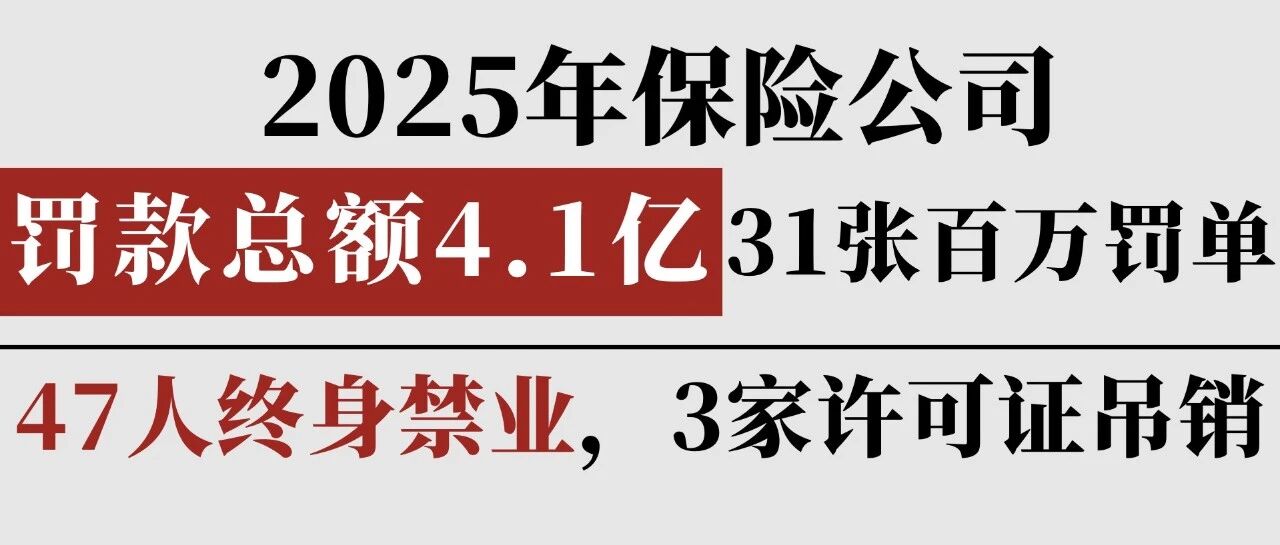
2025年保险公司罚款超4.1亿:3家许可证被吊销,31张百万罚单,47人终身禁业,13人撤职,3家停新!
13个精算师· 2026-01-08 14:26
Core Points - The insurance industry faced significant penalties in 2025, with a total of over 410 million yuan in fines imposed on 134 companies, marking a historical high [3][8][10] - The regulatory environment has intensified, with 31 fines exceeding 1 million yuan and 115 individuals banned from the industry, including 47 receiving lifetime bans [8][20][24] - Major companies such as Huaxia Life and Tianan Life had their licenses revoked, indicating a shift towards stricter enforcement and accountability [11][14] Summary by Sections Penalties Overview - In 2025, the total fines for insurance companies exceeded 410 million yuan, with 2802 penalties issued, reflecting a 16% increase compared to the previous year [10][8] - A total of 31 fines were classified as "million-level," with one fine exceeding 10 million yuan and several others surpassing 5 million yuan [19][14] Regulatory Actions - The regulatory body has adopted a "responsibility to individuals" approach, resulting in 115 individuals facing various degrees of industry bans, with 47 receiving lifetime bans [20][24] - The trend of increasing penalties is evident, with the number of individuals banned doubling from the previous year [24] Company-Specific Actions - Companies such as Huaxia Life, Tianan Life, and Tianan Property had their business licenses revoked, indicating a more severe approach to regulatory compliance [11][14] - The penalties for these companies included not only fines but also the revocation of positions for responsible personnel, showcasing a comprehensive enforcement strategy [12][14] Industry Trends - The insurance sector is experiencing a shift towards high-quality development, driven by regulatory measures aimed at improving operational management and compliance [10][14] - The increase in penalties and the revocation of licenses reflect a broader trend of tightening regulations within the insurance industry [10][14]





Health carriers continue to dominate list of world’s top insurers by 2024 NPW: AM Best
ReinsuranceNe.ws· 2026-01-08 14:00
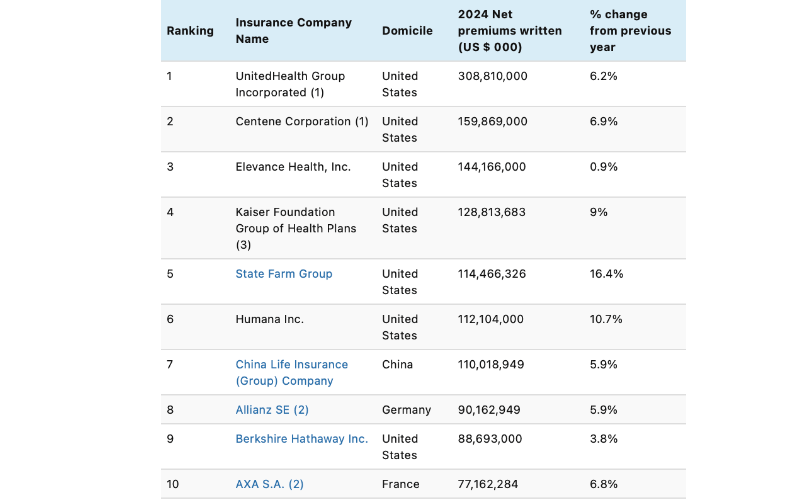
Core Insights - US health insurance companies continue to dominate the global insurance market, with UnitedHealth Group Inc. leading in net premiums written (NPW) for 2024 at $308.81 billion, reflecting a year-over-year increase of 6.2% [1][5] Group 1: Top Insurers by Net Premiums Written - Four of the top five insurers and five of the top ten are US health insurers, with Centene Corporation in second place at $159.87 billion, up 6.9% from 2023 [2] - Elevance Health, Inc. and Kaiser Foundation Health Plan Group hold the third and fourth positions, reporting premiums of $144.17 billion and $128.81 billion, respectively [2] - State Farm Group moved up to fifth place from seventh, with a significant NPW increase of 16.4% to $114.47 billion, the highest percentage increase among the top ten [3] - China Life Insurance (Group) Co. fell to seventh from fifth, reporting $110.02 billion in NPW [3] Group 2: Notable Changes in Rankings - Progressive Corp., ranked 12th, recorded the highest percentage increase among the top 25 insurers, with premiums rising 20.9% to $74.42 billion [4] - Nippon Life Insurance Co., ranked 24th, experienced the largest percentage decline, down 10.9% to $44.95 billion in NPW [4] Group 3: Top Insurers by Non-Banking Assets - Berkshire Hathaway Inc. leads the ranking of the world's top 25 insurers by non-banking assets, reporting $1.15 trillion, an increase of 7.8% year over year [6] - Allianz SE fell to second place with $1.09 trillion in assets, up 6.2% [6] - The top five non-banking asset rankings remained unchanged, with China Life Insurance (Group) Co., Ping An Insurance (Group) Co. of China Ltd., and Prudential Financial, Inc. in third, fourth, and fifth places, respectively [7] Group 4: Changes in Non-Banking Assets - Athene Holding Ltd. recorded the largest percentage increase in non-banking assets, rising 20.9% to $363.34 billion [7] - Japan's National Mutual Insurance Federation of Agricultural Cooperatives, ranked 21st, saw the largest decline, with assets falling 2.6% to $384.02 billion [8]



AI投资引燃融资热潮,全球可转债发行规模创24年新高
Hua Er Jie Jian Wen· 2026-01-08 13:06
Core Insights - The artificial intelligence (AI) boom is rapidly reshaping the global financing market, leading companies to raise significant funds through convertible bonds, with global issuance expected to reach approximately $166.5 billion by 2025, marking a 24-year high since 2001 and nearing historical records [1] - The surge in financing is driven by substantial investments in AI infrastructure and related technologies, with companies like Alibaba, Lumentum Holdings, and Super Micro utilizing convertible bonds to fund their AI-related bets [1] - Convertible bonds, which combine features of debt and equity, are projected to outperform large-cap stocks and traditional bonds in 2025 after years of low returns [1] Group 1: AI-Driven Financing - AI-related companies are becoming increasingly dominant in the convertible bond market, contributing significantly to issuance volumes and investment returns, with approximately 40% of last year's benchmark convertible bond index returns driven by AI-related firms [3] - Companies such as Lumentum, Super Micro, and CoreWeave have raised billions through convertible bonds, while even cryptocurrency miners like Bitfarms Ltd. are turning to this financing method to support their transition to AI and high-performance computing [3] Group 2: Refinancing Demand and Mature Companies - The pressure from maturing debt is another key factor driving market recovery, with about a quarter of outstanding convertible bonds set to mature in the next two years, sustaining market activity [4] - In a high-interest rate environment, mature companies are reassessing the attractiveness of convertible bonds, which allow borrowing at lower interest costs despite potential equity dilution, as seen with European firms like Lufthansa and Ferrovial SE entering the market [4] Group 3: Rise and Resilience of the Asian Market - While North America remains the dominant player in the convertible bond market, the Asian market has played a crucial role in recent recovery, with Alibaba raising $3.2 billion and other insurance giants like Pacific and Ping An raising $2 billion and $1.5 billion respectively [5] - The Asian market is expected to provide more opportunities in 2026 as stock markets stabilize and interest rates level off, with convertible bonds becoming a mainstream financing tool in the region [5] - Despite concerns about the sustainability of AI spending, the convertible bond asset class has shown resilience against market volatility, with Bloomberg data indicating that the Bloomberg Global Convertible Bond Index's decline was less than that of the MSCI World Index during last year's market fluctuations [5]
平安又把幸福告了,涉案64亿
凤凰网财经· 2026-01-08 12:09
Core Viewpoint - The article discusses the arbitration application filed by Ping An Asset Management and Ping An Life Insurance against Huaxia Happiness and its actual controller, Wang Wenxue, involving an amount of approximately 6.4 billion yuan [1]. Group 1: Arbitration and Legal Proceedings - Ping An Life and Ping An Asset Management filed an arbitration application against Huaxia Happiness and Wang Wenxue, with the case amounting to about 6.4 billion yuan [1]. - The case is registered under the Shanghai Financial Court, with a hearing scheduled for December 17, 2025, to confirm the validity of the arbitration agreement [3][4]. Group 2: Investment Background and Debt Issues - Between 2018 and 2020, Ping An invested heavily in Huaxia Happiness through equity and debt instruments [4]. - In February 2021, Huaxia Happiness faced a debt crisis, leading to Ping An becoming the largest shareholder after the forced disposal of shares held by the original controlling shareholder [4]. - In the first half of 2021, Ping An recorded a provision for impairment of 35.9 billion yuan due to Huaxia Happiness's issues [5]. Group 3: Shareholding Changes - As a significant shareholder and creditor, Ping An participated deeply in the debt restructuring of Huaxia Happiness, but by 2025, the restructuring progress was unsatisfactory, leading to increased disagreements [5]. - Ping An initiated a share reduction plan, intending to reduce its holdings by up to 11.74 million shares, representing 3% of Huaxia Happiness's total share capital, between September 1 and November 30, 2025 [5]. - After the completion of the share reduction, Ping An Life and Ping An Asset Management held a combined 24.99% stake in Huaxia Happiness, maintaining their position as the largest shareholder [7].


平安又把幸福告了,涉案64亿
Feng Huang Wang Cai Jing· 2026-01-08 12:03
Core Viewpoint - The arbitration application against Huaxia Happiness and its actual controller Wang Wenxue by Ping An Asset Management and Ping An Life Insurance involves approximately 6.4 billion yuan, stemming from performance compensation obligations outlined in agreements from 2018-2019 [1] Group 1 - Huaxia Happiness's major shareholder, Huaxia Happiness Holdings, and Wang Wenxue are facing arbitration initiated by Ping An Asset Management and Ping An Life Insurance, with the case concerning the validity of the arbitration agreement [1] - The case is set to be heard in the Shanghai Financial Court on December 17, 2025, following the filing of the arbitration application [1] - Ping An invested heavily in Huaxia Happiness through equity and debt from 2018 to 2020, but a debt crisis emerged in 2021, leading to Ping An becoming the largest shareholder after forced disposal of shares by the original controlling shareholder [1] Group 2 - In the first half of 2021, Ping An recorded a 35.9 billion yuan impairment provision due to Huaxia Happiness's issues [2] - Disagreements have grown between Ping An and Huaxia Happiness regarding the debt restructuring process, with Huaxia Happiness planning a pre-restructuring while Ping An questions its compliance [2] - Ping An has begun to reduce its stake in Huaxia Happiness, planning to sell up to 11.74 million shares, representing 3% of the total share capital, between September 1 and November 30, 2025 [2] Group 3 - As of November 30, the share reduction plan period has expired [3] - After the completion of the share reduction, Ping An Life and Ping An Asset Management collectively hold 24.99% of Huaxia Happiness's shares, maintaining their position as the largest shareholder [4]

继续增持!平安四度举牌招行H股
Hua Er Jie Jian Wen· 2026-01-08 11:59
Core Viewpoint - Ping An Life has significantly increased its stake in China Merchants Bank (CMB) H-shares, reaching the 20% threshold by December 31, 2025, reflecting a strategic investment in bank stocks amid a favorable environment for insurance capital [1][2]. Group 1: Investment Strategy - Ping An has made its fourth public stake increase in CMB H-shares within a year, indicating a consistent strategy of acquiring bank stocks, which has become common among insurance funds [2]. - By the end of 2025, Ping An Life's holdings in CMB H-shares reached a book value of 43.956 billion yuan, demonstrating a clear and decisive increase from 5% to 20% [3]. - The long-term downtrend in interest rates has prompted insurance funds to seek stable and generous asset pools, with CMB fitting this profile perfectly [3]. Group 2: CMB's Performance - CMB continues to hold its position as the "king of retail," achieving steady profit growth in the first half of 2025 despite industry-wide pressure on interest margins [4]. - The bank maintains a high provision coverage ratio and outstanding asset quality compared to peers, making it an attractive investment [4]. - CMB's dividend distribution of 2.00 yuan per share for the 2024 fiscal year translates to a high H-share dividend yield, appealing to Ping An Life's need for long-duration matching assets [4]. Group 3: Ping An's Financial Health - Ping An experienced a nearly 50% increase in net profit for 2024, with a 3.7% growth in operating profit for the first half of 2025, indicating strong financial resilience [5]. - The company benefits from a continuous double-digit growth in new business value in life insurance, providing a steady source of capital for investments [5]. - Current market conditions are viewed as a favorable window for insurance capital allocation, supported by regulatory encouragement for long-term funds to enter the market [5]. Group 4: Market Implications - The strategy of increasing holdings in CMB reflects a significant bet on future certainty of returns, as low volatility and high dividends gain consensus in the market [6]. - The effectiveness of this "heavy dividend" strategy will not only impact Ping An's investment returns but also serve as an important case study for observing trends in the era of large asset management [6].

中国太保(601601):推荐报告:攻守兼备的金融核心资产
ZHESHANG SECURITIES· 2026-01-08 11:51
Investment Rating - The investment rating for China Pacific Insurance (601601) is "Buy" (maintained) [5] Core Views - China Pacific Insurance, as the only listed insurance company backed by the Shanghai State-owned Assets Supervision and Administration Commission, is expected to benefit from its deepening transformation and forward-looking layout in the Web3 sector, potentially leading to a dual boost in performance and valuation [1] - The strategic importance of the insurance industry is increasing, with significant expectations for China Pacific Insurance's transformation in life insurance and support from the Shanghai State-owned Assets [2] - The company is positioned to experience strong growth in new business value (NBV) due to its ongoing transformation initiatives and strategic support from its major shareholder [3] - The forward-looking layout in the Web3 sector is anticipated to drive valuation increases for China Pacific Insurance [4] Summary by Relevant Sections Super Expectation Points - The strategic importance of the insurance industry has been recognized, with the release of new policies promoting high-quality transformation [2] - The risk of interest spread losses is easing, with a continuous reduction in liability costs and an expected increase in investment returns from the equity market [3] - The implementation of the "North Star Plan" is expected to significantly boost NBV, with a notable increase in the agent workforce and a substantial rise in NBV from the bancassurance channel [3] - The strategic support from the Shanghai State-owned Assets is crucial for the company's high-quality development [3] - China Pacific Insurance's proactive engagement in the Web3 sector is expected to enhance its market position [4] Financial Forecasts - Projected net profit growth rates for 2025E-2027E are 6.2%, 21.2%, and 29.4% respectively, with corresponding PEV ratios of 0.77x, 0.71x, and 0.65x [9] - The target price based on a 0.9x PEV for 2026 is set at ¥60.85, indicating a potential upside of 27% [11] Financial Summary - For 2025E, the expected operating revenue is ¥419,626 million, with a net profit of ¥47,769 million [11] - The company is expected to maintain a strong performance with a significant increase in NBV and investment income [11]
汉中金融监管分局同意平安产险南郑支公司变更营业场所
Jin Tou Wang· 2026-01-08 11:49
2025年12月30日,汉中金融监管分局发布批复称,《中国平安财产保险股份有限公司陕西分公司关于南 郑支公司变更营业场所的请示》(平保产陕分发〔2025〕137号)收悉。经审核,现批复如下: 一、同意中国平安财产保险股份有限公司南郑支公司将营业场所变更为:陕西省汉中市南郑区天汉大道 以西天佑商务酒店1幢2层2-办公区01号。 二、中国平安财产保险股份有限公司应按照有关规定及时办理变更及许可证换领事宜。 ...
中国万亿市值公司之变:4家新贵晋级,工业富联狂飙近200%
21世纪经济报道· 2026-01-08 11:47
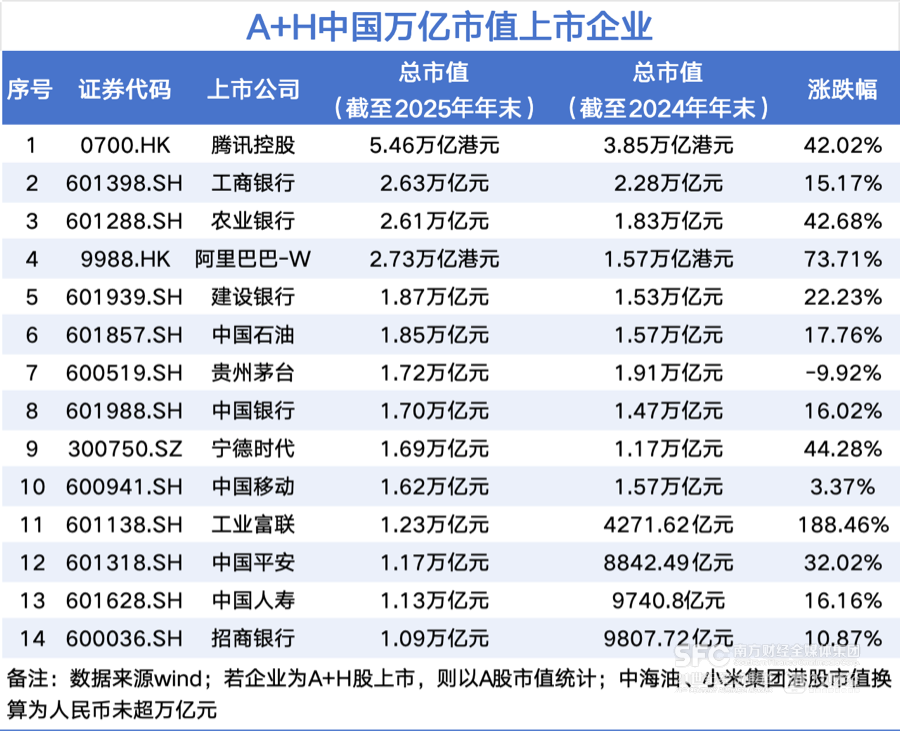
Core Viewpoint - The number of companies with a market capitalization exceeding 1 trillion yuan in China's A+H share market has increased to 14 by the end of 2025, with a total market value increase of approximately 9 trillion yuan, reflecting a growth rate of over 50% [1][2]. Group 1: New Trillion-Yuan Companies - Four new companies have joined the trillion-yuan market cap club: Industrial Fulian, China Ping An, China Life, and China Merchants Bank [1][4]. - Industrial Fulian has seen a remarkable market cap increase of approximately 188%, driven by its core business in AI and precision manufacturing [4][5]. - The financial sector's recovery is highlighted by China Ping An's 32.02% increase, China Life's 16.16% increase, and China Merchants Bank's 10.87% increase in market cap [4][5]. Group 2: Market Trends and Characteristics - The market capitalization growth is characterized by a leading trend in technology and new sectors, while financial and energy sectors show stable growth [1][7]. - Tencent and Alibaba have both seen significant market cap increases, exceeding 1 trillion Hong Kong dollars, driven by AI advancements and recovery in e-commerce [7][9]. - The banking sector, particularly Agricultural Bank of China, has shown strong performance with a market cap increase and a notable rise in stock price, breaking the long-standing "price-to-book" ratio below 1 [11][12]. Group 3: Company Performance Highlights - Tencent's market cap reached 5.46 trillion HKD, with a year-on-year increase of 42.02%, supported by its AI strategy and business integration [2][8]. - Alibaba's market cap rose to 2.73 trillion HKD, benefiting from AI integration and a recovery in its e-commerce business [9]. - Agricultural Bank of China reported a revenue of 550.88 billion yuan and a net profit of 220.86 billion yuan, reflecting a stable asset quality and strong market recognition [12].




中国万亿市值公司之变:四家新贵晋级 两大增长逻辑
2 1 Shi Ji Jing Ji Bao Dao· 2026-01-08 11:41
Core Insights - The number of companies with a market capitalization exceeding 1 trillion yuan in mainland China has increased to 14 by the end of 2025, with a total market value increase of over 9 trillion yuan, reflecting a growth rate of over 50% [1][2] Group 1: New Trillion-Yuan Companies - Four new companies have joined the trillion-yuan market cap club: Industrial Fulian, China Ping An, China Life, and China Merchants Bank, with four headquartered in Shenzhen [3][4] - Industrial Fulian has seen a remarkable market cap increase of approximately 188%, while the other three companies in the financial sector have experienced more modest growth rates: China Ping An at 32.02%, China Life at 16.16%, and China Merchants Bank at 10.87% [4][5] Group 2: Market Trends and Dynamics - The rise of these companies reflects two core market dynamics: explosive growth in the technology sector and valuation recovery in the financial sector [5] - Industrial Fulian's rapid growth is attributed to its comprehensive involvement in the AI industry chain, with a significant revenue increase of 38.4% year-on-year, reaching 603.93 billion yuan in the first three quarters of 2025 [6] - China Life has reported a total premium exceeding 700 billion yuan, with a 41% increase in total investment income, while China Ping An has established a strong competitive barrier through its extensive customer base and technology capabilities [7] Group 3: Performance of Major Players - Tencent and Alibaba have also seen significant market cap increases, with both companies adding over 1 trillion Hong Kong dollars to their valuations, driven by AI advancements and a recovery in their core businesses [8][10] - Tencent's market cap reached 5.46 trillion Hong Kong dollars by the end of 2025, with a stock price increase of over 40%, while Alibaba's market cap rose to 2.73 trillion Hong Kong dollars [10][11] Group 4: Banking Sector Insights - The banking sector has shown signs of valuation recovery, with Agricultural Bank of China achieving a notable stock price increase of over 50% and breaking the long-standing "price-to-book" ratio below 1 [12][13] - Agricultural Bank's revenue for the first three quarters of 2025 was 550.88 billion yuan, with a net profit of 220.86 billion yuan, reflecting a year-on-year increase of 3.03% [12][13]