
腾讯控股

Search documents
未知机构:中泰医药谢木青刘照芊乘通用AI之势建议关注AI医疗昨日-20260213
未知机构· 2026-02-13 02:35
Summary of Conference Call Notes Industry Focus - The focus is on the **AI healthcare sector**, particularly the integration of artificial intelligence in medical applications and services [1][2]. Core Insights and Arguments - The **Chinese government** emphasizes the need to promote large-scale commercial applications of AI, aiming to enhance the AI industry and expand high-value application scenarios [1]. - Recent advancements include **DeepSeek's version update** and the launch of **GLM-5**, indicating continuous breakthroughs in AI models [2]. - The **AI healthcare sector** is gaining traction due to supportive policies, technological advancements, and the gradual commercialization of pathology-assisted diagnostics [2]. - Clear application scenarios for AI in healthcare have been identified: - **B-end applications**: Involvement in medical imaging, surgical robots, in vitro diagnostics, and radiotherapy. - **C-end applications**: Empowering health management, chronic disease monitoring, personalized treatment suggestions, and academic research for doctors [2]. - Continuous policy support is evident through various documents that outline development directions and commercial pathways for AI in healthcare [2]. - The **first inclusion of "AI-assisted"** in the pricing project guidelines for pathology services marks a significant step towards commercialization [2]. - National-level AI application pilot platforms are being promoted in regions like **Beijing and Zhejiang**, enhancing industry conversion efficiency [2]. Additional Important Content - The **AI application market** is experiencing a surge in interest, driven by competition among major tech companies (ByteDance, Tencent, Alibaba, Baidu) in the general AI application field [3]. - Recent achievements, such as **ByteDance's Seedance 2.0**, demonstrate a shift from mere generation capabilities to commercial viability [3]. - The performance of companies like **Tempus** supports the feasibility of AI healthcare business models [3]. - Investment recommendations include companies such as **Dian Diagnostics, KingMed Diagnostics, and Meinian Health** [4]. - Risks highlighted include potential delays in policy implementation and slow commercialization of products or services [5].


未知机构:中泰医药谢木青刘照芊乘通用AI之势建议关注AI医疗昨日国-20260213
未知机构· 2026-02-13 02:35
Summary of Conference Call Records Industry: AI in Healthcare Key Points and Arguments - **Government Support for AI in Healthcare** The State Council emphasized the need to promote large-scale commercial applications of AI, enhance AI terminal and service consumption, and develop AI application pilot bases. This indicates strong governmental backing for the AI healthcare sector [1] - **Technological Advancements** Recent updates in AI models, such as DeepSeek's version update and the launch of GLM-5 by Zhizhu, demonstrate continuous breakthroughs in AI technology. This progress is crucial for the development of AI applications in healthcare [1] - **Commercialization Pathways** The introduction of guidelines like the "Pathology Medical Service Pricing Project" which includes "AI-assisted" services, paves the way for commercialization in the healthcare sector. This is a significant step towards integrating AI into medical services [2] - **Regional Initiatives** Various regions, including Beijing and Zhejiang, are advancing national-level AI application pilot platforms to enhance industrial transformation efficiency. This reflects a commitment to integrating AI with technological innovation [2] - **Market Dynamics and Competition** Major tech companies such as ByteDance, Tencent, Alibaba, and Baidu are competing in the general AI application space, which is driving the proliferation and iteration of AI technologies. For instance, ByteDance's Seedance 2.0 has achieved a breakthrough from "capable of generation" to "capable of commercialization" [2] - **Performance Validation** Companies like Tempus are demonstrating the viability of AI healthcare business models through their performance, further validating the potential of AI applications in the medical field [2] Investment Recommendations - **Growth Potential in AI Healthcare** Given the clear policy support, increasing market attention, and maturing technology, the AI healthcare sector is viewed as having significant growth potential. Recommended companies to watch include Dean Diagnostics, KingMed Diagnostics, and Meinian Health [3]
发百万大奖、买大额理财,科技公司年终狂撒钱
阿尔法工场研究院· 2026-02-13 02:33
Group 1 - The core idea of the article revolves around the intense competition among technology companies for high-end talent, highlighted by extravagant year-end bonuses including houses, cars, and gold [4][6][10] - Liu Jingkang, CEO of Yingshi, emphasized that material incentives are crucial for attracting top talent, alongside a sense of achievement and honor [3][4] - The article notes that many tech companies have successfully raised funds and are using idle capital to invest in financial products from banks and brokerages, with some companies utilizing up to 99% of their financing for such investments [3][13] Group 2 - Yingshi's year-end bonuses included five apartments, five cars, a Porsche, and gold, showcasing the company's commitment to attracting talent [1][7] - Other companies like Tuo Zhu Technology and SK Hynix are also offering competitive year-end bonuses, with SK Hynix providing an average of 640,000 yuan per employee [7][12] - Tencent's year-end bonuses are linked to performance, with some employees reportedly receiving bonuses equivalent to 30 months of salary, indicating a strong financial position [8][9] Group 3 - The article discusses the broader trend of tech companies engaging in a "talent war," where financial resources play a critical role in attracting skilled professionals [10][12] - Companies like Meta are offering substantial compensation packages to attract AI researchers, with reports of salaries reaching up to $3 million over four years [12][13] - The demand for talent in the GPU and AI sectors is high, with a significant talent gap leading to increased salary premiums for experienced engineers [13][14]



未知机构:申万互联网传媒计算机国内海外云均涨价Agent和多模态需求推高重视卖水-20260213
未知机构· 2026-02-13 02:30
Summary of Conference Call Notes Industry Overview - The conference call discusses the cloud computing industry, highlighting recent price increases by major players such as AWS and Google Cloud, as well as domestic companies like UCloud [1][2]. Key Points and Arguments - Recent price hikes by AWS and Google Cloud reflect rising upstream hardware costs and confirm strong downstream demand [3]. - The demand for Agents and multimodal applications is driving a surge in Token consumption, particularly with the popularity of OpenClaw (Clawdbot) [3]. - The proliferation of multimodal AI applications, such as Seedance 2.0, is expected to further accelerate Token consumption, leading to increased usage of cloud computing resources and guaranteed revenue for cloud providers [3]. Important Companies Mentioned - **Kingsoft Cloud**: Recommended as a core cloud provider within the Xiaomi-Kingsoft ecosystem, noted for its high elasticity [4]. - **Baidu Group**: Recognized for its full-stack AI capabilities and control over Kunlun Chip [4]. - **Alibaba**: Identified as a leading domestic cloud provider with strong technical capabilities in full-stack AI and significant cost advantages from self-developed chips [4]. - **Tencent Holdings**: Mentioned for achieving profitability in Tencent Cloud after 25 years, with differentiated competition and SaaS products contributing to 25% of revenue [4].


从爆款神话到被玩家抛弃,阿里基因为何救不了灵犀互娱崩塌?
Sou Hu Cai Jing· 2026-02-13 02:25
2024年12月,阿里大文娱集团董事长兼首席执行官樊路远,在灵犀互娱"五年陈"授戒仪式上发表惊人讲话。他苛责直言灵犀互娱早年"没有流淌着阿里的血 脉",管理层搞"独立王国",缺乏国际视野和创新力,但同时高调立下目标。8年之内灵犀要做到全国游戏行业第三,12年之内跻身全国第二,甚至放言"未 来5-10年,全球游戏收入70%可能来自中国公司,腾讯网易的优势将不再"。 彼时的灵犀互娱,刚完成人事大换血,创始人詹钟晖、技术核心吴云洋先后卸任,由《三国志·战略版》制作人周炳枢接任CEO,开启"产品力驱动"的转型 之路。 一年之后的2025年,灵犀互娱内部年会相比一年前显得低调很多。全程未提及樊路远去年立下的宏大目标,反而聚焦"反思产品质量"、"优化玩家体 验"、"稳定核心团队"三大核心,气氛凝重。 据内部人士透露,年会仅用半小时便结束,未设置表彰环节,甚至未公开2025年全年具体业绩数据,与2024年的高调形成鲜明反差。 这一年间,灵犀互娱深陷多重争议泥潭。女性向赛道核心产品《如鸢》(原《代号鸢》)bug频发,玩家集体投诉却遭官方冷遇、拒绝道歉赔付;《代号 鸢》侵权纠纷再起,庭审在即却迟迟未给出明确回应;自研引擎项目关 ...
恒指收跌233点,大型科技股低走
Guodu Securities Hongkong· 2026-02-13 02:22
Group 1: Market Overview - The Hang Seng Index closed down 233 points, or 0.86%, at 27,032 points, after experiencing significant selling pressure throughout the day [3][4] - Major technology stocks dragged the market down, with Meituan, Ctrip, Tencent, Baidu, JD.com, and Alibaba all reporting declines [4] - The total market turnover was HKD 238.7 billion, with a net inflow of HKD 4.567 billion from northbound trading [3] Group 2: Macro & Industry Dynamics - The Hong Kong Monetary Authority emphasized that managing credit risk will be a top priority in 2026, particularly concerning the commercial real estate sector, which accounts for 14% of total outstanding loans [8] - The MPF Authority aims to reduce administrative fees for the "MPF Easy" platform to below 30 basis points next year, with expected reductions of 57% to 65% in fees for the strong MPF plans [7] Group 3: Company News - Wynn Macau reported an adjusted property EBITDAR of USD 1.085 billion for the year ending December, a decrease of 7.7% year-on-year, with operating revenue down 15.73% [12] - Melco International Development reported a net income of USD 60.635 million for the fourth quarter, a significant turnaround from a net loss of USD 20.274 million in the same period last year [13] - Anton Oilfield Services expects a profit of approximately RMB 360 million to RMB 380 million for the year ending December, representing a year-on-year increase of 48.4% to 56.6% [15]
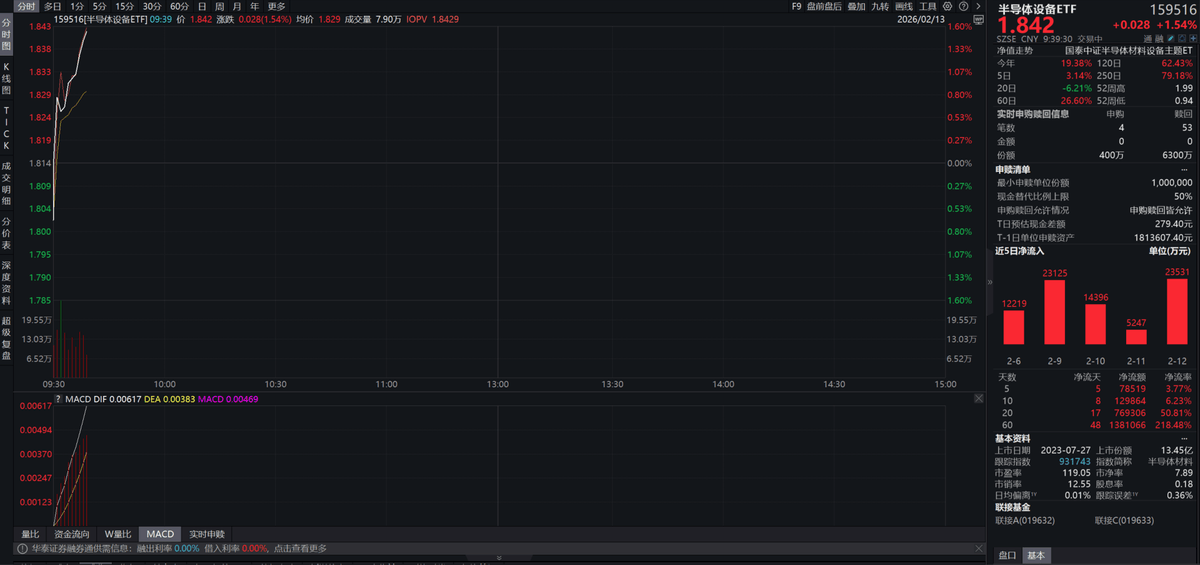
春节档大模型“超级周”来临,半导体设备ETF(159516)强势吸金
Mei Ri Jing Ji Xin Wen· 2026-02-13 02:18
Core Insights - The Chinese AI industry is experiencing a significant shift from "single-point breakthroughs" to "systematic iterations," as multiple domestic model manufacturers release flagship models simultaneously, enhancing market confidence in AI commercialization [1][3][4]. Group 1: Industry Developments - Major Chinese AI companies, including ByteDance, Zhipu, DeepSeek, and MiniMax, have launched new flagship models across various domains such as video generation, image generation, and programming, marking a collective advancement in the industry [1][3]. - Morgan Stanley has termed this phenomenon as the "Spring Festival release cycle," indicating that the simultaneous updates from multiple companies will accelerate market comparisons and shift market share towards the best performers [3][4]. Group 2: Market Dynamics - The perception of domestic large models has evolved from being "followers" to being competitive with global leaders in areas like coding and context handling, leading to increased willingness to pay and higher API workload retention rates [4]. - The marketing battle among AI applications during the Spring Festival has led to a surge in user engagement, validating the potential for explosive consumer traffic and creating a non-linear growth trajectory for inference computing demand [5][6]. Group 3: Long-term Trends - The AI investment narrative is shifting from "training-driven" to "inference-driven," with inference demand expected to become the main engine for computing growth starting in 2026, significantly expanding the market space compared to training [10][19]. - The supply side is undergoing generational upgrades, particularly in optical modules, with a projected demand increase of over tenfold for 1.6T optical modules by 2026 [12][19]. Group 4: Competitive Landscape - The commoditization of large models is leading to a redistribution of power in the platform layer, where differentiation is increasingly based on marketing capabilities, workflow ownership, and product iteration speed rather than just model strength [14][19]. - The semiconductor equipment sector is now closely tied to global AI computing cycles, with increased capital expenditures from overseas storage leaders driving expectations for domestic equipment companies [15][19]. Group 5: Investment Opportunities - The semiconductor equipment ETF (159516) is highlighted as a core investment vehicle, providing exposure to leading companies in the semiconductor equipment and materials sectors, with a current scale exceeding 20 billion [16][19].
从字节Seedance-2
2026-02-13 02:17
Summary of AI Video Industry Insights from ByteDance's CPS 2.0 Industry Overview - The report focuses on the AI video industry, particularly the advancements brought by ByteDance's CPS 2.0 model, which significantly enhances the usability and generation quality in complex interactions and motion scenarios, aligning closely with industrial-grade content creation needs [2][3]. Core Insights and Arguments - **CPS 2.0 Enhancements**: The CPS 2.0 model supports multimodal inputs including images, videos, audio, and natural language instructions, improving video generation controllability and reducing content production costs in film, advertising, and other sectors [2][3]. - **Disruptive Impact on Gaming**: AI video technology is revolutionizing content creation processes in the gaming industry, facilitating innovative applications such as AI-driven narrative games and companion applications, thus accelerating IP visualization and commercialization [2][5]. - **Future Development Directions**: - Integration with social interaction features to meet everyday entertainment and creative needs of ordinary users [6]. - Shift towards platform integration, utilizing consumer applications as traffic entry points for broader user engagement [6]. - Deep integration with assistant functionalities to provide comprehensive solutions for video creation [6]. Investment Opportunities - Companies with strong IP reserves, such as Light Media and Yuedu Group, are expected to see significant commercial value enhancement due to advancements in AI video technology, presenting potential returns for investors [2][5]. - Leading internet companies like Tencent and platform-based companies such as Bilibili, Mango TV, and Focus Media are identified as having investment potential in the AI video sector [4][7]. - Companies focusing on short dramas and comics, such as Kunlun Wanwei, Huanrui Century, and Zhongwen Online, are also highlighted as worthy of attention [4][7]. Additional Important Points - CPS 2.0's capabilities include high-quality multi-shot audio-video output and dual-channel audio, which significantly lowers production costs across various content creation scenarios [3]. - The model's ability to maintain consistency and adherence to instructions enhances the creative capabilities of ordinary users, allowing them to produce content at a professional level [3].
AI应用正当时-模型进入需求时代
2026-02-13 02:17
Summary of Conference Call on AI Industry and Company Developments Industry Overview - The release of Zhiyu GLM 5 marks a significant enhancement in domestic AI models' capabilities in coding and agent tasks, transitioning from code completion to task execution, laying the foundation for commercial applications [2][3] - The domestic AI industry is expected to enter a new phase in the second half of 2025, with models like GLM, MinMax, and kimi gaining global recognition due to their competitive pricing, which remains at one-fifth of similar overseas services [2][5] Key Points on Zhiyu GLM 5 - Zhiyu GLM 5's success is attributed to its strong technical support from Tsinghua University, a high talent density, and active support for domestic computing power [2][6] - The model excels in complex tasks such as programming and light rendering, making it a competitive AI model against top international models like OPPO 4.7 and OPPO 4.6 [6] Pricing and Market Dynamics - Despite recent price increases, domestic AI models remain significantly cheaper than their overseas counterparts, providing a competitive advantage in the global market [4][9] - API and subscription prices for Zhiyu GLM 5 have risen significantly, with basic input prices set at 4 RMB and 6 RMB, and output prices increasing by 125% to 250% for basic token usage [8] Future Trends - The integration of domestic AI models with office tools is expected to become more common starting in 2026, exemplified by the launch of GLM in Excel, which will transform traditional data collection and presentation processes [7] - The demand for cloud computing resources is anticipated to rise alongside the increasing need for AI applications, leading to a significant growth in cloud service demand and revenue for companies like Zhiyu [10] Investment Opportunities - Key areas to watch in the coming years include AI models (Zhiyu, MinMax, Alibaba, ByteDance, Tencent), agent applications (e.g., TaxFriend, Zhongkong, Hehe, Kingsoft), and cloud computing (e.g., Alibaba Cloud, Capital Online, Kingsoft Cloud, Deepin) [11]
平安证券(香港)港股晨报-20260213
Ping An Securities Hongkong· 2026-02-13 02:14
Market Overview - The Hong Kong stock market experienced fluctuations with the Hang Seng Index closing at 23,831 points, down 145 points or 0.61% [1] - The market turnover decreased to 82.799 billion HKD, with net inflows of 484 million HKD recorded in the Hong Kong Stock Connect [1] - The US stock market saw all three major indices decline, with the Dow Jones down 1.34%, S&P 500 down 1.57%, and Nasdaq down 2.03% [2] Sector Performance - In the Hong Kong market, local real estate, software, and 5G concept sectors faced significant declines, while gold stocks performed well [1] - The technology sector in Hong Kong saw a drop, with the Hang Seng Technology Index down 1.65% [1] - Notable stock performances included Budweiser APAC down 5.2%, Lenovo Group down 4.6%, and Meituan down 4.5%, while Zijin Mining rose 3.5% and WuXi AppTec increased by 2.9% [1] Investment Opportunities - The report emphasizes the importance of "technological self-reliance" and AI applications as key themes for future growth in the Hong Kong stock market, suggesting that leading companies in these sectors may see medium to long-term development opportunities [3] - The Ministry of Industry and Information Technology's recent policies on national computing power interconnectivity are expected to boost domestic computing and communication sectors [3] - Investors are advised to focus on sectors supported by policies for "expanding domestic demand," including sports apparel and non-essential service consumption, as well as undervalued central state-owned enterprises with high dividends [3] Key Companies and Trends - The report highlights the performance of companies like BYD, which saw a 35% year-on-year increase in sales in January, benefiting from EU tariff exemptions for Chinese brand SUVs [9] - The report also notes that the domestic export of new energy vehicles reached 286,000 units in January, indicating strong growth potential for leading companies in this sector [9] - Companies such as China Mobile and Zhiyun AI are recommended for their roles in the computing power supply chain, reflecting a growing demand for AI and related technologies [9]