天合光能

Search documents
经济热点快评|太空光伏,能否成为新蓝海?
Sou Hu Cai Jing· 2026-02-07 15:37
最近,马斯克团队考察中国光伏产业链的消息引发关注。马斯克此前提出,计划每年向太空部署100吉瓦太阳能AI卫星能源网络,这相当于全球新增光伏 装机的约1/6,让"太空光伏"概念火出了圈。 光伏和太空的结合早有渊源。1958年,人们在卫星上首次使用太阳电池;十几年后,中国制造的第二颗人造卫星也使用了太阳电池。 为什么这两年市场对太空光伏的关注度持续攀升?一方面,火箭可复用技术降低了发射成本,全球商业航天提速发展,太空经济逐步走向现实。另一方 面,数据中心等加快建设,对电力供应和冷却的综合需求提升,地面基础设施或难以跟上,而太空环境下光伏发电效率远高于地面。 应当说,太空光伏远期想象空间巨大,但目前仍处于探索和验证的初期阶段,产业化进程受技术发展、经济性等因素影响,规模化发展仍需一定时间。比 如,砷化镓电池转换效率高、抗辐射性能优异、可靠性高,但成本高昂;钙钛矿电池有高柔性、低成本等优势,但可靠性有待验证。 更关键的是经济账:根据机构测算,当前太空光伏的度电成本约为2—3美元,而地面光伏的度电成本已降至0.03—0.05美元,两者相差最高达百倍。如果 未来发射成本无法降至当前的1/10以下,且光伏效率无法翻倍提升, ...


钙钛矿GW级产能爆发,产业链上有哪些机会?
Hua Er Jie Jian Wen· 2026-02-07 12:18
Core Viewpoint - The year 2025 marks the beginning of large-scale production for perovskite solar cells, with significant capacity expansion expected in the coming years, driven by advancements in technology and production efficiency [1][8][10]. Industry Overview - The perovskite solar cell industry is transitioning from a phase of "excess capacity" to one of "incremental explosion driven by technological iteration" [1]. - Major players in the industry include equipment leaders with full-line delivery capabilities, core material suppliers, and component manufacturers with advantages in tandem technology [1]. Technological Advancements - Laboratory efficiency for single-junction perovskite cells has reached 27.3%, while tandem cells have surpassed 35.0%, significantly exceeding the theoretical limit of 27.9% for silicon cells [2][5]. - Stability issues, previously a major concern, have been addressed, with companies like GCL-Poly achieving certification for durability under extreme conditions [6]. Production Capacity and Timeline - The production capacity for perovskite solar cells is set to explode, with global capacity expected to exceed 5 GW by 2027 and surpass 30 GW by 2030 [1][10]. - Key milestones include the launch of several GW-scale production lines by leading companies such as JinkoSolar and GCL-Poly in 2025 and 2026 [9][10]. Cost Structure and Economic Viability - Current production costs for perovskite modules are approximately 1.2 yuan/W, but are projected to decrease to 1.0 yuan/W by 2026, approaching the cost levels of silicon cells [1][20]. - The cost structure indicates that material costs account for over 76% of the total, suggesting rapid cost reduction potential as domestic production of materials increases [19]. Equipment and Material Localization - All core equipment for perovskite production has achieved 100% localization, eliminating reliance on foreign technology [13]. - Significant progress has been made in the localization of key materials, with companies like Jinjing Technology achieving over 95% localization for TCO conductive glass [15].
2025年中国太阳能发电量产量为5725.7亿千瓦时 累计增长24.4%
Chan Ye Xin Xi Wang· 2026-02-07 05:17
Core Viewpoint - The report highlights significant growth in China's solar power generation, with a projected increase in production and capacity over the coming years, indicating a robust investment opportunity in the solar energy sector [1]. Industry Summary - According to the National Bureau of Statistics, China's solar power generation reached 42.2 billion kilowatt-hours in December 2025, marking an 18.2% year-on-year increase [1]. - The cumulative solar power generation for the entire year of 2025 was 572.57 billion kilowatt-hours, reflecting a 24.4% growth compared to the previous year [1]. - The report from Zhiyan Consulting provides insights into the market trends and investment prospects for the solar power station industry in China from 2026 to 2032 [1]. Company Summary - Key listed companies in the solar energy sector include Longi Green Energy (601012), Tongwei Co., Ltd. (600438), Sungrow Power Supply Co., Ltd. (300274), JA Solar Technology Co., Ltd. (002459), Trina Solar Limited (688599), TBEA Co., Ltd. (600089), Chint Electric (601877), TCL Zhonghuan (002129), Linyang Energy (601222), and Sungrow Electric (300827) [1].


16.5亿元,中国光伏史上最大一笔专利许可费产生
Xin Lang Cai Jing· 2026-02-07 04:16
去年2月,天合光能(688599.SH)因专利问题,向阿特斯(688472.SH)发起索赔,要求后者赔偿10.58亿 元,目前该事项未能查到最终公开结果。 截至去年三季度末,爱旭股份货币资金48.45亿元,负债总额288.45亿元。资产负债率77.6%,较6月底 的85.75%下滑约8个百分点。 智通财经记者|马悦然 爱旭股份预计去年亏损12亿-19亿元,同比减亏。该公司在公告中透露,2025年ABC组件销售量同比实 现翻倍以上增长;报告期内经营性现金流、制造成本、组件销售毛利率、资产减值同比均有明显改善。 为取得TCL中环(002129.SZ)旗下Maxeon的BC专利授权,爱旭股份和隆基绿能(601012.SH)曾就 TOPCon、BC技术在全球多地产生专利纠纷;晶澳科技(002459.SZ)和正泰新能就TOPCon技术问题闹上 法庭等。 根据最新业绩预告,TCL中环预计2025年亏损82亿-96亿元,较上年同期98.18亿元的亏损有所改善。 ...

马斯克的太阳能,不是给地球用的?
Sou Hu Cai Jing· 2026-02-07 03:05
朋友们,我是郑重。刚刚,一位特斯拉工程师在领英上发了条"求救帖"——公司正紧急招聘太阳能项目 人员,目标直指"美国最大光伏制造商"。而这场招聘狂潮的源头,是马斯克一个月前扔下的重磅炸弹: 三年内,在美国本土打造200GW光伏产能! 200GW是什么概念?这相当于美国当前全部太阳能装机容量的十倍,更是中国年新增装机量的一半! 更颠覆的是,这批光伏板的首要任务不是铺在屋顶,而是飞向太空——去驱动马斯克规划的"轨道AI帝 国"。今天咱们就拆解一下:这场太阳能战略,到底是能源革命还是资本赌局? 第一幕:战略升维——从地面到太空的"能源三级跳" 马斯克的太阳能计划,绝非简单的产能扩张,而是一套环环相扣的"能源三级跳": 1. 地面奠基:特斯拉借助Gigafactory模式,用200GW产能碾压传统光伏巨头,目标将组件成本压至每瓦 0.1美元以下,为太空部署铺平量产道路; 2. 太空布网:SpaceX用Starship将光伏板送入轨道,直接为AI卫星供电,规避地面电网限制与传输损 耗; 3. 生态闭环:xAI作为首个体内客户,消耗太空电力,形成"光伏-算力-数据"的自循环系统。 这一招,直接把光伏从"清洁能源"升级为"文 ...


脚步量青海 热忱砥初心
Xin Lang Cai Jing· 2026-02-06 17:54
Group 1: Overview of the Doctoral Service Team's Visit - The 26th batch of the Doctoral Service Team conducted a three-day investigation focusing on the "Four Places" construction in Qinghai, high-altitude medicine, and red education, covering cities such as Xining, Haidong, and Haibei [1] - The visit included diverse topics from mushroom cultivation to yak farming, and from carbon fiber production to traditional Tibetan medicine, showcasing a rich and compact itinerary [1] Group 2: "Two Bombs, One Satellite" Spirit - The visit to the first nuclear weapon research base in China inspired the team, emphasizing the historical significance and the spirit of dedication to the nation [2] - The team members expressed a strong commitment to contribute to the country, resonating with the "Two Bombs, One Satellite" spirit, which emphasizes dedication and service [2] Group 3: High-Altitude Medical Development - The team learned about advancements in high-altitude medicine, including low-oxygen physiology and disease prevention, highlighting the long-term dedication of researchers like Academician Wu Tianyi [3] - The visit to Haidong's second people's hospital showcased advanced medical equipment and improved healthcare services, enhancing public health awareness [3] Group 4: Industrial Development in Qinghai - The investigation revealed a diverse industrial landscape in Qinghai, including clean energy, carbon fiber production, and the integration of traditional culture with modern industries [4][5] - The "photovoltaic + ecology + animal husbandry" model by Tianhe Solar was praised for its innovative approach to sustainable development [4] - The success of the edible fungus cultivation demonstration garden, which occupies 40% of Qinghai's market share, was highlighted as a model for industry-driven poverty alleviation [5] Group 5: Innovation in Digital Economy and Biotechnology - The establishment of a carbon-neutral data center by China Telecom was noted as a leading example of green development in the digital economy [6] - The extraction of natural astaxanthin from green algae at Haibei Yihai Biotechnology Co. was recognized as a significant advancement in high-value biotechnology [6] - The three-day visit served as a platform for the team to align their expertise with the developmental needs of Qinghai, fostering future collaborations [6]
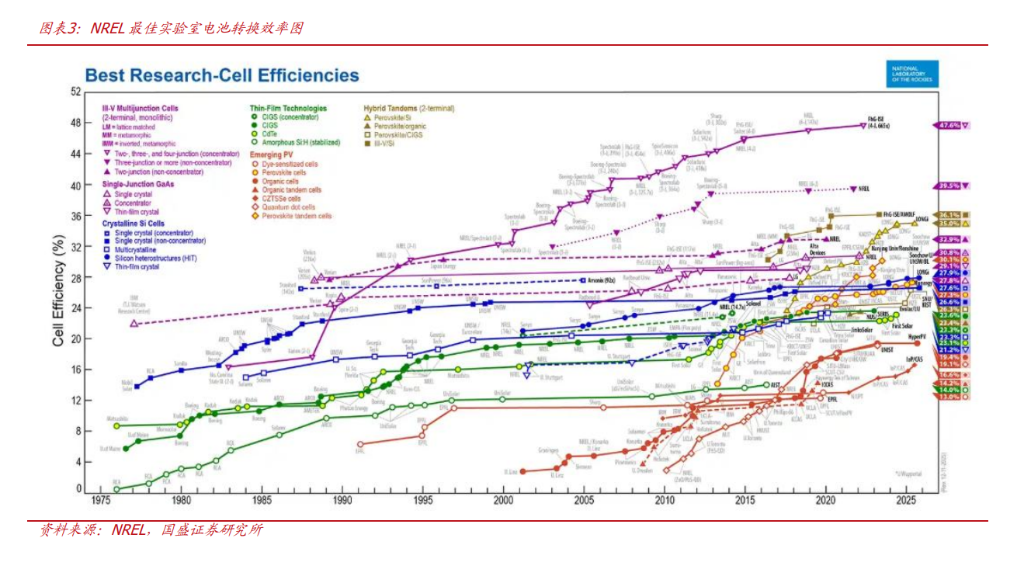
钙钛矿:迎来GW级量产
GOLDEN SUN SECURITIES· 2026-02-06 13:26
Investment Rating - The report maintains a rating of "Increase" for the industry [4] Core Insights - Perovskite solar cells are entering the era of GW-level mass production, with leading companies like JinkoSolar and LONGi Green Energy accelerating capacity release [2][35] - The efficiency of perovskite cells is rapidly improving, with laboratory efficiencies reaching 27.3% for single-junction cells and 35.0% for perovskite-silicon tandem cells, significantly surpassing the maximum efficiency of silicon cells at 27.9% [15][19] - The cost competitiveness of perovskite cells is expected to improve, with unit production costs projected to drop to 1.0 RMB/W by 2026, potentially surpassing silicon cells [2][35] Summary by Sections Section 1: Perovskite as the Next Generation Photovoltaic Solution - Perovskite solar cells utilize a hybrid organic-inorganic metal halide semiconductor as the light-absorbing material, offering advantages such as high efficiency, low cost, and lightweight [8][11] Section 2: Efficiency and Stability Breakthroughs - The report highlights significant advancements in efficiency and stability, with perovskite cells achieving rapid efficiency improvements compared to silicon cells [15][18] - The industry is overcoming stability challenges through material modifications and process optimizations, with some products achieving IEC commercial standard certification [25][26] Section 3: GW-Level Production Era - The first GW-level production line for perovskite solar cells has been launched, marking the beginning of large-scale production [35] - By 2027, global production capacity is expected to exceed 5GW, with a complete supply chain being established [2][35] Section 4: Investment Recommendations - The report suggests focusing on leading companies in the perovskite supply chain, particularly those with clear capacity deployment and advancements in tandem technology, such as LONGi Green Energy and Trina Solar [3] - Equipment manufacturers with high domestic production rates and sufficient orders, like JinkoSolar and Mibet, are also recommended for investment [3]






电力设备行业深度:钙钛矿:迎来GW级量产
GOLDEN SUN SECURITIES· 2026-02-06 12:34
证券研究报告 | 行业深度 gszqdatemark 2026 02 06 年 月 日 电力设备 钙钛矿:迎来 GW 级量产 钙钛矿电池是第三代电池,单结和叠层技术并行发展。钙钛矿是以通式为 ABX₃的有机-无机杂化金属卤化物为吸光材料,具备合成工艺简单、光电 转换效率高、成本低、重量轻等优势,钙钛矿电池技术路线分为单结与叠 层两类。叠层路线又细分为晶硅/钙钛矿叠层、全钙钛矿叠层等,其中晶硅 /钙钛矿叠层可与 PERC、TOPCon、异质结等现有晶硅电池技术结合,兼顾 效率提升与产线兼容性,是当前主流研发方向。 技术端:效率与稳定性双突破。钙钛矿电池效率提升速度远超晶硅电池, 单结钙钛矿实验室最高效率达 27.3%,钙钛矿-硅串联电池效率达 35.0%, 大幅超越晶硅电池 27.9%的实验室效率上限。单结钙钛矿已进入技术迭代 与产业化并行阶段,GW 级量产线逐步落地,头部企业大面积组件效率接 近 20%;叠层电池成为技术迭代核心方向,头部企业钙钛矿-TOPCon 叠 层电池效率突破 34%。行业通过材料改性、封装升级与工艺优化突破稳定 性瓶颈,部分产品通过 IEC 商用标准认证,核心生产设备实现 100%国产 ...
中国光伏制造行业展望
Zhong Cheng Xin Guo Ji· 2026-02-06 09:36
联络人 作者 企业评级部 汤梦琳 010-66428877 mltang@ccxi.com.cn 李洁鹭 010-66428877 jlli@ccxi.com.cn 其他联络人 www.ccxi.com.cn 2026 年 2 月 目录 | 核心观点 | 1 | | --- | --- | | 分析思路 | 2 | | 行业基本面 | 2 | | 行业财务表现 | 12 | | 结论 | 19 | | 附表 | 20 | 王梦莹 010-66428877 mywang01@ccxi.com.cn 中诚信国际 行业展望 中国光伏制造行业 中国光伏制造行业展望,2026 年 2 月 展望 2026 年,国内光伏装机需求将出现小幅回落,海外出口增速也将 趋于下行,预计下游需求增速整体放缓;供给端,在法律政策与自律 协会的推动下,企业将继续减产控价,产业链价格或将出现不同程度 的回升,随着落后产能淘汰,行业集中度将进一步提升。不过短期内 行业供需失衡的格局仍难以得到根本性扭转,产业链价格仍将处于低 位。长期来看产业发展环境有望得到优化,但盈利修复仍需依赖减产 联盟共识、供给侧政策持续发力与需求端的带动,而持续亏损导致 ...
马斯克,引爆中国光伏
投资界· 2026-02-06 07:46
Core Viewpoint - The article discusses the emerging trend of "space photovoltaics" in China, highlighting its potential to reshape the value proposition of Chinese photovoltaic companies as they become integral to Elon Musk's space energy vision [3][4]. Group 1: Market Dynamics - The A-share market has seen a surge in interest in space photovoltaics, with companies like Zairun New Energy and Tuorui New Energy hitting their upper trading limits [3][4]. - The immediate catalyst for this market excitement was Elon Musk's announcement at the Davos Forum about SpaceX and Tesla's plan to establish a photovoltaic production base in the U.S. with an annual capacity of 200 GW, which is projected to meet nearly a quarter of the U.S. electricity demand [4][5]. - The excitement in the market is driven by the perception that space photovoltaics can overcome the limitations faced by ground-based solar energy, such as dependence on weather and daylight [5][6]. Group 2: Industry Positioning - Chinese companies hold a dominant position in the global photovoltaic manufacturing sector, accounting for over 70% of the global supply chain, which positions them favorably for the space photovoltaics market [9]. - The article emphasizes that the space photovoltaics sector is expected to be a significant growth opportunity for Chinese photovoltaic companies, as it offers higher added value compared to traditional ground-based solar energy [6][9]. - The potential market for space photovoltaics is projected to reach between $500 billion and $1 trillion by 2030, indicating a substantial long-term opportunity [5][6]. Group 3: Technological Advancements - The article outlines a three-phase evolution of space photovoltaic technology, starting with gallium arsenide cells for high-value aerospace applications, transitioning to HJT technology for low Earth orbit satellites, and ultimately utilizing perovskite tandem cells for large-scale deployments [13]. - Companies are exploring various technological pathways, including lightweight and efficient solar cells, to meet the unique demands of space applications [13][15]. - The competitive landscape will be shaped by advancements in materials engineering, space certification, and energy transmission systems, indicating a complex interplay of factors driving the industry forward [15].