
趣致集团

Search documents
中证香港300低贝塔指数报1796.42点,前十大权重包含香港中华煤气等
Jin Rong Jie· 2025-07-10 08:25
Core Points - The China Securities Hong Kong 300 Low Beta Index (H300LB) reported a value of 1796.42 points, showing a monthly increase of 3.23%, a three-month increase of 19.10%, and a year-to-date increase of 11.82% [1] Group 1: Index Overview - The China Securities Hong Kong 300 Low Beta Index reflects the overall performance of securities listed on the Hong Kong Stock Exchange from various strategic investment perspectives, with a base date of December 30, 2005, set at 1000.0 points [1] - The top ten holdings of the index include: - Weilu Group (2.2%) - CLP Holdings (2.12%) - Qutoutiao Group (2.1%) - Cheung Kong Infrastructure (2.07%) - Power Assets Holdings (1.88%) - PCCW (1.84%) - Cathay Pacific Airways (1.68%) - Nine Dragons Paper (1.58%) - China Resources Power (1.51%) - Hong Kong and China Gas (1.48%) [1] Group 2: Sector Allocation - The sector allocation of the index holdings is as follows: - Utilities: 17.55% - Industrials: 15.27% - Financials: 14.46% - Communication Services: 10.61% - Real Estate: 9.24% - Consumer Staples: 8.53% - Consumer Discretionary: 8.46% - Energy: 5.95% - Materials: 4.36% - Health Care: 4.30% - Information Technology: 1.28% [2] - The index sample is adjusted semi-annually, with adjustments occurring on the next trading day after the second Friday of June and December each year [2]

国内外科技互联网公司积极布局医疗行业,港股互联网ETF(159568)回调蓄势,盘中交投活跃
Sou Hu Cai Jing· 2025-07-02 05:45
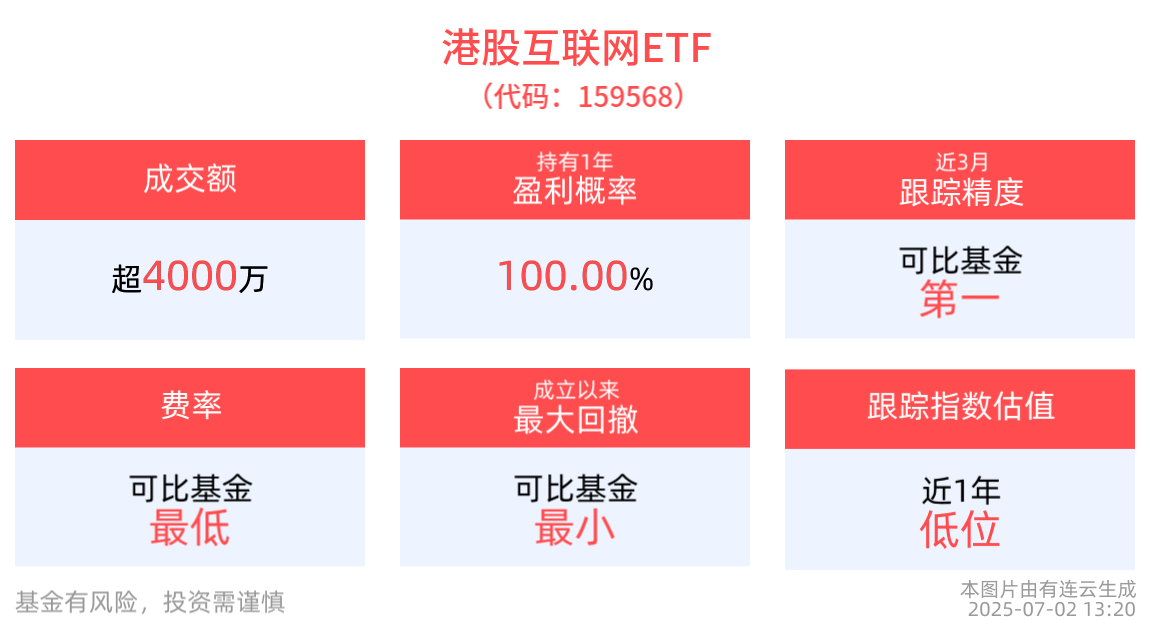
Group 1: Market Performance - As of July 2, 2025, the CSI Hong Kong Internet Index (931637) decreased by 0.88%, with mixed performance among constituent stocks [3] - The Hong Kong Internet ETF (159568) fell by 1.33%, with the latest price at 1.71 yuan, while it recorded a cumulative increase of 0.99% over the past week as of July 1, 2025 [3] - The Hong Kong Internet ETF had a turnover rate of 12.93% during the trading session, with a transaction volume of 41.67 million yuan, indicating active market trading [3] Group 2: Company Developments in Healthcare - Domestic companies like JD Health launched a self-developed medical model "Jingyi Qianxun" and established partnerships with over 150,000 pharmacies by Q1 2025 [4] - ByteDance entered the healthcare sector through acquisitions and established an AI drug development department [4] - Tencent introduced AI platforms for early disease screening and drug discovery, enhancing diagnostic efficiency for healthcare professionals [4] - Internationally, Google, NVIDIA, and Microsoft made significant advancements in AI tools for healthcare, including open-sourcing AI frameworks and developing clinical workflow assistants [4] Group 3: ETF Performance Metrics - The Hong Kong Internet ETF recorded a 54.80% net value increase over the past year, ranking 122 out of 2889 index funds, placing it in the top 4.22% [5] - The ETF achieved a maximum monthly return of 30.31% since inception, with a historical one-year profit probability of 100% [5] - The ETF's management fee is 0.50%, and the custody fee is 0.10%, which are among the lowest in comparable funds [5] - The latest price-to-earnings ratio (PE-TTM) for the index tracked by the ETF is 22.3, indicating a valuation below 80.75% of the time over the past year [5] Group 4: Index Composition - The CSI Hong Kong Internet Index consists of 30 listed companies related to internet businesses, reflecting the overall performance of internet-themed stocks within the Hong Kong Stock Connect [6] - As of June 30, 2025, the top ten weighted stocks in the index accounted for 72.11% of the total index weight, including major players like Xiaomi, Tencent, and Alibaba [6]


公募新产品集体投向“均衡”基金,什么信号?
证券时报· 2025-06-27 00:22
Core Viewpoint - The article highlights a shift in investment strategies among leading public funds in June, indicating a transition towards value-oriented and low-valuation themes in response to changing market conditions [1][2][11]. Group 1: New Product Launch Strategies - Major public funds such as GF Fund, Fuguo Fund, and Huatai-PB Fund launched new balanced theme funds focused on value and low valuation in late June [2][4]. - The cautious approach in building positions for new funds, such as the Ping An Value Enjoyment Mixed Fund, reflects a strategy to navigate the current market volatility [4][5]. - The emergence of terms like "valuation advantage" and "balanced strategy" in new fund names suggests a growing emphasis on performance expectations for mid-term financial results [7][11]. Group 2: Market Trends and Performance Expectations - The article notes a significant cooling in the innovative pharmaceutical sector, with many companies experiencing rapid valuation increases that may not be sustainable [8][11]. - As the market approaches mid-2025, there is a shift in focus towards low-valuation companies that have shown performance improvement trends, making them attractive for institutional investors [8][11]. - The performance of stocks like Shangmei Co., which saw a 74% increase in net profit for 2024, illustrates the connection between market movements and mid-term financial expectations [8]. Group 3: Rebalancing Strategies and Future Outlook - The rebalancing of fund holdings indicates a potential influx of capital into low-valuation sectors, particularly in the Hong Kong non-bank sector, which currently has a PB of 0.98X and a dividend yield of 3.2% [12]. - The article suggests that the current market trend is moving away from thematic investments towards larger-cap stocks, with a preference for value stocks over growth stocks [11][12]. - The anticipated policy trading in early July may further influence market dynamics, with larger-cap stocks expected to exhibit greater elasticity compared to smaller-cap stocks [12].

存量调改成风 | 2025年6月商业地产零售业态发展报告
Sou Hu Cai Jing· 2025-06-25 09:54
Core Viewpoint - The retail sector in commercial real estate is experiencing a transformation driven by consumer promotion policies and the expansion of the duty-free economy across major cities in China, leading to increased consumer spending and inbound tourism [3][5][6]. Group 1: Retail Sector Performance - Major retail operators such as CR Land, Longfor Group, and Link REIT are showing varied performance, with some projects achieving significant growth while others struggle with older assets requiring continuous investment [3][9]. - The retail property portfolio of Link REIT in mainland China reported a total revenue and net property income growth of 29.7% and 28.9% respectively, driven by strong performance from specific projects in Shanghai and Shenzhen [9][12]. Group 2: Consumer Promotion Policies - Cities like Shenzhen, Chongqing, and Chengdu have introduced consumer promotion policies aimed at boosting local economies, with initiatives such as the establishment of new retail stores and events to attract consumers [5][6]. - The focus on green consumption and the establishment of new retail formats, such as duty-free shops in urban areas, are part of a broader strategy to enhance consumer engagement and stimulate economic activity [5][8]. Group 3: Experience and Content Enhancement - Existing retail spaces are undergoing significant upgrades to enhance consumer experience, with a shift towards immersive and engaging environments to attract foot traffic [14][17]. - New entrants in the outlet market are leveraging unique themes and experiences to differentiate themselves, such as health and wellness concepts in shopping centers [13][19]. Group 4: Cross-Border E-commerce Expansion - Cross-border e-commerce platforms like TikTok Shop are expanding into new European markets, indicating a strategic move to capture a broader customer base [30][31]. - Domestic platforms are also enhancing their international competitiveness, with initiatives like JD's collaboration with Xiaohongshu to improve conversion rates and customer engagement [34]. Group 5: REITs and Investment Trends - The approval of new consumption infrastructure REITs, such as the China Green Development REIT, reflects a growing trend towards light-asset operations and the optimization of commercial assets [35][36]. - Existing REITs are showing stable operations, with a reported cash distribution rate of 4.19% for the recently restructured Huaxia First Creation Outlet REIT [36][37].

中证香港300内地低贝塔指数报3631.08点,前十大权重包含华能国际电力股份等
Jin Rong Jie· 2025-06-17 08:24
据了解,中证香港策略指数系列从多种策略投资的角度反映了在香港交易所上市证券的整体表现。该指 数以2005年12月30日为基日,以1000.0点为基点。 金融界6月17日消息,上证指数低开震荡,中证香港300内地低贝塔指数 (H300CNLB,H30236)报 3631.08点。 数据统计显示,中证香港300内地低贝塔指数近一个月上涨6.58%,近三个月上涨7.58%,年至今上涨 10.73%。 从中证香港300内地低贝塔指数持仓样本的行业来看,金融占比17.72%、公用事业占比17.03%、工业占 比13.35%、通信服务占比12.24%、能源占比9.50%、主要消费占比9.05%、原材料占比7.13%、可选消费 占比6.93%、医药卫生占比5.36%、房地产占比1.69%。 资料显示,指数样本每半年调整一次,样本调整实施时间分别是每年6月和12月的第二个星期五的下一 交易日。权重因子随样本定期调整而调整,调整时间与指数样本定期调整实施时间相同。在下一个定期 调整日前,权重因子一般固定不变。特殊情况下将对中证香港策略指数系列进行临时调整。当样本退市 时,将其从指数样本中剔除。样本公司发生收购、合并、分拆、停牌 ...

新高!新高!
Zhong Guo Ji Jin Bao· 2025-06-11 11:35
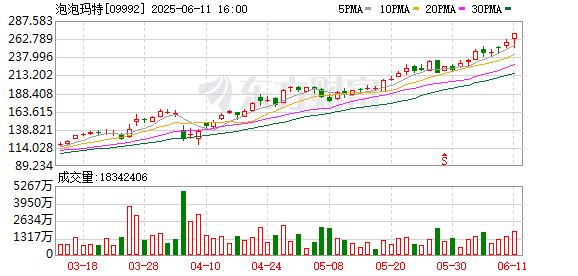
Market Performance - On June 11, Hong Kong's three major stock indices all rose, with the Hang Seng Index up 0.84% to 24,366.94 points, the Hang Seng Tech Index up 1.09% to 5,451.20 points, and the Hang Seng China Enterprises Index up 1.12% to 8,865.72 points. The total market turnover was HKD 235.2 billion, with net inflows from southbound funds amounting to HKD 1.376 billion [2]. Company Highlights - China Hongqiao rose 4.61%, China Life increased by 4.58%, and BYD gained 3.83%, leading the blue-chip stocks. The expectation of asset restructuring for China Hongqiao has driven a revaluation [4]. - Bubble Mart reached a historical high, closing at HKD 269.80 with a gain of 4.25%. According to a report from CICC (Hong Kong), the company is expected to achieve a net profit of RMB 7 billion by 2025, exceeding market expectations by approximately 15% due to underestimated overseas expansion [12]. Industry Trends - The Hang Seng Industry Index showed most sectors rising, with the materials sector up 2.66%, energy sector up 1.43%, and financial sector up 1.17%. Conversely, the consumer staples sector fell by 0.92%, healthcare sector down 0.65%, and utilities sector down 0.21% [6]. - The Wind concept sectors mostly rose, with the Foxconn Index up 5.19%, new materials up 4.3%, and Chinese brokerage firms up 4.14%. The domestic retail index led the declines, down 3.41% [8]. Investment Sentiment - According to Morgan Stanley's latest report, international investors are seeking to diversify their portfolios, showing a stronger willingness to allocate to Chinese stocks due to concerns about missing out on China's technological advancements. The report indicates that there is significant room for increased investment as international exposure to China remains relatively low [10]. - CITIC Securities expressed optimism about the media and gaming sectors, highlighting that these sectors are among the best emerging consumer segments, with valuations still considered low. The firm believes that the cultural export initiatives supported by policy will further enhance growth in these sectors [20].
中证香港300内地低贝塔指数报3507.98点,前十大权重包含华能国际电力股份等
Jin Rong Jie· 2025-05-29 08:15
Core Viewpoint - The China Securities Index 300 Mainland Low Beta Index has shown significant growth, with a 5.72% increase over the past month, 7.58% over the past three months, and a year-to-date increase of 6.97% [1]. Group 1: Index Performance - The China Securities Index 300 Mainland Low Beta Index is currently at 3507.98 points [1]. - The index was established on December 30, 2005, with a base point of 1000.0 [1]. Group 2: Top Holdings - The top ten holdings of the index include: - Weilu Group (3.39%) - China Telecom (3.37%) - Shandong Gold (2.91%) - Jingtai Holdings (2.88%) - China Mobile (2.87%) - Zheshang Bank (2.77%) - China Merchants Port (2.65%) - Huaneng International Power (2.58%) - Qizhi Group (2.56%) - Zhaojin Mining (2.52%) [1]. Group 3: Sector Allocation - The sector allocation of the index is as follows: - Financials: 20.45% - Industrials: 17.74% - Energy: 14.05% - Communication Services: 12.89% - Utilities: 11.71% - Health Care: 7.92% - Materials: 7.21% - Consumer Discretionary: 5.67% - Consumer Staples: 1.67% - Information Technology: 0.67% [2]. Group 4: Index Adjustment - The index samples are adjusted semi-annually, with adjustments occurring on the next trading day after the second Friday of June and December [2]. - Weight factors are generally fixed until the next scheduled adjustment, with special circumstances allowing for temporary adjustments [2].
越“夜”越嗨 看鄞州这个商圈如何花式促消费
Sou Hu Cai Jing· 2025-05-28 04:03
暮色下,K11商圈活动丰富多彩。 5月25日晚,暮色渐染甬城,宁波K11商圈举办的一场"乘风夜'肆'"主题市集活动,吸引客流量突破2万 人次。 "滋滋"作响的烤架前,37岁的张天龙忙得像个陀螺——左手飞速翻转烤串,右手扫码收款。摊位前,蜿 蜒的队伍宛如一条长龙,此起彼伏的"老板再加十串"的呼喊声,混着孜然味与肉香在空气中交织。 "从下午3点开摊到晚上9点收摊,根本停不下来!"张天龙笑道,当晚,他卖了200多串烧烤。 上述案例是宁波K11商圈花式促消费的一个缩影。 平时,针对楼宇白领,茑屋书店每月推出至少3款新品咖啡,其中一款日式咖啡月销量突破1200杯;以 哪吒为元素的图书、卡片、杯子等十余款文创产品,一经上架便迅速售罄。 这两天,宁波K11负一楼的Green Health超市成了榴莲控的"快乐星球"。一款榴莲以每公斤不到40元的价 格限时促销,刚摆满货架就被抢购一空,甚至有顾客提前蹲点,只为抢到这份甜蜜。不仅如此,该超市 还巧妙抓住周末消费高峰,接连举办4场龙虾烧烤派对,销售小龙虾超500公斤,让"烟火气"与销售额一 同"狂飙"。 百丈街道辖区内拥有宁波K11、花园里等商圈及20幢商务楼宇,2000多家企业 ...

一年卖出十多亿,复合增长近20%,这个做收纳袋的品牌凭什么在A股上市?
Sou Hu Cai Jing· 2025-05-20 02:14
Core Viewpoint - Taily Technology, a company specializing in vacuum storage bags, successfully listed on the A-share market, achieving a market value of nearly 6 billion yuan on its first trading day, highlighting the potential in niche consumer sectors despite the dominance of popular brands [4][6][22]. Group 1: Company Overview - Taily Technology focuses on vacuum storage bags and has developed over 800 patents, becoming the exclusive supplier of compression bags for China's aerospace sector [4][6]. - The company has rapidly gained market share on major e-commerce platforms like Tmall and JD, frequently ranking first in its category [4][6]. - Taily's growth is attributed to its unique technological barriers and the belief in the existence of "categories without brands" in the consumer market, which presents opportunities for brand development [4][9]. Group 2: Investment Insights - Wu Zhiwei, founder of Zhandao Capital, recognized the potential in the "categories without brands" market, leading to an investment in Taily in 2021 after a long-term relationship with the company's founder [4][10][19]. - Zhandao Capital has successfully invested in several consumer companies, demonstrating a strategy focused on identifying and nurturing brands in underdeveloped categories [6][10]. - The investment philosophy emphasizes the importance of brand awareness and strategic thinking among founders, as well as the need for a clear brand positioning to succeed in competitive markets [10][48]. Group 3: Market Dynamics - The vacuum storage market is still in its early stages, with significant opportunities for brand establishment as consumer awareness grows [8][9]. - Taily's success illustrates that even in traditional sectors, there is potential for high profitability and market leadership through effective branding and strategic positioning [20][34]. - The company aims to expand its product offerings and market presence, particularly in new materials, while maintaining its focus on high-end branding [36][52]. Group 4: Future Growth Strategies - Taily's future growth will involve solidifying its position as a leading brand in the home storage category and potentially expanding into new markets [34][36]. - The company is expected to leverage its technological capabilities and supply chain strengths to enhance its brand influence and market reach [37][39]. - Taily's strategic focus will include educating consumers about its products and enhancing brand recognition to overcome current challenges in market visibility [58][60].

QDII基金选股标准放宽 重仓“新面孔”估值不便宜
Zheng Quan Shi Bao· 2025-05-11 18:24
Core Viewpoint - The QDII funds are showing increased tolerance for stock valuations, reflecting a shift in market risk appetite as liquidity conditions change and Chinese asset prices rise globally [1][4]. Group 1: QDII Fund Investment Trends - QDII funds are beginning to invest in previously overlooked stocks, such as Blucor, which has seen its stock price rise over 110% in the last five months despite a projected net loss of 401 million yuan for 2024 [2]. - Funds are increasingly focusing on new economy sectors, with E Fund investing in Quzhi Group, which operates AI-driven vending machines, despite the company projecting a net loss of 167.2 million yuan for 2024 [3]. - Southern Fund has invested in the U.S.-listed company Manbang, which utilizes AI for logistics, marking a shift in QDII fund strategies towards more aggressive stock selection [3]. Group 2: Market Sentiment and Strategy - The shift towards a more aggressive investment strategy among QDII funds indicates growing confidence among institutional investors in the current market [4]. - Historically, QDII funds maintained strict selection criteria to avoid significant losses, but recent changes in liquidity and asset pricing have prompted a reevaluation of these strategies [4]. - Even companies with substantial losses, such as Weimeng Group, are being targeted by funds, suggesting a belief in their potential to benefit from domestic consumption recovery [4]. Group 3: Valuation Perspectives - Valuation assessments are subjective, varying significantly among fund managers based on their market outlook and investment philosophy [5]. - The rise of technology narratives is influencing stock market valuations, contributing to the more aggressive strategies adopted by QDII funds [6]. - The emergence of Chinese tech companies as new growth engines is creating diverse and sustainable investment opportunities, particularly in sectors like AI and consumer demand [7]. Group 4: Market Dynamics - The recovery of the Hang Seng Index's dynamic P/E ratio to historical averages suggests that further valuation increases will depend on corporate earnings and macroeconomic recovery [8]. - There is a notable shift of funds from higher-valued markets in the U.S. and India to lower-valued markets in China and Europe, providing additional capital to the Hong Kong tech sector [7].

